

simply amazing, always for you.
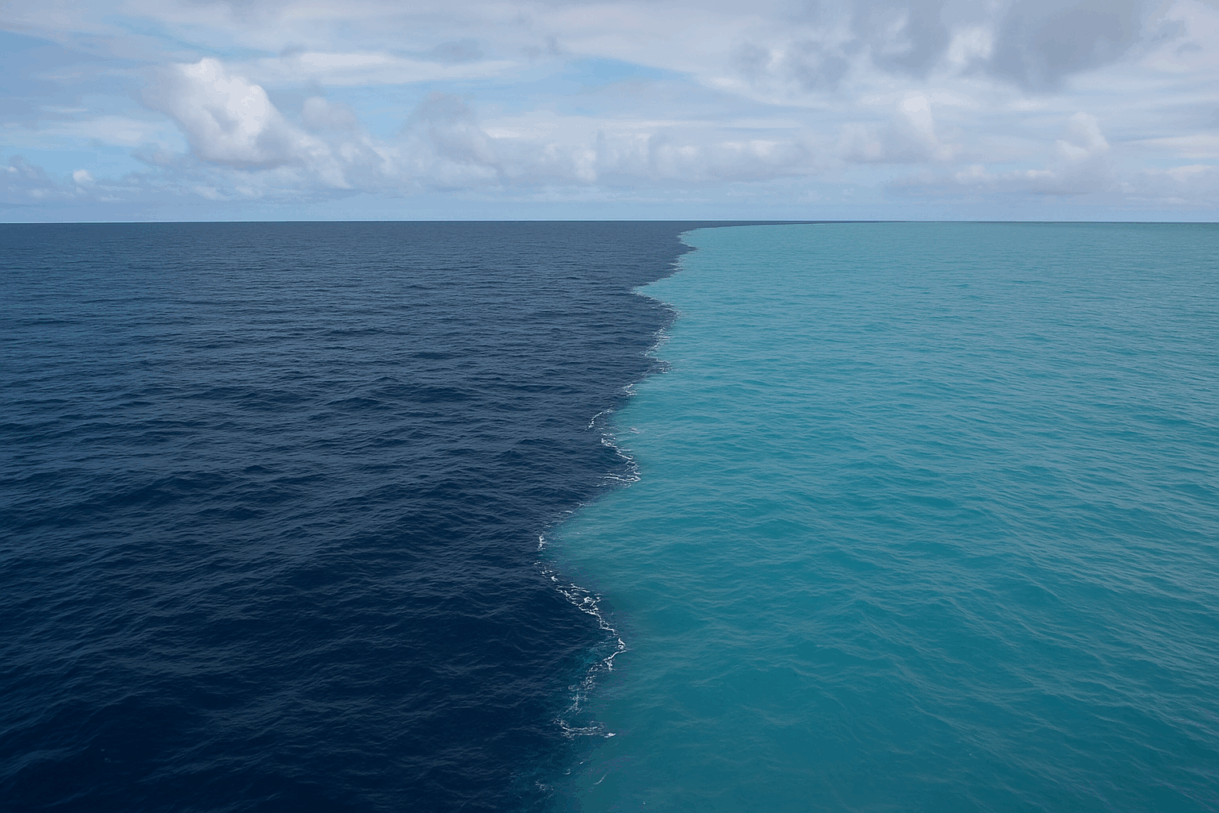
The belief that the Pacific Ocean and the Atlantic Ocean do not mix is one of the most widespread misconceptions in modern geography. It circulates everywhere — from viral photos to mysterious travel documentaries to dramatic TikTok edits of sailors pointing at a visible line where two oceans meet. In these images, the water on one side appears deep blue, while the other looks lighter, murkier, or even brownish. The two sides seem to form a perfect split, as if an invisible wall holds them apart.

But the truth is far more fascinating than the myth.

The Pacific and Atlantic Oceans do mix. They simply mix slowly, unevenly, and under the influence of some of the most powerful natural forces on Earth. The boundary between them is not a physical wall. It is a shifting, dynamic zone shaped by temperature, salinity, pressure, wind patterns, and centuries of global circulation. Furthermore, the history of how humans discovered these boundaries adds layers of drama to the story.

This article dives into the science, the myths, the mistaken photographs, and the real oceanographic explanations — while weaving in the centuries-old human quest to understand the world’s waters.
1. The Origins of the Myth: Why People Believe the Oceans Don’t Mix
Before breaking down the science, it helps to understand where the myth comes from.
People assume the Atlantic and Pacific do not mix because they have seen:
1. Viral images
For example:
- Pictures of the Gulf of Alaska where glacial meltwater meets ocean saltwater.
- Photos of the Strait of Gibraltar where different seas meet.
- Videos from the southern tip of South America showing two differently colored water masses.
These images show water masses with different densities, not entire oceans refusing to mix.
2. Cultural stories and misconceptions
Early explorers described ocean boundaries as “lines of separation” or “clashing seas.” Without modern scientific tools, they assumed these boundaries were physical barriers.

3. The dramatic effect of visible ocean fronts
In real life, when a boat passes through an oceanic front, you can sometimes see a visible line where sediment-rich water meets clear blue water. Sailors have described it for centuries.
All these create the illusion of unmixed oceans. But they are illusions nonetheless.
2. How the Oceans Actually Meet: The Boundary Isn’t a Wall, but a Convergence Zone
The Pacific and Atlantic Oceans meet at several points, but the most dramatic and scientifically important is the Drake Passage — the stretch of ocean between the southern tip of South America and Antarctica.
Here, powerful currents and radically different water masses collide.
What actually happens at their boundary?
There is no wall.
There is a transition zone that can stretch hundreds of kilometers across, where water from one ocean gradually diffuses into the other.
The boundary looks sharp in photos because of:
- Sediment differences
- Salinity variations
- Temperature contrasts
- Different plankton concentrations
- Light reflection differences at the surface
But below the surface, the two waters blend through mixing and turbulence.
3. The Real Science: Why They Look Like They Don’t Mix
The Pacific and Atlantic seem to resist mixing for four major scientific reasons.
A. Salinity Differences: The Atlantic Is Saltier
One of the biggest contrasts between the two oceans is salinity.
- The Atlantic Ocean has higher salinity.
- The Pacific Ocean has lower salinity.
Higher salinity means higher density. That creates a difference in buoyancy. When two water masses with different densities meet, they resist mixing immediately. Instead, they form a halocline, a salinity boundary.
This halocline can appear as a visible line.
But it is temporary.
Given time, turbulence and currents force the water to mix.
B. Temperature Differences: Warm Meets Cold
Temperature also changes water density.
- The Atlantic typically has warmer surface waters, especially near the equator and Caribbean.
- The Pacific has cooler regions that stretch across immense distances.
These contrasting temperatures create a thermocline — a temperature boundary.
Cold water is heavier and tends to sink under warm water, creating layers that take time to mix.
C. Currents and the Coriolis Effect Keep Them Moving Apart
Currents operate like lanes on a highway, each flowing in a different direction. The Pacific and Atlantic have their own massive current systems driven by:
- Wind
- Earth’s rotation (Coriolis effect)
- Water density
- Sunlight and heat distribution
For example:
- The Gulf Stream in the Atlantic moves warm water northward.
- The California Current in the Pacific moves cold water southward.
These systems create large-scale movement in opposite directions that keep their water masses mostly separate before mixing deeper in the ocean.
D. Water Masses Mix Slowly at Great Depths
Surface water may resist mixing temporarily, but the deep ocean tells a different story.
Deep-water circulation — the slowly pulsing movement of water throughout the globe — connects all oceans into a single massive system called the Global Conveyor Belt.
A single molecule of ocean water can take over 1,000 years to travel through this system.
So the oceans do mix, but on timescales far longer than human perception.
4. The History of Human Encounters with the “Unmixing Oceans”
Centuries before scientific equipment, sailors noticed strange lines in the ocean.
They called them:
- Water walls
- Lines of separation
- Clashing seas
- Boundaries of the world
Here are a few famous historical encounters.
Magellan’s Expedition (1520): The Shock of the Strait
When Ferdinand Magellan’s crew sailed from the Atlantic into the Pacific through what is now the Strait of Magellan, they described:
- Dramatic temperature differences.
- Sudden shifts in current direction.
- Water that appeared smoother on one side and violently rough on the other.
To them, it felt like entering a new world. They believed the oceans were separate realms.
Captain James Cook (1700s): The First Real Scientific Observations
Captain Cook documented visible boundaries in the Drake Passage where:
- Dark blue water met lighter green water.
- Warm currents collided with cold flows.
- Sediment-heavy water streaked across clear seas.
Cook was one of the first to suspect that oceans were interconnected but layered with different water masses.
Modern Oceanography (1900s–Present): The Science Becomes Clear
With satellites, buoys, and underwater gliders, scientists now understand:
- The boundaries are fronts, not walls.
- Mixing happens gradually.
- The ocean is one interconnected system.
Today, oceanographers can map exactly where and how the oceans blend.
5. Why Some Places Look Like Two Oceans Refusing to Mix
Some locations are famous for dramatic water contrasts that go viral online.
A. Gulf of Alaska
Where freshwater from melting glaciers flows into salty ocean water. The minerals and sediments create a sharp color contrast.
B. Strait of Gibraltar
Where the Atlantic rushes into the Mediterranean. Two water layers with different densities form a visible boundary.
C. Southern Ocean Fronts
Some of the clearest ocean boundaries on Earth appear here due to strong currents and temperature contrasts.
None of these places represent the Pacific and Atlantic “not mixing.” They simply show temporary differences in water masses.
6. So, Do the Pacific and Atlantic Oceans Mix? The Final Answer
Yes — they absolutely mix.
They cannot avoid mixing because:
- Currents connect them.
- Deep circulation links all oceans.
- Wind and waves force mixing.
- Temperature and salinity gradually equalize.
What people mistake for separate oceans are surface contrasts caused by density differences. These differences create the illusion of a boundary, but beneath the surface, the water is already blending.
7. Why the Myth Will Probably Never Die
Despite the scientific truth, the idea that the oceans do not mix will keep surviving because:
- The visible color differences are striking.
- Human beings love dramatic explanations.
- Viral images exaggerate the contrast.
- The ocean remains one of Earth’s most mysterious places.
As long as photos circulate online, people will continue to ask the question — and that is part of what makes ocean education so important.
8. The Beauty of a Connected Ocean
Understanding this topic requires us to appreciate the ocean’s complexity.
What looks like separation is actually interaction.
What looks like division is actually connection.
What seems like a solid boundary is really a temporary meeting point between two fluid giants constantly shaping the planet.
The Pacific and Atlantic are different in many ways — in their histories, currents, temperatures, and chemistry — yet they are part of one vast, breathing global system.
They do mix, just not in the oversimplified way most people imagine.
And that truth is far more impressive than the myth.
SUGGESTED READS
- The Ocean’s Role in Climate Change: A Vital Regulator Under Threat
- The Invention of the Telephone
- The Evolution of Schools: Who Invented School?
- How Far Can Wild Animals See? A Look at Nature’s Vision Masters
- The Semicolon: An In-Depth Exploration of Its Use

Support Our Website!
We appreciate your visit and hope you find our content valuable. If you’d like to support us further, please consider contributing through the TILL NUMBER: 9549825. Your support helps us keep delivering great content!
If you’d like to support Nabado from outside Kenya, we invite you to send your contributions through trusted third-party services such as Remitly, western union, SendWave, or WorldRemit. These platforms are reliable and convenient for international money transfers.
Please use the following details when sending your support:
Phone Number: +254701838999
Recipient Name: Peterson Getuma Okemwa
We sincerely appreciate your generosity and support. Thank you for being part of this journey!