

simply amazing, always for you.
Leggings are one of the most worn, debated, photographed, criticized, and defended pieces of clothing in modern fashion. They are everywhere — from airports and university lecture halls to high-end brunch spots and casual workplaces. Yet for something so common, leggings still operate under a quiet, invisible rulebook.
Some people wear them effortlessly and look polished. Others wear nearly identical pairs and get labeled “underdressed,” “inappropriate,” or “trying too hard.” Why?
Because leggings are not neutral garments. They sit at the intersection of comfort, body politics, generational change, and evolving dress codes. They blur lines — between athletic and casual, private and public, structure and softness. And whenever clothing blurs boundaries, society responds with unspoken rules.
This is not about shaming or restriction. It is about understanding the psychology, sociology, and visual mechanics behind how leggings are perceived in public spaces — and how to wear them with intention rather than guesswork.
Leggings as Social Communication
Clothing is never just fabric. It is semiotic — meaning it communicates social meaning.
Sociologist Erving Goffman famously described everyday life as a performance. In his framework, we present ourselves through signals: posture, tone, grooming, and clothing. Leggings signal specific things, whether we intend them to or not:
- Comfort orientation
- Athletic identity
- Youth culture alignment
- Informality
- Body confidence
Unlike structured trousers or denim, leggings cling to the body’s natural shape. That closeness amplifies perception. Because they reveal rather than structure, they place attention on silhouette rather than tailoring.
This is where the hidden rules begin.
Rule #1: Opacity Is Non-Negotiable
The single most important rule of wearing leggings in public is thickness.
Leggings that become transparent under light, bending, or stretching move from “outerwear” to “undergarment-adjacent.” That shift is subtle but powerful.
The reason major athletic brands like Lululemon and Nike emphasize “squat-proof” material is not only about gym functionality. It is about public legitimacy.
Opaque leggings communicate intention. Sheer leggings communicate oversight.
The public does not consciously evaluate thread density — but it reacts instinctively to visual integrity. If skin tone, underwear seams, or fabric strain are visible, the garment loses structural authority.
Fabric weight, compression blend, and elasticity retention matter. Premium leggings are engineered to hold their opacity under stress. Thin cotton blends often are not.
If there is one technical standard that separates polished from careless, it is opacity.
Rule #2: Context Determines Acceptability
Leggings are context-sensitive garments.
They are invisible in a gym. They are neutral in an airport. They are scrutinized in a corporate boardroom.
Fashion sociologist Joanne Entwistle argues that dress operates within “situated bodily practice,” meaning appropriateness is determined by environment and social intensity.
Consider three categories:
Low-Intensity Environments
- Grocery stores
- Coffee shops
- Travel settings
- Casual errands
Here, leggings are socially normalized.
Medium-Intensity Environments
- University campuses
- Creative offices
- Informal social gatherings
Styling begins to matter. Structure, layering, and footwear influence perception.
High-Intensity Environments
- Corporate workplaces
- Religious ceremonies
- Formal events
- Government institutions
In these spaces, leggings must be styled strategically — often with structured layers — or avoided altogether.
The garment does not change. The environment does.
Rule #3: Balance Is Psychological
The human brain seeks visual equilibrium. When the lower half of the body is tightly contoured, the eye looks for proportional compensation above.
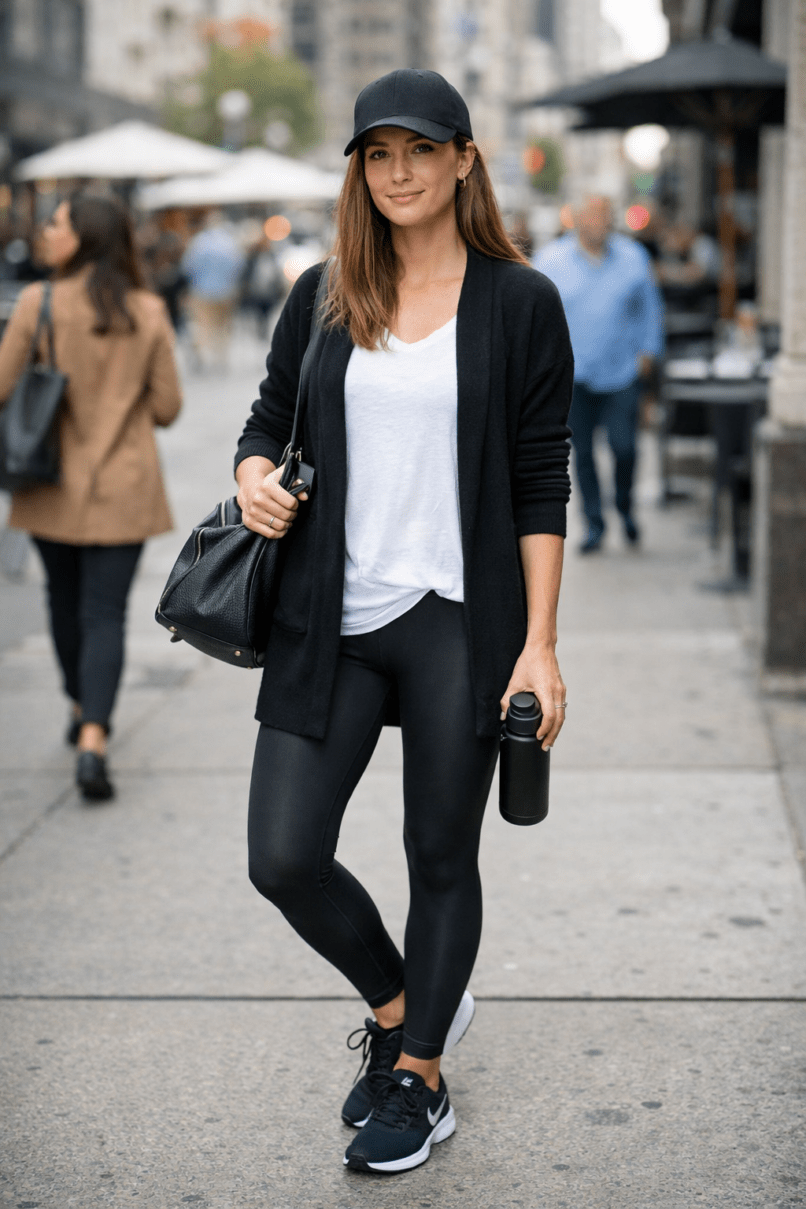
This is why oversized sweaters, tunics, long blazers, and coats pair so well with leggings. They restore balance.
When celebrities such as Kendall Jenner wear leggings with crop tops, the look works within fashion-forward or editorial contexts. But in everyday public environments, that same combination may shift perception toward informality or overt body emphasis.
It is not morality. It is visual proportion psychology.
The hidden equation often reads:
Fitted bottom + Structured or elongated top = Social equilibrium
Rule #4: Athleisure vs. Loungewear
Not all leggings are designed for public display.
The rise of athleisure — popularized by brands like Athleta and Adidas — intentionally blurred athletic functionality with streetwear aesthetics.
Athleisure leggings typically include:
- Sculpted waistbands
- Matte, high-density fabric
- Minimal pilling
- Performance stitching
- Clean seam architecture
Loungewear leggings, by contrast, often:
- Contain higher cotton ratios
- Lose shape quickly
- Sag at the knees
- Appear thin under light
The public reads these differences subconsciously. If leggings resemble pajamas, they will be categorized as such.
Rule #5: The Visible Panty Line Debate
Visible panty lines (VPL) are not inherently inappropriate — but they disrupt silhouette continuity.
Leggings create a smooth contour. When underwear seams interrupt that contour, the garment’s illusion of intentional outerwear is compromised.
Seamless underwear technology emerged precisely to preserve visual integrity under form-fitting garments.
This is less about modesty and more about structural coherence. Fashion functions as controlled illusion. Leggings demand clean lines to maintain legitimacy.
Rule #6: Maintenance and Wear Integrity
Leggings age quickly.
Because they stretch repeatedly and hug high-friction areas, they are prone to:
- Pilling
- Thinning
- Waistband fatigue
- Color fading
A worn pair signals neglect. A crisp pair signals intention.
In professional or semi-professional settings, maintenance quality can determine whether leggings are perceived as styled or sloppy.
Garments communicate care.
Rule #7: Generational Shift
Millennials normalized leggings outside gyms. Gen Z removed almost all remaining restrictions.
Shows like Sex and the City helped popularize form-fitting, body-conscious dressing in everyday scenarios, accelerating cultural acceptance of tight silhouettes.
But generational perceptions still vary.
Older generations often associate leggings with exercise or youth culture. Younger generations associate them with baseline comfort.
Understanding your audience matters.
Rule #8: Body Politics and Double Standards
Leggings reveal body shape. That reality introduces bias.
Two individuals wearing identical leggings may receive dramatically different social reactions depending on:
- Body size
- Gender
- Cultural background
- Confidence level
Public reactions often expose implicit bias rather than objective dress-code standards.
The hidden rule here is uncomfortable: perception is not neutral.
Rule #9: Geography Changes Everything
Urban environments normalize leggings more than conservative or rural settings.
In cities like Los Angeles and London, leggings function as everyday attire. In more conservative regions, they may still attract commentary.
Clothing norms are culturally local.
When traveling, observe before adopting.
Rule #10: Footwear Anchors the Outfit
Shoes determine category.
Sneakers frame leggings as athletic.
Boots elevate them into styled casual.
Heels reposition them into fashion territory.
Slippers collapse them into loungewear.
Footwear operates as a contextual anchor.
Rule #11: Professional Adaptation
Some industries embrace leggings — fitness, creative fields, remote tech environments. Traditional sectors remain cautious.
To integrate leggings into professional spaces:
- Add structured blazers
- Choose dark, matte fabrics
- Avoid decorative cutouts
- Maintain minimal branding
- Prioritize polished footwear
Professionalism is often about signaling deliberation rather than conformity.
Rule #12: The Confidence Variable
Clothing and posture are inseparable.
Adjusting leggings constantly signals discomfort. Moving with composure signals ownership.
Confidence modifies interpretation.
Rule #13: Social Media Distortion
Online styling often occurs under curated lighting, camera angles, and digital editing.
Public space lacks filters.
An outfit optimized for Instagram may not translate identically offline.
Rule #14: Cultural Negotiation
Leggings symbolize comfort capitalism — the prioritization of ease in an overworked society.
They blur public and private dress codes. They collapse rigid hierarchies of formality.
Society is still negotiating that shift.
Why These Rules Exist
Leggings disrupt traditional fashion structures. Trousers are tailored and shaped. Jeans are thick and structured. Skirts create space between body and fabric.
Leggings remove that space.
When clothing reveals form without tailoring, it forces society to renegotiate boundaries around modesty, professionalism, and public presentation.
The hidden rules are not laws. They are evolving social negotiations.
Strategic Styling Principles
If you want leggings to read as polished in public:
- Choose high-opacity fabric.
- Maintain garment integrity.
- Balance proportions.
- Match environment intensity.
- Anchor with appropriate footwear.
- Add structure when needed.
When these principles align, leggings become versatile and intentional rather than controversial.
Wearing leggings in public is not inherently inappropriate.
The controversy arises because they sit at cultural fault lines:
- Comfort vs. tradition
- Body visibility vs. structure
- Casual vs. professional
- Personal expression vs. social expectation
Understanding the hidden rules gives you agency.
You can comply, strategically bend, or consciously ignore them.
But once you understand the mechanics — fabric density, context, proportion, maintenance, and perception — you are no longer guessing.
Clothing always communicates.
The question is whether you are communicating deliberately.
And with leggings, deliberation makes all the difference.
SUGGESTED READS
- Which Underwear Is Healthier for Daily Wear — Seamless or Cotton?
- How to Get Rid of Visible Panty Lines for Good — Smart, Comfortable Solutions
- Why Do Ladies Show Pant Lines? The Honest Truth No One Talks About

Support Our Website!
We appreciate your visit and hope you find our content valuable. If you’d like to support us further, please consider contributing through the TILL NUMBER: 9549825. Your support helps us keep delivering great content!
If you’d like to support Nabado from outside Kenya, we invite you to send your contributions through trusted third-party services such as Remitly, western union, SendWave, or WorldRemit. These platforms are reliable and convenient for international money transfers.
Please use the following details when sending your support:
Phone Number: +254701838999
Recipient Name: Peterson Getuma Okemwa
We sincerely appreciate your generosity and support. Thank you for being part of this journey!