

simply amazing, always for you.
Dubai, United Arab Emirates — Tensions in the Middle East escalated sharply on February 28, 2026, after Iran launched a wave of ballistic missiles and drones toward several Gulf states, including the United Arab Emirates (UAE). The attack came in retaliation for coordinated military strikes carried out by the United States and Israel on Iranian territory earlier in the week.

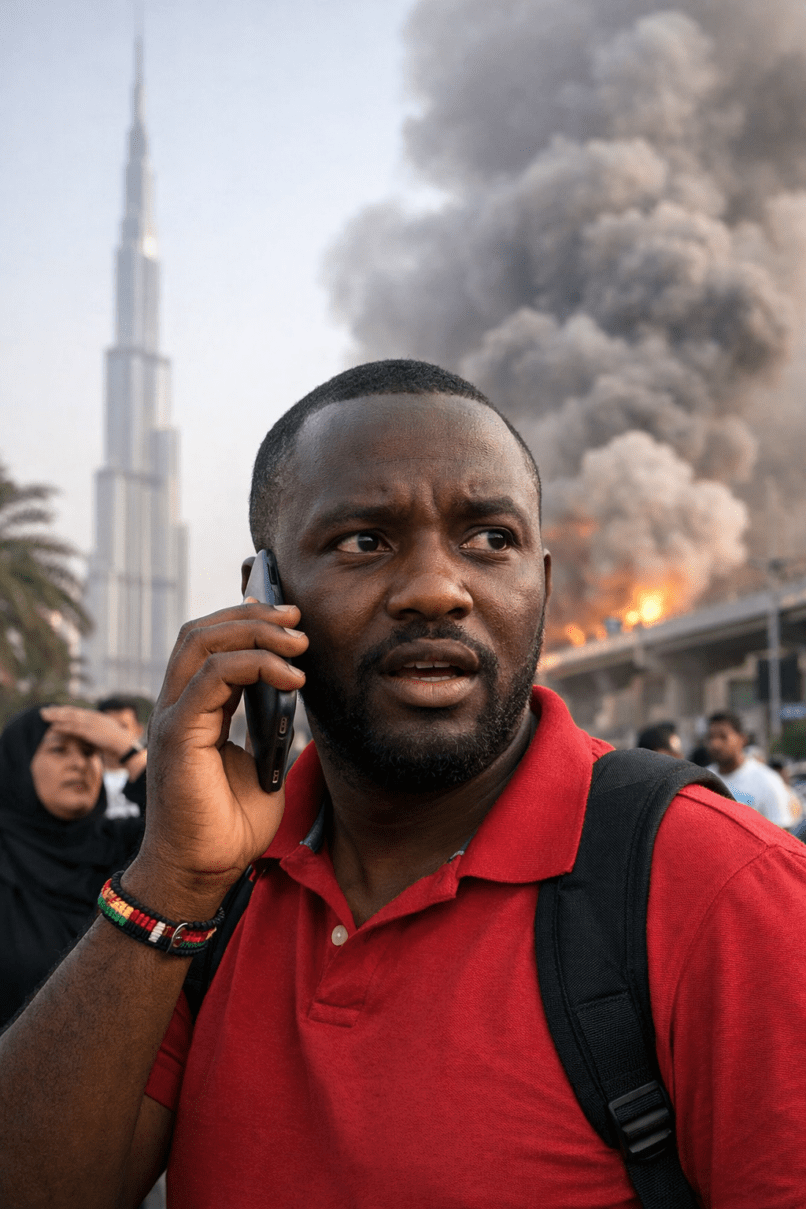
While the UAE’s air defense systems intercepted the majority of incoming projectiles, debris from the interceptions struck parts of Dubai and Abu Dhabi, injuring civilians and causing damage to infrastructure. Among the affected sites was Dubai International Airport, one of the world’s busiest aviation hubs.

For the thousands of Kenyans working and living in the UAE, the incident has triggered anxiety, disrupted travel, and raised concerns about safety and economic stability.

What Happened in Dubai
According to international news agencies, Iran fired multiple ballistic missiles and drones toward Gulf states that host U.S. military assets. The UAE, which maintains close strategic ties with Western powers, was among the targets.
Air defense systems activated immediately, intercepting most of the threats in the airspace above Dubai and Abu Dhabi. Residents reported loud explosions in the sky as missiles were neutralized. However, falling debris from intercepted missiles caused localized damage.
At least four people were injured near Dubai International Airport, and parts of airport infrastructure sustained minor damage. Operations at the airport were temporarily suspended as authorities closed airspace to assess the situation and ensure passenger safety.
Images and videos circulating on social media showed smoke rising from limited areas and emergency services responding swiftly. Authorities later confirmed that the situation was under control and that critical infrastructure remained largely intact.
The Immediate Impact on Aviation and Travel
Dubai serves as a major global transit point, linking Asia, Europe, Africa, and the Americas. Even a short suspension of flights at Dubai International Airport has ripple effects worldwide.
Following the missile incident:

- UAE airspace was temporarily closed.
- Several international airlines suspended or diverted flights.
- Thousands of passengers experienced delays and cancellations.
- Regional carriers reassessed flight paths to avoid conflict zones.
Among the airlines affected was Kenya Airways, which suspended flights to the UAE as a precautionary measure. The disruption left many Kenyans stranded either in Nairobi awaiting departure or in Dubai attempting to return home.
Given the UAE’s strategic location in global aviation, even temporary instability creates significant operational challenges for airlines, logistics companies, and travelers.
The UAE Government’s Response
The UAE government condemned the missile attack as a violation of its sovereignty and international law. Officials emphasized that the majority of missiles were intercepted successfully and that national defense systems functioned effectively.
Emergency alerts were issued advising residents to remain indoors temporarily and follow official safety instructions. Within hours, authorities announced that the immediate threat had been neutralized and that recovery and assessment operations were underway.
The UAE has historically positioned itself as a secure and stable regional hub for business, tourism, and expatriate workers. Maintaining that reputation will likely remain a top priority as officials navigate the diplomatic and security implications of the attack.
Kenyans in the UAE: A Community on Edge
The UAE hosts a significant Kenyan diaspora, particularly in Dubai and Abu Dhabi. Kenyans work across sectors such as:
- Hospitality and tourism
- Aviation and airport services
- Construction and engineering
- Retail and domestic services
- Healthcare
- Financial and professional services
While exact figures fluctuate, hundreds of thousands of Kenyans live across the wider Gulf region, with a substantial number based in the UAE.
For many Kenyan families, remittances from relatives working in Dubai are a critical source of income. Any instability in the region has both emotional and economic consequences.
Safety Concerns Among Kenyans
In the immediate aftermath of the missile incident, Kenyan workers reported heightened anxiety. Social media groups and diaspora forums were filled with questions about safety, travel, and whether further escalation was likely.
The Kenyan government, through its diplomatic missions in the Gulf, issued advisories urging citizens to:
- Remain calm.
- Follow UAE government instructions.
- Avoid spreading unverified information.
- Stay connected to official communication channels.
So far, there have been no confirmed reports of Kenyan nationals injured in the incident. However, many remain cautious, particularly those living near key infrastructure or high-profile commercial zones.
Economic Implications for Kenyan Workers
While the physical damage from the attack appears limited, the broader economic implications could be significant if tensions continue.
1. Employment Stability
If regional tensions escalate, certain sectors could be affected:
- Tourism may slow if travelers perceive increased risk.
- Hospitality businesses could experience cancellations.
- Aviation and logistics operations may face route disruptions.
- Construction timelines could be adjusted due to security concerns.
For Kenyan workers employed in these industries, reduced business activity could translate into fewer shifts, delayed salaries, or contract uncertainties.
2. Remittances to Kenya
Remittances from the Gulf region are a vital component of Kenya’s foreign exchange earnings. If employment conditions become unstable or if workers choose to return home prematurely, remittance flows could decline.
This would affect families who rely on money sent from Dubai for school fees, medical expenses, and household needs.
3. Cost of Living and Insurance
Periods of geopolitical instability often lead to:
- Higher insurance premiums.
- Increased transport costs.
- Temporary supply chain disruptions.
Although Dubai’s infrastructure remains operational, any prolonged regional conflict could increase living expenses, affecting low- and middle-income workers disproportionately.
Travel Uncertainty for Kenyan Families
The suspension of flights by Kenya Airways and other carriers disrupted travel plans for:
- Workers returning home on leave.
- Students traveling between Kenya and the UAE.
- Families visiting relatives.
- Business travelers.
Even after airspace reopened, airlines continued to adjust schedules cautiously. For Kenyans who depend on rotational work schedules, delayed travel can create contractual complications with employers.
Additionally, visa renewal processes and residency documentation timelines may be affected if travel corridors remain unpredictable.
Broader Regional Context
The missile incident in Dubai is part of a larger geopolitical confrontation involving Iran, the United States, and Israel. Several Gulf states reported similar airspace alerts and interceptions.
The Gulf region hosts significant foreign military installations and strategic infrastructure, making it a focal point during escalations.
However, it is important to note that the UAE’s defensive response prevented large-scale destruction. The country’s advanced missile defense systems and emergency protocols limited casualties and infrastructure damage.
Psychological Impact on Expatriates
Beyond physical safety and economic stability, the psychological toll should not be underestimated.
For many Kenyans, working in the UAE already involves being far from family and social support systems. Experiencing missile alerts and explosions can intensify feelings of vulnerability.
Diaspora community leaders have encouraged members to:
- Stay connected with each other.
- Verify information before sharing.
- Seek counseling support if anxiety becomes overwhelming.
- Maintain communication with family back home.
What Happens Next?
The key question now is whether the situation will stabilize or escalate.
Several factors will determine the trajectory:
- Diplomatic responses from the UAE and allied countries.
- Whether Iran signals further military action.
- International mediation efforts.
- Regional security coordination.
For Kenyans in the UAE, the immediate focus remains on monitoring official updates and ensuring personal safety.
Practical Advice for Kenyans in the UAE
- Stay informed through official UAE channels.
- Register with the Kenyan embassy or consulate if not already registered.
- Confirm flight details directly with airlines before traveling.
- Keep emergency contact numbers accessible.
- Avoid spreading unverified rumors online.
Preparedness, not panic, is the appropriate response.
A Critical Moment for the Region
Dubai has built its global reputation on stability, commerce, and openness. The missile incident marks one of the most serious direct security threats to the emirate in recent memory.
Yet the swift interception of most missiles and the rapid restoration of airport operations demonstrate the UAE’s defensive capabilities and crisis management systems.
For Kenyans living and working in the UAE, the situation is serious but currently contained. The coming days will reveal whether this incident remains an isolated escalation or signals a deeper regional conflict.
In the meantime, vigilance, accurate information, and calm decision-making are essential — both for those in the UAE and for families watching anxiously from Kenya.
SUGGESTED READS
- KCSE Results Shock: Why Your Grades Might Not Decide Your Future After All
- Before You Wear That Bodycon Dress, Read This
- Why Men Disappear Emotionally After Sex
- Why So Many Young Men Are Failing in College
- The Hidden Male Fear That Makes Him Pull Away From You

Support Our Website!
We appreciate your visit and hope you find our content valuable. If you’d like to support us further, please consider contributing through the TILL NUMBER: 9549825. Your support helps us keep delivering great content!
If you’d like to support Nabado from outside Kenya, we invite you to send your contributions through trusted third-party services such as Remitly, western union, SendWave, or WorldRemit. These platforms are reliable and convenient for international money transfers.
Please use the following details when sending your support:
Phone Number: +254701838999
Recipient Name: Peterson Getuma Okemwa
We sincerely appreciate your generosity and support. Thank you for being part of this journey!