

simply amazing, always for you.
Why Most People Fail at Learning a New Language
Every year, millions of people set out to learn a new language. They download apps, buy textbooks, watch a few videos—and then quit. Not because they lack intelligence or discipline, but because they follow the wrong system.
The traditional model of language learning is deeply flawed. It emphasizes memorizing grammar rules, translating sentences, and passing tests. Yet, even after years of study, many learners struggle to hold a basic conversation.
The truth is simple: language is not a subject you study—it is a skill you train.
Just like playing the piano, lifting weights, or learning to drive, fluency comes from consistent, deliberate practice using the right methods. If you approach it correctly, you can make more progress in three months than most people do in three years.
This article breaks down the most effective, science-backed approach to learning a new language. It is practical, realistic, and designed for results.
Understanding How Language Learning Actually Works
Before diving into techniques, you need to understand how the brain acquires language.
Research in linguistics and cognitive science, particularly the work of Stephen Krashen, shows that humans learn languages primarily through exposure—not memorization.
This concept is known as the Input Hypothesis. It states that learners acquire language when they are exposed to input that is slightly above their current level.
In simpler terms: you learn best when you understand most of what you hear or read, but not all of it.
This is why children become fluent without studying grammar. They are constantly exposed to meaningful language in context.
For adult learners, the implication is clear: you need to replicate this process as closely as possible.
The Core Principle: Comprehensible Input
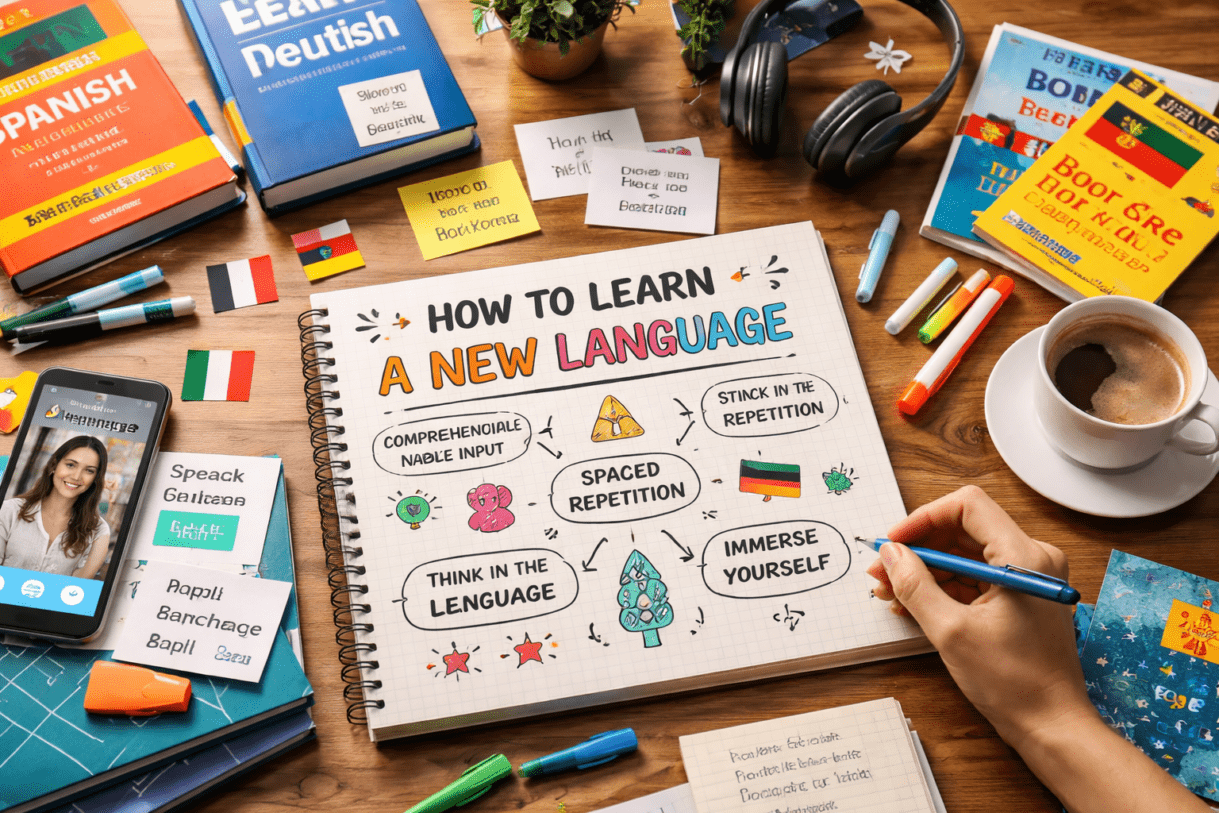
If there is one concept that separates successful learners from struggling ones, it is comprehensible input.
What Is Comprehensible Input?
It is language that you can mostly understand but still challenges you slightly.
For example:
- Watching a simple TV show in your target language
- Listening to slow, beginner-friendly podcasts
- Reading short stories designed for learners
Why It Works
Your brain naturally detects patterns, builds vocabulary, and internalizes grammar without conscious effort when exposed to understandable content.
This is far more efficient than memorizing rules.
How to Apply It
Start with material that feels easy. If you understand less than 60%, it is too difficult. If you understand 100%, it is too easy.
The ideal range is 70–90% comprehension.
Speaking Early: The Shortcut Most Learners Ignore
One of the biggest mistakes learners make is delaying speaking.
They tell themselves:
“I’ll start speaking when I’m ready.”
That moment never comes.
Language is not just knowledge—it is a performance skill. You do not become fluent by thinking about language; you become fluent by using it.
Why Speaking Matters
- It forces active recall, strengthening memory
- It exposes gaps in your knowledge
- It builds confidence and fluency
How to Start Speaking Immediately
You do not need a partner to begin.
Start with:
- Talking to yourself about your day
- Describing objects around you
- Narrating your thoughts
Then progress to real conversations using apps like HelloTalk and Tandem, where you can connect with native speakers.
The key is consistency, not perfection.
Vocabulary Mastery Through Spaced Repetition
Vocabulary is the building block of language. Without words, you cannot communicate.
However, traditional memorization methods are inefficient. You forget most of what you learn within days.
This is where spaced repetition comes in.
What Is Spaced Repetition?
It is a system that schedules reviews at optimal intervals to maximize retention.
Apps like Anki and Quizlet use this principle to help you remember information long-term.
How to Use It Effectively
- Learn 10–20 new words per day
- Focus on high-frequency vocabulary
- Study words in context (phrases, sentences)
For example, instead of memorizing “eat,” learn:
“I eat breakfast at 7 a.m.”
This builds both vocabulary and structure.
Stop Translating: Train Your Brain to Think in the Language
Translation is one of the biggest barriers to fluency.
When you translate, your brain goes through a slow, inefficient process:
- Think in your native language
- Convert to the target language
- Speak
This creates hesitation and limits fluency.
The Better Approach
Train yourself to think directly in the target language.
Practical Techniques
- Use images instead of translations when learning new words
- Associate words with experiences and emotions
- Practice forming simple sentences without reverting to your native language
Over time, your brain will build direct connections, making communication faster and more natural.
Immersion: The Ultimate Accelerator
Immersion is widely considered the fastest way to learn a language.
But you do not need to move abroad to immerse yourself.
You can create an immersive environment wherever you are.
How to Build Artificial Immersion
- Change your phone and apps to the target language
- Watch movies and shows without subtitles (or with target-language subtitles)
- Listen to music and podcasts daily
- Follow native speakers on social media
The goal is to surround yourself with the language so it becomes part of your daily life.
The Power of Consistency Over Intensity
Many learners start strong, studying for hours each day, only to burn out after a few weeks.
The key to success is consistency, not intensity.
Why Consistency Wins
Language learning is cumulative. Small daily efforts compound over time.
Studying 30 minutes every day is far more effective than studying five hours once a week.
A Sustainable Daily Routine
- 10 minutes: vocabulary review
- 15 minutes: listening practice
- 15 minutes: speaking practice
- 10 minutes: reading or writing
This simple routine can transform your progress if done consistently.
High-Frequency Words: The 80/20 Rule of Language Learning
Not all words are equally important.
Research shows that a small percentage of words make up the majority of everyday language.
What This Means for You
Learning the most common 1,000 words can give you access to about 80% of daily conversations.
Where to Focus
- Common verbs (go, make, take, want)
- Everyday nouns (food, time, people)
- Connectors (and, but, because)
This approach maximizes efficiency and accelerates comprehension.
The Shadowing Technique: Fast-Track Your Fluency
The shadowing technique, popularized by Alexander Arguelles, is one of the most powerful tools for improving speaking and listening.
How It Works
- Listen to a native speaker
- Repeat immediately, mimicking pronunciation and rhythm
Benefits
- Improves accent
- Enhances listening skills
- Builds speaking confidence
This technique trains your brain to process and produce language simultaneously.
Overcoming Common Challenges
1. Fear of Making Mistakes
Mistakes are not failures—they are feedback.
Every error helps refine your understanding and improve your skills.
2. Lack of Motivation
Motivation is unreliable. Discipline is what matters.
Build habits, not bursts of enthusiasm.
3. Plateaus
Progress is not always linear.
When you hit a plateau:
- Change your learning materials
- Increase difficulty slightly
- Focus on weak areas
Setting Clear, Measurable Goals
Vague goals lead to vague results.
Instead of saying:
“I want to learn French,”
Say:
“I want to hold a 10-minute conversation in French within three months.”
Clear goals provide direction and accountability.
The Role of Technology in Language Learning
Modern tools have made language learning more accessible than ever.
Apps, online platforms, and digital resources allow you to practice anytime, anywhere.
However, tools are only as effective as the system you use them in.
Do not rely on a single app. Combine multiple methods for the best results.
A 30-Day Action Plan for Rapid Progress
Week 1: Foundation
- Learn basic vocabulary (100–150 words)
- Start listening to beginner content
- Practice speaking simple sentences
Week 2: Expansion
- Increase vocabulary
- Begin short conversations
- Watch simple videos
Week 3: Integration
- Combine listening, speaking, and reading
- Practice daily conversations
- Use shadowing techniques
Week 4: Acceleration
- Engage in longer conversations
- Consume more complex content
- Refine pronunciation and fluency
Why Most Language Learning Advice Fails
Most advice focuses on tools rather than strategy.
People search for the “best app” instead of building an effective system.
The truth is, no app can make you fluent on its own.
Fluency comes from consistent exposure, active practice, and deliberate learning.
The Real Secret to Learning a Language Fast
There is no magic shortcut, but there is a proven path.
The best way to learn a new language is to:
- Immerse yourself in comprehensible input
- Practice speaking daily
- Use spaced repetition for vocabulary
- Stay consistent over time
If you follow this system, you will see real progress.
Fluency is not reserved for the gifted. It is achievable for anyone willing to put in the right kind of effort.
SUGGESTED READS
- Why Curious Minds Get Richer, Smarter, and More Successful
- Kenya’s Silent Mental Health Crisis: Why Millions Are Struggling in Silence
- In Kenya, Success Comes With Expectations — Here’s Why
- Young, Ambitious, and Struggling: The True Story of Kenya’s Youth
- Why So Many Young Men Are Failing in College
- The 10 Most Influential People in Human History — And Why Their Impact Still Shapes Our Lives

Support Our Website!
We appreciate your visit and hope you find our content valuable. If you’d like to support us further, please consider contributing through the TILL NUMBER: 9549825. Your support helps us keep delivering great content!
If you’d like to support Nabado from outside Kenya, we invite you to send your contributions through trusted third-party services such as Remitly, western union, SendWave, or WorldRemit. These platforms are reliable and convenient for international money transfers.
Please use the following details when sending your support:
Phone Number: +254701838999
Recipient Name: Peterson Getuma Okemwa
We sincerely appreciate your generosity and support. Thank you for being part of this journey!