

simply amazing, always for you.
Iran Escalates War With Fresh Missile Barrages Despite U.S. “Progress” Claims
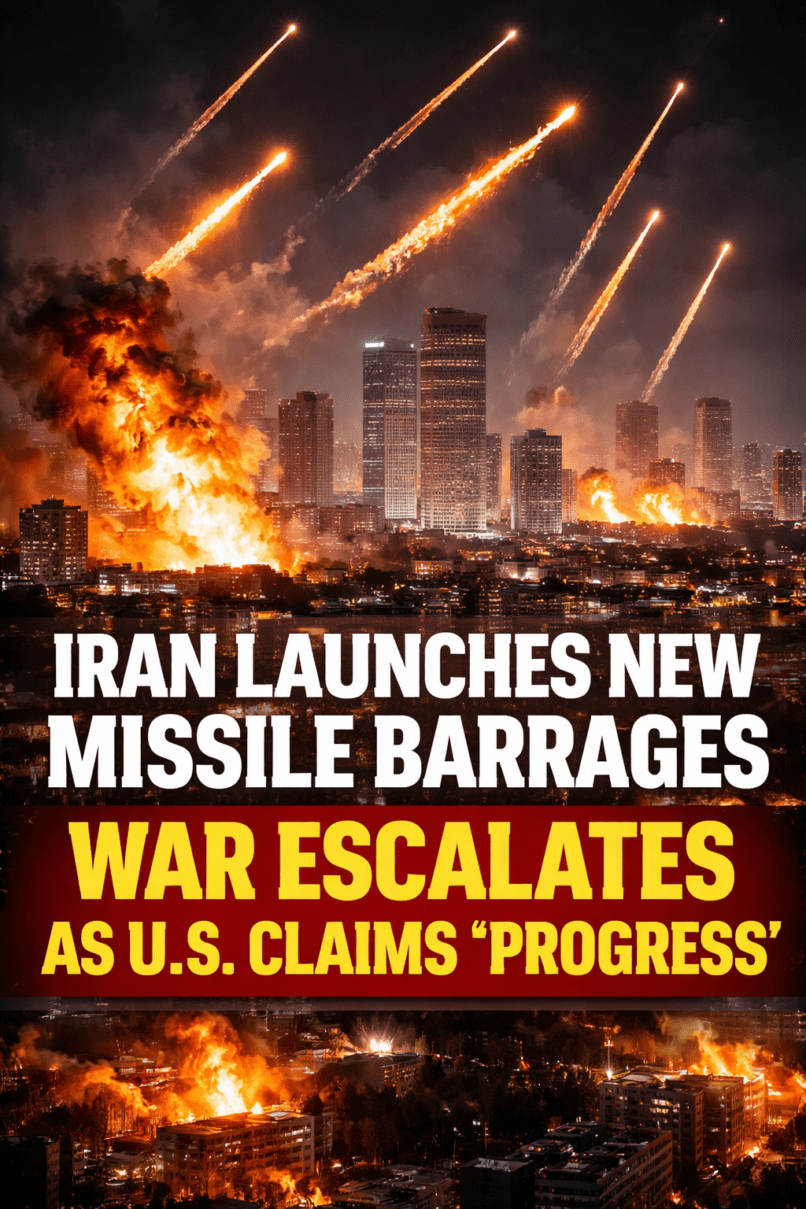
The war between Iran and the United States has entered a dangerous new phase, with fresh missile barrages launched from Tehran even as Washington insists that diplomatic progress is being made behind the scenes.
In a striking contradiction that underscores the volatility of the crisis, the battlefield is heating up at the very moment leaders claim negotiations could bring it to an end.
Tehran Fires Again: A Message Written in Missiles
Iranian forces unleashed a new wave of missile strikes across the region, targeting strategic locations linked to U.S. allies, including parts of Israel. Several projectiles were reported heading toward major urban centers such as Tel Aviv, triggering air raid sirens and forcing civilians into shelters.
Security analysts say the timing of the strikes is deliberate.
Rather than signaling restraint, Tehran appears to be demonstrating that it will not negotiate from a position of weakness. The renewed attacks suggest a calculated strategy: escalate militarily to strengthen leverage politically.
Washington’s Narrative: “Talks Are Working”
At the center of the diplomatic messaging is Donald Trump, who has publicly stated that discussions aimed at ending the conflict are showing “very good progress.”
The United States has reportedly paused certain planned strikes, particularly those targeting Iran’s energy infrastructure, in what officials describe as a goodwill gesture to allow negotiations to gain traction.
However, this partial restraint is limited. U.S. military operations targeting Iranian missile systems and defense installations are ongoing, meaning the war effort itself has not slowed in any meaningful sense.
Tehran Pushes Back: “No Talks Under Fire”
Iranian officials have sharply rejected claims that meaningful negotiations are underway.
Sources within Tehran insist that no direct talks with Washington are happening, and any possibility of dialogue is conditional on a complete halt to U.S. military actions. Among the demands reportedly being discussed internally:
- Immediate cessation of U.S. strikes
- Security guarantees against future attacks
- Compensation for damage caused by American operations
This hardline stance reflects internal pressure from powerful factions within Iran’s military establishment, particularly the Revolutionary Guard, which opposes concessions while under attack.
A War Expanding Beyond Borders
The conflict is no longer confined to bilateral hostilities. It is rapidly evolving into a broader regional crisis.
Missile trajectories, proxy engagements, and strategic positioning have drawn multiple actors into the equation, either directly or indirectly. The risk of miscalculation has increased significantly, especially in congested airspaces and maritime corridors.
The Strait of Hormuz—a critical artery for global oil shipments—remains under constant threat. Any disruption here could trigger immediate and severe consequences for the global economy.
Oil Markets React: Shockwaves Beyond the Battlefield
Global oil prices have surged past the $100 mark, reflecting mounting fears that the conflict could spiral into a prolonged disruption of supply chains.
For countries like Kenya, the implications are immediate and severe:
- Rising fuel prices
- Increased cost of goods and transportation
- Pressure on inflation and household spending
Economists warn that if the conflict persists, African economies already grappling with debt and currency pressures could face an additional external shock.
Mediation Efforts Intensify — But No Breakthrough
Several countries, including Oman, Egypt, and Pakistan, are actively working behind the scenes to de-escalate the situation.
These mediation efforts are focused on creating indirect communication channels between Tehran and Washington. However, diplomats familiar with the process describe progress as “fragile” and “uncertain.”
The fundamental problem remains unchanged: neither side is willing to appear weak, and both are attempting to negotiate from a position of strength while actively engaged in combat.
The Dangerous Gap Between Words and War
What makes the current moment particularly volatile is the widening gap between political rhetoric and military reality.
On one hand, U.S. officials speak of progress and possible resolution. On the other, missiles continue to fly, targets are being struck, and tensions are escalating.
This disconnect creates a high-risk environment where:
- Misinterpretation of intent becomes likely
- Escalation can occur accidentally
- Diplomatic signals are undermined by military actions
In strategic terms, this is one of the most unstable phases of any conflict — when both war and peace narratives coexist without alignment.
What Happens Next?
The trajectory of the conflict now hinges on a few critical variables:
- Whether indirect talks can evolve into formal negotiations
- Whether either side agrees to a temporary ceasefire
- Whether regional actors are drawn further into the conflict
At present, none of these conditions appear imminent.
Instead, the situation suggests a prolonged standoff where intermittent diplomacy coexists with sustained military engagement.
A Crisis Far from Resolution
Despite optimistic messaging from Washington, the facts on the ground tell a different story. Iran’s renewed missile barrages are not the actions of a country preparing to de-escalate.
They are the actions of a state signaling resolve.
Until there is a clear alignment between diplomatic efforts and military behavior, the war is likely to continue — with rising risks not just for the Middle East, but for the global economy and regions like Africa that remain highly exposed to external shocks.
SUGGESTED READS
- OnlyFans Owner Leonid Radvinsky Dies at 43 After Private Cancer Battle
- Donald Trump has reportedly paused planned strikes on Iran’s energy infrastructure
- Hassan Joho Poised as Ruto’s Running Mate? Coast Leaders Rally Ahead of 2027
- Raphael Tuju Resurfaces After Days of Disappearance
- Struggling to Focus at Home? Fix Your Motivation Today
- “Tuko Kadi”: The Phrase Powering Kenya’s Political Awakening, Youth Identity, and Digital Culture
- You’re Learning Languages the Wrong Way — Here’s the Only Method That Actually Works

Support Our Website!
We appreciate your visit and hope you find our content valuable. If you’d like to support us further, please consider contributing through the TILL NUMBER: 9549825. Your support helps us keep delivering great content!
If you’d like to support Nabado from outside Kenya, we invite you to send your contributions through trusted third-party services such as Remitly, western union, SendWave, or WorldRemit. These platforms are reliable and convenient for international money transfers.
Please use the following details when sending your support:
Phone Number: +254701838999
Recipient Name: Peterson Getuma Okemwa
We sincerely appreciate your generosity and support. Thank you for being part of this journey!