

simply amazing, always for you.
In a world defined by constant notifications, endless scrolling, and relentless pressure to perform, the human mind has become overstimulated and undertrained. Most people move through their day on autopilot—reacting, worrying, and rushing—without ever truly being present.
This is where mindfulness comes in.
Mindfulness is not a trend. It is not a vague spiritual concept. It is a rigorously studied mental practice grounded in disciplines like psychology and neuroscience. At its core, mindfulness is the ability to pay attention—on purpose, in the present moment, without judgment.
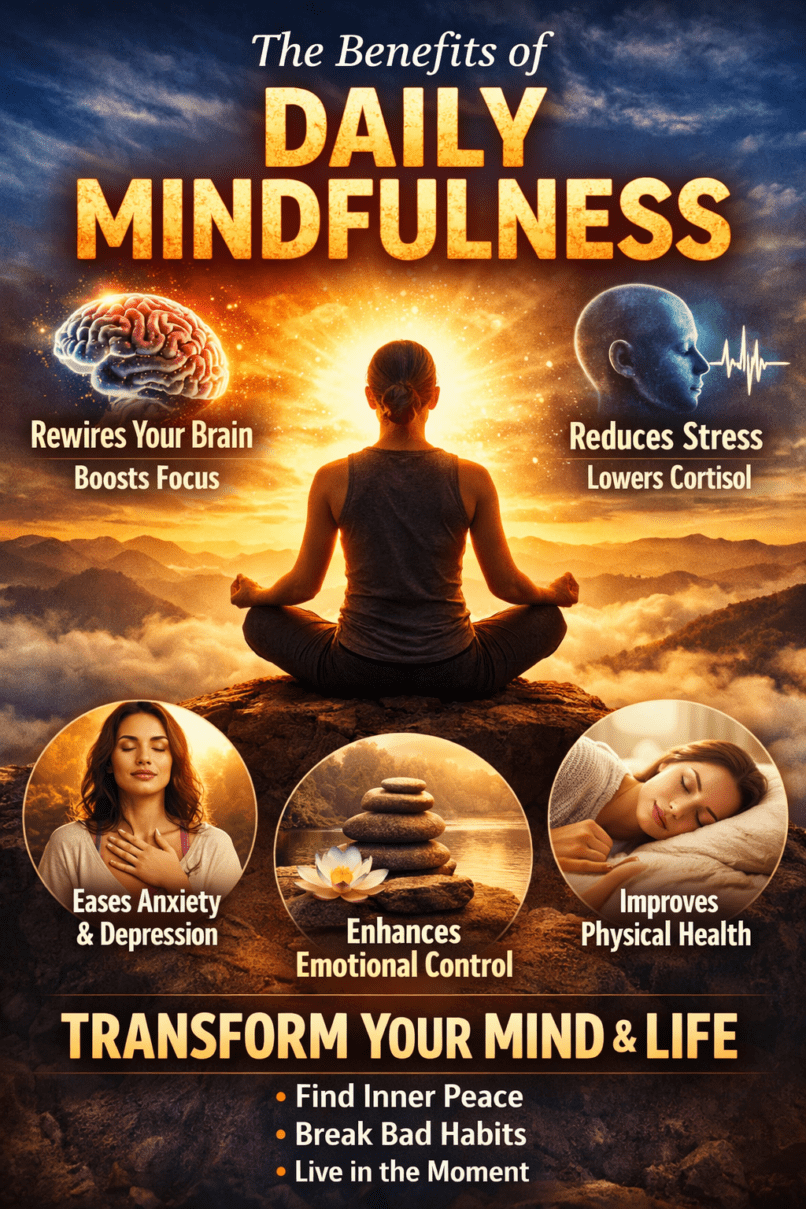
Practiced daily, it becomes one of the most powerful tools for improving mental clarity, emotional stability, physical health, and overall life satisfaction.
This article breaks down, in depth, why daily mindfulness is not optional if you want to function at your highest level—and how it quietly reshapes your brain, behavior, and future.
What Mindfulness Really Means (And What It Doesn’t)
Before diving into benefits, it’s important to clarify what mindfulness actually is.
Mindfulness is:
- Awareness of your thoughts, feelings, and surroundings
- Intentional attention to the present moment
- Non-judgmental observation of your internal state
Mindfulness is NOT:
- Emptying your mind
- Escaping reality
- Being passive or detached
Instead, mindfulness trains you to engage with reality more clearly and effectively.
When you practice mindfulness daily, you are essentially upgrading your brain’s operating system.
The Science Behind Mindfulness
Modern science has validated what ancient traditions understood for centuries: the brain is adaptable. This concept, known as neuroplasticity, explains how repeated mental activity physically reshapes neural pathways.
Mindfulness leverages neuroplasticity to:
- Strengthen attention networks
- Reduce reactivity in the emotional centers of the brain
- Improve communication between different brain regions
One key system affected by mindfulness is the hypothalamic-pituitary-adrenal axis, which controls the body’s stress response.
When mindfulness becomes a daily habit, this system becomes less reactive—meaning you experience less chronic stress, even in high-pressure environments.
1. Daily Mindfulness Dramatically Reduces Stress
Stress is not just a feeling—it is a physiological state.
When you are stressed:
- Your heart rate increases
- Your muscles tense
- Your body releases cortisol
Over time, chronic stress leads to fatigue, poor health, and burnout.
Mindfulness interrupts this cycle.
By focusing your attention on the present moment—such as your breathing—you signal to your body that you are safe. This reduces activation of the stress response system.
Long-Term Effects:
- Lower baseline stress levels
- Faster recovery from stressful situations
- Reduced emotional overwhelm
Instead of reacting automatically to every challenge, you respond with clarity and control.
2. It Sharpens Focus in a Distracted World
Modern life is engineered to destroy attention.
Social media, emails, and constant notifications fragment your focus, making it harder to concentrate deeply.
Mindfulness trains your attention like a muscle.
Every time you:
- Notice your mind wandering
- Bring it back to your breath or task
You strengthen your ability to focus.
The Result:
- Improved concentration
- Better memory retention
- Higher productivity
This is especially critical in knowledge-based work, where deep thinking is more valuable than constant activity.
3. It Improves Emotional Regulation
Most people do not control their emotions—their emotions control them.
Anger, anxiety, frustration—these arise automatically and often lead to impulsive reactions.
Mindfulness changes this dynamic.
It creates a space between:
What happens → How you respond
Instead of reacting instantly, you observe your emotions.
This simple shift allows you to:
- Respond calmly instead of reacting impulsively
- Avoid unnecessary conflict
- Make better decisions under pressure
Mindfulness doesn’t eliminate emotions—it gives you mastery over them.
4. It Reduces Anxiety and Depression
Mental health challenges like anxiety disorder and depression are often fueled by patterns of thinking:
- Worrying about the future
- Ruminating on the past
- Negative self-talk
Mindfulness disrupts these patterns.
By anchoring your attention in the present moment, you reduce the mental loops that sustain anxiety and depression.
This is why therapies like mindfulness-based cognitive therapy are widely used in clinical settings.
Measurable Benefits:
- Reduced symptoms of anxiety
- Lower risk of depressive relapse
- Improved emotional resilience
5. It Enhances Self-Awareness
Self-awareness is the foundation of personal growth.
Without it, you:
- Repeat the same mistakes
- Stay stuck in unhealthy habits
- React unconsciously
Mindfulness increases your awareness of:
- Thoughts
- Emotions
- Behavioral patterns
You begin to notice:
- Why you feel a certain way
- What triggers your reactions
- How your habits shape your life
This awareness gives you the power to change.
6. It Improves Physical Health
Mindfulness is not just mental—it has real physical benefits.
Research shows it can:
- Lower blood pressure
- Improve sleep quality
- Strengthen the immune system
Chronic stress is a major contributor to illness. By reducing stress, mindfulness indirectly improves overall health.
People who practice mindfulness regularly often report:
- Better energy levels
- Fewer stress-related illnesses
- Improved recovery from fatigue
7. It Strengthens Relationships
Most relationship problems come down to one issue: poor communication.
When you are distracted, reactive, or emotionally overwhelmed, you:
- Misinterpret others
- Respond defensively
- Escalate conflicts
Mindfulness improves how you interact with others by helping you:
- Listen more attentively
- Respond thoughtfully
- Stay present in conversations
This leads to:
- Deeper connections
- Reduced conflict
- Greater empathy
8. It Increases Productivity Without Burnout
Many people chase productivity by working harder.
Mindfulness takes a different approach—it helps you work smarter.
By improving focus and reducing mental clutter, you:
- Complete tasks more efficiently
- Make fewer mistakes
- Maintain energy throughout the day
Unlike hustle-driven productivity, mindfulness-based productivity is sustainable.
You get more done without exhausting yourself.
9. It Helps You Break Bad Habits
Habits operate automatically.
Whether it’s:
- Overeating
- Procrastination
- Excessive phone use
These behaviors are often triggered by unconscious patterns.
Mindfulness brings these patterns into awareness.
Once you notice:
- The urge
- The trigger
- The behavior
You can interrupt the cycle.
This is how real habit change happens—not through willpower alone, but through awareness.
10. It Anchors You in the Present Moment
Most people live in two places:
- The past (regret, guilt)
- The future (worry, anxiety)
Very few live in the present.
Mindfulness trains you to return to “now.”
This has profound effects:
- Reduced overthinking
- Greater appreciation of life
- Increased sense of peace
When you are fully present, even simple moments become meaningful.
Why Daily Practice Matters (Consistency Over Intensity)
Mindfulness is not something you do once and master.
It is a skill that improves with repetition.
Practicing daily—even for just 5–10 minutes—creates cumulative effects:
- Your brain rewires gradually
- Your reactions change subtly
- Your awareness deepens over time
Skipping days breaks this momentum.
Consistency is what turns mindfulness from an exercise into a lifestyle.
A Simple Daily Mindfulness Routine
You don’t need complicated techniques.
Start with this:
Step 1: Find a Quiet Space
Sit comfortably. No distractions.
Step 2: Focus on Your Breath
Notice:
- The inhale
- The exhale
Step 3: Observe Your Thoughts
Your mind will wander. That’s normal.
When it does:
- Notice it
- Gently bring your attention back to your breath
Step 4: Practice for 5–10 Minutes Daily
Consistency matters more than duration.
Common Mistakes to Avoid
1. Trying to “Clear Your Mind”
This is impossible. The goal is awareness, not silence.
2. Expecting Instant Results
Mindfulness is a long-term investment.
3. Being Too Harsh on Yourself
Wandering thoughts are part of the process.
The Long-Term Impact of Mindfulness
If you practice mindfulness daily for months or years, the changes become profound:
- You become calmer under pressure
- Your thinking becomes clearer
- Your emotions become more stable
- Your decisions improve
You don’t just feel different—you operate differently.
A Small Habit with Massive Returns
Daily mindfulness is one of the highest-return habits you can build.
It requires:
- No money
- No equipment
- Very little time
Yet it improves:
- Your mental health
- Your physical health
- Your productivity
- Your relationships
In a chaotic world, mindfulness gives you something rare: control over your own mind.
And once you have that, everything else becomes easier.
SUGGESTED READS
- The Millionaire Who Still Takes the Morning Bus
- “Your Goods Are Expensive” — The Lie, the Truth, and the Fix
- Why Kenya Is Often Called “the Capital of Africa”
- Step-by-Step Blueprint: How to Make Someone Regret Losing You
- THE BIRTH OF THE AK-47: A STORY OF WAR, WOUNDS, AND ONE MAN’S OBSESSION
- Why the Pacific Ocean and the Atlantic Ocean Seem Not to Mix: The Science, the History, and the Myth

Support Our Website!
We appreciate your visit and hope you find our content valuable. If you’d like to support us further, please consider contributing through the TILL NUMBER: 9549825. Your support helps us keep delivering great content!
If you’d like to support Nabado from outside Kenya, we invite you to send your contributions through trusted third-party services such as Remitly, western union, SendWave, or WorldRemit. These platforms are reliable and convenient for international money transfers.
Please use the following details when sending your support:
Phone Number: +254701838999
Recipient Name: Peterson Getuma Okemwa
We sincerely appreciate your generosity and support. Thank you for being part of this journey!