

simply amazing, always for you.
The Most Powerful Invention You Use Every Day
You are using it right now.
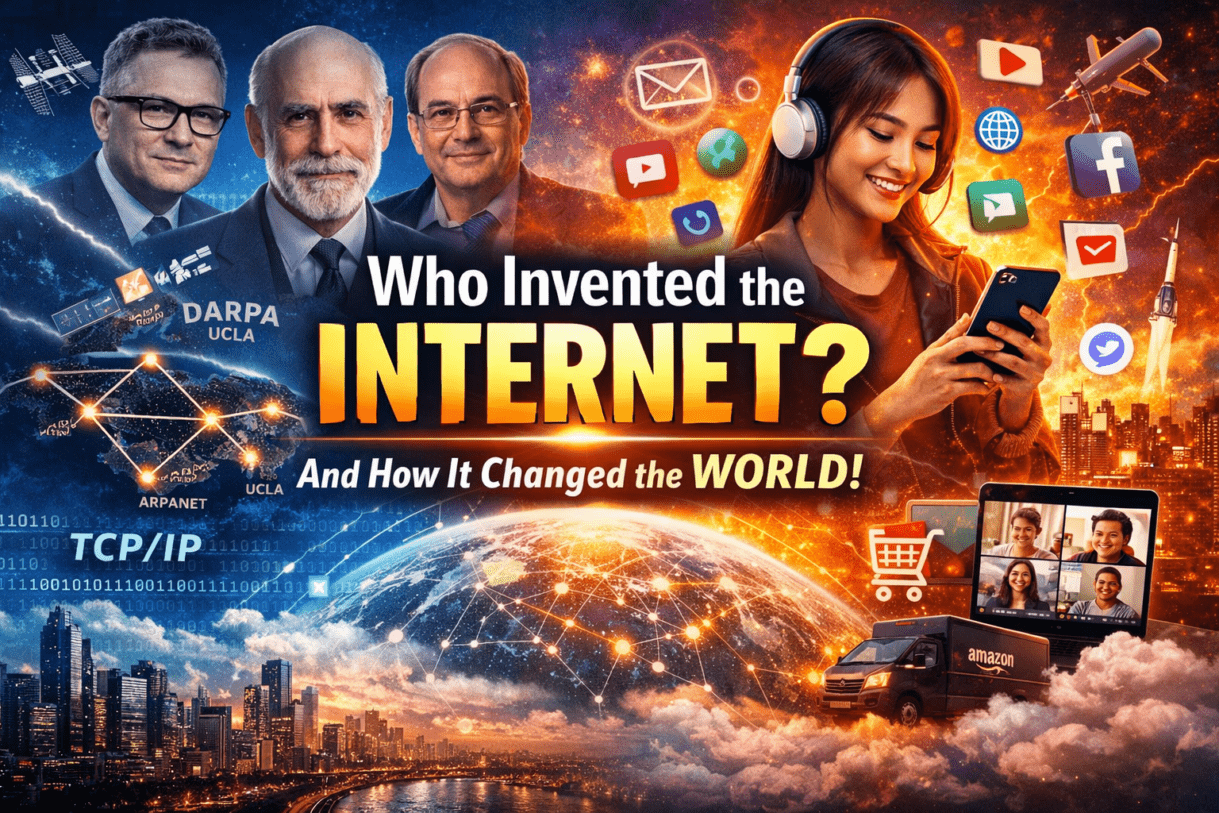
Whether you’re scrolling, researching, working, or streaming, the internet has become so deeply embedded in modern life that it feels almost invisible. Yet, behind this everyday convenience lies one of the most complex and collaborative inventions in human history.
Unlike the light bulb or the telephone, the internet was not invented by a single genius working in isolation. Instead, it emerged from decades of research, experimentation, and vision from multiple scientists, engineers, and institutions.
In this in-depth guide, we’ll break down:
- Who actually invented the internet
- The key milestones that built it
- The difference between the internet and the web
- How it reshaped the global economy, communication, and culture
- Why it remains the backbone of modern civilization
This is not just a history lesson—it’s the story of how the world became connected.
The Big Question: Who Really Invented the Internet?
The most accurate answer is this: no single person invented the internet.
Instead, it was a layered innovation built over time. However, several pioneers played critical roles.
The Visionary: J.C.R. Licklider
In the early 1960s, Licklider introduced the idea of a globally interconnected network of computers. He called it the “Galactic Network.”
At a time when computers were massive, isolated machines, this idea sounded almost science fiction.
Working at DARPA, Licklider imagined a future where:
- People could access data from anywhere
- Computers could communicate seamlessly
- Information sharing would be instantaneous
This vision became the philosophical blueprint of the internet.
The First Real Step: ARPANET
The concept became reality in 1969 with ARPANET, the first operational computer network.
It connected four universities in the United States:
- UCLA
- Stanford
- UC Santa Barbara
- University of Utah
The first message sent was supposed to be “LOGIN,” but the system crashed after “LO.”
Even in failure, history was made.
Why ARPANET Was Revolutionary
ARPANET introduced packet switching, a method of breaking data into small chunks and sending them independently across a network.
This made communication:
- Faster
- More efficient
- More resilient
Without packet switching, the modern internet wouldn’t exist.
The Architects of the Internet: Vint Cerf and Bob Kahn
In the 1970s, these two engineers solved a critical problem:
How do different networks communicate with each other?
Their solution was TCP/IP (Transmission Control Protocol/Internet Protocol).
This system:
- Standardized communication between networks
- Allowed multiple networks to connect into one “network of networks”
- Became the foundation of the modern internet
In 1983, ARPANET officially adopted TCP/IP, marking what many consider the true birth of the internet.
The Game-Changer: Tim Berners-Lee
In 1989, Berners-Lee introduced something that would bring the internet to the masses: the World Wide Web.
While working at CERN, he created:
- HTML (the language of web pages)
- HTTP (the communication protocol)
- The first web browser
This made the internet accessible to ordinary people—not just scientists and engineers.
Internet vs. World Wide Web: What’s the Difference?
This is where many people get confused.
- Internet = Infrastructure (networks, cables, servers)
- World Wide Web = Content (websites, pages, apps)
Think of it like this:
- The internet is the road system
- The web is the traffic on those roads
Without Berners-Lee’s contribution, the internet would still exist—but you probably wouldn’t be using it.
The Evolution of the Internet: From Experiment to Global System
1. 1960s–1970s: Research and Military Use
Initially, the internet was:
- Funded by the U.S. government
- Used for military and academic research
- Limited to a small number of institutions
The goal was resilience—especially during the Cold War.
2. 1980s: Expansion and Standardization
With TCP/IP in place, more networks began connecting.
Key developments:
- Universities joined the network
- Email became popular
- Early forms of online communities emerged
3. 1990s: The Public Internet Explosion
This is when everything changed.
- The web became publicly accessible
- Browsers made navigation easy
- Businesses began going online
Companies like Microsoft and Netscape played major roles in popularizing the web.
4. 2000s: The Rise of Social Media and E-Commerce
The internet evolved from information-sharing to interaction.
Platforms like:
- Amazon
transformed how people:
- Communicate
- Shop
- Build communities
5. 2010s–Present: Mobile, Cloud, and AI Era
Today’s internet is:
- Mobile-first
- Cloud-powered
- Data-driven
Apps like WhatsApp and TikTok dominate global communication.
How the Internet Changed the World
The impact of the internet is not incremental—it is transformational.
Let’s break it down across key domains.
1. Communication: From Weeks to Seconds
Before the internet:
- Letters took days or weeks
- International communication was expensive
- Information moved slowly
After the internet:
- Instant messaging
- Video calls
- Global collaboration in real time
Communication became:
- Faster
- Cheaper
- Borderless
This shift didn’t just improve convenience—it redefined relationships, business, and culture.
2. Information Access: The Death of Gatekeeping
In the past, access to knowledge depended on:
- Libraries
- Schools
- Physical resources
Today:
- Search engines like Google provide instant answers
- Online courses democratize education
- Anyone can publish content
This has led to:
- A more informed population
- Increased self-learning
- New career opportunities
3. Business and the Global Economy
The internet created entirely new industries.
E-Commerce Boom
Platforms like:
- Alibaba
- Amazon
enabled:
- Global marketplaces
- Direct-to-consumer sales
- 24/7 shopping
Remote Work Revolution
The internet made it possible to:
- Work from anywhere
- Collaborate across continents
- Build digital careers
This is especially impactful in regions like Africa, where talent can now access global markets.
The Gig Economy
Freelancing, content creation, and online entrepreneurship are now viable careers.
People earn through:
- Blogging
- YouTube
- Digital marketing
- Online services
4. Education: Learning Without Limits
The internet removed geographic barriers to education.
Today, anyone can:
- Learn coding online
- Take university-level courses
- Access global knowledge
This has:
- Empowered individuals
- Reduced inequality in education
- Accelerated skill development
5. Social and Cultural Transformation
Social media platforms like TikTok and Facebook have reshaped culture.
Positive Effects
- Global connectivity
- Cultural exchange
- Amplified voices
Negative Effects
- Misinformation
- Online addiction
- Mental health challenges
The internet didn’t just connect people—it changed how people think, interact, and express themselves.
6. Politics and Power
The internet has become a powerful political tool.
It enables:
- Real-time communication from leaders
- Grassroots movements
- Citizen journalism
But also introduces:
- Cyber warfare
- Surveillance
- Disinformation campaigns
7. Innovation and Technology Acceleration
The internet is the foundation for modern technologies:
- Artificial Intelligence
- Cloud computing
- Fintech and mobile banking
- Smart devices
Without the internet, none of these would scale globally.
The Internet in Africa: A Quiet Revolution
In places like Kenya, the internet has had a profound impact.
Mobile Internet Growth
Affordable smartphones and mobile data have:
- Connected millions
- Enabled digital entrepreneurship
- Expanded financial inclusion
Fintech Innovation
Mobile money platforms have transformed banking, allowing people to:
- Send money instantly
- Access financial services
- Run businesses digitally
Challenges of the Internet Age
Despite its benefits, the internet comes with serious challenges.
1. Cybersecurity Threats
- Hacking
- Identity theft
- Data breaches
2. Privacy Concerns
- Data tracking
- Surveillance
- Loss of personal control
3. Digital Divide
Not everyone has equal access, creating inequality.
4. Misinformation
False information spreads faster than ever.
The Future of the Internet
The internet is still evolving.
Key trends include:
1. Artificial Intelligence Integration
Smarter systems, automation, and personalized experiences.
2. Decentralization (Web3)
More control for users over data and identity.
3. Faster Connectivity
Technologies like 5G and satellite internet.
4. Virtual and Augmented Reality
Immersive digital experiences.
The Invention That Changed Everything
The internet is not just a tool—it is infrastructure for modern life.
From the early vision of J.C.R. Licklider to the groundbreaking work of Vint Cerf, Bob Kahn, and Tim Berners-Lee, it represents one of humanity’s greatest collaborative achievements.
Its impact is everywhere:
- How we communicate
- How we work
- How we learn
- How we live
And the truth is, we are still only at the beginning.
SUGGESTED READS
- The Illusion of Friendship: Understanding the Painful Realization That Some Bonds Were Never Genuine
- The Power of Calmness: How Inner Peace Leads to Clear Thinking and Better Decisions
- As Long as You Know Your Heart and Intentions Are Pure, Don’t Explain Yourself to Anyone
- The Strength in Smiles: A Tribute to Resilient Souls Who Have Been Through a Lot
- Embracing Imperfection: Why Making Mistakes is Better Than Faking Perfection
- No Revenge: Why Naturally Ugly People Destroy Their Own Lives

Support Our Website!
We appreciate your visit and hope you find our content valuable. If you’d like to support us further, please consider contributing through the TILL NUMBER: 9549825. Your support helps us keep delivering great content!
If you’d like to support Nabado from outside Kenya, we invite you to send your contributions through trusted third-party services such as Remitly, western union, SendWave, or WorldRemit. These platforms are reliable and convenient for international money transfers.
Please use the following details when sending your support:
Phone Number: +254701838999
Recipient Name: Peterson Getuma Okemwa
We sincerely appreciate your generosity and support. Thank you for being part of this journey!