

simply amazing, always for you.
The Everyday Mystery You’ve Always Felt but Rarely Questioned
Step outside at midday and the heat can feel relentless—roads radiate warmth, buildings trap heat, and the air itself seems heavy. Yet return to the same spot just hours later, and everything changes. The air cools, surfaces lose their warmth, and the environment becomes noticeably more comfortable—or even cold.
This daily transformation isn’t random. It is driven by a precise interplay of physics, atmospheric science, and Earth’s energy balance. Understanding why it’s cooler at night opens the door to deeper insights about weather, climate, agriculture, urban living, and even energy consumption.
This is not just a simple “the sun goes away” explanation. It is a layered process involving heat absorption, storage, release, atmospheric dynamics, and planetary behavior.
Let’s break it down in full.
The Core Principle: Earth’s Energy Balance
At the heart of the day-night temperature difference lies one fundamental concept: energy in versus energy out.
During the day:
- The Earth receives energy from the Sun.
- Surfaces absorb and store that energy.
- The atmosphere warms up.
At night:
- The incoming energy stops.
- The Earth continues to release stored heat.
- Temperatures fall because more energy is leaving than entering.
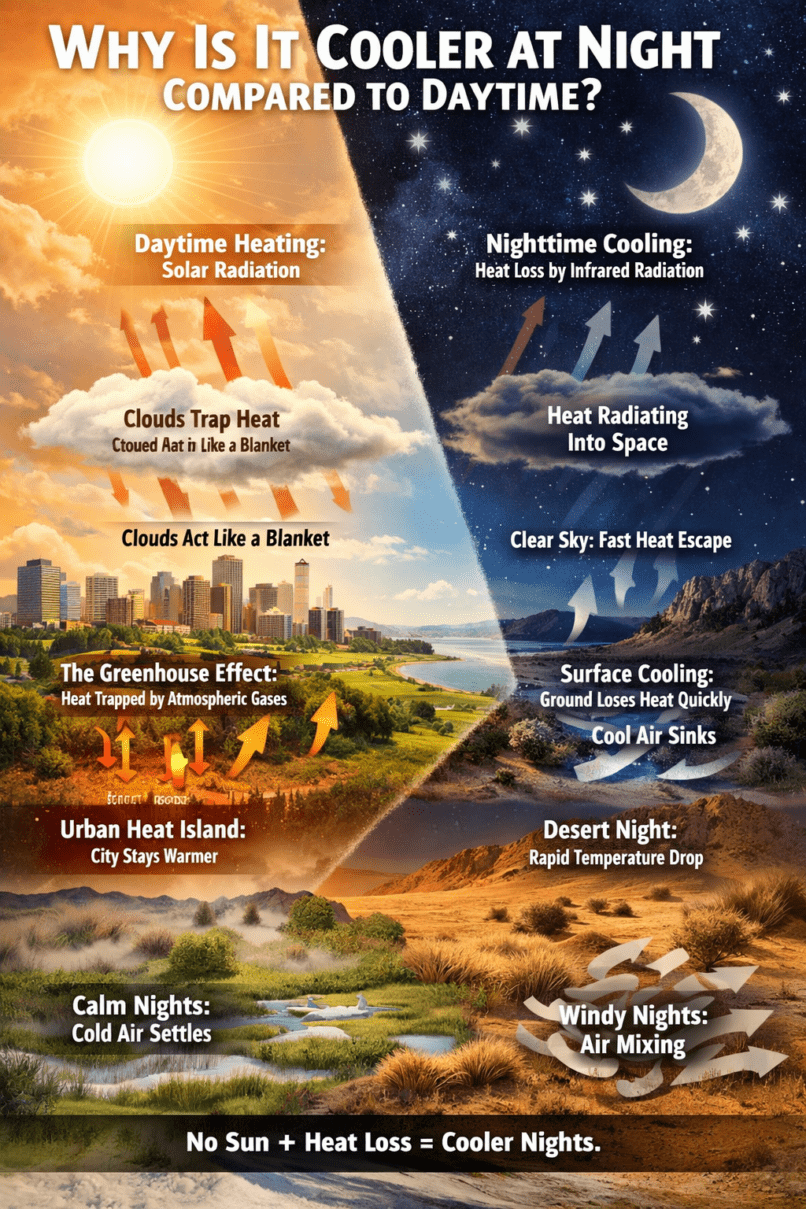
This imbalance—no incoming solar energy but continued heat loss—is the primary reason nights are cooler.
Solar Radiation: The Daytime Heating Engine
The Sun is the Earth’s primary energy source. It emits energy in the form of electromagnetic radiation, including visible light and ultraviolet rays.
When sunlight reaches Earth:
- Land, water, and man-made surfaces absorb it.
- Some energy is reflected (especially by light-colored surfaces).
- The rest is converted into heat.
This process steadily raises temperatures throughout the day.
The strongest heating typically occurs between late morning and early afternoon—not exactly at noon—because surfaces continue accumulating heat even after peak sunlight.
Heat Storage: The Earth Doesn’t Heat Instantly
One critical but often overlooked factor is thermal inertia—the ability of materials to absorb and store heat.
Different surfaces behave differently:
- Asphalt and concrete absorb heat quickly and release it slowly.
- Water absorbs heat slowly and releases it even more slowly.
- Soil varies depending on moisture content.
This is why:
- Cities remain warm even after sunset.
- Coastal regions experience milder temperature swings.
- Dry inland areas heat up and cool down rapidly.
During the day, the Earth acts like a giant heat reservoir. At night, that stored heat begins to escape.
Nightfall: The Sudden Shutdown of Incoming Energy
As the Earth rotates, your location eventually turns away from the Sun. Once the Sun sets:
- Incoming solar radiation drops to zero.
- Heating stops almost instantly.
- Cooling becomes the dominant process.
This transition marks the beginning of temperature decline.
However, the cooling process isn’t immediate or uniform. It depends on how much heat was stored during the day and how quickly it can escape.
Infrared Radiation: How the Earth Loses Heat
The Earth doesn’t simply “cool down”—it actively emits energy back into space through Infrared Radiation.
Here’s how it works:
- Warm surfaces emit energy as infrared waves.
- This energy travels upward into the atmosphere.
- Some escapes into space, while some is absorbed by atmospheric gases.
At night:
- This radiation continues uninterrupted.
- With no incoming solar energy to balance it, the net effect is cooling.
The clearer the sky, the faster this heat escapes.
The Role of the Atmosphere: Not Just Empty Space
The atmosphere plays a major role in how fast temperatures drop at night.
The Greenhouse Effect
Certain gases in the atmosphere—such as carbon dioxide, methane, and water vapor—trap heat. This process is known as the Greenhouse Effect.
During the night:
- The Earth emits infrared radiation.
- Greenhouse gases absorb and re-emit some of that heat.
- This slows down cooling.
Without this effect, nighttime temperatures would plummet dramatically—similar to what happens on the Moon, where there is no atmosphere.
Why Clear Nights Are Colder Than Cloudy Nights
Clouds are one of the most important variables in nighttime temperatures.
Clear Nights:
- Heat escapes freely into space.
- Rapid cooling occurs.
- Temperatures drop significantly.
Cloudy Nights:
- Clouds act like insulation.
- They reflect heat back toward the surface.
- Cooling is slower, and temperatures remain higher.
This is why you often experience colder nights under clear skies and milder nights when it’s cloudy.
Surface Cooling: The Ground Leads the Process
Cooling begins at the Earth’s surface, not in the air.
Here’s the sequence:
- The ground loses heat through radiation.
- The air in contact with the ground cools.
- Cooler air sinks and spreads.
This creates what meteorologists call a temperature inversion, where:
- Air near the ground is cooler than air above it.
This is why early mornings—just before sunrise—are usually the coldest time of day.
Wind and Air Mixing: A Hidden Influence
Wind can significantly affect how cold it gets at night.
Calm Conditions:
- Cool air settles near the ground.
- Minimal mixing occurs.
- Temperatures drop more sharply.
Windy Conditions:
- Air mixes vertically.
- Warmer air from above replaces cooler air near the surface.
- Cooling is reduced.
This is why still nights often feel colder than windy ones, even if the temperature readings are similar.
Humidity: The Invisible Temperature Regulator
Water vapor in the air plays a crucial role in nighttime temperatures.
High Humidity:
- More heat is retained.
- Cooling is slower.
- Nights feel warmer.
Low Humidity:
- Heat escapes more easily.
- Rapid cooling occurs.
- Nights feel colder.
This explains why deserts, which have very low humidity, experience extreme temperature drops after sunset.
Why Deserts Get So Cold at Night
Deserts provide the clearest example of nighttime cooling.
During the day:
- Intense sunlight heats the ground rapidly.
At night:
- There are no clouds to trap heat.
- Very little moisture is present.
- Heat escapes quickly.
The result:
- Large temperature swings between day and night.
This phenomenon is known as a high diurnal temperature range.
Urban vs Rural: Why Cities Stay Warmer at Night
Cities behave differently due to the urban heat island effect.
In urban areas:
- Concrete and asphalt store heat during the day.
- Buildings trap and re-radiate heat.
- Human activity adds additional warmth.
At night:
- Heat is released slowly.
- Temperatures remain higher than surrounding rural areas.
In contrast, rural areas:
- Have more vegetation and open land.
- Lose heat more quickly.
- Experience cooler nights.
Altitude Matters: Why High Places Get Colder Faster
Elevation plays a significant role in nighttime temperatures.
At higher altitudes:
- The atmosphere is thinner.
- There is less heat retention.
- Temperatures drop more quickly.
This is why highland areas experience cooler nights compared to low-lying regions.
For example, cities located at higher elevations often have noticeably cooler evenings, even in tropical regions.
Seasonal Differences: Not All Nights Are Equal
Nighttime cooling varies across seasons.
Summer:
- Days are longer.
- More heat is absorbed.
- Nights are shorter and warmer.
Winter:
- Days are shorter.
- Less heat is stored.
- Nights are longer and colder.
The duration of darkness directly affects how much time the Earth has to lose heat.
The Coldest Moment: Just Before Sunrise
Many people assume midnight is the coldest time of night, but that’s not accurate.
Cooling continues throughout the night because:
- Heat loss is continuous.
- No solar energy replaces it.
The lowest temperature typically occurs:
- Just before sunrise
- After the longest period of uninterrupted cooling
Extreme Case Study: The Moon
To fully understand Earth’s nighttime cooling, consider the Moon.
The Moon:
- Has no atmosphere
- Cannot trap heat
- Experiences extreme temperature swings
Daytime temperatures can exceed 120°C, while nighttime temperatures can drop below -170°C.
This stark contrast highlights the importance of Earth’s atmosphere in moderating nighttime temperatures.
Real-World Implications of Nighttime Cooling
Understanding why nights are cooler has practical importance in several areas:
Agriculture
- Frost risk depends on nighttime cooling.
- Farmers monitor clear skies and wind conditions closely.
Energy Use
- Cooler nights reduce air conditioning demand.
- Buildings lose heat, affecting heating requirements.
Urban Planning
- Designing cities to reduce heat retention improves comfort.
- Green spaces help regulate temperatures.
Human Comfort
- Sleep quality is often better in cooler environments.
- Temperature regulation affects health and productivity.
Nairobi Context: Why Nights Feel Cooler Despite Warm Days
In regions like Nairobi, nighttime cooling is particularly noticeable due to:
- Moderate altitude (around 1,795 meters above sea level)
- Relatively thinner atmosphere compared to coastal areas
- Periodic clear skies that allow heat to escape
Even after warm days, nights can feel surprisingly cool because heat dissipates efficiently.
Common Misconceptions About Nighttime Cooling
“The Air Just Becomes Cold”
Not exactly. The air cools because the ground loses heat first.
“Wind Makes It Colder”
Wind doesn’t necessarily lower the actual temperature—it increases heat loss from your body, making it feel colder.
“Clouds Always Mean Warmer Nights”
Generally true, but other factors like humidity and wind still matter.
Final Summary: The Science in One Clear Flow
Here is the full process simplified:
- The Sun heats the Earth during the day.
- Surfaces absorb and store that heat.
- After sunset, incoming energy stops.
- The Earth emits heat through infrared radiation.
- The atmosphere partially traps this heat.
- Cooling continues throughout the night.
- The lowest temperature occurs just before sunrise.
A Daily Cycle Driven by Physics
The cooler temperatures you experience at night are not random—they are the result of a finely balanced physical system involving solar energy, heat storage, atmospheric dynamics, and Earth’s rotation.
Every evening, the planet transitions from a state of energy gain to energy loss. That shift triggers a cascade of processes—radiation, cooling, air movement, and atmospheric interaction—that collectively lower temperatures.
Once you understand this cycle, nighttime cooling stops being a simple observation and becomes a predictable, explainable phenomenon rooted in the laws of physics.
SUGGESTED READS
- Who Invented the Internet and How It Changed the World
- Unlock Your Brain’s Full Power: 10 Mind-Blowing Benefits of Daily Mindfulness You Can’t Ignore
- Struggling to Focus at Home? Fix Your Motivation Today
- “Tuko Kadi”: The Phrase Powering Kenya’s Political Awakening, Youth Identity, and Digital Culture
- You’re Learning Languages the Wrong Way — Here’s the Only Method That Actually Works
- Why Curious Minds Get Richer, Smarter, and More Successful
- How Sharp Boys Trick Young Kenyans Into Losing Big Money Online

Support Our Website!
We appreciate your visit and hope you find our content valuable. If you’d like to support us further, please consider contributing through the TILL NUMBER: 9549825. Your support helps us keep delivering great content!
If you’d like to support Nabado from outside Kenya, we invite you to send your contributions through trusted third-party services such as Remitly, western union, SendWave, or WorldRemit. These platforms are reliable and convenient for international money transfers.
Please use the following details when sending your support:
Phone Number: +254701838999
Recipient Name: Peterson Getuma Okemwa
We sincerely appreciate your generosity and support. Thank you for being part of this journey!