

simply amazing, always for you.
Gikomba Traders Push Back After Demolitions
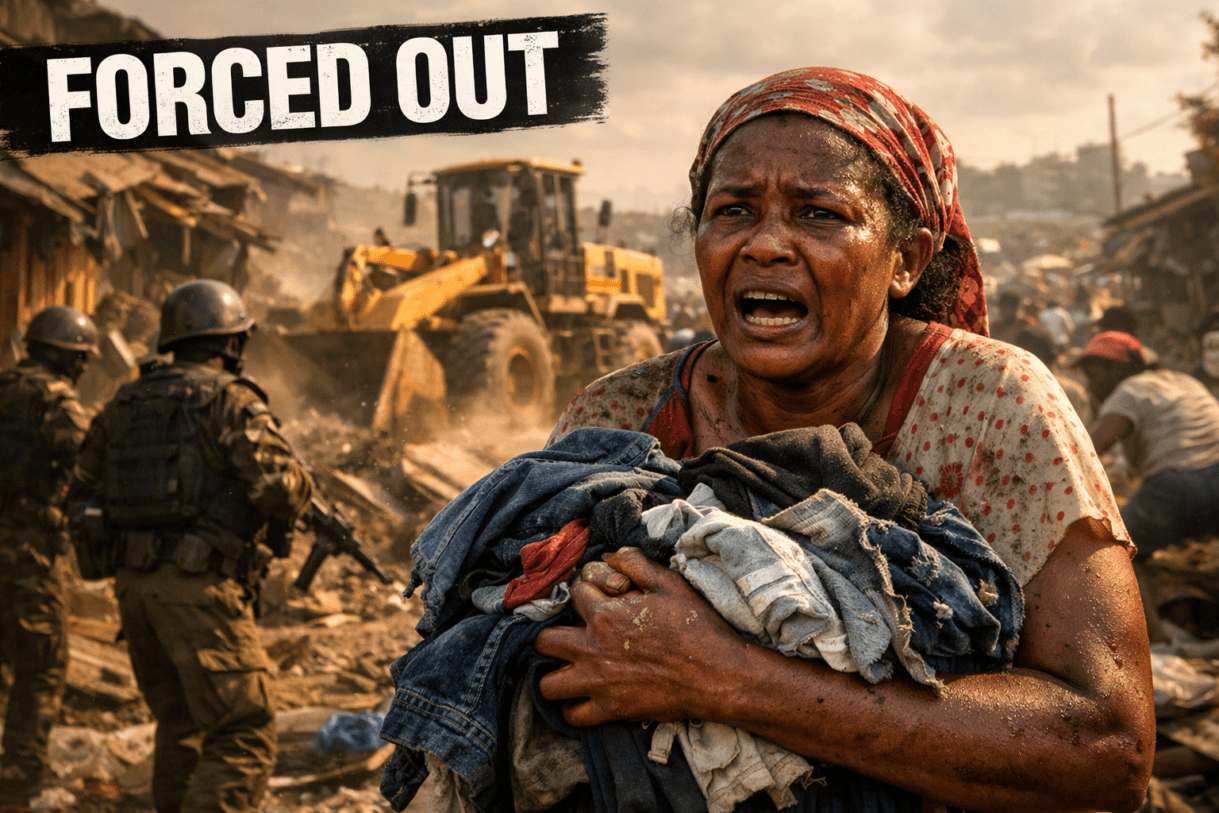
Tension is escalating in Gikomba Market, one of East Africa’s largest open-air markets, after traders staged a fierce pushback against ongoing demolitions and a controversial relocation plan. What began as an environmental enforcement operation has rapidly morphed into a high-stakes confrontation between government authorities and thousands of informal traders who depend on the market for survival.
At the center of the dispute is a widening gap between policy and reality. Authorities say the demolitions are necessary to reclaim riparian land along the Nairobi River and mitigate flooding risks. Traders, however, argue that the process has been rushed, poorly communicated, and economically devastating.
The result is a volatile mix of legal battles, protests, and deepening mistrust.
A Market That Powers a City
To understand the magnitude of the crisis, one must first understand Gikomba itself.
Located near the heart of Nairobi, Gikomba is not just a market—it is a massive economic engine. It is estimated to support tens of thousands of traders, transporters, casual laborers, and suppliers. The market is especially known for its second-hand clothing trade, drawing buyers from across Kenya and neighboring countries.
On any given day, the narrow alleys are packed with activity: traders shouting prices, buyers negotiating deals, and handcarts weaving through congested pathways. For many, this is not just business—it is survival.
The ongoing demolitions have therefore struck at the very core of an ecosystem that sustains entire families.
The Demolitions: What Triggered the Crisis?
The government’s action is part of a broader initiative to restore urban waterways and enforce environmental regulations. Structures deemed to be encroaching on riparian land along the Nairobi River have been marked for demolition.
Officials insist that the move is long overdue. Years of unchecked expansion, they argue, have narrowed the river, increased pollution, and heightened the risk of flooding during heavy rains.
But while the policy objective may be clear, the execution has sparked outrage.
Traders say demolitions began with little warning, leaving many scrambling to salvage goods and relocate their operations overnight. Some report losing stock worth thousands of shillings, with no compensation or clear guidance on what comes next.
The 30-Metre vs 50-Metre Battle
One of the most contentious issues is the sudden shift in the required buffer zone.
According to trader representatives, there had been an earlier understanding that businesses would relocate 30 metres away from the river. However, authorities later expanded this requirement to 50 metres—a move that significantly increases the number of affected traders.
This change has fueled suspicion and anger.
Many traders believe the expansion is arbitrary and disproportionately punitive. Some have gone further, alleging that the additional land being cleared could be repurposed for private development.
Whether or not such claims hold merit, the perception alone has been enough to erode trust.
“Where Do We Go?” — The Relocation Dilemma
At the heart of the protests is a simple but urgent question: where are the traders supposed to go?
Authorities have indicated that alternative spaces have been identified and that a modernized market is in the pipeline. However, traders argue that these assurances lack clarity and immediacy.
Several concerns have been raised:
- Insufficient Space: Temporary relocation sites are reportedly too small to accommodate the volume of traders displaced.
- Poor Infrastructure: Many of the proposed areas lack basic amenities such as drainage, sanitation, and security.
- Loss of Customer Base: Moving away from established trading zones risks severing long-standing customer relationships.
For small-scale traders operating on thin margins, even a few days of disruption can be catastrophic. A poorly executed relocation could mean the difference between staying afloat and total financial collapse.
Legal Pushback and Court Intervention
The dispute has now moved beyond the streets and into the courtroom.
A petition filed on behalf of traders has challenged the demolitions, arguing that the process violates constitutional protections, including the right to fair administrative action and adequate notice.
In a significant development, the court issued a temporary halt to the demolitions, providing a window for further deliberation.
Legal experts note that the case could set an important precedent for how urban redevelopment projects are handled in Kenya, particularly when they affect informal settlements and markets.
Politics Enters the Fray
As expected, the crisis has attracted political attention.
Leaders from across the political spectrum have weighed in, some siding with traders and others defending the government’s position. Public statements, site visits, and media appearances have added another layer of complexity to an already charged situation.
Critics argue that political involvement risks turning a policy issue into a populist battleground. Supporters, however, say it is necessary to amplify the voices of affected traders.
Either way, the issue is no longer confined to Gikomba—it has become a national talking point.
The Government’s Defense: Environment vs Economy
From the government’s perspective, the demolitions are a matter of necessity, not choice.
Officials point to the deteriorating state of the Nairobi River, citing pollution, illegal dumping, and encroachment as key challenges. Restoring the river, they argue, is critical for public health, environmental sustainability, and urban resilience.
They also emphasize that flooding poses a real and growing threat, particularly in low-lying areas.
In this context, enforcing a 50-metre buffer zone is presented as a scientifically grounded decision rather than an arbitrary one.
However, critics counter that environmental goals should not come at the expense of human livelihoods—especially when alternative solutions may exist.
The Human Cost: Stories from the Ground
Behind the policy debates and legal arguments are real people facing real consequences.
A clothes vendor who has worked in Gikomba for over a decade describes losing nearly all her stock during the demolitions. With no savings and no alternative income, she now faces an uncertain future.
A young porter, who earns daily wages transporting goods, says his income has dropped to zero since trading activity slowed down.
These stories are not isolated—they are representative of a broader crisis affecting thousands.
A Pattern of Urban Displacement?
The events at Gikomba are not occurring in isolation.
Across Nairobi, similar operations have targeted informal settlements, roadside vendors, and small-scale traders. While each case has its own context, a common pattern is emerging: rapid urban development colliding with informal economic structures.
Urban planners argue that modernization is essential for long-term growth. However, social advocates warn that without inclusive planning, such efforts risk deepening inequality.
The Gikomba standoff is therefore part of a larger conversation about the future of cities in Africa.
What Happens Next?
With demolitions temporarily halted, attention now turns to negotiations and legal proceedings.
Several possible outcomes are on the table:
- Revised Relocation Plan: Authorities may be forced to engage more deeply with trader representatives to develop a mutually acceptable solution.
- Compensation Framework: Financial support could be introduced to cushion affected traders.
- Phased Implementation: Instead of abrupt demolitions, a gradual approach may be adopted.
- Court Ruling: The judiciary’s final decision will play a निर्णing role in shaping the path forward.
Each of these options carries its own implications, both for Gikomba and for urban policy more broadly.
Analysis: A Crisis of Trust
At its core, the Gikomba crisis is not just about land or policy—it is about trust.
Traders feel excluded from decision-making processes that directly affect their lives. Authorities, on the other hand, face the challenge of enforcing regulations in a complex and often chaotic urban environment.
Bridging this gap will require more than legal rulings or political statements. It will require genuine dialogue, transparency, and a willingness to compromise.
Why This Story Matters Beyond Nairobi
While the events are unfolding in Nairobi, the implications extend far beyond Kenya.
Cities across Africa are grappling with similar challenges: rapid urbanization, environmental degradation, and the need to formalize informal economies.
The outcome of the Gikomba dispute could therefore serve as a case study for policymakers, activists, and urban planners across the continent.
A Tipping Point for Urban Kenya
Gikomba is at a crossroads.
What happens here will shape not only the future of one market but also the broader trajectory of urban development in Kenya. Will modernization be inclusive, or will it come at the cost of the most vulnerable?
For now, traders remain defiant.
They are not rejecting change—they are demanding fairness.
And until that demand is met, the standoff is unlikely to end.
SUGGESTED READS
- Why Your Daily Spending Decisions Matter More Than You Think
- Convicted Killer of 13-Year-Old Na’Ziyah Harris Found Dead in Prison
- Who Invented the Internet and How It Changed the World
- How to Supercharge Your Productivity at Work
- Inside the High-Stakes Release That Shook Washington

Support Our Website!
We appreciate your visit and hope you find our content valuable. If you’d like to support us further, please consider contributing through the TILL NUMBER: 9549825. Your support helps us keep delivering great content!
If you’d like to support Nabado from outside Kenya, we invite you to send your contributions through trusted third-party services such as Remitly, western union, SendWave, or WorldRemit. These platforms are reliable and convenient for international money transfers.
Please use the following details when sending your support:
Phone Number: +254701838999
Recipient Name: Peterson Getuma Okemwa
We sincerely appreciate your generosity and support. Thank you for being part of this journey!