

simply amazing, always for you.
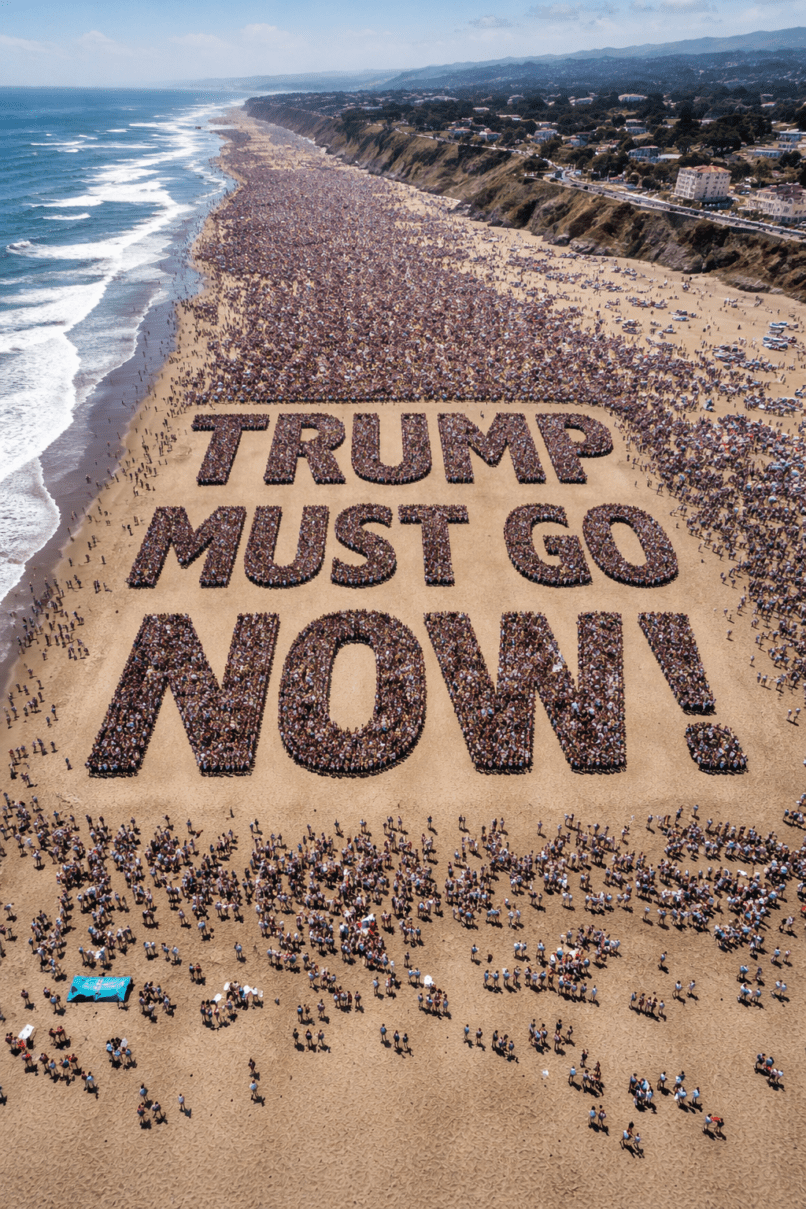
In a striking display of coordinated activism, thousands of protesters in San Francisco transformed a stretch of coastline into a massive human banner—an aerial message so large it could only be fully understood from above.
The demonstration, which unfolded along the city’s iconic shoreline, marks one of the most visually powerful protest tactics seen in recent months. Participants aligned their bodies with precision, forming bold, capitalized words that sent a clear political message to leaders, media outlets, and the global public watching from afar.
A Protest Designed for the Sky
Unlike traditional marches or rallies, this demonstration was engineered for aerial impact. Protesters gathered in carefully assigned positions, often coordinated through digital maps, volunteer marshals, and on-the-ground organizers. From the sand, the formation appeared chaotic. From the sky, however, it snapped into focus—a perfectly legible message crafted by human bodies.
Drone footage and helicopter images quickly circulated online, amplifying the reach of the protest far beyond the beach. Within hours, the images had spread across social media platforms, news outlets, and activist networks.
This method—sometimes referred to as a “human banner”—has become increasingly popular among large protest movements. It combines scale, symbolism, and visual storytelling into a single, viral moment.
The Message Behind the Formation
While slogans have varied across demonstrations, the underlying themes remain consistent: political frustration, calls for systemic change, and demands for accountability. In this particular event, protesters used their bodies to spell out a direct and urgent message aimed at national leadership.
Observers noted that the wording was intentionally bold and unambiguous, leaving little room for interpretation. It was not just a protest—it was a statement designed to dominate headlines and command attention.
For many participants, the act of physically becoming part of the message carried emotional weight.
“You’re not just holding a sign—you are the sign,” one protester explained. “It makes you feel like your voice is literally part of something bigger.”
Part of a Larger Movement
The demonstration is linked to a broader wave of coordinated protests that have taken place across the United States and beyond. Known in some circles as the “No Kings” movement, these actions have drawn large crowds united by a shared sense of urgency around political and social issues.
No Kings protests have been characterized by their scale, organization, and increasingly creative tactics. From mass marches to coordinated shutdowns, activists are experimenting with new ways to capture attention in an oversaturated media environment.
The human banner strategy stands out as one of the most effective.
Logistics Behind the Spectacle
Creating a human sign of this magnitude is no small feat. It requires meticulous planning, often days or even weeks in advance.
Organizers typically:
- Map out the message using grid systems
- Assign participants specific positions
- Use color coordination (clothing or props) for clarity
- Deploy volunteers to guide alignment in real time
On the day of the protest, participants are directed into place using flags, hand signals, or mobile communication tools. Timing is critical—especially when coordinating with drone operators or media crews capturing the final image.
Despite the complexity, the process is surprisingly efficient when executed well. Within minutes, a loose crowd can transform into a cohesive visual statement.
Why This Tactic Is Going Viral
The rise of human-banner protests reflects a broader shift in how activism intersects with media.
In an age dominated by visual content, protests are no longer just about physical presence—they are about optics.
A traditional march might draw thousands, but a single aerial image can reach millions.
This approach taps into several key dynamics:
- Social media amplification: Eye-catching visuals spread rapidly
- Media pickup: News outlets are more likely to cover visually compelling events
- Public engagement: Dramatic imagery sparks conversation and debate
In short, the human sign is not just a protest—it is a media strategy.
San Francisco: A Historic Stage for Protest
San Francisco has long been a focal point for activism in the United States. From civil rights demonstrations to anti-war protests, the city has cultivated a reputation as a hub for political expression.
Its geography—particularly open spaces like beaches and parks—makes it uniquely suited for large-scale visual demonstrations. Wide, unobstructed areas allow for massive gatherings and clear aerial visibility.
This latest protest adds to that legacy, blending traditional activism with modern media tactics.
Voices From the Ground
Participants described a mix of determination, frustration, and solidarity.
Many said they were motivated by a desire to be heard in a political climate they feel increasingly disconnected from.
Others emphasized the importance of unity.
“When you’re standing shoulder to shoulder with thousands of people, all forming one message, it reminds you that you’re not alone,” another attendee said.
For some, the experience was also deeply personal—a way to channel anger and hope into a tangible, collective action.
The Broader Impact
While it is too early to measure the long-term political impact of this specific demonstration, its immediate effect is undeniable: visibility.
The images have already reached a global audience, sparking discussions across social and political lines.
Critics argue that such demonstrations are more symbolic than substantive. Supporters counter that visibility is the first step toward change.
Regardless of perspective, one thing is clear: the strategy works.
What Comes Next
As protest movements continue to evolve, tactics like the human banner are likely to become more sophisticated.
We may see:
- Larger formations
- More complex messages
- Integration with augmented reality or live streaming
- Coordinated global “simultaneous” human signs
The goal remains the same: capture attention, communicate a message, and mobilize public sentiment.
The image of thousands of people forming a single, unified message on a beach is more than just a spectacle—it is a reflection of modern activism.
In a world where attention is currency, protesters are finding new ways to make their voices impossible to ignore.
And in San Francisco, they’ve once again turned the landscape itself into a platform for protest—proving that sometimes, the most powerful message is one you can only see from above.
SUGGESTED READS
- No Warning, No Mercy: Gikomba Traders Left Devastated After Sudden Demolitions
- Convicted Killer of 13-Year-Old Na’Ziyah Harris Found Dead in Prison
- Inside the High-Stakes Release That Shook Washington
- Iran Unleashes New Missile Barrages as U.S. Claims “Progress” — War Spirals Out of Control
- OnlyFans Owner Leonid Radvinsky Dies at 43 After Private Cancer Battle
Support Our Website!
We appreciate your visit and hope you find our content valuable. If you’d like to support us further, please consider contributing through the TILL NUMBER: 9549825. Your support helps us keep delivering great content!
If you’d like to support Nabado from outside Kenya, we invite you to send your contributions through trusted third-party services such as Remitly, western union, SendWave, or WorldRemit. These platforms are reliable and convenient for international money transfers.
Please use the following details when sending your support:
Phone Number: +254701838999
Recipient Name: Peterson Getuma Okemwa
We sincerely appreciate your generosity and support. Thank you for being part of this journey!