

simply amazing, always for you.
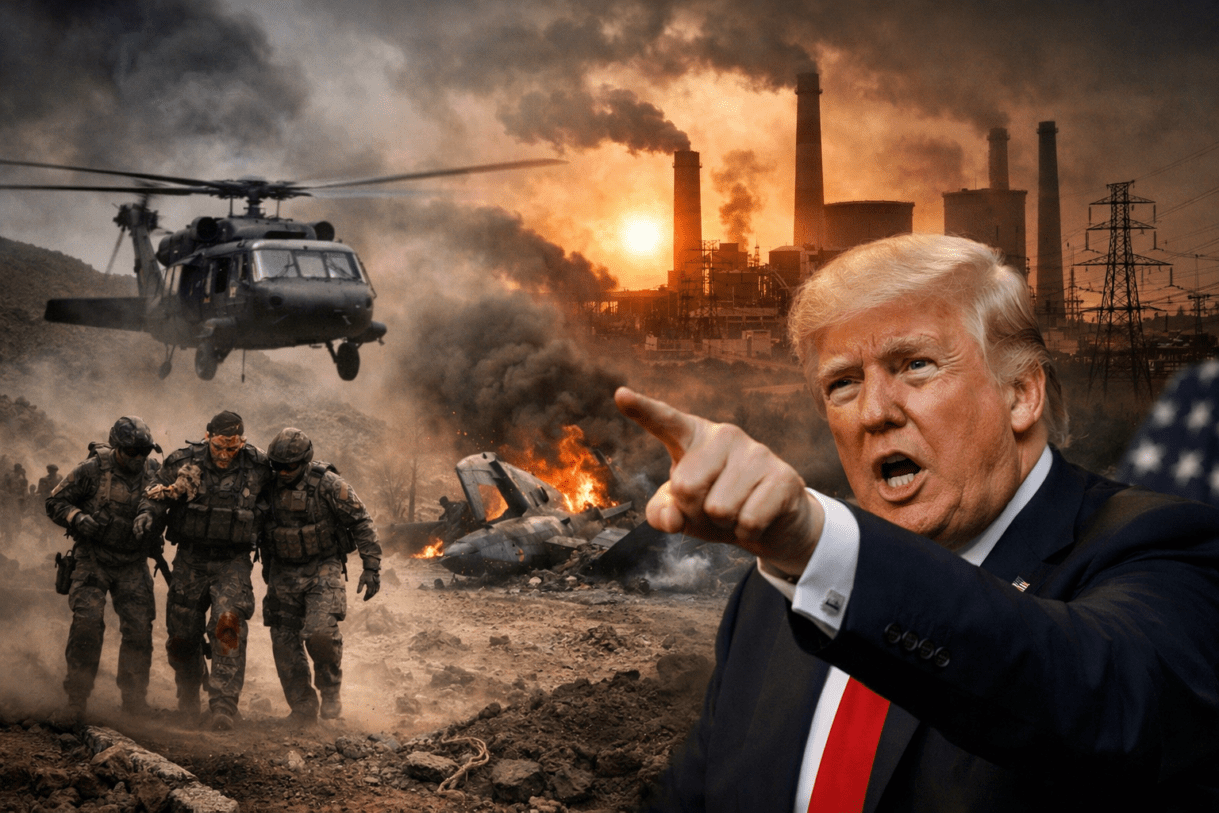
A high-risk U.S. military rescue deep inside Iranian territory has triggered a new and dangerous phase in the escalating conflict between United States and Iran, with Donald Trump now openly threatening to target Iran’s critical infrastructure, including power plants and bridges.
The dramatic sequence of events — involving a downed fighter jet, a stranded American airman, and a daring extraction mission under fire — is now being viewed by analysts as a potential turning point in a conflict that is rapidly edging toward full-scale war.
A FIGHTER JET SHOT DOWN OVER HOSTILE TERRITORY
The crisis began when a U.S. F-15E Strike Eagle was shot down during combat operations inside Iranian airspace. The aircraft, a dual-seat fighter used for precision strikes, carried two crew members.
While one crew member was quickly accounted for, the second — a weapons systems officer — was left stranded in mountainous terrain deep inside Iran. Injured and isolated, the airman reportedly evaded Iranian search teams for more than 24 hours, setting off an urgent rescue effort by U.S. forces.
This marked a significant escalation in the conflict, as it represented one of the rare instances of a U.S. manned aircraft being downed over Iranian territory in the current war.
INSIDE THE DARING RESCUE MISSION
What followed was a complex and highly dangerous military operation.
U.S. special operations forces launched a coordinated rescue mission involving helicopters, surveillance aircraft, and elite commandos. The operation unfolded under extreme pressure, with Iranian forces reportedly closing in on the downed airman’s location.
According to defense officials, rescue helicopters came under direct fire as they approached the extraction zone. Despite the hostile environment, the U.S. forces successfully retrieved the injured airman and evacuated him safely.
The mission has since been described by officials as one of the most daring combat search-and-rescue operations in recent years.
For Donald Trump, the successful rescue was both a military and political victory. In public remarks, he praised the operation as “incredible” and “one of the most complex rescues ever carried out.”
TRUMP ESCALATES: “POWER PLANTS COULD BE NEXT”
However, any sense of relief following the rescue was quickly overshadowed by a sharp escalation in rhetoric.
Shortly after confirming the mission’s success, Trump issued a stark warning to Iran, suggesting that the United States could begin targeting key infrastructure, including power plants and bridges.
The threat signals a major shift in strategy — from primarily military targets to assets that underpin civilian life and national stability.
Military analysts say that strikes on energy infrastructure would have devastating consequences, potentially crippling Iran’s electricity supply, disrupting water systems, and severely impacting hospitals and communication networks.
Such a move would also carry significant legal and humanitarian implications under international law, where civilian infrastructure is often protected unless deemed directly tied to military operations.
WHY POWER PLANTS ARE A CRITICAL TARGET
Power plants are among the most strategically sensitive targets in modern warfare.
Disabling them can:
- Paralyze industrial production
- Disrupt military logistics and communications
- Trigger widespread civilian hardship
Historically, targeting energy infrastructure has been associated with high-intensity conflicts, signaling a willingness to escalate beyond conventional battlefield engagements.
If the United States follows through on these threats, it would mark a clear transition into a more aggressive and potentially destabilizing phase of the war.
THE STRAIT OF HORMUZ: A GLOBAL FLASHPOINT
At the center of the broader conflict is the Strait of Hormuz, one of the world’s most critical oil transit routes.
Iran has been accused of threatening or partially disrupting shipping through the strait, raising alarm in global markets. A significant portion of the world’s oil supply passes through this narrow waterway, making it a key strategic asset.
Trump has demanded that Iran ensure the waterway remains open, warning that failure to do so could trigger further U.S. military action.
Any prolonged disruption could send global oil prices soaring, with ripple effects reaching economies far beyond the Middle East, including countries in Africa such as Kenya.
A WAR THAT IS RAPIDLY EXPANDING
The current conflict, which began earlier this year, has already resulted in significant casualties and destruction.
Reports indicate that:
- Multiple U.S. personnel have been killed
- Hundreds have been wounded
- Iranian military infrastructure has sustained repeated strikes
Despite these losses, Iran retains substantial military capability, including missile systems and drones capable of targeting U.S. assets and allies across the region.
The downing of the F-15E and the subsequent rescue mission underscore the intensity of the ongoing hostilities.
IRAN’S POSSIBLE RESPONSE
Iran has not remained silent.
Officials in Tehran have warned that any attack on critical infrastructure would be met with a strong and potentially wide-ranging response.
Possible retaliation scenarios include:
- Missile strikes on U.S. military bases in the region
- Attacks on allied oil facilities
- Cyber operations targeting U.S. infrastructure
There are also concerns that the conflict could expand beyond Iran’s borders, drawing in regional actors and escalating into a broader Middle East war.
THE GLOBAL STAKES
The implications of this confrontation extend far beyond Washington and Tehran.
A full-scale escalation could:
- Disrupt global energy supplies
- Trigger sharp increases in fuel prices
- Destabilize financial markets
- Increase geopolitical tensions worldwide
For countries like Kenya, the impact would likely be felt through higher fuel costs, inflation, and economic uncertainty.
A CRITICAL MOMENT
The successful rescue of the downed airman demonstrated the reach and capability of U.S. military forces. But instead of calming tensions, it appears to have intensified them.
With Donald Trump now openly considering strikes on Iran’s power infrastructure, the conflict has entered a phase where the risks of escalation are significantly higher.
What happens next will depend on decisions made in both Washington and Tehran — decisions that could shape not only the outcome of this conflict but also the stability of the global order.
The rescue of a single airman has become the catalyst for a potentially explosive escalation between the United States and Iran.
With threats now targeting critical infrastructure and tensions rising around the Strait of Hormuz, the world is watching closely.
This is no longer just a military confrontation — it is a high-stakes geopolitical crisis with consequences that could be felt across continents.

Support Our Website!
We appreciate your visit and hope you find our content valuable. If you’d like to support us further, please consider contributing through the TILL NUMBER: 9549825. Your support helps us keep delivering great content!
If you’d like to support Nabado from outside Kenya, we invite you to send your contributions through trusted third-party services such as Remitly, western union, SendWave, or WorldRemit. These platforms are reliable and convenient for international money transfers.
Please use the following details when sending your support:
Phone Number: +254701838999
Recipient Name: Peterson Getuma Okemwa
We sincerely appreciate your generosity and support. Thank you for being part of this journey!