

simply amazing, always for you.
The Gross Habit That Isn’t Actually Gross
Let’s be honest—few bodily experiences are as universally disliked as mucus. Whether it’s the thick drip at the back of your throat during a cold or the constant swallowing when your sinuses act up, it feels unpleasant, sometimes even alarming. Many people quietly wonder: Is swallowing mucus bad for me? Should I spit it out instead?
Here’s the truth: your body not only expects you to swallow mucus—it relies on it.
This isn’t just a random biological quirk. It’s a carefully designed survival mechanism that plays a central role in your immune defense, respiratory health, and even digestion. In fact, you swallow mucus every single day without noticing, even when you’re perfectly healthy.
This article breaks down everything—no myths, no fluff. You’ll learn what mucus actually is, why your body produces it, what happens after you swallow it, and when it might signal something more serious.
What Is Mucus, Really?
Mucus is a gel-like secretion produced by specialized cells lining your respiratory, digestive, and reproductive systems. It’s primarily made up of:
- Water (about 95%)
- Glycoproteins (called mucins)
- Salts
- Enzymes
- Antibodies
These components give mucus its sticky, elastic texture—perfect for trapping unwanted particles.
The Body’s Invisible Shield
Think of mucus as your body’s first line of defense. Every breath you take introduces:
- Dust
- Bacteria
- Viruses
- Pollution particles
Without mucus, these would go straight into your lungs or bloodstream. Instead, mucus traps them, forming a protective barrier.
You’re Swallowing Mucus All the Time (Even Right Now)
Here’s something most people don’t realize: your body produces about 1 to 1.5 liters of mucus every day.
Most of it doesn’t come out as visible “phlegm.” Instead, it:
- Moves silently from your nasal passages down your throat
- Gets swallowed unconsciously
- Enters your digestive system
This process is completely normal and happens whether you’re sick or not.
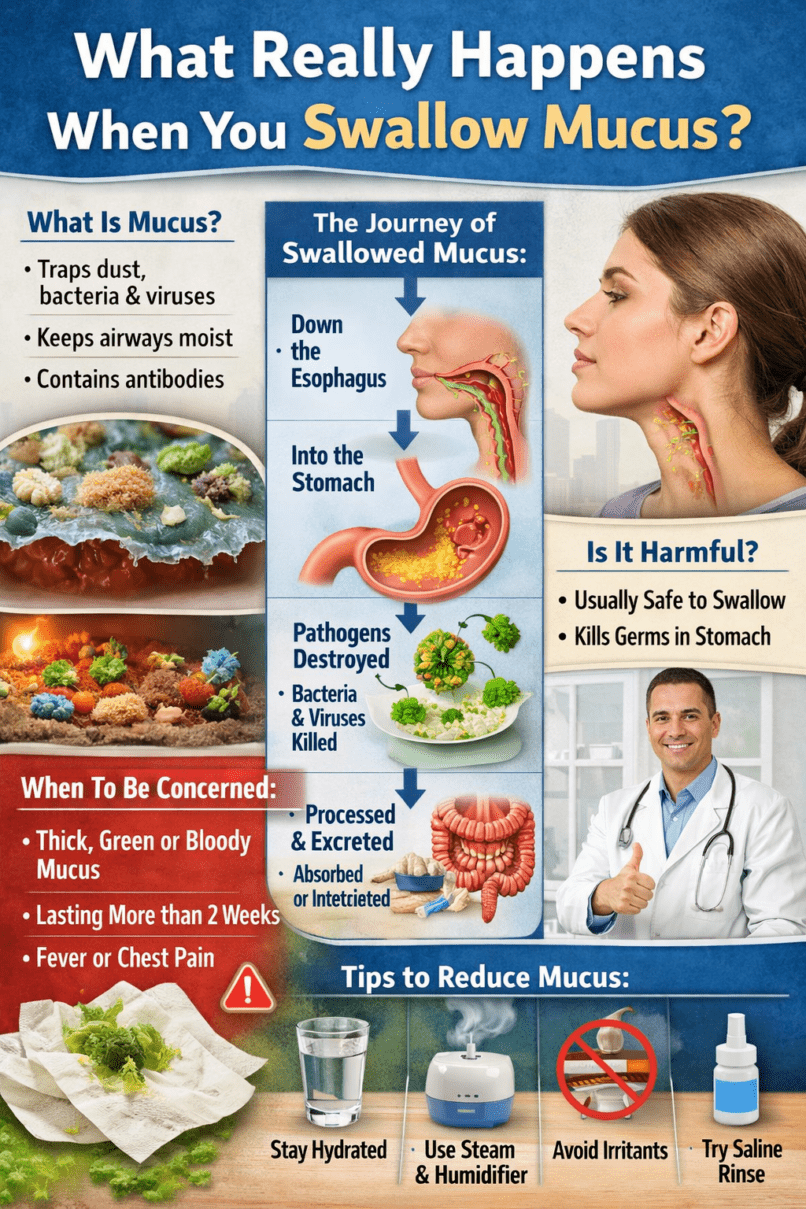
What Happens When You Swallow Mucus?
Let’s break it down step by step.
1. It Travels Down the Esophagus
Once swallowed, mucus follows the same path as food:
- From the throat
- Through the esophagus
- Into the stomach
Nothing unusual here—your body treats it like any other substance you ingest.
2. The Stomach Takes Over
Your stomach is a powerful chemical chamber filled with:
- Hydrochloric acid (very strong acid)
- Digestive enzymes like pepsin
When mucus enters:
- The protein structure (mucins) begins to break down
- Any trapped microbes are exposed
This is where things get interesting.
3. Harmful Microbes Are Destroyed
Mucus often contains trapped pathogens—like those from a Common Cold or Allergic Rhinitis.
Your stomach acid acts as a biological disinfectant:
- Most bacteria are killed instantly
- Viruses are neutralized
- Toxins are broken down
This is why swallowing mucus doesn’t usually make you sicker—it actually helps remove pathogens from your respiratory system.
4. Nutrients and Waste Are Processed
After digestion:
- Useful components are absorbed
- Waste moves through the intestines
- Eventually, it’s excreted
Your body efficiently recycles or eliminates everything.
Is Swallowing Mucus Harmful?
Short answer: No, it’s not harmful for most people.
In fact, it’s often better than constantly spitting, because:
- It keeps your throat hydrated
- It prevents irritation
- It allows your digestive system to neutralize pathogens
Why Swallowing Mucus Can Feel Uncomfortable
Even though it’s safe, it doesn’t always feel good—especially when you’re sick.
Common reasons include:
1. Excess Production
Conditions like:
- Sinusitis
- Colds
- Allergies
…can cause your body to produce more mucus than usual.
This leads to:
- Frequent swallowing
- A “lump in the throat” sensation
- Postnasal drip
2. Thicker Mucus
When mucus becomes thick or sticky, it’s harder to swallow.
Causes include:
- Dehydration
- Infection
- Dry air
3. Stomach Sensitivity
Swallowing large amounts of mucus can sometimes lead to:
- Mild nausea
- A heavy feeling in the stomach
- Occasional gagging
This is especially common in children.
The Color of Mucus: What It Tells You
Not all mucus is the same. Its color can give clues about your health.
Clear Mucus
- Normal and healthy
- Indicates proper hydration
White Mucus
- Slight congestion
- Early stage of a cold
Yellow or Green Mucus
- Suggests infection
- Immune system is active
Brown or Black Mucus
- Exposure to pollution or smoke
Red or Bloody Mucus
- Irritation or injury
- Needs medical attention if persistent
Mucus and the Immune System: A Powerful Partnership
Mucus isn’t just a passive trap—it’s an active immune player.
It contains:
- Antibodies (especially IgA)
- Antimicrobial enzymes
- White blood cell components
When pathogens get trapped:
- They’re immobilized
- They’re attacked by immune molecules
- They’re removed via swallowing or coughing
This system works silently, 24/7.
Swallowing vs. Spitting: Which Is Better?
Many people prefer to spit out mucus, especially when it’s thick or visible.
Swallowing Pros:
- Natural and efficient
- Kills pathogens in the stomach
- Less messy and socially acceptable
Spitting Pros:
- Reduces nausea when mucus is excessive
- Provides relief from throat buildup
The Verdict:
Both are fine. Choose what’s more comfortable for you. There’s no medical rule forcing one over the other.
When Swallowing Mucus Might Signal a Problem
While it’s usually harmless, certain symptoms shouldn’t be ignored.
Watch out for:
- Persistent thick green or yellow mucus
- Mucus lasting more than 10–14 days
- Fever and fatigue
- Chest pain or difficulty breathing
- Blood in mucus
These could indicate:
- Respiratory infections
- Chronic sinus issues
- More serious conditions
Why Your Body Produces More Mucus When You’re Sick
When you’re infected, your body ramps up mucus production as a defense mechanism.
Here’s why:
- Trap more pathogens
- Flush them out faster
- Protect inflamed tissues
It’s not a flaw—it’s a survival strategy.
Postnasal Drip: The Main Culprit Behind Constant Swallowing
That annoying feeling of mucus dripping down your throat is called postnasal drip.
Causes include:
- Allergies
- Infections
- Weather changes
- Strong smells
It often leads to:
- Frequent swallowing
- Throat clearing
- Coughing
How to Reduce Excess Mucus Naturally
If swallowing mucus becomes uncomfortable, you can reduce its production.
1. Stay Hydrated
Water thins mucus, making it easier to swallow.
2. Use Steam or Humidifiers
Moist air loosens thick mucus.
3. Avoid Irritants
Smoke, dust, and pollution worsen mucus production.
4. Eat Smart
Some people find relief by reducing dairy (though evidence is mixed).
5. Use Saline Rinses
They help clear nasal passages effectively.
Myths About Swallowing Mucus
Myth 1: It Makes You Sicker
False. Your stomach destroys most pathogens.
Myth 2: It Builds Up in Your Stomach
False. It gets digested and processed like food.
Myth 3: Spitting Is Always Better
False. It’s a personal preference, not a medical necessity.
Children and Mucus: Why It’s More Noticeable
Kids often struggle more with mucus because:
- Their airways are smaller
- They produce mucus quickly during infections
- They are more sensitive to throat sensations
This is why they may:
- Gag
- Vomit mucus
- Refuse to swallow
It’s usually normal and temporary.
The Role of Mucus in Lung Health
In your lungs, mucus works with tiny hair-like structures called cilia.
Together, they:
- Trap particles
- Move them upward
- Push them toward the throat
From there, it’s swallowed or coughed out.
This system is known as the mucociliary escalator—one of the body’s most important defense mechanisms.
When Mucus Becomes Excessive or Chronic
Chronic mucus production may be linked to:
- Long-term allergies
- Chronic sinus infections
- Environmental exposure
- Underlying respiratory conditions
If symptoms persist, medical evaluation is important.
Your Body Knows What It’s Doing
Swallowing mucus might feel unpleasant, but it’s not harmful. In fact, it’s one of the most efficient ways your body protects itself from infection and environmental threats.
Instead of viewing it as something gross or dangerous, think of it as part of a highly advanced biological system working in your favor.
The next time you feel that familiar drip in your throat, remember: your body is doing exactly what it was designed to do—keeping you safe, one swallow at a time.
SUGGESTED READS
- How Exercise Transforms Your Mind: The Ultimate Guide to Mental Health Benefits
- How Food Can Solve Angriness: The Science of Eating Your Way to Calm
- How to Break Free from Sugar Cravings: Tips for Healthy Eating
- How to Start a Plant-Based Diet: A Beginner’s Guide to Healthy Eating
- The 10 Best Foods for Boosting Your Immune System Naturally
- Why Is My Nipple or Breast Painful? Understanding the Causes, Symptoms, and Solutions

Support Our Website!
We appreciate your visit and hope you find our content valuable. If you’d like to support us further, please consider contributing through the TILL NUMBER: 9549825. Your support helps us keep delivering great content!
If you’d like to support Nabado from outside Kenya, we invite you to send your contributions through trusted third-party services such as Remitly, western union, SendWave, or WorldRemit. These platforms are reliable and convenient for international money transfers.
Please use the following details when sending your support:
Phone Number: +254701838999
Recipient Name: Peterson Getuma Okemwa
We sincerely appreciate your generosity and support. Thank you for being part of this journey!