

simply amazing, always for you.
Few quotes about success and failure have stood the test of time quite like this one:
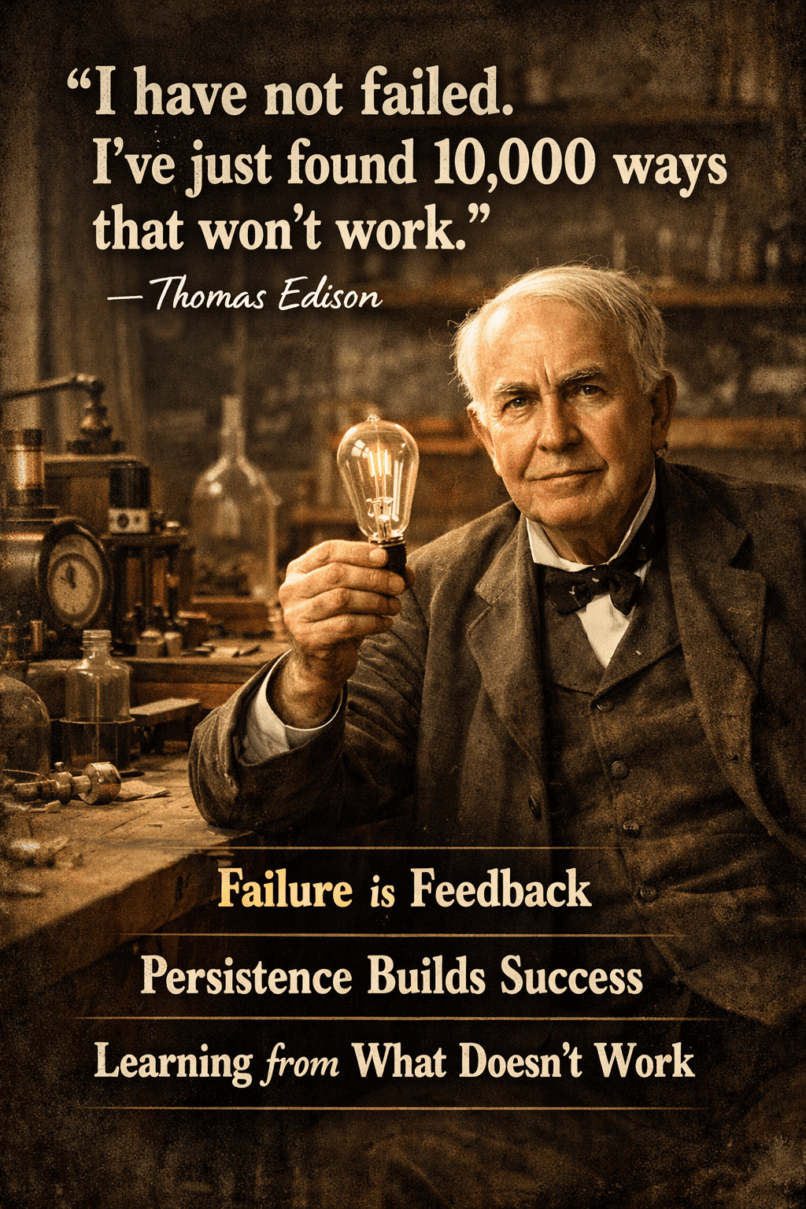
“I have not failed. I’ve just found 10,000 ways that won’t work.”
These words, attributed to Thomas Edison, are more than a clever remark. They are a philosophy—a blueprint for resilience, innovation, and long-term success.
In a world obsessed with quick wins, overnight success, and instant gratification, Edison’s perspective offers something far more valuable: a reframing of failure itself.
This article breaks down the true meaning of this quote, explores why it matters in today’s fast-paced world, and shows how you can apply its lessons to your own life, career, and ambitions.
The Context Behind the Quote
To fully appreciate the depth of Edison’s statement, you need to understand what he was up against.
Edison is often celebrated for inventing the practical electric light bulb. What many people overlook is the brutal trial-and-error process behind it. He tested thousands of materials—filaments that burned too quickly, didn’t glow, or failed entirely.
To most people, that would look like repeated failure.
To Edison, it was progress.
Each unsuccessful attempt wasn’t a dead end. It was data. It was elimination. It was one step closer to discovering what would work.
That mindset is the essence of the quote.
Failure vs. Feedback: A Critical Distinction
At the heart of Edison’s philosophy is a simple but transformative shift:
Failure is not failure—it’s feedback.
Most people interpret failure emotionally:
- “I’m not good enough.”
- “This isn’t working.”
- “I should stop.”
But Edison approached failure analytically:
- “This method doesn’t work.”
- “Now I know what to avoid.”
- “What can I try next?”
This distinction is critical in any domain—business, academics, relationships, or personal growth.
Why This Matters
When you label something as failure, you attach identity to it.
When you label it as feedback, you detach emotion and focus on improvement.
That single shift can determine whether you quit or keep going.
The Psychology of Persistence
Edison’s quote isn’t just about hard work. It’s about how you think while working.
Psychologists often refer to this as a “growth mindset”—the belief that abilities and intelligence can be developed through effort and learning.
Edison embodied this mindset long before it was formally studied.
Key Traits of This Mindset
- Resilience
You don’t stop when things go wrong—you adjust. - Curiosity
Instead of asking “Why me?” you ask “What can I learn?” - Long-Term Thinking
You understand that meaningful success takes time. - Detachment from Ego
You’re willing to be wrong repeatedly without taking it personally.
These traits are what separate high achievers from those who give up too early.
Why Most People Fail Before They Succeed
Ironically, the biggest barrier to success is not failure—it’s the fear of failure.
Most people:
- Quit after a few attempts
- Avoid risks altogether
- Stick to comfort zones
Edison’s quote exposes this flaw.
If it took 10,000 attempts to succeed, then stopping at attempt number 50 isn’t failure—it’s premature quitting.
The Real Problem: Unrealistic Expectations
We live in an era where success stories are often simplified:
- “He built a million-dollar company in a year.”
- “She became famous overnight.”
What you don’t see:
- Years of invisible struggle
- Countless failed ideas
- Rejections and setbacks
Edison’s story reminds us that success is rarely linear.
The Iteration Principle: Success Through Refinement
Edison’s process can be described using a powerful concept: iteration.
Iteration means:
- Try something
- Evaluate the result
- Adjust and try again
Repeat until it works.
This is the same principle used in:
- Software development
- Scientific research
- Product design
- Entrepreneurship
Why Iteration Works
Because perfection doesn’t exist at the start.
Every successful outcome is the result of continuous refinement.
Edison didn’t stumble upon success. He engineered it through iteration.
Applying Edison’s Philosophy in Real Life
Understanding the quote is one thing. Applying it is another.
Here’s how you can integrate this mindset into different areas of your life:
1. In Your Career
Whether you’re job hunting, building a business, or climbing the corporate ladder, rejection is inevitable.
Instead of thinking:
- “I didn’t get the job.”
Reframe it as:
- “What can I improve for the next application?”
Each rejection becomes preparation.
2. In Business and Entrepreneurship
Most successful businesses fail multiple times before succeeding.
Products flop. Marketing campaigns fail. Ideas don’t stick.
Edison’s mindset teaches you to:
- Test quickly
- Learn faster
- Adapt continuously
Every failed attempt sharpens your strategy.
3. In Education
Students often fear getting answers wrong.
But learning happens because of mistakes.
If you never get anything wrong, you’re not challenging yourself enough.
Edison’s quote encourages students to:
- Embrace mistakes
- Analyze errors
- Improve systematically
4. In Personal Growth
Whether you’re trying to:
- Build discipline
- Improve relationships
- Develop new habits
You will fail repeatedly.
That’s not a sign to stop.
It’s a sign you’re in the process.
The Hidden Strength in Repetition
Doing something thousands of times sounds exhausting.
But repetition builds:
- Skill
- Confidence
- Mastery
Edison didn’t just learn what didn’t work—he became better with each attempt.
The Compounding Effect
Each attempt builds on the last.
Over time, small improvements lead to massive breakthroughs.
This is how mastery is formed—not through talent alone, but through persistence.
Why This Quote Still Matters Today
In today’s digital world, attention spans are shorter and patience is thinner.
People want:
- Fast results
- Instant success
- Minimal effort
Edison’s quote is a direct challenge to that mindset.
It reminds us that:
- Real success takes time
- Failure is part of the process
- Persistence is non-negotiable
Common Misinterpretations of the Quote
While the quote is powerful, it’s often misunderstood.
Misinterpretation 1: “Just keep trying endlessly”
Persistence without strategy is ineffective.
Edison didn’t blindly repeat the same mistake—he adjusted each time.
Misinterpretation 2: “Failure doesn’t matter”
Failure does matter—but only if you ignore the lessons.
The value lies in what you learn, not the failure itself.
Misinterpretation 3: “Success is guaranteed if you persist”
Persistence increases your chances—but it must be paired with:
- Learning
- Adaptation
- Critical thinking
The Discipline of Learning from Failure
Edison’s quote isn’t about stubbornness—it’s about intelligent persistence.
To apply it effectively, you must:
- Analyze what went wrong
- Identify patterns
- Adjust your approach
- Try again with improvement
Without this loop, failure becomes repetition instead of progress.
Real-World Examples of Edison’s Philosophy
Edison’s mindset isn’t unique—it’s shared by many successful individuals.
In Technology
Startups often pivot multiple times before finding success.
In Sports
Athletes lose countless matches before becoming champions.
In Art
Writers and creators produce many failed drafts before masterpieces.
The pattern is consistent: success is built on layers of “what didn’t work.”
The Emotional Side of Failure
Let’s be honest—failure doesn’t feel good.
It’s frustrating. It’s discouraging. It can shake your confidence.
Edison’s genius wasn’t just intellectual—it was emotional resilience.
He didn’t let frustration define his journey.
How to Manage Failure Emotionally
- Accept that discomfort is part of growth
- Focus on process over outcome
- Celebrate small improvements
- Detach your identity from results
Turning Failure Into an Advantage
Most people fear failure.
But those who embrace it gain a competitive edge.
Why?
Because they:
- Learn faster
- Adapt quicker
- Build resilience
While others hesitate, they move forward.
Edison’s 10,000 attempts weren’t a disadvantage—they were his advantage.
The Ultimate Lesson: Redefining Success
Edison’s quote forces us to rethink what success really means.
Success is not:
- Immediate
- Easy
- Linear
Success is:
- Iterative
- Messy
- Built on persistence
Each failed attempt is part of the success story.
Without them, success wouldn’t exist.
The Power of Not Giving Up
“I have not failed. I’ve just found 10,000 ways that won’t work.”
This quote is not just about invention—it’s about life.
It teaches us that:
- Failure is not the end
- Persistence is essential
- Learning is the real progress
In a world that glorifies instant success, Edison’s words remind us of a deeper truth:
The path to success is paved with attempts that didn’t work—but moved you forward anyway.
If you adopt this mindset, you don’t just increase your chances of success.
You transform the way you approach challenges entirely.
SUGGESTED READS
- No Revenge: Why Naturally Ugly People Destroy Their Own Lives
- The Cycle of Consequences: How Actions Inevitably Return to Us
- The Power of Boundaries: Protecting Your Well-Being and Letting Go of Toxic Relationships
- Dance before the music is over, live before your life is over
- Nothing Drains Your Energy Faster Than Your Thoughts: Protect Your Peace
- Understanding Human Mistakes: Growth Beyond the Past Choices
- Setting Boundaries: The First Step Towards Protecting Your Energy

Support Our Website!
We appreciate your visit and hope you find our content valuable. If you’d like to support us further, please consider contributing through the TILL NUMBER: 9549825. Your support helps us keep delivering great content!
If you’d like to support Nabado from outside Kenya, we invite you to send your contributions through trusted third-party services such as Remitly, western union, SendWave, or WorldRemit. These platforms are reliable and convenient for international money transfers.
Please use the following details when sending your support:
Phone Number: +254701838999
Recipient Name: Peterson Getuma Okemwa
We sincerely appreciate your generosity and support. Thank you for being part of this journey!