

simply amazing, always for you.
A Child of the Sky
Nairobi in the late 1970s was a city of contrasts. On one hand, the city centre pulsed with ambition — streets filled with young professionals, markets brimming with life, matatus darting in every direction, and a skyline that was only beginning to reach upward. On the other hand, sprawling neighbourhoods of modest homes told the quieter stories of hardworking families who dreamed big but lived within the boundary’s tradition set for them.

In one such home lived a little girl named Irene Koki Mutungi. Her childhood seemed ordinary at first glance — school, chores, family gatherings — but her imagination was anything but ordinary. While other children sketched flowers or houses, she sketched airplanes. When her friends played house, she played pilot, pretending to steer through clouds no one else could see.
The sound of an aircraft engine was her lullaby. Every time a plane thundered across the Nairobi sky, she ran outside, head tilted back, eyes wide. Unlike her playmates, she didn’t just watch the silver bird; she became it. She imagined the levers in her hands, the runway below, the voices in her headset. The skies didn’t just fascinate her — they called her.
Her father, himself a pilot, often noticed the way she gazed at the horizon. Sometimes, he’d smile quietly, sensing that his daughter carried a secret dream too heavy to keep hidden for long. Little did he know, she was already plotting a course that would one day make her the first Kenyan woman to fly a commercial plane.
Chapter One: Seeds of a Dream
Koki’s fascination with aviation wasn’t born in a vacuum. Her father’s profession as a pilot gave her a front-row seat to a world that many children her age never even glimpsed. He would sometimes take her to Wilson Airport, the busy hub for small aircraft in Nairobi. The air there always smelled of fuel and possibility, and the sight of men in crisp uniforms walking confidently across the tarmac etched itself deeply into her memory.
At the time, the idea of a female pilot in Kenya was almost laughable. In the early 1980s, women were expected to choose careers in teaching, nursing, or secretarial work. If a woman wanted to work in aviation at all, she became a flight attendant. The cockpit? That was reserved for men.
But Koki had already learned something from watching planes soar overhead: nothing was impossible if you had the courage to lift off.
One evening, as she sat on the veranda doing homework, she finally voiced her dream aloud.
“Daddy,” she said cautiously, “I want to fly a plane.”

Her father studied her face carefully, expecting perhaps a trace of childish fantasy. But her eyes burned with conviction. He smiled, not with amusement, but with quiet pride.
“Then you will,” he said simply.
It was the affirmation she needed, a seed watered in fertile soil. From that day, her dream stopped being secret. It became a plan.
Chapter Two: Into the Cockpit
By the time she was 17, Koki’s dream was ready to test its wings. While her classmates were preparing for university, she enrolled at Wilson Airport to pursue a private pilot’s license.
Her first day was unforgettable. The airstrip hummed with activity, student pilots rushing between lessons and mechanics tending to aircraft. Koki, in her modest uniform, felt the weight of a hundred eyes on her. She was the only girl in a sea of men.
Some cadets looked at her with curiosity. Others with doubt. A few with thinly veiled disdain.
“Are you here to learn flying, or just to watch?” one of them asked half-jokingly.
Koki smiled politely, hiding the sting of his words. “To fly,” she replied firmly.
The first time she climbed into the cockpit, she felt an almost spiritual connection. The switches, the controls, the view through the windscreen — it was overwhelming, yet familiar, like coming home to a place she’d never been. When the engine roared to life, she felt her heartbeat sync with it.
Her instructor guided her through the basics. As the aircraft lifted off for the very first time, the world below shrank, and the horizon stretched infinitely before her. She gripped the yoke, adrenaline flooding her veins, and thought, This is it. This is where I belong.
By the end of her training, she had earned her private pilot’s license. But for Koki, this was just a beginning. She wanted to fly commercial aircraft — the giants of the sky.
Chapter Three: Across the Ocean
Kenya had no program for commercial pilot training that suited her ambitions, so she made a bold decision: she would travel to the United States. Oklahoma City, with its well-regarded aviation training schools, became her destination.
It wasn’t easy. Being far from home, grappling with culture shock, and studying a discipline as rigorous as aviation pushed her to the edge of her limits. Her classmates, once again mostly male, often doubted her abilities. But Koki thrived under pressure.
She poured over textbooks late into the night, practiced on simulators until her eyes ached, and spent hours flying under the watchful eyes of her instructors. Each time she aced a test or nailed a maneuver, she proved not only to them but to herself that she was exactly where she needed to be.
When she finally earned her Commercial Pilot License, she felt an almost indescribable mix of relief and triumph. She had crossed an ocean, defied expectations, and was now qualified to fly the very machines she had dreamed of since childhood.
She was ready to go home and make history.
Chapter Four: The First Woman at Kenya Airways
In 1995, a 19-year-old Koki walked into the headquarters of Kenya Airways. The airline had never employed a female pilot before. She was about to become the first.
The moment wasn’t easy. Some colleagues welcomed her warmly. Others were skeptical, muttering that a woman in the cockpit was a gamble. There were even passengers who, upon seeing her at the controls, refused to board the plane.
One story she has often recounted is of a passenger who, after realizing a woman was in the cockpit, tried to switch flights. Koki did not take it personally. She simply flew the plane with flawless precision. When the flight landed safely, on time and without incident, the same passenger quietly thanked her.
For years, she was the only woman in the cockpit at Kenya Airways. But slowly, her competence eroded prejudice. Pilots who once doubted her began to respect her. Passengers grew accustomed to hearing her calm voice over the intercom. She wasn’t just “the lady pilot” anymore — she was Captain Mutungi.
Chapter Five: Breaking Africa’s Ceiling
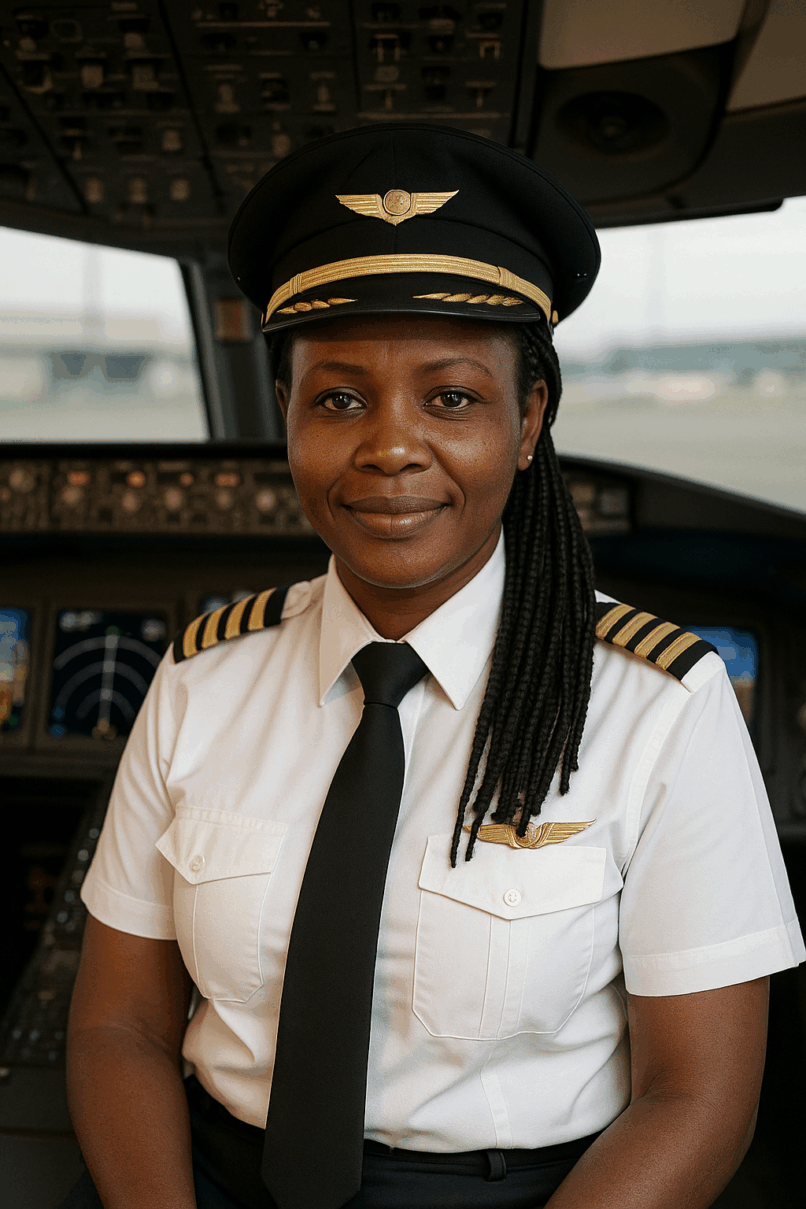
In 2004, she became Africa’s first female airline captain. She took command of a Boeing 737, her uniform crisp, her voice steady, her confidence unshakable.
As she guided the plane into the sky that day, she wasn’t just flying for herself. She was flying for every African girl who had been told to lower her gaze, to shrink her dreams, to stay grounded.
Her promotion made headlines across the continent. Parents pointed her out to their daughters. Teachers told her story in classrooms. She had become more than a pilot — she had become a symbol of what was possible.
But Koki wasn’t done yet.
Chapter Six: The Dreamliner
Ten years later, in April 2014, Koki Mutungi achieved another historic milestone. She became the first African woman certified to captain a Boeing 787 Dreamliner — one of the most advanced commercial aircraft in the world.
The Dreamliner was no ordinary aircraft. It was a marvel of modern engineering, a symbol of cutting-edge aviation. To be entrusted with its command was the pinnacle of a pilot’s career.
The day she first stepped into its cockpit, she felt the weight of her journey. From the curious little girl in Nairobi, to the determined student in Oklahoma, to the lone woman among male pilots at Kenya Airways — every step had led her here.
When the Dreamliner lifted off, she smiled. Not because it was easy, but because she had made the impossible possible.
Chapter Seven: Storms Above the Clouds
Success did not shield her from challenges. Gender bias was a storm that often shadowed her career. Some whispered she was only a symbol, a token. Others suggested she couldn’t handle the pressure.
But Koki responded not with arguments, but with action. Flight after flight, she demonstrated skill, calm under pressure, and leadership that silenced critics.
She also faced personal sacrifices. The life of a pilot was demanding, often pulling her away from family and friends. Yet, through it all, she held onto her love for the sky. That love became her anchor in turbulent times.
Chapter Eight: Inspiring a Generation
Today, Koki Mutungi is more than a pilot. She is a mentor, a role model, and a beacon of hope for young women in Kenya and across Africa.
She regularly speaks at schools and aviation forums, urging girls to dream boldly. She tells them that the cockpit is not a man’s domain — it is open to anyone with courage, discipline, and passion.
Her story has paved the way for others. Pilots like Betty Jerono, Kenya’s first female gyrocopter pilot, and Joyce Beckwith, the country’s first Black female hot-air balloon pilot, now walk paths made easier because Koki dared to be first.
Chapter Nine: Legacy in the Skies
Captain Irene Koki Mutungi’s legacy is not just about breaking records. It’s about rewriting narratives. She transformed the cockpit from a symbol of exclusion to a stage of possibility.
Her name is etched not only in Kenya’s aviation history but in Africa’s collective memory. And though she has achieved so much, perhaps her greatest accomplishment is the countless little girls who now look up at the sky and think, If she did it, so can I.
The Girl Who Refused to Stay Grounded
Looking back, Koki often reflects on her journey with humility. She doesn’t see herself as a hero, but as a woman who answered the call of the sky.
From the dusty fields of Nairobi to the cockpit of a Dreamliner, her story is proof that dreams — no matter how impossible they seem — can take flight.
For Irene Koki Mutungi, the sky was never the limit. It was only the beginning.
SUGGESTED READS
- Maina Njenga: Prophet, Cult Leader or Political Pawn?
- The Mau Mau Rebellion: Kenya’s First War for Freedom
- The Rise, Evolution, and Impact of the Sungusungu Vigilantes in Kisii, Kenya
- Mungiki: The Rise, Fall, and Shadows of Kenya’s Most Feared Underground Movement
- The Coffin Thief of Nairobi: The True Story of John Kibera
- The Last Blessing: The Man Who Made It Rain From Heaven

Support Our Website!
We appreciate your visit and hope you find our content valuable. If you’d like to support us further, please consider contributing through the TILL NUMBER: 9549825. Your support helps us keep delivering great content!
If you’d like to support Nabado from outside Kenya, we invite you to send your contributions through trusted third-party services such as Remitly, western union, SendWave, or WorldRemit. These platforms are reliable and convenient for international money transfers.
Please use the following details when sending your support:
Phone Number: +254701838999
Recipient Name: Peterson Getuma Okemwa
We sincerely appreciate your generosity and support. Thank you for being part of this journey!
Whats Happening i’m new to this, I stumbled upon this I have discovered It positively helpful and it has helped me out loads. I am hoping to give a contribution & aid different customers like its helped me. Good job.