

simply amazing, always for you.
Born of Shadows
In the dusty backstreets of Nairobi’s informal settlements, long before he became a household name, John Kibera was just another forgotten child. His life began in turmoil. His parents’ bitter separation left emotional wreckage that would never truly heal. When his mother remarried and relocated to Nakuru, young John followed her into what he thought would be a fresh start. Instead, he met cruelty.
His stepfather—a man as hard as the stones that lined the Rift Valley—resented John’s presence. He beat him, denied him basic necessities, and refused him an education. At eleven, the boy was scavenging for scraps and stealing small amounts just to survive. One day, hungry and desperate, he stole KSh 150 from a relative. It was his first arrest.
But the system didn’t treat him as a child. They threw him into Shikusa GK Prison in Kakamega, a detention center for juvenile offenders. It was a place meant for reform, but it operated more like a grooming school for criminals.
There, Kibera learned to fight. He learned how to steal without getting caught. He learned silence, suspicion, and brutality. And he learned that no one was coming to save him.
Chapter Two: Lessons from the Caged Wolves
Shikusa GK was home to many like him—young boys who had been discarded by society and molded by pain. But some inmates were not children. They were older, more dangerous, and far more intelligent. They taught him how to organize, how to hide weapons, how to outwit police.
“You go in a chicken thief and come out a wolf,” Kibera later said.
By the time he left Shikusa after six years, Kibera was not a reformed boy. He was a young man armed with knowledge of Nairobi’s criminal underworld and contacts that would change his life—for worse and later, for better.
It was the mid-1990s, and Nairobi’s crime rate was soaring. Kibera found himself absorbed into gangs run by notorious robbers like Wanugu, Wacucu, and Rasta—names whispered in fear across Kenya. They were masters of highway heists, bank raids, and violent burglaries.
Kibera was now an apprentice in one of East Africa’s most feared criminal networks.
Chapter Three: Gunfire and Blood on the Tarmac
Kibera’s days were now filled with risk, blood, and fast money. He rode in stolen cars, wielded illegal firearms, and planned getaways that looked like scenes from Hollywood films. The cash flowed, but it came soaked in danger.
He was shot twice during police chases. Once, after a robbery in Westlands went wrong, his accomplice was gunned down. Kibera barely escaped with his life. The close calls began to take a toll.
In time, most of the mentors he idolized were dead. Wanugu was killed in a dramatic police shootout. Wacucu and Rasta followed soon after. Kibera was watching his future play out in front of him—and it always ended in a hail of bullets.
He realized something most criminals ignore until it’s too late: everyone gets caught. Or dies.
Chapter Four: The Coffin King Is Born
But Kibera was not ready to retire. He was resourceful. And cunning.
In 1999, following another botched operation and fearing for his life, he disappeared from the radar and re-emerged with a new idea—macabre, but profitable.
He began to rob graves.
Kibera called cemeteries “police-free zones.” Who would think to patrol a graveyard at night? No alarms. No guards. No living witnesses.
He recruited eight trusted men—former convicts, street-smart and ruthless. Their operation was calculated to the last detail. They scoured Kenya’s obituary sections daily. They looked for signs of wealth: wording like “beloved patriarch,” “celebrated businessman,” or “laid to rest in an imported mahogany casket.”
They attended wakes, infiltrated burial committee meetings, and even contributed a 10% “seed offering” to gain access to coffin types and costs.
At night, they struck.
Chapter Five: A Night in the Graveyard
The sound of soil being lifted echoed in the dark. The moon provided the only light as Kibera’s gang dug in silence, barely whispering. They worked fast—trained hands unearthing the dead with military precision.
Once they reached the coffin, they pried it open. They never touched the body. In most cases, they moved it respectfully aside. They didn’t want the corpse; they wanted the wood.
Imported coffins fetched the highest price—up to KSh 70,000 each. Over five years, the gang exhumed over 1,000 graves. Some were freshly buried. Others had been underground for weeks.
Their buyers? Local undertakers, shady funeral home operators, and even a well-connected Asian coffin shop owner in Nairobi.
Kibera was making millions.
By his own estimation, he had earned more than KSh 7–8 million through grave robbery alone. He bought a home in Kitengela. He wore fine clothes and walked with the swagger of a man untouchable.
But death was catching up.
Chapter Six: Blood on the Soil
The gang’s luck couldn’t last forever. In Murang’a, four of Kibera’s men were lynched by villagers who discovered them desecrating a grave. Another was gunned down by police during a night operation. One escaped, only to die days later in a car crash.
By 2003, Kibera was the only one left.
He was haunted. The faces of the dead, the betrayal of the grieving families, the blood of his friends—they followed him like shadows.
One night, while digging a grave alone, he heard movement. He panicked and crawled into a coffin to hide. Hours passed. The fear, the darkness, the smell of death—it broke something inside him.
He emerged from the grave a changed man.
Chapter Seven: Redemption at the Kencom Stage
John Kibera walked into Kamukunji Police Station and surrendered. He turned in his pistol, confessed to past crimes, and asked to serve time.
The court gave him six months—light punishment, many thought, for a man who had stolen from the dead.
But Kibera didn’t waste the time. In prison, he read. He prayed. He broke down weeping one night and cried out for forgiveness.
After his release in 2003, he gave his life to Christ.
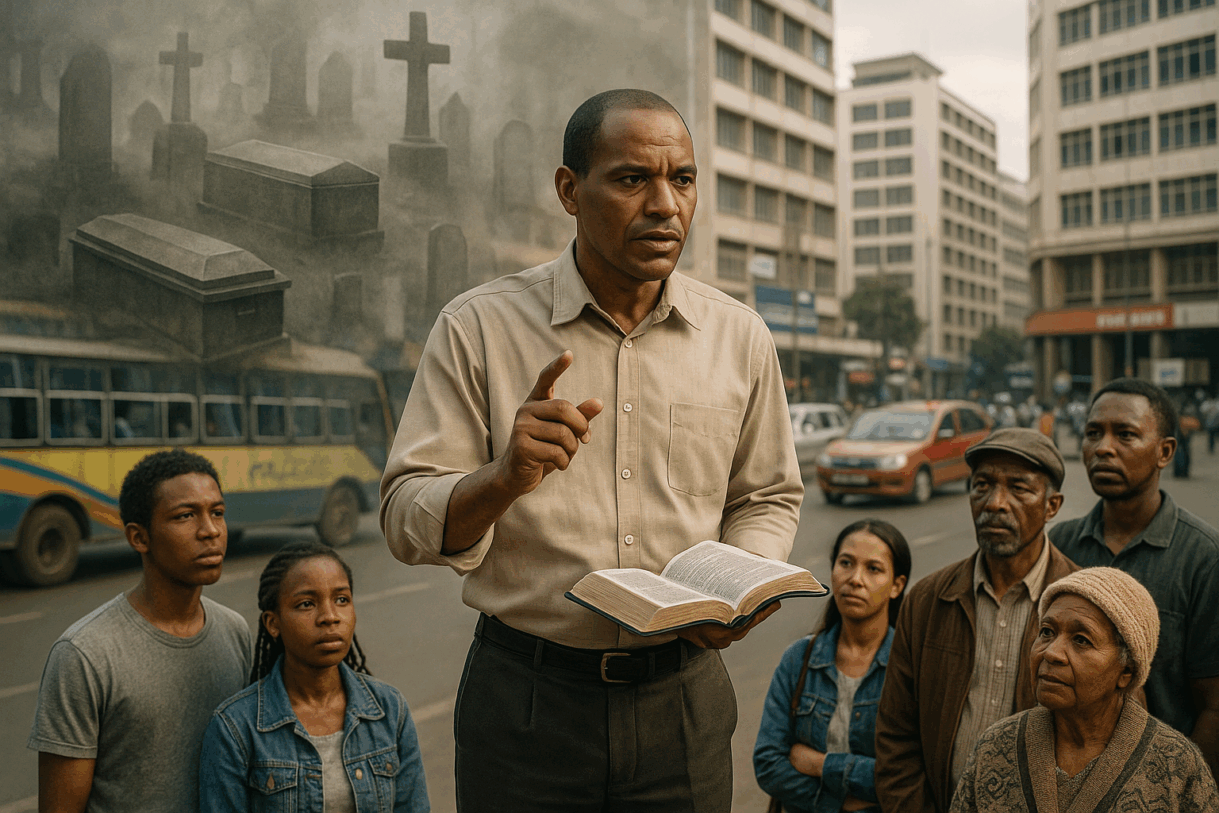
By 2013, he was a full-time street preacher at the Kencom stage in Nairobi CBD. The man once feared by funeral homes was now a motivational speaker, urging others to leave behind crime and violence.
He donated his Kitengela home—built on coffin money—to charity. “I cannot live in a house that was paid for by death,” he said.
Chapter Eight: The Faces at the Funeral
Today, John Kibera speaks to schools, churches, prisons, and government reform programs. He has even worked with UN-Habitat, spreading messages of peace and social justice.
Still, not everyone is ready to forgive.
At funerals, some people look at him with suspicion. Others whisper behind his back. “Isn’t that the man who once stole coffins?” they ask.
Kibera doesn’t deny it.
Instead, he uses his story as a tool.
“I stole from the dead,” he says, “but I’m trying to give back to the living.”
Lessons from the Grave
John Kibera’s story is one of unimaginable darkness and rare redemption. He went deeper into crime than most ever dare—violating one of humanity’s oldest taboos: disturbing the dead.
Yet from this abyss, he climbed out. Not through fame. Not through riches. But through confession, remorse, and faith.
He is living proof that even the worst can change. That no soul is too far gone to be reclaimed.
And in a world where young boys are still beaten, neglected, and criminalized instead of helped—his story is more urgent than ever.
SUGGESTED READS
- The Dark Legacy of Okija Shrine: Nigeria’s Most Notorious Traditional
- How Foday Sankoh Led Sierra Leone into Chaos: The Ruthless Rise of a Rebel
- The Blood Oath: Rise of the Bakassi Boys
- Why Many Nigerians Still Visit Native Doctors: A Deep Dive into Beliefs, Culture, and Modern Realities
- Behind the Bars: The Most Dangerous Prisons in the World

Support Our Website!
We appreciate your visit and hope you find our content valuable. If you’d like to support us further, please consider contributing through the TILL NUMBER: 9549825. Your support helps us keep delivering great content!
If you’d like to support Nabado from outside Kenya, we invite you to send your contributions through trusted third-party services such as Remitly, SendWave, or WorldRemit. These platforms are reliable and convenient for international money transfers.
Please use the following details when sending your support:
Phone Number: +254701838999
Recipient Name: Peterson Getuma Okemwa
We sincerely appreciate your generosity and support. Thank you for being part of this journey!