

simply amazing, always for you.
A Fragmented Yet Hyperconnected Attention Economy
In today’s hyperconnected digital world, what captures public attention can change by the hour. A single controversial comment, a red-carpet appearance, a court ruling in a small state, or a viral product campaign can dominate global feeds in minutes. But while specific topics change rapidly, the underlying currents behind what trends stay remarkably consistent.

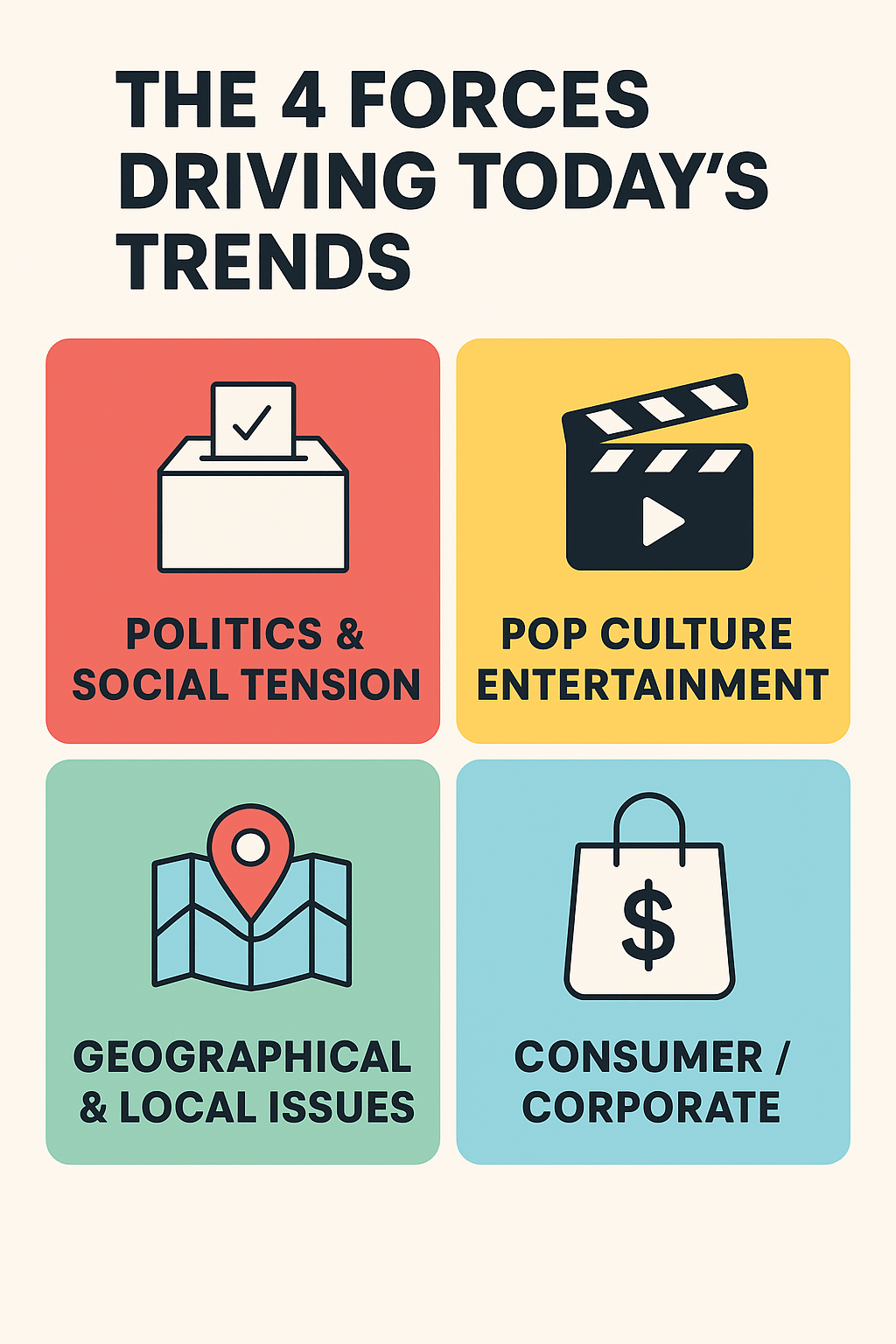
Recent trending topics — from the political shockwaves of the assassination of Charlie Kirk, to the buzz around the VMAs, and renewed interest in companies like Office Depot — all point to four enduring categories that continue to drive public discourse:
- Politics & Social Tension
- Pop Culture & Entertainment
- Geographical & Local Flashpoints
- Consumer / Corporate Shifts
These categories not only dominate trend charts, but also reveal how society is feeling, thinking, and reacting. Below, we break them down to understand what’s rising — and why it matters.
1. Politics and Social Tension: Polarization Becoming the Norm
The Charlie Kirk Shockwave
The killing of Charlie Kirk during an event at Utah Valley University has jolted the political landscape. Charlie Kirk, a conservative activist and commentator, was a lightning rod figure who drew intense admiration and equally intense opposition. His sudden death during a public event turned what would normally be an ideological debate into a visceral, physical tragedy.
This single event ignited nationwide conversations about:
- The escalation of political violence in the United States
- The rhetoric of polarization and how public figures’ words might incite or inflame tensions
- Concerns about freedom of speech versus public safety on campuses
The aftermath saw political leaders from both left and right condemning the violence — while simultaneously blaming the other side’s rhetoric for fostering an environment where such acts seem possible. This duality is telling: polarization is now so entrenched that even shared grief becomes partisan fodder.
The Broader Trend: Normalization of Extremism
This isn’t an isolated phenomenon. Over recent years, the U.S. has seen:
- More threats against politicians (including local officials and judges)
- Campus unrest, with protests escalating into clashes
- Online communities normalizing extreme rhetoric as “just debate”
Terms like Antifa or “radical right” trend whenever street protests, violent incidents, or viral speeches hit the headlines. And each time, they spark a wave of algorithm-driven tribalism: users cluster along partisan lines, amplifying content that reinforces their worldview while attacking opposing narratives.
Why It Matters
The rise of political tension as a dominant trend category means any major news event — no matter how local — can be weaponized in the larger “culture war.” It shows a public sphere less focused on compromise or policy, and more focused on conflict and spectacle.

In the trend economy, outrage travels faster than nuance — and that’s shaping both media coverage and public perception.
2. Pop Culture and Entertainment: The Eternal Attention Magnets
While political headlines may dominate hard news cycles, pop culture drives emotional engagement and mass participation. The recent surge in trends around the VMAs, Vikings: Valhalla, and celebrity couples illustrate how powerful the entertainment ecosystem remains.
VMAs: Red Carpet as Cultural Battleground
The MTV Video Music Awards have once again captured social media’s full attention. What’s trending is not just who won, but:
- Red carpet fashion statements that spark aesthetic debates
- Relationship reveals — couples going “public” and dominating fan discussions
- Viral performance moments that get clipped, memed, and endlessly remixed
Award shows like the VMAs are now less about industry recognition and more about producing viral cultural moments. Every outfit, pose, and snippet is designed to live beyond the broadcast, flooding feeds for days.
The Rise of Maximalist Status Symbols
Celebrities flashing supersized engagement rings and extravagant lifestyles are trending across platforms. According to recent fashion reports, larger-than-life diamonds are making a comeback — reflecting a shift away from minimalism and toward aspirational excess.
This signals that in an uncertain economy, escapism and luxury fantasies are more appealing than ever. People want spectacle — and pop culture obliges.
Music and Shows as Shared Emotional Experiences
Meanwhile, shows like Vikings: Valhalla or viral tracks topping the Billboard charts keep proving the timeless draw of shared entertainment. Social feeds erupt with reactions, theories, edits, and memes. These cultural touchstones create a sense of community, even among strangers — offering relief from the combative tone of political spaces.
Why It Matters
Pop culture is the emotional glue in an increasingly divided society. Even when opinions differ, the tone of engagement is lighter, playful, and communal. This category dominates because it provides a shared language and a temporary escape from heavier news — which explains its constant presence in trending charts.
3. Geographical and Local Flashpoints: The New National Catalysts
In a global media environment, “local” stories can become national within hours. Recent trends like New Mexico, UCLA, and the Utah Valley University incident show how geography shapes trend dynamics.
How Local Events Go Global
Consider how the Charlie Kirk assassination — a local tragedy on a campus in Utah — rapidly became a global headline. Initially, it was a regional story covered by campus media and local press. But within hours:
- National outlets amplified it
- Politicians weighed in on social platforms
- Opinion leaders reframed it to fit broader culture-war narratives
The same pattern has played out in other cases — from wildfires in New Mexico to protests at UCLA. In each instance, what starts local gets refracted through ideological lenses, sparking national or even international debates.
Local Institutions as Cultural Symbols
Institutions like UCLA also trend for sports victories, celebrity alumni, or viral campus activism. Universities are increasingly seen as microcosms of larger societal battles — about free speech, diversity, political activism, and youth culture.
Why It Matters
This trend shows that the boundaries between “local” and “national” have collapsed. Social platforms reward novelty, conflict, and emotion — and local news often provides all three. The result is a feedback loop: local flashpoints spark national outrage, which fuels more attention to local conflicts.
4. Consumer and Corporate Shifts: Where Tech, Aesthetics, and Identity Collide
Amid the chaos of politics and the escapism of pop culture, consumer and corporate trends quietly shape daily life. This category includes everything from tech innovations to brand controversies and lifestyle shifts — and it’s rising fast.
The AI Consumer Boom
Search interest is surging in tools like AI video generators, AI agents, and user-generated content platforms. These aren’t just niche tech terms anymore — they’re becoming mainstream as creators, marketers, and everyday users integrate them into work and play.
The rise of AI content tools signals a shift toward democratized production, where everyone can be a brand, and content creation becomes hyper-scaled.
Lifestyle and Wellness Obsessions
At the same time, lifestyle trends — from non-toxic air fryers to K-Beauty skincare to wellness aesthetics — are dominating searches. This shows a blend of practical consumerism and self-image building. Shoppers increasingly want products that are:
- Safe and ethically made
- Instagrammable and aesthetically appealing
- Endorsed by influencers or viral communities
Brands Chasing Culture in Real Time
Even traditional companies like Office Depot trend when they launch new campaigns or face controversies. In the modern media cycle, a single marketing stunt or corporate misstep can explode into public discourse.
Brands are under pressure to act like cultural participants, not just product sellers. They must respond quickly to trends, join conversations, and build personalities — or risk irrelevance.
Why It Matters
Consumer/corporate topics might seem trivial, but they shape behavior more directly than politics or pop culture. They influence how people shop, present themselves, and interact with technology. This category shows how capitalism and culture are becoming inseparable: products are now identity markers, and trends often reflect that.
Navigating a Fragmented Trend Landscape
The current trending landscape reveals a world defined by contrast and convergence:
- Politics and social tension feed on division, fear, and spectacle.
- Pop culture and entertainment offer escape, fantasy, and shared community.
- Geographical flashpoints show how local stories spark national battles.
- Consumer and corporate trends shape everyday behavior, aesthetics, and identity.
These four forces often collide in unpredictable ways — a campus protest becomes a culture war symbol; a pop star’s outfit becomes a brand marketing strategy; a political tragedy reshapes online discourse. In this volatile environment, attention is the ultimate currency, and every trend competes for it.
Understanding these categories isn’t just about watching what’s popular. It’s about seeing how society processes change, conflict, and desire. Politics tells us what we fear. Entertainment shows what we crave. Local flashpoints reveal what angers or shocks us. And consumer trends show what we choose to surround ourselves with.
In a world where trends shape reality, these four forces are the map — and the mirror.
SUGGESTED READS
- RutonomicsAt3 — The True State of William Ruto’s Economic Legacy After 3 Years
- The Untold Story of Africa’s First Scholars: The Legacy of Timbuktu and the Rise of Literacy on the Continent
- Understanding the 2022 Kenyan Elections: Have We Learned from the Past?
- Kibaki vs. Raila: A Timeline of Political Rivalry and National Impact
- The Role of the International Criminal Court in African Conflicts

Support Our Website!
We appreciate your visit and hope you find our content valuable. If you’d like to support us further, please consider contributing through the TILL NUMBER: 9549825. Your support helps us keep delivering great content!
If you’d like to support Nabado from outside Kenya, we invite you to send your contributions through trusted third-party services such as Remitly, western union, SendWave, or WorldRemit. These platforms are reliable and convenient for international money transfers.
Please use the following details when sending your support:
Phone Number: +254701838999
Recipient Name: Peterson Getuma Okemwa
We sincerely appreciate your generosity and support. Thank you for being part of this journey!
Your point of view caught my eye and was very interesting. Thanks. I have a question for you.
kindly ask