

simply amazing, always for you.
A Revolution Without a Headquarters
Revolutions used to have headquarters. They had leaders, manifestos, meeting halls, and clearly defined enemies. They moved slowly, deliberately, and often violently. Kenya’s past political struggles followed this pattern—from the fight for independence to the push for multiparty democracy in the 1990s.
Today, a different kind of revolution is taking shape.
It has no headquarters.
No official leaders.
No single ideology.
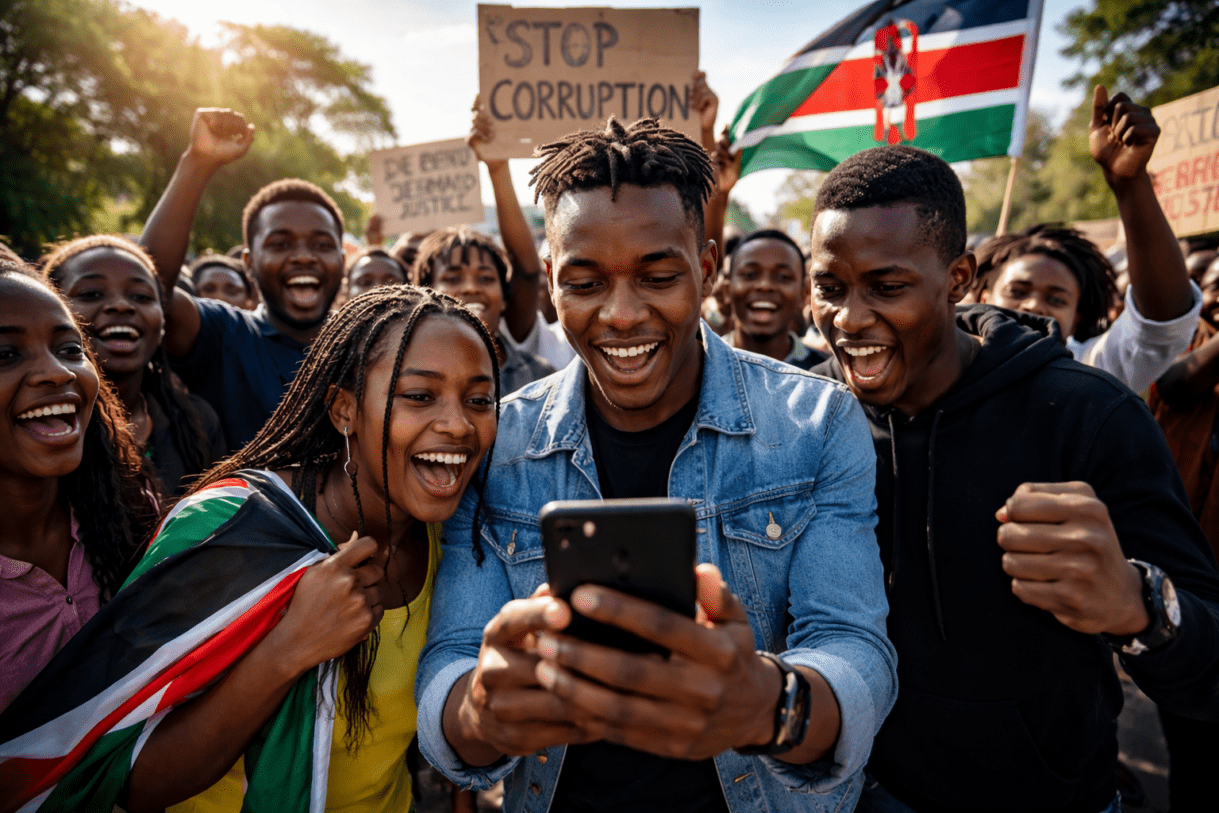
Instead, it lives on phones, timelines, livestreams, comment sections, and encrypted group chats. It erupts suddenly, spreads unpredictably, and refuses to be easily controlled. This is the social media–driven revolution reshaping Kenya’s political culture, public discourse, and relationship with power.
This revolution is not always visible on the streets, but it is deeply felt in homes, offices, campuses, and matatus. It is altering how Kenyans understand authority, accountability, citizenship, and resistance.
Social media has not just changed communication in Kenya. It has fundamentally changed power.
Kenya Before Social Media: Power, Silence, and Gatekeepers
To understand the magnitude of this shift, it is important to remember what political communication in Kenya looked like before social media.
For decades, information flowed vertically:
- From government to citizens
- From political elites to voters
- From editors to audiences
Mainstream media—newspapers, radio, and television—served as gatekeepers. What was reported, how it was framed, and when it aired often depended on ownership interests, political pressure, or regulatory fear.
Public dissent existed, but it was constrained:
- Organizing required physical meetings
- Messaging was slow and fragmented
- State response often arrived before public momentum could build
Silence was a powerful political tool. Many injustices went undocumented. Many stories never reached a national audience.
Social media shattered that structure.
The Smartphone as a Political Weapon
The most important political tool in modern Kenya is not a party card or a protest placard. It is a smartphone.
With a smartphone, an ordinary citizen can:
- Record abuse of power in real time
- Broadcast events live without editorial filters
- Challenge official narratives instantly
- Mobilize thousands of people within hours
This technological shift has collapsed the distance between the governed and the governors.
A police encounter in a rural town can become a national debate by evening. A budget proposal can be dissected line by line by citizens with no formal political office. A politician’s statement can be fact-checked, mocked, or rejected within minutes.
Power now has witnesses.
Social Media as Kenya’s New Public Square
Historically, public debate in Kenya happened in:
- Barazas
- University halls
- Newsrooms
- Parliament
Today, the most influential debates happen online.
Platforms such as X, Facebook, TikTok, Instagram, YouTube, and WhatsApp have become Kenya’s new public square. Unlike traditional spaces, these platforms are:
- Always open
- Highly participatory
- Unrestricted by geography
- Emotionally charged
Anyone can speak. Everyone can respond. And no one fully controls the conversation.
This has democratized participation, but it has also made politics louder, faster, and more volatile.
The Rise of Digital-First Activism
Modern Kenyan activism often begins online before it reaches the streets—if it reaches them at all.
Digital-first activism includes:
- Hashtag campaigns
- Viral videos exposing injustice
- Online petitions and fundraisers
- Coordinated posting to pressure institutions
These actions can produce real-world consequences:
- Officials issuing public statements
- Institutions launching investigations
- Corporations reversing decisions
- International attention amplifying local issues
Importantly, many of these movements operate without formal organizations. They rely on momentum rather than membership, visibility rather than hierarchy.
This makes them powerful—but also unstable.
Leaderless Movements and the Crisis of Representation
One defining feature of Kenya’s new digital revolution is the rejection of traditional leadership.
Many young Kenyans no longer believe:
- Politicians represent their interests
- Civil society speaks for them
- Opposition leaders are fundamentally different from those in power
As a result, movements increasingly resist appointing spokespersons or leaders.
This has advantages:
- No single individual can be targeted or co-opted
- The movement feels inclusive and organic
- Participation is fluid and accessible
But it also creates problems:
- No clear negotiating authority
- Internal disagreements become public
- Movements can lose direction quickly
This tension reflects a deeper crisis of representation in Kenya. Social media has exposed the gap between leaders and lived reality.
Youth, Digital Identity, and Political Awakening
Kenya is a young country. A large proportion of the population is under 35, and this demographic dominates social media spaces.
For many young Kenyans, political identity is formed online rather than through:
- Political parties
- Ethnic blocs
- Family loyalties
Social media allows young people to:
- Share personal economic struggles
- Compare Kenya with global peers
- Learn political language outside classrooms
- Build solidarity across ethnic and regional lines
This does not mean ethnicity has disappeared from Kenyan politics. But digital spaces weaken its dominance by foregrounding shared economic pain and generational frustration.
Unemployment, taxation, corruption, and cost of living resonate more strongly than ethnic rhetoric in online discourse.
Breaking the State’s Monopoly on Truth
Perhaps the most revolutionary impact of social media in Kenya is the collapse of the state’s monopoly on truth.
In the past, official statements often went unchallenged due to:
- Limited access to information
- Fear of reprisal
- Media caution
Today, official narratives are immediately tested against:
- Citizen videos
- Eyewitness accounts
- Leaked documents
- Data shared by independent analysts
Contradictions are exposed quickly. Attempts at denial often backfire, creating further outrage.
This does not mean social media always produces truth. Falsehoods spread easily. But it does mean authority is no longer unquestioned.
Truth has become contested—and that contestation itself is a form of power.
Hashtags as Instruments of Collective Power
Hashtags may appear trivial, but in Kenya they have become tools of political organization.
A successful hashtag:
- Creates a shared identity
- Aggregates individual voices
- Makes an issue searchable
- Attracts media and international attention
Sustained hashtag campaigns have:
- Forced resignations
- Pressured police accountability
- Exposed corruption
- Amplified marginalized voices
Hashtags transform scattered anger into focused pressure.
However, they also risk becoming performative—strong on visibility, weak on follow-through. The challenge lies in converting online consensus into offline change.
The State Responds: Regulation, Surveillance, and Intimidation
The Kenyan state has not remained passive.
Government responses to digital dissent include:
- Calls for regulation of online speech
- Arrests of vocal digital activists
- Surveillance of online spaces
- Strategic use of pro-government influencers
Authorities often justify these actions using language of:
- National security
- Public order
- Misinformation control
This creates a dangerous gray area where legitimate dissent risks being criminalized.
The struggle between digital freedom and state control is now one of the central political conflicts in Kenya.
Social Media, Misinformation, and the Battle for Credibility
The same tools that empower citizens can also mislead them.
Kenya’s digital space is vulnerable to:
- Disinformation campaigns
- Politically sponsored propaganda
- Edited or misleading videos
- Emotion-driven false narratives
This has consequences:
- Public trust erodes
- Genuine causes are discredited
- Polarization deepens
As a result, credibility has become a political currency. Activists, journalists, and citizens increasingly compete not just for attention, but for trust.
Fact-checking, digital literacy, and ethical online behavior are now essential to sustaining the revolution’s legitimacy.
Memes, Humor, and Political Expression
One unique aspect of Kenya’s online political culture is its creativity.
Memes, satire, parody, and humor play a central role in political critique. They:
- Lower barriers to participation
- Make complex issues relatable
- Protect speakers through ambiguity
Humor has always been part of Kenyan resistance, but social media amplifies it dramatically.
However, there is a risk:
- Serious issues may be trivialized
- Outrage may be replaced by entertainment
- Attention may shift from solutions to spectacle
Still, humor remains one of the most effective ways Kenyans process political frustration.
Economic Pain as the Fuel of Digital Revolt
At the heart of Kenya’s digital revolution lies economics.
Rising costs of living, unemployment, taxation, and shrinking opportunities have created widespread frustration. Social media gives that frustration language, visibility, and community.
Economic pain becomes political consciousness when:
- Individuals realize their struggles are shared
- Private hardship becomes public discussion
- Blame shifts from personal failure to systemic issues
Social media accelerates this transformation.
The revolution is not driven by ideology alone. It is driven by lived experience.
From Awareness to Action: The Missing Link
Despite its power, social media has limitations.
Awareness does not automatically produce reform. Viral moments fade. Attention moves on. Institutions remain slow and resistant.
The critical question for Kenya’s digital revolution is:
How does online energy translate into lasting institutional change?
This requires:
- Organization beyond platforms
- Clear policy demands
- Strategic engagement with legal and political systems
- Patience and discipline
Without this transition, the revolution risks becoming cyclical outrage rather than structural change.
A New Political Consciousness Is Emerging
Despite its contradictions, something irreversible is happening.
More Kenyans now:
- Question authority instinctively
- Demand transparency
- Understand constitutional rights
- Engage politically outside elections
This is a profound shift.
Even when movements fail or fade, the awareness they create does not disappear. It accumulates. It reshapes expectations.
The state may suppress individual voices, but it cannot fully reverse this collective awakening.
What the Future Holds
Social media will not save Kenya on its own. But it has permanently altered the political terrain.
The future of Kenya’s revolution will depend on:
- Whether digital movements mature into sustainable civic engagement
- How the state balances control and democratic space
- Whether citizens resist manipulation while demanding accountability
- How economic justice is addressed alongside political reform
The revolution may not arrive in a single dramatic moment. It may unfold slowly, unevenly, and imperfectly.
But it is already underway.
And for the first time in Kenya’s history, power must negotiate not just with elites—but with millions of connected, vocal, and increasingly conscious citizens.
SUGGESTED READS
- The Untold Story of Youth Movements in Modern Kenya: How a Generation Is Quietly Rewriting Power
- Inside Kenya’s Protest Culture: Why Anger Keeps Exploding—and Why Hope Refuses to Die
- Voters Are Exhausted — Inside Kenya’s Rising Political Fatigue
- Kenya’s Democracy Is Being Tested — And Many Fear It’s Quietly Slipping Away
- What the 2027 Elections Mean for Kenya’s Economy and Jobs

Support Our Website!
We appreciate your visit and hope you find our content valuable. If you’d like to support us further, please consider contributing through the TILL NUMBER: 9549825. Your support helps us keep delivering great content!
If you’d like to support Nabado from outside Kenya, we invite you to send your contributions through trusted third-party services such as Remitly, western union, SendWave, or WorldRemit. These platforms are reliable and convenient for international money transfers.
Please use the following details when sending your support:
Phone Number: +254701838999
Recipient Name: Peterson Getuma Okemwa
We sincerely appreciate your generosity and support. Thank you for being part of this journey!
A really good blog and me back again.