

simply amazing, always for you.
Trust used to feel simpler.
You met someone through friends, family, church, school, or work. Your social circles overlapped. There was visibility, shared context, and a slower pace of connection. Today, relationships often begin with a swipe, continue in private chats, and unfold in a world where everyone has options, access, and exposure.
Yet despite being more connected than ever, many couples quietly admit the same thing: trust feels fragile. Suspicion rises faster. Jealousy appears more quickly. Doubt creeps in even when there is no clear evidence of betrayal.
So why is trust becoming harder in modern relationships?
The answer is not that people are “worse” than before. It is that the environment around love has fundamentally changed. Technology, economic stress, cultural shifts, attachment trauma, and hyper-individualism have altered how we form bonds. The psychological machinery of trust remains the same, but the conditions under which it operates have grown more complex.
This in-depth guide explores the real reasons trust is harder today, how modern culture affects intimacy, and what couples can realistically do to rebuild security in an uncertain world.
What Trust Actually Means in a Relationship
Before examining why trust is eroding, we need clarity on what trust truly is.
In relationship science, trust is not blind faith. It is the confident expectation that your partner will act in ways that protect your emotional and relational well-being.
Relationship researcher John Gottman describes trust as built in “sliding door moments” — everyday choices where one partner either turns toward or away from the other.
Trust includes:
- Reliability – Doing what you say you will do.
- Consistency – Behaving predictably over time.
- Emotional safety – Allowing vulnerability without punishment.
- Integrity – Aligning words and actions.
- Loyalty – Protecting the relationship even when tempted not to.
Trust is cumulative. It grows slowly through repeated positive interactions. But it can weaken quickly when uncertainty increases.
Modern life is full of uncertainty.
The Digital Age: Visibility Without Context
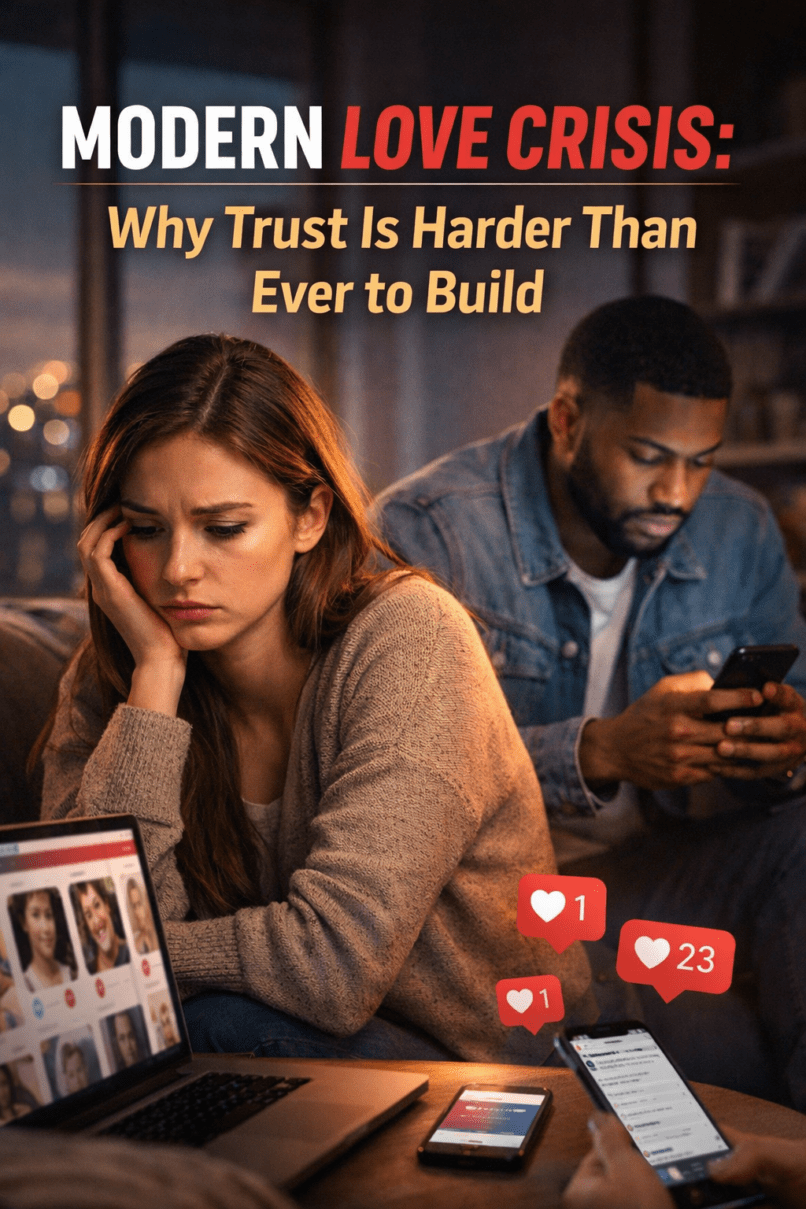
One of the biggest shifts affecting trust is the rise of social media and digital communication.
Platforms like Instagram, TikTok, and WhatsApp have changed how couples interact, monitor, and interpret each other’s behavior.
The Problem of Constant Visibility
In previous decades, you rarely saw your partner’s casual social interactions. Now:
- You see who likes their photos.
- You see who comments.
- You see when they are “online.”
- You see who they follow.
But visibility does not equal context.
A simple comment can trigger overthinking:
Why did she use a heart emoji?
Why did he reply so fast?
Why did they follow each other back?
Trust struggles in environments where small digital signals are open to interpretation.
The Rise of Micro-Cheating
Micro-cheating refers to subtle behaviors that may not qualify as full infidelity but feel emotionally disloyal. Examples include:
- Flirtatious DMs.
- Secret conversations.
- Maintaining contact with ex-partners.
- Hiding interactions.
Digital platforms make these behaviors easier to conceal — and easier to discover.
The result? Increased suspicion.
Trust becomes harder when partners feel they must monitor each other’s online presence to feel secure.
Dating Apps and the Paradox of Infinite Choice
Modern relationships often begin on dating platforms like Tinder, Bumble, or Hinge.
While these platforms expand opportunity, they also create psychological complications.
Psychologist Barry Schwartz popularized the idea of the “paradox of choice”: when options increase, satisfaction can decrease.
How Too Many Options Affect Trust
When someone knows there are thousands of potential matches available, commitment may feel less final. Even after entering a relationship, the awareness of alternatives lingers.
This subtle mindset shift can manifest as:
- Fear of settling.
- Curiosity about “what else is out there.”
- Difficulty fully investing emotionally.
- Anxiety about being replaced.
Trust thrives when partners feel chosen — not temporarily selected.
In a swipe culture, exclusivity must be consciously defined rather than assumed.
Economic Pressure and Financial Stress
Trust is not built in a vacuum. Financial stress directly affects emotional stability.
Rising living costs, job insecurity, student loans, and economic uncertainty strain modern couples. When survival anxiety increases, emotional availability often decreases.
Under financial pressure, partners may:
- Hide spending.
- Conceal debt.
- Avoid discussing money.
- Withdraw emotionally due to stress.
Financial secrecy erodes trust quickly.
Modern relationships also face shifting financial roles. Dual-income households are common. Women are increasingly financially independent. Men may experience pressure tied to traditional expectations.
When financial identity shifts without open communication, insecurity can develop.
Trust suffers when money conversations are avoided.
Changing Gender Roles and Relationship Expectations
Historically, relationship roles were more clearly defined. Today, gender roles are evolving rapidly.
Women pursue careers, leadership positions, and financial independence. Men are increasingly expected to be emotionally expressive and domestically involved.
These shifts are healthy, but transitions can create confusion.
Questions arise:
Who leads?
Who sacrifices?
Who earns more?
Who initiates affection?
What does masculinity or femininity look like now?
When expectations are unclear, insecurity grows.
Trust requires role clarity — not rigid tradition, but shared understanding.
Without explicit conversations, partners may operate from unspoken assumptions that clash.
Attachment Styles and Unresolved Trauma
Attachment theory, pioneered by John Bowlby and expanded by Mary Ainsworth, explains how early childhood experiences shape adult relationships.
The four primary attachment styles are:
- Secure
- Anxious
- Avoidant
- Disorganized
How Attachment Affects Trust
- Anxious attachment: Hyper-alert to signs of rejection.
- Avoidant attachment: Fearful of emotional dependency.
- Secure attachment: Comfortable with intimacy and autonomy.
Many adults enter relationships with unresolved trauma — betrayal, abandonment, emotional neglect.
Modern awareness of mental health has increased, but healing has not always followed.
Unresolved wounds create hypervigilance.
When past betrayal colors present interactions, trust becomes fragile even in healthy relationships.
Hyper-Individualism and Self-Preservation Culture
Modern culture emphasizes self-growth, independence, and personal fulfillment.
Messages like:
“Put yourself first.”
“Never tolerate less.”
“If it doesn’t serve you, leave.”
These ideas encourage healthy boundaries — but they can also reduce relational endurance.
Trust requires vulnerability and interdependence.
When both partners prioritize self-protection above relational investment, emotional walls remain high.
Hyper-individualism fosters exit readiness rather than commitment resilience.
Public Relationship Drama and Social Learning
Celebrity relationships dominate media headlines. Public breakups and scandals are widely consumed.
Stories involving figures like Kim Kardashian or Will Smith become cautionary tales.
Repeated exposure to public betrayal shapes perception.
Psychologically, this relates to the availability heuristic — we overestimate how common something is when we see it frequently.
When infidelity narratives dominate media, suspicion increases even in stable relationships.
Trust becomes harder when betrayal feels normalized.
Emotional Literacy Deficits
Modern couples expect:
- Deep communication.
- Emotional intelligence.
- Conflict resolution skills.
- Continuous reassurance.
However, many adults were never taught emotional regulation.
Without emotional literacy:
- Silence is misinterpreted.
- Conflict escalates quickly.
- Defensiveness replaces dialogue.
- Assumptions replace clarification.
Trust cannot survive chronic misunderstanding.
Emotional skill-building is essential for modern intimacy.
Situationships and Ambiguity
Undefined relationships are increasingly common.
Ambiguity feels casual at first, but long-term vagueness creates instability.
When exclusivity is implied but not discussed, violations feel deeply personal.
Trust requires clarity.
Clear agreements reduce unnecessary suspicion.
The Impact of Mental Health Challenges
Anxiety and depression are rising globally.
When a partner struggles with mental health, behaviors may shift:
- Withdrawal.
- Irritability.
- Emotional numbness.
Without awareness, these symptoms may be misinterpreted as infidelity or loss of interest.
Trust suffers when mental health conversations are absent.
The Decline of Community Accountability
Past generations often had stronger communal oversight.
Families, neighbors, and religious institutions provided social structure.
Today, relationships are more private and independent.
While autonomy increases, accountability decreases.
Modern couples must self-regulate without strong external stabilizers.
Why Trust Feels Harder — Even When Love Is Real
Trust feels harder because:
- We see more.
- We compare more.
- We fear replacement.
- We lack communal grounding.
- We carry unresolved trauma.
- We expect emotional perfection.
Modern relationships demand psychological maturity that previous generations may not have needed to the same extent.
Trust is no longer supported by tradition alone. It must be actively constructed.
How to Rebuild and Strengthen Trust in Modern Relationships
Despite these challenges, trust is absolutely possible.
1. Define Boundaries Explicitly
Discuss:
- What counts as cheating?
- Is emotional flirting acceptable?
- How should ex-partners be handled?
Clarity reduces anxiety.
2. Practice Consistent Transparency
Transparency does not mean surveillance.
It means:
- Open phone habits.
- Honest financial discussions.
- Clear communication about social interactions.
3. Heal Attachment Wounds
Therapy, self-reflection, and honest dialogue help reduce projection from past trauma.
4. Limit Comparison Culture
Curate social media consumption.
Remember: highlight reels are not full realities.
5. Improve Emotional Literacy
Learn conflict resolution.
Develop listening skills.
Respond rather than react.
6. Prioritize Reliability Over Intensity
Grand romantic gestures mean little without consistency.
Trust grows through small, repeated demonstrations of dependability.
The Future of Trust
Trust is not disappearing. It is evolving.
Modern relationships operate in a high-stimulation, high-option, high-visibility environment.
Couples who succeed recognize this complexity.
They do not assume trust.
They design it.
Trust today requires:
- Emotional maturity.
- Intentional communication.
- Boundary clarity.
- Financial honesty.
- Digital awareness.
The environment has changed. Human needs have not.
At the core, we still want:
- To feel chosen.
- To feel safe.
- To feel valued.
- To feel secure.
Trust may be harder in modern relationships — but it is also more conscious, more deliberate, and potentially deeper than ever before.
The couples who thrive are not those untouched by temptation or insecurity.
They are those who understand the landscape — and build trust anyway.
SUGGESTED READS
- The Emotional Cost of Being Strong in Kenyan Society — And Why Many Are Tired of Pretending
- https://nabado.co.ke/2026/02/14/valentines-day-in-the-modern-world-history-meaning-psychology-and-why-love-still-needs-a-date/
- https://nabado.co.ke/2026/02/12/love-money-and-expectations-the-hidden-reasons-modern-couples-are-struggling-more-than-ever/
- https://nabado.co.ke/2026/02/11/what-changed-the-real-reasons-relationships-in-kenya-are-failing-more-often/
- https://nabado.co.ke/2026/01/03/you-let-them-stay-as-a-friend-now-theyre-disrespecting-your-home-what-to-do-next/
- https://nabado.co.ke/2025/12/11/step-by-step-blueprint-how-to-make-someone-regret-losing-you/

Support Our Website!
We appreciate your visit and hope you find our content valuable. If you’d like to support us further, please consider contributing through the TILL NUMBER: 9549825. Your support helps us keep delivering great content!
If you’d like to support Nabado from outside Kenya, we invite you to send your contributions through trusted third-party services such as Remitly, western union, SendWave, or WorldRemit. These platforms are reliable and convenient for international money transfers.
Please use the following details when sending your support:
Phone Number: +254701838999
Recipient Name: Peterson Getuma Okemwa
We sincerely appreciate your generosity and support. Thank you for being part of this journey!