

simply amazing, always for you.
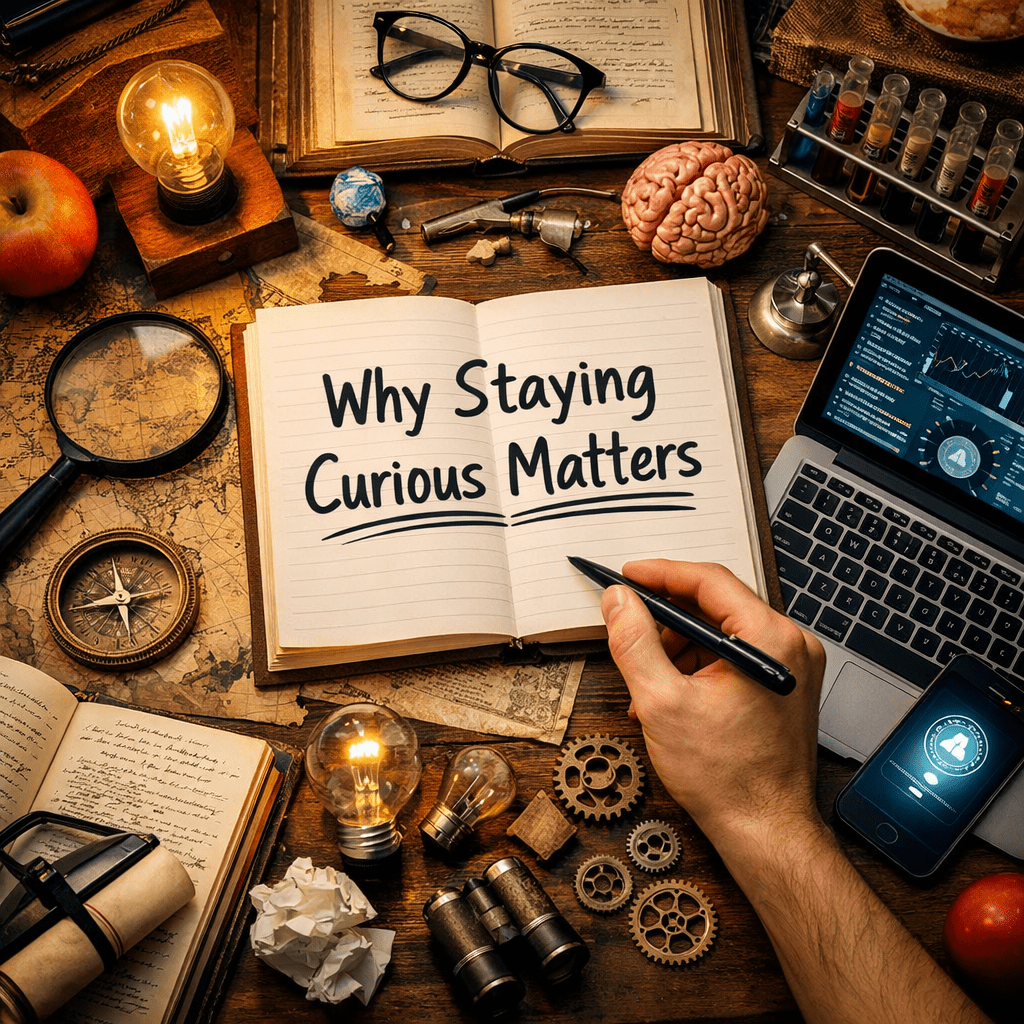
Curiosity is often dismissed as a soft trait—something associated with children, creativity, or idle wondering. But in reality, curiosity is one of the most powerful cognitive tools a person can develop. It shapes how you think, how you learn, how you relate to others, and ultimately, how far you go in life.
In an era defined by rapid change—technology shifts, economic uncertainty, and information overload—curiosity is no longer optional. It is a survival skill.
This article breaks down why staying curious matters at a deep level, from brain function to career success, and how cultivating it can fundamentally change your trajectory.
What Is Curiosity, Really?
Curiosity is the desire to acquire new knowledge, explore unfamiliar ideas, and understand how things work. In Cognitive Psychology, curiosity is considered a form of intrinsic motivation—meaning it comes from within rather than from external rewards.
There are two primary types of curiosity:
- Diversive curiosity – the urge to explore new things broadly (e.g., scrolling, discovering new topics)
- Epistemic curiosity – the deeper desire to understand complex ideas and solve problems
While both forms are useful, epistemic curiosity is what drives mastery, innovation, and expertise.
The Science: How Curiosity Rewires Your Brain
Curiosity is not just psychological—it’s biological.
When you become curious, your brain activates reward circuits linked to dopamine. This chemical doesn’t just make you feel good—it enhances learning and memory formation.
Curiosity also supports neuroplasticity—the brain’s ability to form new neural connections. This is critical for adapting to new environments and challenges.
Research shows that when you’re curious:
- You retain information longer
- You process ideas more deeply
- You become more mentally flexible
This is why curiosity is strongly linked to long-term cognitive health and a reduced risk of conditions like Alzheimer’s disease.
Why Curiosity Is the Foundation of Learning
Most people approach learning passively—they wait to be taught. Curious individuals take the opposite approach: they actively seek knowledge.
This distinction matters.
Curiosity transforms learning from a chore into a self-driven process. Instead of memorizing information, you pursue understanding.
For example:
- A student studies to pass exams
- A curious learner studies to understand how systems work
The second approach leads to deeper expertise and long-term retention.
In a world where information is abundant, the real advantage is not access to knowledge—it is the desire to pursue it.
Curiosity and Problem-Solving: Thinking Beyond the Obvious
Every meaningful problem requires more than surface-level thinking.
Curious people naturally:
- Question assumptions
- Explore alternative explanations
- Look for underlying causes
This mindset is essential in complex decision-making environments—business, technology, leadership, and science.
Consider how major discoveries began. The concept of Gravity wasn’t obvious until someone asked a simple but powerful question: Why do objects fall the way they do?
Curiosity forces you to go deeper. And depth is where real solutions exist.
Curiosity Drives Innovation and Competitive Advantage
Innovation is not accidental—it is the result of sustained curiosity.
Organizations that succeed long-term prioritize curiosity because it leads to:
- New ideas
- Process improvements
- Market disruption
At an individual level, curiosity gives you a strategic edge:
- You learn faster than others
- You adapt to change more effectively
- You spot opportunities others miss
In highly competitive environments, these advantages compound over time.
The difference between stagnation and growth often comes down to one thing: whether you keep asking questions.
The Link Between Curiosity and Career Growth
Curiosity is one of the most underrated career accelerators.
Employers consistently value individuals who:
- Take initiative to learn
- Ask intelligent questions
- Seek to understand systems, not just tasks
Curious professionals don’t just do their jobs—they expand them.
They:
- Learn new tools without being told
- Stay ahead of industry trends
- Transition across roles and industries more easily
In contrast, a lack of curiosity leads to stagnation. Skills become outdated, opportunities are missed, and growth slows down.
In practical terms, curiosity determines whether you remain relevant.
Curiosity and Emotional Intelligence
Curiosity is not limited to intellectual pursuits—it plays a critical role in social interactions.
When you are curious about people:
- You listen more actively
- You avoid quick judgments
- You understand different perspectives
This builds stronger relationships, both personally and professionally.
Curiosity also enhances empathy. Instead of reacting emotionally, you seek to understand motivations and context.
In leadership, this is a critical skill. Leaders who ask questions rather than impose assumptions create more trust and better outcomes.
How Curiosity Reduces Fear and Builds Confidence
Fear often stems from uncertainty. When you don’t understand something, your brain interprets it as a threat.
Curiosity reframes uncertainty.
Instead of avoiding the unknown, you explore it.
This shift has powerful effects:
- It reduces anxiety
- It increases confidence
- It encourages experimentation
Curious individuals are more willing to take calculated risks because they see uncertainty as an opportunity to learn rather than a danger to avoid.
The Hidden Cost of Losing Curiosity
Many people start life curious and gradually lose it.
This happens due to:
- Rigid education systems
- Fear of failure
- Comfort with routine
- Overreliance on easy answers
The consequences are significant:
- Reduced creativity
- Slower learning
- Limited adaptability
- Decreased engagement with life
Without curiosity, life becomes repetitive. Growth slows, and opportunities pass unnoticed.
In fast-changing environments, this is a serious disadvantage.
Practical Ways to Stay Curious Every Day
Curiosity is not fixed—it can be developed deliberately.
Here are actionable strategies:
1. Ask Better Questions
Replace passive thinking with active inquiry:
- Why does this work this way?
- What am I missing?
- Is there another perspective?
The quality of your questions determines the quality of your thinking.
2. Expose Yourself to New Ideas
Read outside your field. Engage with unfamiliar topics. Curiosity thrives on novelty.
3. Challenge Your Assumptions
Regularly question what you believe to be true. This prevents intellectual stagnation.
4. Embrace Not Knowing
Admitting you don’t know something is not a weakness—it’s the starting point of learning.
5. Follow Your Interests Deeply
Don’t just skim topics. Dive into them. Depth builds expertise.
6. Surround Yourself with Curious People
Curiosity is contagious. Being around inquisitive individuals elevates your thinking.
Curiosity in the Digital Age: A Double-Edged Sword
Today, curiosity is both easier and harder to sustain.
On one hand, the internet provides unlimited access to information. On the other, it encourages shallow exploration—constant switching between topics without depth.
To truly benefit from curiosity:
- Avoid endless scrolling
- Focus on deep learning
- Prioritize quality over quantity
Curiosity must be intentional to be effective.
Why Curiosity Is the Ultimate Long-Term Advantage
Skills become outdated. Industries change. Technology evolves.
Curiosity, however, remains constant.
It ensures that:
- You continue learning
- You adapt to change
- You remain intellectually engaged
In essence, curiosity is a meta-skill—the skill that enables all other skills.
Staying curious is not just about acquiring knowledge.
It is about maintaining a mindset that keeps you evolving.
It affects how you think, how you relate to others, and how you respond to challenges. It determines whether you grow or stagnate.
In a world that rewards adaptability, creativity, and continuous learning, curiosity is not optional—it is essential.
If you cultivate it deliberately, it becomes one of the most powerful assets you can possess.
SUGGESTED READS
- How Sharp Boys Trick Young Kenyans Into Losing Big Money Online
- The Pressure to Appear Successful in Kenya
- Why ‘Going Abroad’ Has Become the Biggest Dream for Young Kenyans
- The Plane Kenyans Couldn’t Stop Watching
- Why Many Young Kenyans Are Delaying Marriage
- “What Will People Say?” — The Question Quietly Controlling Millions of Kenyans

Support Our Website!
We appreciate your visit and hope you find our content valuable. If you’d like to support us further, please consider contributing through the TILL NUMBER: 9549825. Your support helps us keep delivering great content!
If you’d like to support Nabado from outside Kenya, we invite you to send your contributions through trusted third-party services such as Remitly, western union, SendWave, or WorldRemit. These platforms are reliable and convenient for international money transfers.
Please use the following details when sending your support:
Phone Number: +254701838999
Recipient Name: Peterson Getuma Okemwa
We sincerely appreciate your generosity and support. Thank you for being part of this journey!