

simply amazing, always for you.
The Plane That Carried a Nation’s Emotions
There are moments in a country’s history when time seems to pause. Conversations slow down, televisions stay on longer than usual, and people constantly refresh their phones for updates.
For Kenya, one such moment came when the body of Raila Odinga was flown home from India.
It was not just another international flight. It became one of the most followed and emotionally charged journeys in Kenya’s modern history. Millions of Kenyans tracked the aircraft online, watched the news live, and gathered near the airport waiting for the plane to land.
The flight symbolized more than a return from abroad. It represented the final journey of a man who had dominated Kenyan politics for decades.
From the moment the aircraft left India to the moment it touched down at Jomo Kenyatta International Airport, the entire nation watched.
This is the story of the flight that carried Raila Odinga home—and the emotions it stirred across Kenya.
A Leader Who Shaped Kenya’s Political History
To understand why the flight attracted such massive attention, it is important to understand the life and influence of Raila Odinga.
For more than four decades, he remained one of the most powerful figures in Kenyan politics.
Born in 1945, Raila was the son of Jaramogi Oginga Odinga, Kenya’s first vice president and one of the most influential leaders in the country’s early political history.
Growing up in such an environment meant that politics was never far away.
But Raila did not simply inherit his political path. Instead, he built a reputation as a reformist, activist, and opposition leader who challenged power repeatedly.
Over the years, he became known for:
- Fighting for multiparty democracy
- Opposing authoritarian rule
- Advocating constitutional reforms
- Representing the voice of opposition politics
These struggles often placed him at the center of national debates about democracy, governance, and justice.
For many supporters, Raila Odinga became more than a politician.
He became a symbol of resistance and hope.
Years of Political Battles and Influence
Few political figures in Kenya have fought as many high-stakes battles as Raila Odinga.
He ran for the presidency multiple times, contesting elections that shaped the country’s political direction.
He also served as the Prime Minister of Kenya from 2008 to 2013, working in a coalition government formed after one of the most turbulent elections in Kenya’s history.
During those years, he helped steer Kenya through a delicate political transition and played a role in the adoption of the 2010 Constitution, which transformed the country’s governance structure.
Even after leaving office, he remained one of the most influential voices in national politics.
His supporters affectionately called him “Baba,” a nickname that reflected the deep emotional connection many Kenyans felt toward him.
The Unexpected News From India
The moment that shocked the country began thousands of kilometers away.
Reports emerged that Raila Odinga had traveled to India for specialized medical treatment.
Such trips were not unusual for senior political leaders seeking advanced healthcare.
But the news that followed stunned the nation.
Raila Odinga had died while receiving treatment in India.
Within minutes, the announcement spread across Kenya.
Television channels interrupted their programming.
Radio stations began continuous coverage.
Social media exploded with reactions.
Across cities, towns, and villages, Kenyans began discussing the same question:
What would happen next?
National Grief and Political Reactions
The reaction to Raila Odinga’s death was immediate and emotional.
Political leaders across the country issued statements expressing shock and sadness.
Among those who paid tribute were:
- William Ruto
- Uhuru Kenyatta
- Leaders from opposition and ruling parties alike
The tributes reflected a rare moment of unity in Kenyan politics.
Even those who had been fierce political rivals acknowledged Raila’s contribution to democracy and governance.
President Ruto declared a period of national mourning, and flags across the country were lowered to half-mast.
But as the country mourned, attention soon turned to a different question.
When would Raila Odinga’s body return home?
Preparing the Journey Home
Bringing the body of such a prominent national figure back to Kenya required careful planning.
Government officials, the Odinga family, and diplomatic teams coordinated with Indian authorities to arrange the journey.
The task eventually fell to Kenya Airways, the country’s flag carrier.
A special aircraft was prepared to transport the body from India to Nairobi.
Inside the plane were:
- Raila Odinga’s casket draped in the Kenyan flag
- Family members
- Government representatives
- A small group of officials overseeing the journey
Once the aircraft departed India, something extraordinary began to happen.
The Flight Kenyans Could Not Stop Watching
As soon as news broke that the plane had taken off, Kenyans began searching for the flight online.
Many turned to flight-tracking platforms that allow users to follow aircraft in real time.
Soon screenshots began appearing across social media.
People shared the aircraft’s route, altitude, and expected arrival time.
Within hours, thousands—then hundreds of thousands—were tracking the same flight.
For many Kenyans, watching the plane approach home became deeply symbolic.
It was the final journey of a man whose political career had defined decades of Kenyan history.
Social Media Turns the Flight Into a National Event
The digital age transformed the flight into something unprecedented.
Hashtags about Raila Odinga began trending across Kenya.
Users posted:
- Screenshots of the plane’s location
- Messages of tribute
- Emotional reactions to the approaching arrival
Television stations began broadcasting live updates.
News anchors discussed the flight’s progress.
Every few minutes, reporters announced how close the aircraft was to Kenya.
It was no longer just a flight.
It had become a national moment.
The Emotional Arrival in Nairobi
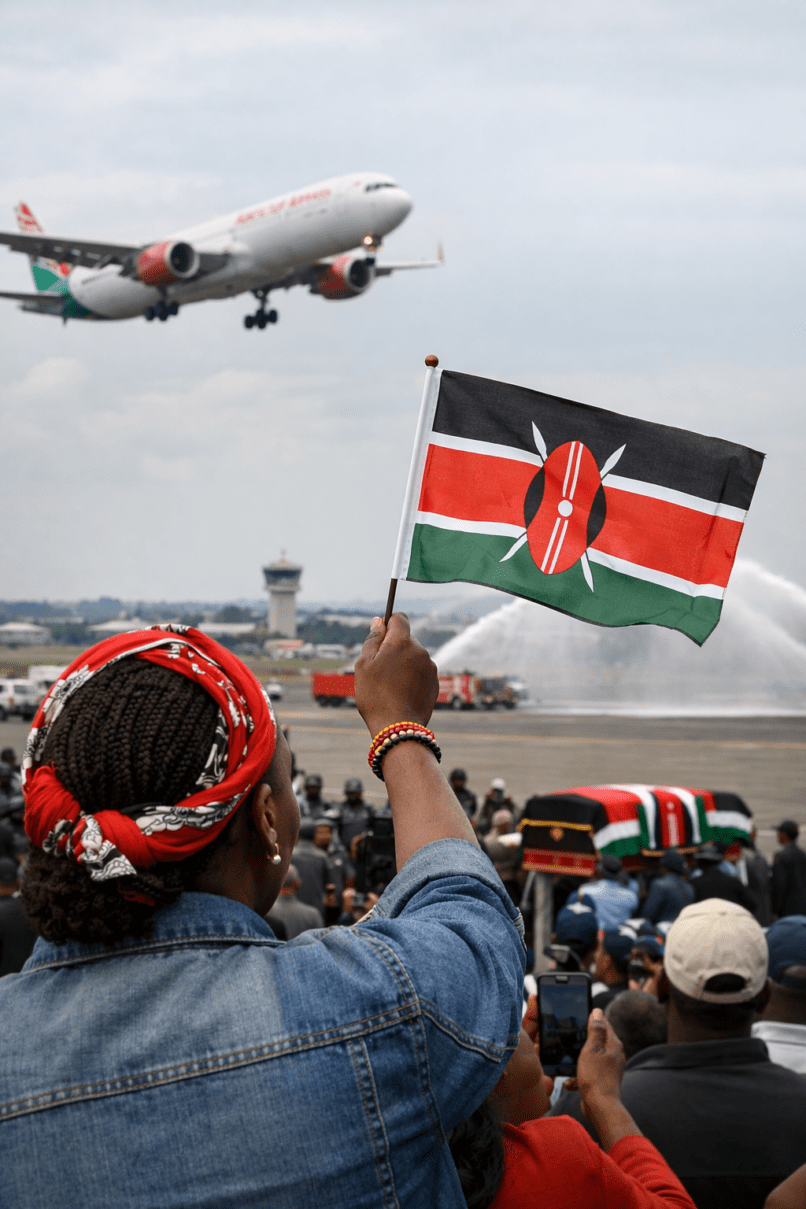
When the aircraft finally approached Nairobi, thousands of people had already gathered near the airport.
The plane descended toward Jomo Kenyatta International Airport, Kenya’s busiest international airport.
Inside the airport, government officials waited quietly.
The plane touched down slowly on the runway.
Moments later, airport fire trucks sprayed water arches over the aircraft in a ceremonial salute.
The gesture is one of aviation’s highest honors, typically reserved for historic flights or retiring aircraft.
For many Kenyans watching live, the moment felt surreal.
The journey that millions had followed online had finally ended.
Crowds Gather at the Airport
Outside the airport, the atmosphere was unlike anything seen in recent years.
Thousands of supporters had gathered long before the plane landed.
Many held flags.
Others wore clothing bearing Raila Odinga’s image.
Some simply stood quietly, waiting.
When the casket was finally brought out of the aircraft, emotions overwhelmed the crowd.
Some people cried.
Others sang songs associated with political rallies.
The moment captured the deep emotional connection Raila had built with his supporters.
A Rare Moment of Political Unity
Inside the airport reception area, Kenya’s political leaders gathered for the official ceremony.
Among those present were:
- President William Ruto
- Former President Uhuru Kenyatta
- Senior government officials
- Opposition leaders
- Members of the Odinga family
For years, many of these leaders had been political rivals.
But on that day, they stood together in silence.
The moment symbolized something larger than politics.
It represented the recognition that Raila Odinga had played a defining role in Kenya’s democratic journey.
The Motorcade Through Nairobi
After the airport ceremony, the body was placed in a hearse and transported through Nairobi.
The motorcade moved slowly along major roads.
Crowds gathered along highways and intersections.
Some people held banners.
Others simply watched as the procession passed.
Traffic slowed across parts of the city as thousands tried to witness the moment.
The procession eventually reached the funeral facility where preparations for public viewing began.
Kenyans Line Up to Say Goodbye
In the days that followed, thousands of Kenyans queued for hours to pay their final respects.
Some traveled from distant counties just for the opportunity to see the casket.
The turnout was so large that organizers had to expand viewing arrangements.
The scenes were emotional.
Elderly supporters wept openly.
Young people took photographs to remember the moment.
For many Kenyans, it was their final chance to honor a leader who had shaped the country’s political history.
The Legacy of Raila Odinga
Even after his death, Raila Odinga’s influence remained visible across Kenyan politics.
His legacy included:
- Advocacy for democratic reforms
- Participation in constitutional change
- Decades of political opposition
Few leaders in Kenya’s history had remained as relevant for as long as he had.
For his supporters, he represented resilience and determination.
For critics, he was a formidable political rival.
But for historians, he was undeniably one of the central figures in Kenya’s political evolution.
The Final Journey to Siaya
After ceremonies in Nairobi, Raila Odinga’s body was flown to Kisumu before traveling by road to his rural home in Bondo.
The journey to Siaya County attracted massive crowds.
Supporters lined roads across western Kenya.
Some people climbed rooftops or stood along highways just to catch a glimpse of the procession.
The burial site held deep significance.
It was close to the resting place of his father, Jaramogi Oginga Odinga.
The symbolism was powerful.
A father and son who had both shaped Kenya’s political history now rested in the same land.
Why the Flight Became Historic
The flight carrying Raila Odinga’s body from India became historic for several reasons.
The Emotional Connection
Few politicians in Kenya had built such a deep emotional bond with supporters.
The Power of Technology
Real-time flight tracking allowed millions of people to follow the journey.
The Symbolism
The flight represented a final return home after decades of political struggle.
The National Moment
For a brief period, the country paused to reflect on its political history.
What Kenya Learned From the Moment
The moment revealed several important truths about Kenya.
First, politics in Kenya often goes beyond policy.
Leaders become symbols of identity, hope, and resistance.
Second, technology now shapes how national moments unfold.
Millions experienced the flight not at the airport, but through their phones and televisions.
Finally, the moment showed that even the most divisive political figures can unite a nation in reflection after death.
A Flight That Became History
The plane that carried Raila Odinga’s body from India was more than just an aircraft crossing continents.
It became a symbolic journey watched by millions of Kenyans.
From the moment the plane departed India to its emotional landing in Nairobi, the flight captured the attention of the entire nation.
It reminded Kenyans that leadership leaves a lasting imprint on history.
Raila Odinga’s final journey home was not just about mourning a politician.
It was about recognizing the legacy of a man who helped shape Kenya’s political story for generations.
For many Kenyans, the image of that plane descending toward Nairobi will remain unforgettable.
It was the moment when a nation watched the sky—and said goodbye.
SUGGESTED READS
- Living Paycheck to Paycheck in Kenya: The Silent Financial Crisis No One Is Talking About
- Before You Wear That Bodycon Dress, Read This
- Why Men Disappear Emotionally After Sex
- Why So Many Young Men Are Failing in College
- The Hidden Male Fear That Makes Him Pull Away From You
- How Smart Creators Are Using AI to Make $1,000+ a Week in today’s world.

Support Our Website!
We appreciate your visit and hope you find our content valuable. If you’d like to support us further, please consider contributing through the TILL NUMBER: 9549825. Your support helps us keep delivering great content!
If you’d like to support Nabado from outside Kenya, we invite you to send your contributions through trusted third-party services such as Remitly, western union, SendWave, or WorldRemit. These platforms are reliable and convenient for international money transfers.
Please use the following details when sending your support:
Phone Number: +254701838999
Recipient Name: Peterson Getuma Okemwa
We sincerely appreciate your generosity and support. Thank you for being part of this journey!