

simply amazing. always for you.
April 7, 2026
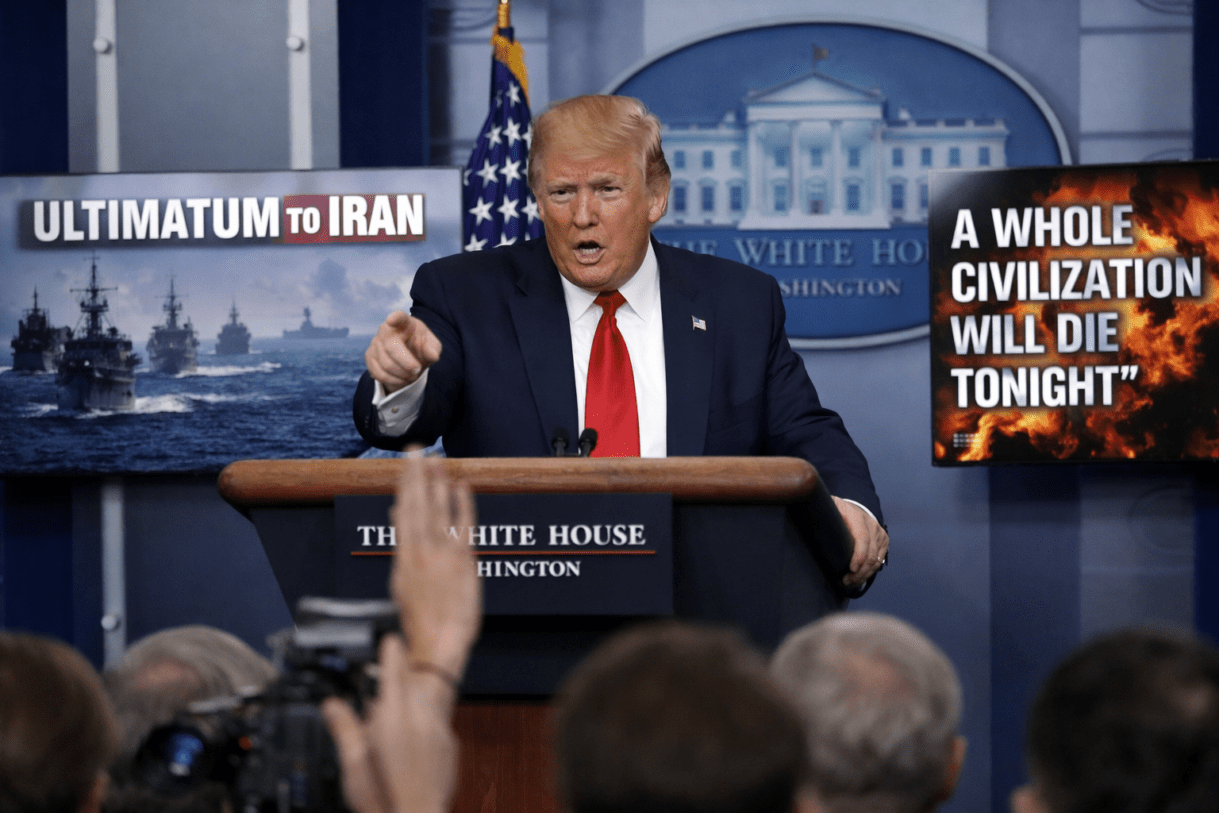
In a dramatic escalation of tensions between the United States and Iran, former U.S. President Donald Trump issued a stark ultimatum to Tehran on Tuesday, warning of catastrophic consequences if the country failed to comply with U.S. demands by a set evening deadline. The rhetoric—described by critics as among the most extreme ever used by a U.S. leader toward a sovereign nation—has sent shockwaves across diplomatic, military, and economic circles worldwide.
At the heart of the crisis is a rapidly deteriorating standoff between Washington and Iran, one that has escalated beyond traditional diplomatic pressure into a confrontation increasingly defined by military signaling, economic coercion, and existential warnings. Trump’s declaration that “a whole civilization will die tonight” if Iran did not yield has drawn both alarm and scrutiny, with analysts racing to interpret whether the statement reflects a genuine operational posture or a calculated attempt at coercive diplomacy.
A Deadline That Shook the World
The ultimatum reportedly centered on Iran’s control over critical maritime routes, particularly the strategically vital Strait of Hormuz, through which a significant portion of the world’s oil supply flows. U.S. officials have long accused Tehran of threatening the stability of this corridor, citing recent incidents involving shipping disruptions and military maneuvers.
Trump’s demand was unambiguous: Iran was to take immediate steps to guarantee unrestricted passage through the strait or face overwhelming consequences. The deadline—8 p.m. Washington time—introduced a sense of urgency rarely seen in modern geopolitical disputes.
Markets reacted almost instantly. Oil prices surged amid fears of supply disruptions, while global stock indices dipped as investors braced for potential conflict. Governments across Europe and Asia issued advisories urging restraint, emphasizing the potential global ramifications of a military escalation in the Gulf.
Interpreting the “Civilization” Remark
While Trump’s phrasing captured headlines, its precise meaning remains subject to interpretation. The suggestion that an entire civilization could be wiped out was widely viewed not as a literal plan for annihilation, but as a hyperbolic warning of large-scale military action targeting Iran’s infrastructure.
Defense analysts point out that modern warfare strategies often emphasize disabling a nation’s operational capabilities—power grids, communication networks, transportation hubs—rather than indiscriminate destruction of civilian populations. However, the line between strategic targeting and humanitarian catastrophe is thin.
“Taking down critical infrastructure in a country like Iran would have cascading effects,” said one regional security expert. “You’re talking about electricity outages, water shortages, hospital disruptions—conditions that could lead to widespread suffering.”
Such outcomes raise serious legal and ethical questions under international humanitarian law, particularly regarding the protection of civilian populations during armed conflict.
Rising Military Posture
The rhetoric did not emerge in a vacuum. In recent weeks, U.S. military activity in the region has intensified significantly. Naval deployments have increased, with carrier strike groups positioned within striking distance of Iranian territory. Air assets have been repositioned, and reconnaissance missions have expanded.
Meanwhile, Iran has conducted its own military exercises, showcasing missile capabilities and reinforcing its defensive positions. State media in Tehran has portrayed the U.S. ultimatum as an act of aggression, vowing that Iran will not capitulate under pressure.
Officials aligned with Iran’s leadership have warned that any attack on their territory would trigger a robust response, potentially involving regional allies and proxy forces. This raises the specter of a broader conflict that could engulf multiple countries in the Middle East.
Diplomatic Fallout
International reaction to Trump’s statement has been swift and, in many cases, sharply critical. European leaders have called for immediate de-escalation, emphasizing the importance of diplomatic engagement over military threats.
At the United Nations, emergency consultations were reportedly underway as member states sought to assess the implications of the unfolding situation. Several diplomats expressed concern that such rhetoric undermines established norms of international relations and increases the risk of miscalculation.
“This is the kind of language that closes doors rather than opens them,” said a senior European official. “When you frame a situation in existential terms, it becomes much harder to find a negotiated solution.”
Even within the United States, reactions have been mixed. Some political figures have defended Trump’s approach as a necessary show of strength, arguing that Iran has historically responded only to decisive pressure. Others have condemned the rhetoric as reckless, warning that it could provoke unintended consequences.
Legal and Ethical Questions
The possibility of targeting civilian infrastructure has sparked intense debate among legal scholars and human rights organizations. Under the principles of international humanitarian law, parties to a conflict are required to distinguish between military and civilian targets and to avoid actions that would cause disproportionate harm to civilians.
Critics argue that broad threats against a nation’s “civilization” could be interpreted as signaling a willingness to disregard these principles. While no specific operational plans have been publicly disclosed, the ambiguity itself has become a source of concern.
“There’s a difference between deterring aggression and threatening actions that could harm millions of civilians,” said one legal expert. “The language matters because it shapes expectations and potentially justifies actions.”
Economic Reverberations
Beyond the immediate geopolitical implications, the crisis has significant economic dimensions. The Strait of Hormuz remains one of the most critical arteries for global energy supply, with roughly a fifth of the world’s oil passing through its waters.
Any disruption—whether through military conflict or precautionary shutdowns—could have far-reaching effects on global markets. Already, energy analysts are warning of potential price spikes that could ripple through economies worldwide, affecting everything from transportation costs to inflation rates.
Shipping companies have begun rerouting vessels where possible, while insurers are reassessing risk premiums for operations in the region. These developments underscore how localized conflicts can quickly evolve into global economic challenges.
Iran’s Response
Iranian officials have rejected the ultimatum outright, framing it as an infringement on their sovereignty. State-aligned media outlets have emphasized the country’s resilience, drawing on historical narratives of resistance against external pressure.
In public statements, Iranian leaders have insisted that they will continue to defend their national interests, including their role in regional security dynamics. At the same time, they have signaled openness to dialogue—provided it occurs on equal footing and without coercion.
This dual approach—defiance combined with conditional openness—reflects a broader strategy aimed at maintaining domestic support while leaving room for potential diplomatic engagement.
The Risk of Miscalculation
Perhaps the most concerning aspect of the current situation is the potential for miscalculation. With both sides adopting hardened positions and engaging in military signaling, the margin for error is narrowing.
History offers numerous examples of conflicts that escalated not through deliberate intent, but through misunderstandings or unintended incidents. In a region as volatile as the Middle East, the consequences of such missteps could be severe.
Military analysts warn that even a minor confrontation—such as a naval skirmish or an airspace violation—could rapidly spiral into a broader conflict, particularly given the heightened state of alert on both sides.
Domestic Implications in the U.S.
Trump’s approach to Iran is also shaping domestic political discourse within the United States. Supporters argue that his willingness to use strong language and decisive action reflects a commitment to protecting American interests.
Critics, however, contend that the rhetoric risks entangling the country in another prolonged conflict. They point to the experiences of past military engagements in the region as cautionary tales, emphasizing the human and financial costs of war.
Public opinion appears divided, with some Americans expressing concern about the potential for escalation, while others support a tougher stance toward Iran.
A Region on Edge
Across the Middle East, the situation is being closely monitored. Neighboring countries are assessing their own security postures, while regional alliances are being tested.
Some nations have called for restraint and offered to mediate, while others are preparing for the possibility of conflict. The interconnected nature of the region means that any escalation could have cascading effects, drawing in multiple actors.
Humanitarian organizations are also raising alarms about the potential impact on civilian populations, particularly in densely populated urban areas that could be affected by infrastructure disruptions.
The Path Forward
As the deadline approaches, the world is watching closely. The choices made in the coming hours could shape the trajectory of U.S.-Iran relations for years to come—and potentially redefine the geopolitical landscape of the Middle East.
Diplomatic channels, though strained, remain open. Some analysts believe that the starkness of Trump’s warning may be intended to force a last-minute concession or negotiation, rather than to signal an inevitable military action.
Others are less optimistic, warning that the combination of heightened rhetoric and military readiness increases the likelihood of confrontation.
The current standoff between the United States and Iran represents a critical juncture in international relations.
Trump’s warning, with its dramatic language and firm deadline, has amplified tensions and introduced a new level of urgency to an already volatile situation.
Whether this moment leads to de-escalation or conflict will depend on a complex interplay of decisions, perceptions, and actions on both sides. What is clear, however, is that the stakes are extraordinarily high—not only for the parties directly involved, but for the global community as a whole.
As the deadline passes and the next phase unfolds, one thing remains certain: the world is entering a period of uncertainty that demands careful navigation, measured responses, and a renewed commitment to avoiding outcomes that could have devastating consequences.
SUGGESTED READS
- KPA Boss Captain William K. Ruto Survives Horror Crash as Daughter Dies in Shocking Highway Tragedy
- TICKING TIME BOMB: Iran Ceasefire Push Collides with U.S. War Threats
- London’s Secret Underground EXPOSED: 7 Abandoned Tube Stations Hidden Beneath Your Feet
- The Power of Kind Gestures: Meaningful Ways to Show Appreciation in Everyday Life
- Trump’s Ruthless Move: Pam Bondi Fired as Attorney General Overnight

Support Our Website!
We appreciate your visit and hope you find our content valuable. If you’d like to support us further, please consider contributing through the TILL NUMBER: 9549825. Your support helps us keep delivering great content!
If you’d like to support Nabado from outside Kenya, we invite you to send your contributions through trusted third-party services such as Remitly, western union, SendWave, or WorldRemit. These platforms are reliable and convenient for international money transfers.
Please use the following details when sending your support:
Phone Number: +254701838999
Recipient Name: Peterson Getuma Okemwa
We sincerely appreciate your generosity and support. Thank you for being part of this journey!