

simply amazing, always for you.
Africa is a continent rich in cultural heritage, and at the heart of this heritage lies a powerful force: oral tradition. For centuries, before the written word became widespread, African societies relied on storytelling, proverbs, songs, praise poetry, rituals, and folklore to pass on knowledge. This was not limited to politics, war, or religion. One of the most sacred and well-guarded domains of African oral tradition is love, relationships, and marriage.
In African cultures, how people fall in love, court one another, marry, resolve disputes, and raise children is deeply interwoven with oral wisdom passed down through generations. These traditions serve as a cultural compass, guiding behavior, shaping expectations, and offering conflict resolution tools in intimate relationships.
In this article, we delve deeply into how oral traditions influence African relationships and marriage. We’ll explore the tools of oral culture, how they inform romantic ideals, guide couples through courtship and marital life, and continue to offer timeless insight into modern relationships.
1. Understanding Oral Tradition in Africa
Oral tradition is the transmission of cultural material through vocal utterances—whether in the form of stories, songs, proverbs, riddles, chants, or rituals. Before writing systems became common in Africa, knowledge was preserved and passed through memory and speech.
It’s important to note that oral tradition is not primitive—it is a dynamic, structured system of cultural preservation. In fact, much of African history, cosmology, and social organization has been passed through oral forms, often with strict rules about accuracy and integrity.
In the context of relationships and marriage, oral tradition operates in several formats:
- Proverbs and idioms
- Folktales and myths
- Initiation ceremonies
- Marriage negotiation customs
- Songs and praise poetry
- Clan and lineage storytelling
- Conflict mediation rituals
2. African Proverbs: Nuggets of Relationship Wisdom
African proverbs are arguably the most famous and widespread form of oral tradition. They pack centuries of wisdom into a few words and are used to teach, warn, inspire, or guide.
Examples of African Proverbs on Love and Marriage:
- “If the full moon loves you, why worry about the stars?” – Tanzania This proverb speaks to the power of true love and contentment with what one has.
- “Even the best cooking pot will not produce food.” – African Proverb A reminder that beauty or potential means little without action—relevant in choosing partners.
- “Marriage is like a groundnut: you must crack it to see what is inside.” – Ghana This teaches that the depth of marriage can only be understood through experience.
- “He who marries a beauty marries trouble.” – Nigeria A caution that superficial attractions may lead to complications.
- “A man who uses force is afraid of reasoning.” – Kenya Important in highlighting non-violence and communication in relationships.
Proverbs are used during marriage ceremonies, in advice from elders, and in conversations between parents and children. They are also invoked during times of marital conflict to offer perspective and wisdom.
3. Courtship and Engagement: Oral Customs and Guidance
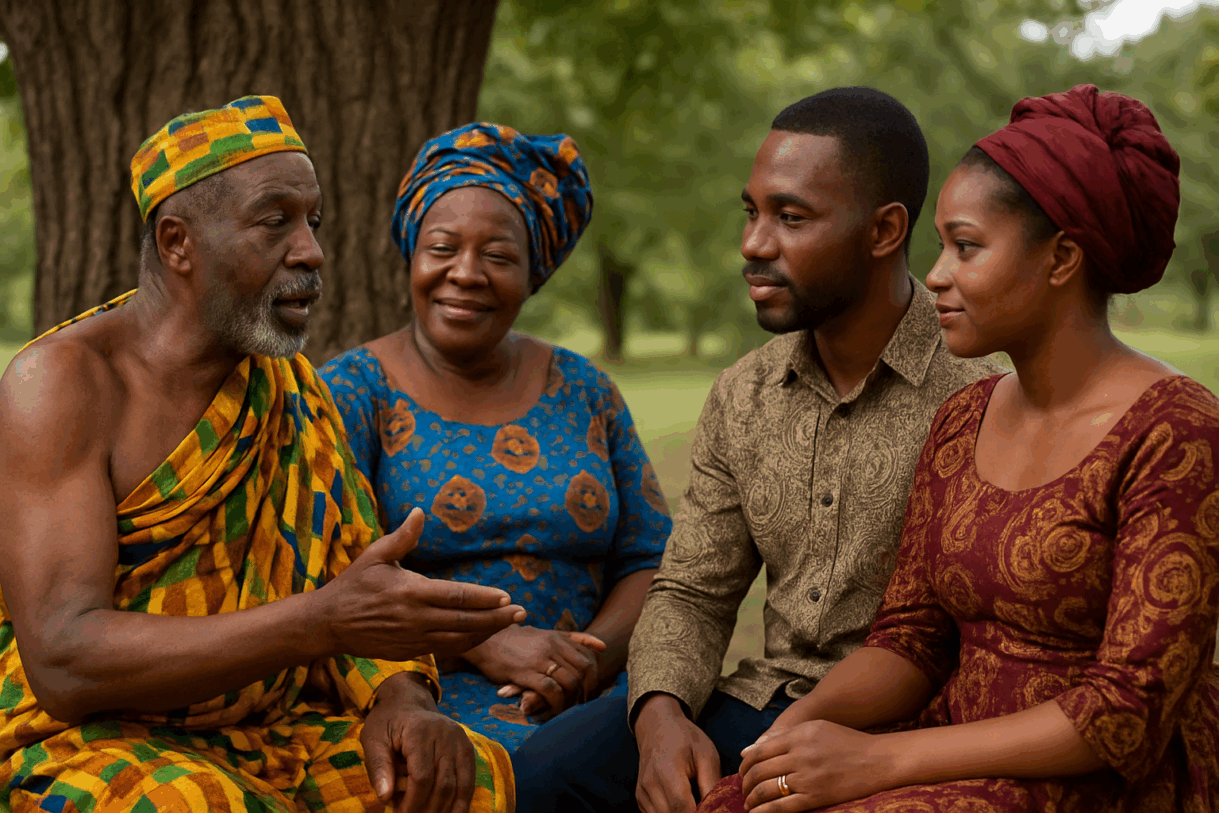
In many African societies, courtship is not a completely private affair. It is governed by customs, rituals, and family involvement. Oral tradition plays a critical role in how young people are taught to approach love.
a) Guidance from Elders
Elders often recount stories and give verbal counsel about how to handle relationships. These oral teachings cover:
- How to choose a suitable partner
- The role of patience and respect
- The danger of infatuation vs. enduring love
- Family compatibility and spiritual signs
Young men and women learn what to expect in relationships and how to avoid common pitfalls through oral narratives and family discussions.
b) Praise Names and Romantic Expression
In some cultures, young men compose praise poetry or songs to woo potential partners. These are not just flattery—they are rich with symbolism, metaphor, and cultural references. For example, in Zulu culture, a man might call a woman “the daughter of the storm who calms the sky,” showing both poetic flair and emotional intelligence.
In Swahili coastal regions, love letters and oral recitations are part of taarab culture—a fusion of music, poetry, and romance.
4. Marriage Ceremonies and Rituals Anchored in Oral Tradition
a) Bride Price Negotiations (Lobola/Dowry)
In many African cultures, the process of marriage begins with negotiations between families. These meetings are filled with ritual speech, proverbs, and storytelling.
For example, in South Africa’s Lobola tradition, elders speak in idioms and symbolic language during bride price discussions. They may say things like, “We have seen a flower in your garden and wish to pluck it,” rather than naming the daughter directly.
b) Marriage Songs and Dances
During traditional wedding ceremonies, songs and dances serve as a form of oral history. Songs often tell:
- Stories of the bride and groom
- Praise of the families involved
- Blessings for the couple’s future
The lyrics are often passed down or composed spontaneously, laced with humor, wit, and coded advice.
c) Oral Blessings and Curses
Marriage blessings are sometimes given through public speech. An elder may stand before the community and deliver a long, poetic monologue invoking ancestors, fertility, peace, and prosperity. On the flip side, failure to honor tradition might incur verbal “curses” or shaming songs—a powerful social control mechanism.
5. Conflict Resolution and Counseling Through Oral Wisdom
Every marriage faces challenges. In African contexts, when things go wrong, couples often seek help not from therapists but from elders or family heads.
a) The Elders’ Circle
Disputes are brought before elders who use:
- Proverbs to calm tensions
- Storytelling to mirror the couple’s struggles
- Public speech to remind them of communal values
This form of oral conflict resolution can be extremely effective because it doesn’t just diagnose problems—it restores honor and realigns roles using time-tested wisdom.
b) Naming and Shaming
If a husband is abusive or a wife is unfaithful, traditional songs might be sung at the market or at night by women’s groups. These songs use metaphor to expose wrongdoing without directly naming names, preserving dignity while enforcing moral codes.
6. Oral Tradition in Modern African Marriages
Some might wonder—has modernity silenced oral tradition in relationships?
While times have changed, oral tradition still thrives, though often in evolved forms:
- WhatsApp groups among families spread oral proverbs and advice
- Church ceremonies blend oral traditions with religious vows
- Contemporary musicians incorporate old love proverbs in lyrics
- YouTube and TikTok creators retell folktales about marriage themes
- Urban griots and poets continue to perform spoken word on love and relationships
Additionally, many couples still seek elder guidance before or after marriage, showing that oral wisdom remains relevant even in digital times.
7. Case Study: The Role of Oral Tradition in the Maasai Marriage System
In the Maasai community of Kenya and Tanzania, oral tradition shapes every stage of marriage:
- Initiation rites prepare boys and girls for adult roles through storytelling and songs.
- Elderly men conduct bride wealth negotiations using symbolic language.
- Weddings include chants that recount the clan histories and honor ancestors.
- Songs by women communicate expectations, complaints, or blessings regarding the bride.
This system ensures that marriage is not just a union between individuals but a reaffirmation of communal values and continuity.
8. Folktales as Relationship Lessons
African folktales are not just bedtime stories—they are tools of moral instruction. Many contain allegories about love, betrayal, loyalty, and wisdom.
Examples:
- “The Tortoise and the Birds” – warns about greed and deceit, lessons for fidelity and trust in marriage.
- “The Lion’s Bride” – explores themes of mismatched unions and the dangers of ignoring parental advice.
- “The Clever Wife” – teaches that intelligence and wisdom are as valuable as beauty in a partner.
These stories teach listeners to think critically about relationships, long before they enter one.
9. Oral Tradition as a Repository of Gender Roles
While oral traditions offer wisdom, they also reflect gender roles and expectations in African marriages:
- Men are often portrayed as providers and leaders.
- Women are praised for patience, beauty, and homemaking skills.
Modern critics argue that some oral traditions reinforce patriarchy, but others see them as a starting point for conversation and cultural evolution.
Progressive elders today often reinterpret proverbs and folktales to emphasize equality, empathy, and shared responsibilities in relationships.
10.Why Oral Tradition Still Matters
In an age dominated by dating apps, instant messaging, and self-help books, African oral tradition continues to offer something rare: rooted wisdom shaped by generations of lived experience.
It is not just a relic of the past—it is a living cultural force. In relationships and marriage, where love, conflict, commitment, and community all converge, oral tradition remains a vital guide.
It teaches us to listen, to reflect, and to value the voices of those who came before us. In the songs of a wedding, the proverb whispered by a grandmother, or the story told by a village elder, lies the heart of African love and union.
SUGGESTED READS
- African Proverbs About Love and Relationships: Timeless Wisdom from the Continent
- How to Know If You’re Truly in Love (6 Signs You Can’t Ignore)
- 5 Relationship Quotes That Will Change the Way You Think About Love
- The Most Surprising Relationship Facts You Need to Know in 2025
- I Tried Couples Therapy for a Month — Here’s What Happened
- How to Fight Fair in a Relationship (Without Hurting Each Other)

Support Our Website!
We appreciate your visit and hope you find our content valuable. If you’d like to support us further, please consider contributing through the TILL NUMBER: 9549825. Your support helps us keep delivering great content!
If you’d like to support Nabado from outside Kenya, we invite you to send your contributions through trusted third-party services such as Remitly, western union, SendWave, or WorldRemit. These platforms are reliable and convenient for international money transfers.
Please use the following details when sending your support:
Phone Number: +254701838999
Recipient Name: Peterson Getuma Okemwa
We sincerely appreciate your generosity and support. Thank you for being part of this journey!
very informative articles or reviews at this time.
Hey there, I think your blog might be having browser compatibility issues. When I look at your blog in Opera, it looks fine but when opening in Internet Explorer, it has some overlapping. I just wanted to give you a quick heads up! Other then that, awesome blog!