

simply amazing, always for you.
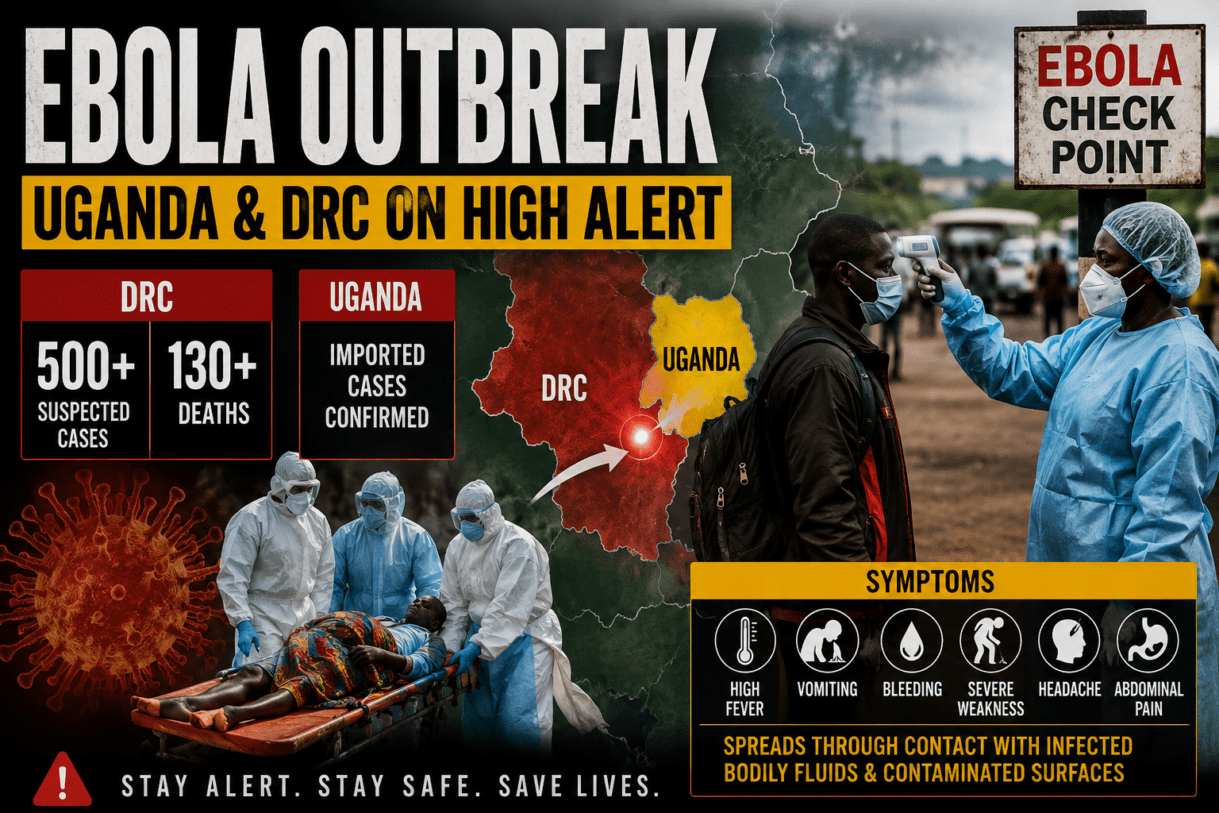
A growing Ebola outbreak in Central and East Africa has triggered fresh fears after cases spread between the Democratic Republic of the Congo (DRC) and Uganda, forcing global health agencies into emergency response mode.
The World Health Organization recently declared the outbreak a Public Health Emergency of International Concern after infections linked to the rare Bundibugyo strain crossed borders and began spreading through vulnerable communities. The situation has become one of the most closely watched health emergencies in Africa in 2026.
Health officials say the outbreak began in eastern DRC before infected travelers carried the virus into Uganda through busy border crossings used daily by traders, transport workers, and families.
Death Toll Climbs as Cases Increase
Authorities in the DRC have reported hundreds of suspected infections, with the number of deaths continuing to rise. Medical experts fear the real figures could be much higher due to limited healthcare access in remote and conflict-affected areas.
Uganda has also confirmed imported cases tied directly to the outbreak in eastern Congo. Emergency surveillance teams have been deployed across border districts to track contacts and isolate suspected infections before the virus spreads further.
Hospitals in both countries are under pressure as healthcare workers attempt to contain the outbreak while protecting themselves from infection.
Rare Ebola Strain Raises Concern
Unlike previous Ebola outbreaks dominated by the Zaire strain, the current crisis involves the Bundibugyo variant, a less common but still highly dangerous form of the virus.
The absence of a fully approved vaccine specifically designed for the Bundibugyo strain has complicated containment efforts. Researchers and international health agencies are now evaluating experimental vaccines and treatment options as the outbreak expands.
Experts warn that delayed detection, weak healthcare infrastructure, and regional instability could allow the virus to spread rapidly if aggressive containment measures fail.
Border Screening Intensified
Uganda and the DRC have strengthened health checks at border points, airports, and transport hubs. Travelers are being screened for symptoms including fever, vomiting, bleeding, severe weakness, headaches, and abdominal pain.
Health officials are also conducting large-scale contact tracing operations to identify people who may have interacted with infected patients.
Community awareness campaigns have intensified in high-risk regions as governments urge residents to report symptoms immediately and avoid physical contact with suspected Ebola patients.
WHO and Global Agencies Respond
International agencies including the World Health Organization, Africa CDC, and emergency medical teams have dispatched supplies, protective gear, laboratory support, and rapid-response specialists to affected regions.
Mobile isolation units and emergency treatment centers are now being established near outbreak hotspots in an effort to prevent health systems from collapsing under pressure.
The WHO has warned neighboring countries to remain alert due to heavy regional movement across East and Central Africa.
Fear of Regional Spread
Public health experts say the outbreak’s location is particularly dangerous because eastern DRC serves as a major transport and migration corridor connecting multiple African nations.
Cross-border trade between Uganda and Congo remains active despite growing concern, increasing the risk of further transmission if infected individuals evade detection.
Several neighboring countries have already heightened surveillance at border posts and hospitals amid fears the outbreak could expand beyond the current epicenter.
What Is Ebola?
Ebola is a severe viral disease that spreads through direct contact with infected bodily fluids, contaminated surfaces, or infected animals. Symptoms often begin suddenly and can quickly become life-threatening without urgent medical treatment.
The virus is not spread through normal airborne transmission like influenza or COVID-19, but outbreaks can escalate rapidly in crowded areas with poor sanitation and weak healthcare systems.
Past Ebola outbreaks in Africa have killed thousands of people and caused major economic and humanitarian crises.
Governments Urge Calm
Despite rising concern, health authorities are urging the public not to panic. Officials insist that rapid detection, isolation, and contact tracing remain effective tools for stopping Ebola outbreaks when applied early.
Citizens in both Uganda and the DRC are being encouraged to avoid misinformation circulating online and rely on verified updates from health ministries and international organizations.
As emergency teams race to contain the virus, the coming weeks are expected to determine whether the outbreak can be controlled before it spreads deeper across the region.
SUGGESTED READS
- Success Is Not Final; Failure Is Not Fatal: The Courage to Continue That Counts
- I Didn’t Fail — I Learned: The Powerful Truth Behind Thomas Edison’s 10,000 Attempts
- The Illusion of Friendship: Understanding the Painful Realization That Some Bonds Were Never Genuine
- The Power of Calmness: How Inner Peace Leads to Clear Thinking and Better Decisions
- As Long as You Know Your Heart and Intentions Are Pure, Don’t Explain Yourself to Anyone
- The Strength in Smiles: A Tribute to Resilient Souls Who Have Been Through a Lot
- Embracing Imperfection: Why Making Mistakes is Better Than Faking Perfection

Support Our Website!
We appreciate your visit and hope you find our content valuable. If you’d like to support us further, please consider contributing through the TILL NUMBER: 9549825. Your support helps us keep delivering great content!
If you’d like to support Nabado from outside Kenya, we invite you to send your contributions through trusted third-party services such as Remitly, western union, SendWave, or WorldRemit. These platforms are reliable and convenient for international money transfers.
Please use the following details when sending your support:
Phone Number: +254701838999
Recipient Name: Peterson Getuma Okemwa
We sincerely appreciate your generosity and support. Thank you for being part of this journey!