

simply amazing, always for you.
When a Simple Gesture Turned Into a National Moment
At first glance, it looked almost absurd.
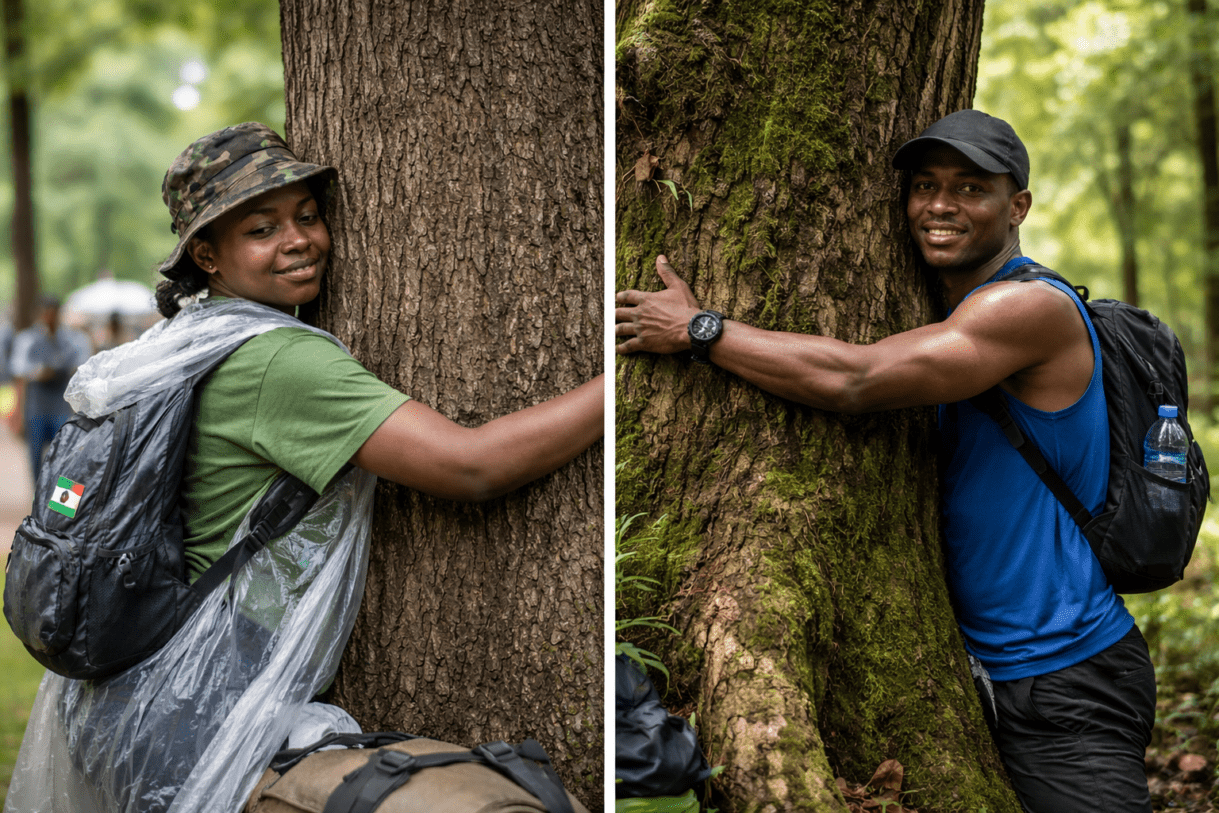
A young woman stood in a public park in Kenya, arms wrapped tightly around a tree, refusing to let go. Hours passed. Then a day. Then another. Cameras gathered. Passersby stopped. Social media lit up.
What began as a quiet, deeply personal act soon transformed into a national headline — and eventually, a cultural conversation.
This is how “Hug Tree Kenya” was born.
Not as an organization.
Not as a brand.
But as a moment — one that forced a country to pause and ask uncomfortable questions about forests, climate change, mental health, and how far someone must go to be heard.
Now, months later, the story has taken a new turn. A Kenyan man has announced plans to challenge the tree-hugging endurance record, extending the movement into unexpected territory.
But to understand why that matters, you have to start at the beginning.
The Woman Who Refused to Let Go
The tree-hugging movement in Kenya is inseparable from Truphena Muthoni, a young environmental conservationist whose endurance-based protest captured national attention.
Her goal was not spectacle for its own sake.
She hugged a single tree continuously for an extraordinary length of time — under observation, documentation, and public scrutiny — with one clear message:
“Planting trees is not enough if we keep destroying the ones we already have.”
In a country where environmental discussions are often reduced to statistics and policy promises, her act reintroduced emotion into conservation.
She didn’t chain herself to a bulldozer.
She didn’t block a highway.
She simply held on.
And somehow, that was enough to make people look.
Why Tree Hugging Struck a Nerve in Kenya
Kenya’s environmental challenges are not abstract.
The country’s major water towers — including the Mau Forest Complex, Mount Kenya, and the Aberdares — face constant pressure from logging, settlement, and development. Forest loss affects rainfall patterns, food security, electricity generation, and livelihoods.
Yet for many Kenyans, these issues feel distant.
Tree hugging changed that.
It turned environmental degradation into something human-scale — one body, one tree, one decision not to let go.
Mental health advocates also noted something else: the act resonated emotionally. In a fast, stressful, hyper-digital world, the image of someone physically reconnecting with nature felt oddly grounding.
Applause, Criticism, and a Divided Public
As media coverage intensified, so did debate.
Supporters saw courage and creativity — proof that peaceful activism could still cut through public fatigue.
Critics questioned effectiveness.
“What does hugging a tree actually change?” some asked.
Environmental experts weighed in cautiously. Symbolic activism, they noted, does not replace policy enforcement or community forestry — but it can ignite public pressure, which often precedes real change.
Whether loved or doubted, one fact was undeniable:
Kenya was talking about trees again.
Then Came the Challenger
Just as attention began to fade, a new voice entered the conversation.
A Kenyan man — a fitness enthusiast and environmental advocate — publicly announced his intention to challenge and potentially surpass the existing tree-hugging endurance record.
Importantly, he did not frame his plan as a rivalry.
Instead, he described it as continuation.
A way to keep the conversation alive.
A way to prove that environmental concern cuts across gender.
A way to show that commitment can be physical, uncomfortable, and public.
As of now, his attempt remains unverified and has not yet taken place. No official Guinness World Records recognition has been granted.
But his announcement alone reignited debate.
Is Environmental Activism Becoming a Competition?
The idea of competing for a conservation record made some people uneasy.
Should protecting nature become a contest?
Does endurance risk overshadowing substance?
Others disagreed.
They argued that visibility matters, especially in a media environment where environmental stories are quickly buried beneath politics and scandal.
The man behind the planned attempt has responded by emphasizing follow-through: community tree planting, environmental education, and collaboration with conservation groups.
Whether that balance holds remains to be seen.
A New Form of Protest: Endurance Activism
Tree hugging in Kenya has introduced a broader concept — endurance activism.
This is protest through persistence.
Through discomfort.
Through staying power.
It mirrors the reality of environmental damage itself — slow, relentless, and often ignored until it becomes impossible to avoid.
From hunger strikes to long marches, history shows that endurance can force attention. Tree hugging simply reframes that idea in a gentler, more intimate form.
Why the Gender Conversation Matters
The emergence of a male challenger has also sparked discussion about recognition.
Many observers caution against letting new attention eclipse the woman whose action started it all. Women have long been at the forefront of environmental protection, yet their efforts are frequently minimized once movements gain traction.
At the same time, others argue that broader participation strengthens the cause.
Both views point to the same truth: the environment does not belong to one hero.
It requires many.
Beyond the Headlines: What Impact Really Looks Like
Ultimately, the success of Hug Tree Kenya will not be measured in hours hugged or records claimed.
It will be measured by:
- Trees protected, not just planted
- Communities engaged, not just inspired
- Policies enforced, not just promised
Symbolism opens the door. Action must walk through it.
A Quiet Act That Refused to Stay Quiet
In a world of loud protests and louder politics, Hug Tree Kenya reminds us that sometimes the most radical act is stillness.
One person.
One tree.
A refusal to let go.
Whether or not the record is ever broken again, something lasting has already happened: Kenyans were reminded that nature is not an abstract concept.
It is something you can touch.
Hold.
Protect.
And sometimes, the most powerful protest is simply staying where you are and saying, “These matters.”

Support Our Website!
We appreciate your visit and hope you find our content valuable. If you’d like to support us further, please consider contributing through the TILL NUMBER: 9549825. Your support helps us keep delivering great content!
If you’d like to support Nabado from outside Kenya, we invite you to send your contributions through trusted third-party services such as Remitly, western union, SendWave, or WorldRemit. These platforms are reliable and convenient for international money transfers.
Please use the following details when sending your support:
Phone Number: +254701838999
Recipient Name: Peterson Getuma Okemwa
We sincerely appreciate your generosity and support. Thank you for being part of this journey!