

simply amazing, always for you.
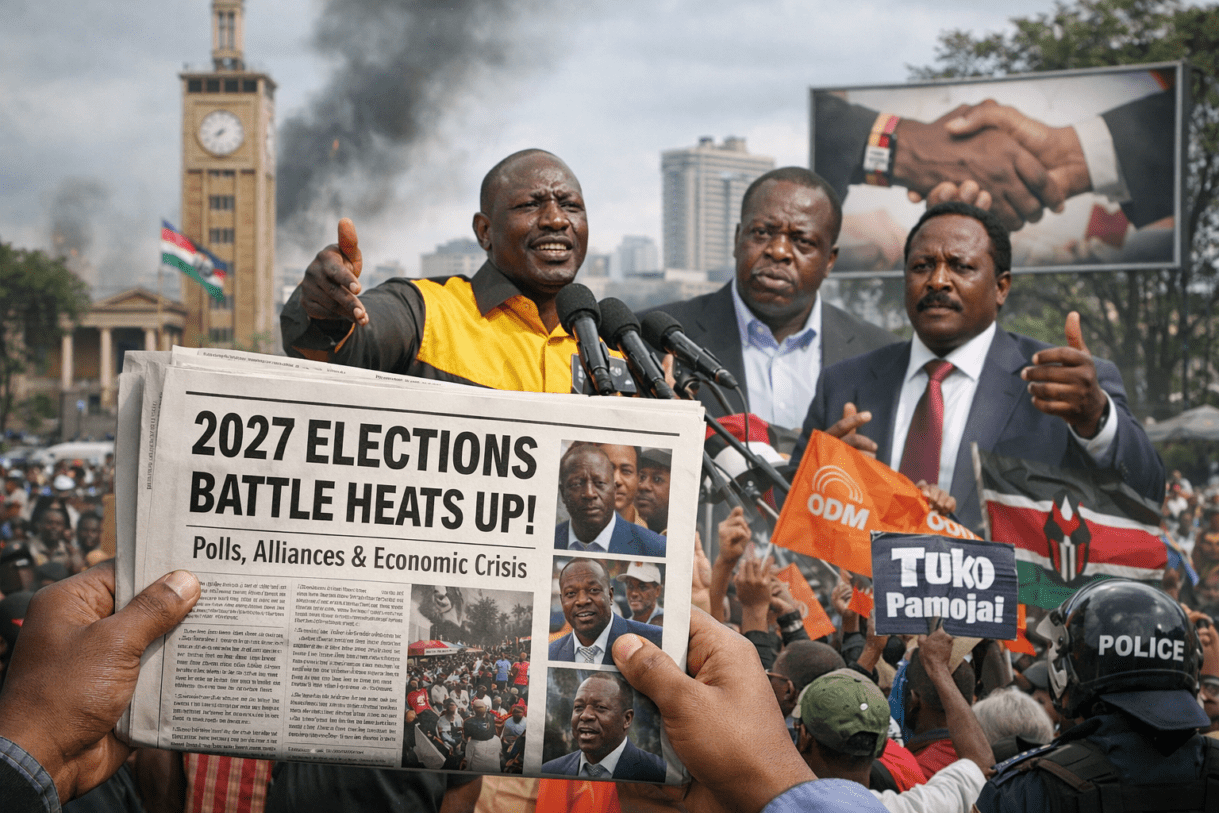
Kenya’s political landscape has entered a new and restless phase. With the 2027 General Election still more than a year away, the country is already deep in a season of positioning, polling, alliance-testing, and narrative warfare. What is striking is not just who is leading in early opinion surveys, but how politics itself is being reshaped — by economic pressures, shifting regional loyalties, institutional tensions, and a growing public demand for accountability.
Unlike previous election cycles, the current political moment is less about grand rallies and more about subtle recalibrations: influence measured in polls, power expressed through parliamentary arithmetic, and legitimacy contested in the court of public opinion. From State House to opposition benches, and from county power brokers to online political spaces, Kenya’s politics is in motion — and the direction it takes will determine not just the 2027 outcome, but the nature of governance in the years ahead.
This article examines the key forces currently shaping Kenyan politics: leadership perception, polling trends, regional dynamics, the broad-based government experiment, parliamentary power struggles, and the growing role of public sentiment in redefining political legitimacy.
A Presidency Under the Microscope
President William Ruto remains the central figure in Kenya’s political story. Nearly halfway through his first term, his leadership continues to command attention — and controversy. Recent opinion polls place him ahead of potential challengers in hypothetical presidential match-ups, but the margins are not commanding. Instead, they reflect a fragmented electorate still weighing performance against promises.
Ruto’s political strength lies in his mastery of political survival. He has demonstrated an ability to absorb pressure, reframe criticism, and maintain relevance even during moments of intense public dissatisfaction. However, the political environment he operates in is far more unforgiving than during his rise to power. High cost of living, taxation debates, public debt, and unemployment have reshaped the expectations Kenyans place on leadership.
Unlike earlier administrations that enjoyed long honeymoon periods, Ruto’s presidency has unfolded under constant scrutiny. Every policy move — from fiscal reforms to social protection programs — is evaluated not just on intent, but on immediate impact. This has turned governance into a daily political contest rather than a long-term policy project.
Yet despite these pressures, the president retains a strong national footprint. His support cuts across traditional regional blocs, signaling a shift away from purely ethnic arithmetic toward performance-based evaluation — even if imperfectly applied.
Polls, Perception, and the Power of Early Momentum
Opinion polls have become one of the most influential political tools in Kenya’s current cycle. While critics argue that early polling can be misleading, political actors treat them as signals — shaping strategy, alliances, and messaging.
Recent surveys suggest a competitive field rather than a dominant frontrunner. While Ruto leads in several polls, the combined opposition figures represent a significant portion of the electorate. This suggests that the next election may be decided not by popularity alone, but by turnout, coalition discipline, and narrative coherence.
What is notable is the growing importance of perceived influence rather than formal office. Governors, senators, and vocal Members of Parliament are increasingly ranking high in regional influence surveys, reflecting the decentralization of political power since devolution. In regions like Western Kenya, Rift Valley, and parts of Coast, local leaders now command loyalty that once belonged almost exclusively to national figures.
This shift complicates national campaigns. Presidential aspirants can no longer rely on single kingpins to deliver entire regions. Instead, they must navigate complex local alliances, policy expectations, and generational divides.
The Broad-Based Government Experiment
One of the most consequential developments in Kenya’s recent political history has been the emergence of a broad-based government arrangement between traditionally opposing forces. Designed to stabilize the country after prolonged political tensions, the arrangement has reshaped both governance and opposition politics.
Supporters argue that the broad-based approach has reduced street protests, calmed markets, and allowed government to function without constant political paralysis. They see it as a pragmatic response to Kenya’s deeply polarized political culture — one that prioritizes stability over confrontation.
Critics, however, view the arrangement as a betrayal of democratic accountability. They argue that it has weakened opposition oversight, blurred ideological lines, and concentrated power in ways that undermine checks and balances. For many Kenyans, the absence of a visibly robust opposition has raised concerns about who holds the government accountable when things go wrong.
Public opinion on the arrangement remains divided. Some surveys indicate modest increases in support, particularly among voters fatigued by political conflict. Others show persistent skepticism, especially among younger voters who view political cooperation as elite self-preservation rather than public service.
What is clear is that the broad-based model has altered Kenya’s political geometry. It has forced politicians to rethink their roles, reposition their rhetoric, and appeal to voters who are increasingly suspicious of political convenience.
Parliament: Power Struggles and Legal Battles
Away from rallies and press conferences, some of Kenya’s most significant political battles are unfolding in Parliament and the courts. Disputes over majority status, committee leadership, and legislative influence have exposed the fragile nature of political coalitions.
Court rulings on parliamentary majority have not only shifted legislative arithmetic but also exposed how legal interpretation has become a political tool. These disputes are about more than numbers; they shape who controls the legislative agenda, who chairs key committees, and whose bills move forward.
For the public, these battles often appear detached from daily struggles. However, their impact is real. Parliamentary control influences taxation laws, budget priorities, and oversight of public spending — all issues that directly affect citizens’ lives.
The challenge for lawmakers is credibility. As Kenyans grapple with rising living costs, political infighting risks reinforcing the perception that leaders are more focused on power than service.
Regional Politics and the Rise of Local Power Centers
Devolution has fundamentally changed Kenyan politics, and its effects are becoming more pronounced as the election cycle advances. Governors and county leaders are no longer junior partners in national politics; they are power centers in their own right.
In several regions, governors now enjoy approval ratings that rival or surpass national figures. This has shifted political bargaining power downward, forcing presidential hopefuls to engage in more nuanced, localized campaigns.
Regional politics is also becoming more issue-driven. Infrastructure, healthcare, agriculture, and revenue allocation dominate local discourse, sometimes overshadowing national ideological debates. This creates both opportunity and risk for national leaders: those who align their agenda with county priorities stand to gain, while those who ignore local concerns risk rejection.
At the same time, regional influence is no longer static. Urbanization, youth migration, and digital activism are reshaping traditional voting patterns. Counties once considered politically predictable are showing signs of volatility, making electoral forecasting more complex than ever.
The Economy as a Political Battleground
No issue shapes Kenyan politics more powerfully than the economy. Inflation, taxation, job creation, and debt management dominate political conversations across social classes.
Economic indicators suggest pockets of resilience — particularly in the private sector — but these macro-level signals often clash with lived experience. For many households, the cost of basic goods remains high, and wage growth has not kept pace with inflation. This disconnect fuels political frustration and skepticism toward official narratives.
Political actors understand this reality. Economic messaging has become sharper, more emotional, and more localized. Leaders are increasingly judged not by long-term plans but by immediate relief measures. Promises of future growth must now compete with demands for present-day survival.
This dynamic favors leaders who can communicate empathy as well as policy. Technocratic explanations alone are no longer sufficient; voters want to feel seen and understood.
Media, Narratives, and the Digital Battlefield
Kenya’s political discourse is increasingly shaped online. Social media platforms have become arenas for political branding, criticism, satire, and mobilization. Nicknames, memes, and viral clips often carry as much influence as formal speeches.
This digitalization of politics has lowered barriers to participation but also intensified polarization. Misinformation spreads quickly, while nuanced debate struggles to gain traction. Political actors invest heavily in online presence, recognizing that narrative control can shape perception long before ballots are cast.
Traditional media remains influential, but it now competes with decentralized digital voices. Bloggers, activists, and citizen journalists play a growing role in agenda-setting, particularly among younger voters.
For politicians, this environment is both an opportunity and a risk. Authentic engagement can build trust, but missteps are amplified instantly and remembered indefinitely.
Opposition Identity in a Changing Landscape
With traditional lines blurred by cooperation and realignment, the concept of opposition in Kenya is evolving. Rather than a single unified force, opposition now appears fragmented — expressed through issue-based criticism, civil society activism, and dissent within government ranks.
This decentralization of opposition raises important questions. Can accountability function without a clearly defined alternative government? Or does Kenya need to rethink what opposition looks like in a multi-party, coalition-driven system?
Some analysts argue that the future of opposition lies less in personalities and more in movements — around cost of living, governance transparency, youth employment, and constitutionalism. If so, political legitimacy may increasingly be earned outside Parliament and beyond party structures.
Youth, Apathy, and Political Re-Engagement
Kenya’s youth population remains one of its most politically significant — and unpredictable — demographics. While young people have historically driven change, recent cycles have seen rising apathy fueled by unemployment, disillusionment, and perceived elite capture of politics.
However, this apathy should not be mistaken for disengagement. Youth activism has shifted forms, moving from rallies to digital spaces, from party loyalty to issue advocacy. When mobilized, young voters can still reshape outcomes — but they demand authenticity, accountability, and tangible results.
Any serious 2027 strategy must address this demographic not as a voting bloc, but as partners in shaping the future.
What Lies Ahead
Kenya’s political moment is defined by uncertainty — but also possibility. The next year will test whether the country’s leaders can rise above tactical maneuvering and address the deeper questions facing the nation: economic justice, institutional trust, and democratic accountability.
Early polls offer hints, not verdicts. Alliances may shift, narratives may collapse, and new voices may emerge. What remains constant is the electorate’s growing insistence on results over rhetoric.
As Kenya moves closer to 2027, politics will become louder, sharper, and more contested. But beneath the noise lies a clear message from the public: leadership is no longer about survival alone. It is about service, credibility, and the ability to navigate complexity without losing the people along the way.
The coming months will reveal who truly understands that message — and who underestimates it.

Support Our Website!
We appreciate your visit and hope you find our content valuable. If you’d like to support us further, please consider contributing through the TILL NUMBER: 9549825. Your support helps us keep delivering great content!
If you’d like to support Nabado from outside Kenya, we invite you to send your contributions through trusted third-party services such as Remitly, western union, SendWave, or WorldRemit. These platforms are reliable and convenient for international money transfers.
Please use the following details when sending your support:
Phone Number: +254701838999
Recipient Name: Peterson Getuma Okemwa
We sincerely appreciate your generosity and support. Thank you for being part of this journey!