

simply amazing, always for you.
A Moment That Shook Military Confidence
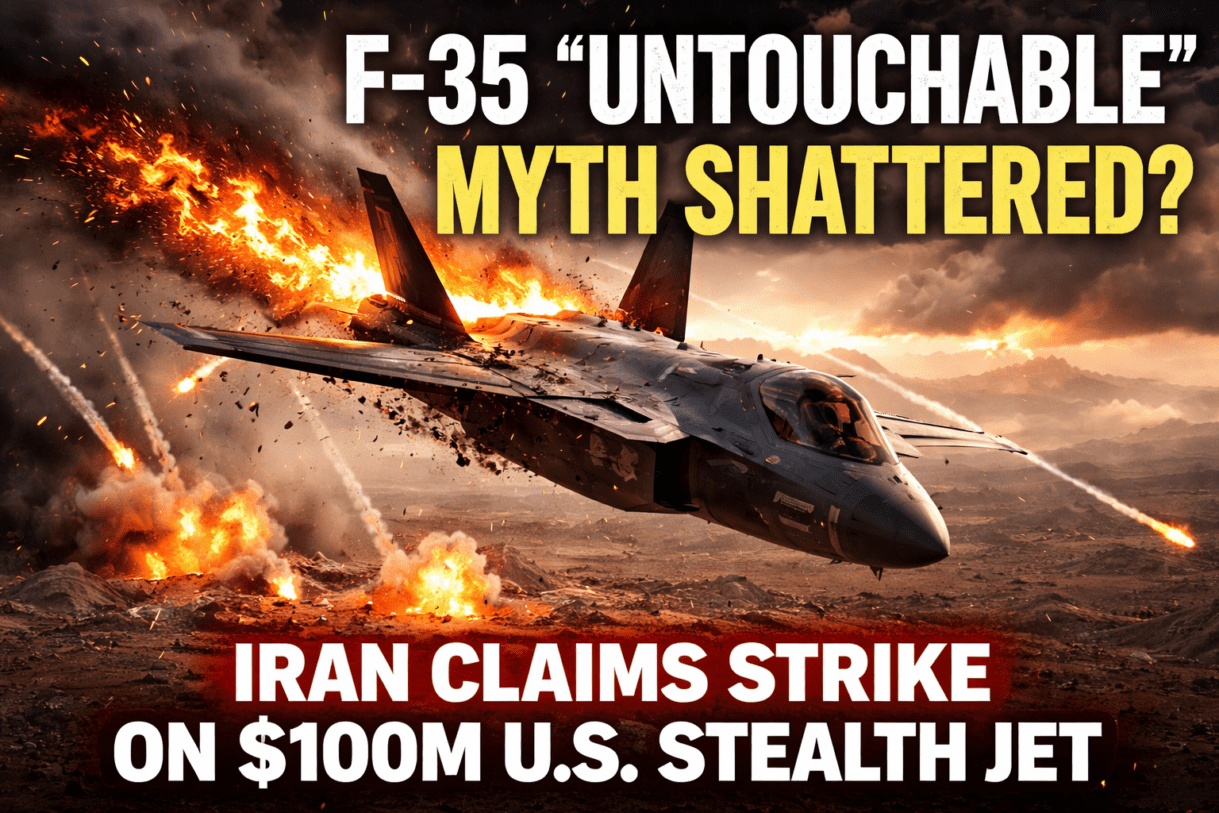
For decades, the F-35 Lightning II has been marketed as nearly untouchable—a machine engineered to slip through enemy defences, evade radar, and dominate modern battlefields. But a sudden incident over Iran has disrupted that narrative in a way few expected.
A U.S. F-35, returning from a combat mission over Iranian territory, was forced into an emergency landing at a U.S. base in the Middle East. According to officials from United States Central Command, the pilot survived and is in stable condition. That much is confirmed.
What remains unclear—and deeply controversial—is what caused the emergency.
Did Iran manage to hit one of the most advanced fighter jets ever built?
If true, the implications stretch far beyond a single aircraft. They strike at the heart of modern military doctrine.
The Official Line vs. The Real Questions
Public statements have been cautious.
U.S. military officials have not confirmed that the aircraft was shot down or directly struck by Iranian air defences. Instead, they’ve described the incident as under investigation. However, multiple defence reports suggest the aircraft may have sustained damage during its mission.
On the other side, Iranian sources have moved quickly to claim success. State-linked narratives assert that Iran’s air defence systems successfully targeted the stealth jet—an assertion that, if validated, would mark the first known combat hit on an operational F-35.
Between these two positions lies a fog of war filled with speculation, intelligence gaps, and strategic messaging.
But analysts are focusing on one specific possibility that is gaining traction: the idea that Iran didn’t defeat the F-35 with superior technology—but with a smarter application of simpler tools.
The “Hi-Tech vs Low-Tech” Reality
To understand why this incident is so significant, you have to understand how stealth works—and more importantly, how it doesn’t.
The F-35 is designed primarily to evade radar. Its shape, materials, and coatings reduce its radar cross-section, making it extremely difficult for traditional radar systems to detect or track it.
But stealth is not invisibility.
Every jet engine produces heat. And heat can be tracked.
This is where the concept of passive infrared detection becomes critical.
The Hidden Weakness: Infrared Signature
Even the most advanced stealth aircraft cannot hide from physics.
Jet engines generate intense thermal signatures. These heat emissions can be detected by systems designed to track infrared radiation rather than radio waves.
Unlike radar systems, infrared tracking systems do not emit signals. They are passive. That means:
- They cannot be easily detected by incoming aircraft
- They are difficult to jam or deceive
- They provide minimal warning to pilots
This type of system is often referred to as IRST (Infrared Search and Track).
And it may be the key to understanding what happened over Iran.
Iran’s Evolving Air Defence Strategy
Iran has spent years developing a layered air defence network. While it may not match the technological sophistication of U.S. systems on paper, it has focused on asymmetry—finding ways to counter superior technology with unconventional methods.
One such approach involves integrating passive detection systems into air defense networks.
Rather than relying solely on radar, Iran has reportedly deployed systems capable of detecting aircraft through heat signatures. These systems are harder to suppress and can operate without revealing their position.
This strategy has already been tested in real-world conflict zones.
Lessons From Yemen: A Warning Ignored?
In Yemen, Iran-backed Houthi forces have demonstrated the ability to challenge advanced aerial platforms using relatively low-cost systems.
These forces have used passive detection methods to track drones and aircraft, sometimes with surprising effectiveness. While the scale and sophistication differ from a direct confrontation with U.S. forces, the underlying principle remains the same:
If you can’t see stealth aircraft with radar, look for what they cannot hide—their heat.
Many defense analysts warned that this approach could eventually be applied at a higher level. The incident involving the F-35 may be the first indication that those warnings were not theoretical.
What Likely Happened Over Iran
While the full details remain classified or unconfirmed, a plausible operational scenario is emerging based on available information and known capabilities.
- The F-35 enters contested airspace, relying on its stealth profile to avoid radar detection.
- Iranian defence systems, possibly using passive infrared sensors, detect the aircraft’s heat signature.
- The aircraft is tracked without triggering conventional radar warning systems.
- A missile system—potentially guided by infrared or combined targeting methods—is launched.
- The aircraft sustains damage but remains controllable.
- The pilot executes an emergency landing at a nearby U.S. base.
This scenario aligns with both the U.S. acknowledgment of an emergency landing and Iran’s claim of a successful engagement—without requiring confirmation of a shootdown.
Why This Changes Everything
Even the possibility that an F-35 was successfully targeted carries enormous implications.
1. The End of Absolute Stealth
For years, stealth technology has been treated as a near-guarantee of survivability in contested airspace. This incident suggests that assumption may no longer hold.
Stealth reduces detection—it does not eliminate it.
Future aircraft will need to address not just radar visibility, but infrared and multi-spectrum detection as well.
2. The Rise of Passive Warfare
The shift from active to passive detection systems represents a fundamental change in air defence philosophy.
Passive systems:
- Are harder to detect
- Cannot be easily jammed
- Provide a strategic advantage against stealth platforms
This makes them particularly attractive to countries facing technologically superior adversaries.
3. Cost Asymmetry Becomes a Strategic Weapon
An F-35 costs roughly $80–100 million per unit, depending on configuration.
Infrared detection systems and associated missile platforms can be significantly cheaper.
This creates a dangerous imbalance:
A relatively low-cost defence system can threaten a high-value asset.
In strategic terms, that changes the economics of air warfare.
4. Psychological and Political Impact
Beyond the technical aspects, the psychological effect of the incident cannot be overstated.
The F-35 has been a symbol of U.S. military dominance. Any perceived vulnerability—even if limited—can:
- Embolden adversaries
- Undermine deterrence
- Trigger political debates over defence spending
For Iran, even the claim of hitting an F-35 is a propaganda victory.
For the United States, it raises uncomfortable questions.
The Fog of Information Warfare
It is important to recognize that both sides have strong incentives to shape the narrative.
The United States may downplay the incident to maintain confidence in its capabilities.
Iran may exaggerate its success to project strength and deterrence.
The truth likely lies somewhere in between.
What is clear is that the incident is real, the emergency landing occurred, and the circumstances remain under investigation.
How the U.S. Military Might Respond
If the incident is confirmed to involve a successful engagement by Iranian systems, several responses are likely.
Enhanced Countermeasures
Future missions may incorporate improved infrared suppression technologies, including:
- Engine cooling techniques
- Heat-diffusing exhaust systems
- Advanced countermeasure flares
Tactical Adjustments
Mission profiles may change to reduce exposure, including:
- Higher-altitude operations
- Increased reliance on stand-off weapons
- Greater use of electronic warfare support
Technology Development
Long-term, the focus will shift toward:
- Multi-spectrum stealth capabilities
- AI-assisted threat detection
- Next-generation aircraft designs
The Broader Geopolitical Context
This incident does not exist in isolation.
Tensions between the United States and Iran have been escalating, with increasing military activity in the region.
Any direct engagement—even a limited one—carries the risk of escalation.
If Iran has demonstrated an ability to challenge U.S. air superiority, it could alter the strategic balance in the Middle East.
Allies and adversaries alike will be watching closely.
What Experts Are Saying
Defence analysts are divided.
Some argue that the incident is being overhyped, noting that:
- The aircraft was not shot down
- Emergency landings can result from multiple causes
- Stealth aircraft have always had known limitations
Others see it as a warning sign:
- A proof of concept for anti-stealth tactics
- Evidence of evolving air defence strategies
- A potential turning point in modern warfare
The debate is ongoing—and far from settled.
The F-35 emergency landing after a mission over Iran is more than just an isolated incident.
It is a moment that exposes the evolving nature of warfare, where technological superiority is no longer absolute and innovation often comes from unexpected directions.
Whether the aircraft was directly hit or not, the mere possibility that it could be tracked and targeted using non-traditional methods is enough to trigger a reassessment of long-held assumptions.
The age of stealth dominance may not be over—but it is no longer uncontested.
SUGGESTED READS
- The 3-Meter Mistake That Almost Cost Her Life
- Winnie Odinga Nomination Creates Turmoil as Babu Owino Challenges Leadership Move
- Top U.S. Intelligence Chief Quits Over Iran War as Middle East Erupts
- How Sharp Boys Trick Young Kenyans Into Losing Big Money Online
- The Pressure to Appear Successful in Kenya
- Why ‘Going Abroad’ Has Become the Biggest Dream for Young Kenyans
- The Plane Kenyans Couldn’t Stop Watching

Support Our Website!
We appreciate your visit and hope you find our content valuable. If you’d like to support us further, please consider contributing through the TILL NUMBER: 9549825. Your support helps us keep delivering great content!
If you’d like to support Nabado from outside Kenya, we invite you to send your contributions through trusted third-party services such as Remitly, western union, SendWave, or WorldRemit. These platforms are reliable and convenient for international money transfers.
Please use the following details when sending your support:
Phone Number: +254701838999
Recipient Name: Peterson Getuma Okemwa
We sincerely appreciate your generosity and support. Thank you for being part of this journey!