

simply amazing, always for you.
The Selfie That Almost Cost a Life
What began as a breathtaking winter getaway in the snow-covered mountains of Xinjiang quickly spiraled into a scene of terror that has since shocked the world.
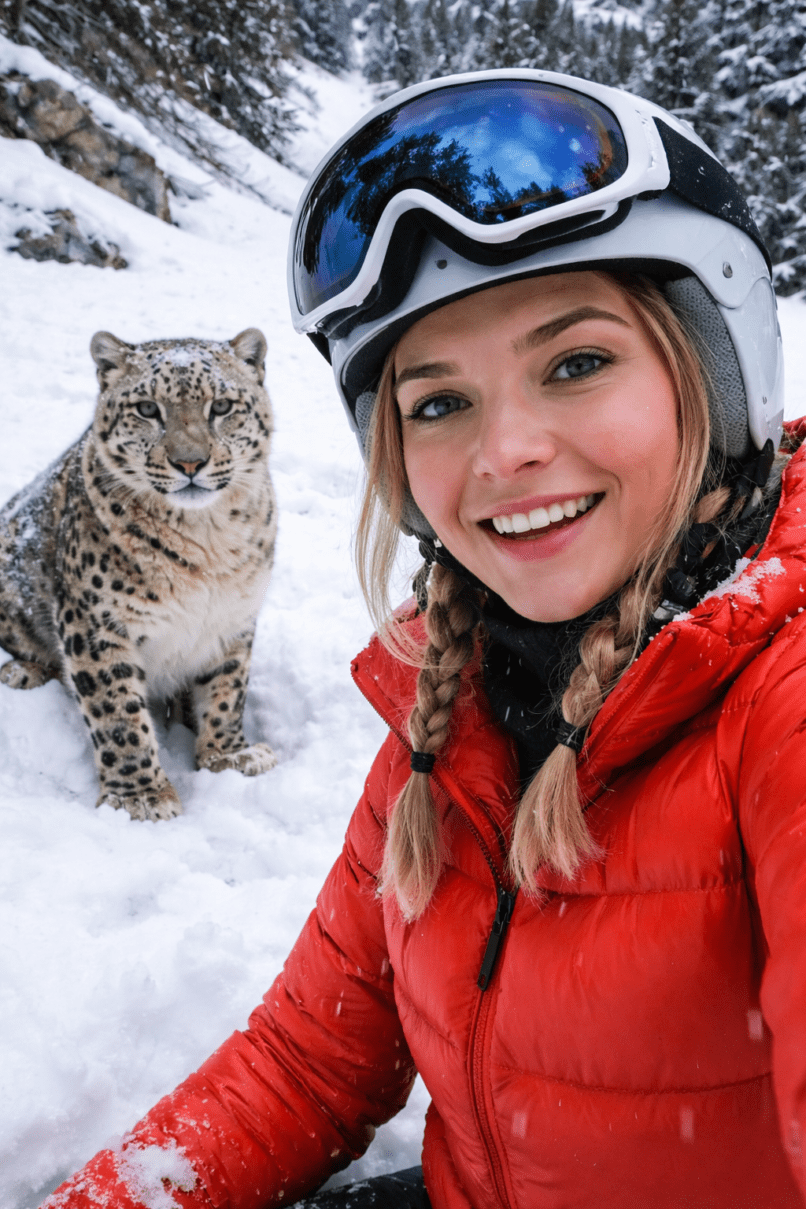
A female tourist, enjoying a ski holiday in one of China’s most scenic alpine destinations, came face-to-face with one of nature’s most elusive predators — the snow leopard.
Instead of backing away, she stepped closer.
Moments later, she was fighting for her life.
This is the chilling story of how a single decision — driven by curiosity, excitement, and the urge to capture the perfect photo — turned into a violent wildlife attack that is now serving as a global warning.
A Rare Encounter Turns Dangerous
The incident occurred near a ski resort in the remote Koktokay region, an area known for its pristine snowfields and occasional sightings of rare wildlife.
Snow leopards are famously elusive. Many wildlife enthusiasts spend years hoping to catch even a glimpse of one in the wild. So when the animal appeared, calmly resting in the snow, it felt like a once-in-a-lifetime opportunity.
Witnesses say the leopard was not behaving aggressively. It appeared relaxed, almost indifferent to the humans nearby.
But what happened next changed everything.
“Don’t Go Closer” — The Warning That Was Ignored
According to eyewitness accounts, several people at the scene warned the woman not to approach the animal.
They knew the risk.
They understood the unpredictability of wild predators.
But in an age where every moment is documented, shared, and validated online, the temptation proved too strong.
The tourist moved closer — reportedly within just a few meters — raising her phone to capture a photo.
It was a critical mistake.
The Attack: Seconds That Felt Like Forever
Without warning, the snow leopard lunged.
What had been a calm and almost surreal encounter turned instantly violent.
The animal struck with speed and precision — a reminder that even the most elusive predators are built for lethal efficiency. It knocked the woman to the ground and began attacking her head and face.
Witnesses described the moment as chaotic and horrifying.
Some froze.
Others screamed.
A few attempted to intervene.
But for those brief seconds, the situation was completely out of control.
A Brave Rescue Amid Chaos
In what many are calling a heroic act, a nearby ski instructor rushed toward the scene armed with nothing but ski poles.
Facing down one of the world’s most powerful wild cats is not something most people would dare attempt.
But hesitation could have cost the woman her life.
The instructor struck at the animal, creating enough distraction and fear to force it to retreat. The snow leopard eventually backed away, disappearing into the snowy terrain as quickly as it had attacked.
The woman was left injured, bleeding, and in urgent need of medical attention.
A Fight for Survival
Emergency responders moved quickly.
The victim was transported to a nearby medical facility where doctors worked to stabilize her condition. Reports indicate she suffered serious injuries to her face and head — areas commonly targeted by big cats during attacks.
Despite the severity of the assault, she survived.
But survival came at a cost.
Physical scars may heal over time. Psychological trauma, however, can linger much longer.
Why Snow Leopards Rarely Attack Humans
The snow leopard is often referred to as the “ghost of the mountains” — not just because of its camouflage, but because of how rarely it is seen.
Unlike other big cats such as lions or tigers, snow leopards are not known to prey on humans. In fact, documented attacks are extremely rare.
So why did this one happen?
Wildlife experts point to a simple explanation: proximity and perceived threat.
When a human enters a predator’s comfort zone, especially without caution, the animal may interpret the situation as dangerous.
In this case, the leopard likely reacted defensively.
The Psychology Behind Risky Wildlife Encounters
This incident highlights a growing global issue: risky human behavior around wildlife.
From safaris in Africa to national parks in North America, tourists are increasingly pushing boundaries for photos, videos, and social media content.
There is a psychological component at play:
- The illusion of control
- The belief that “nothing will happen”
- The normalization of close encounters through viral content
When people see others take similar risks online without consequences, it lowers their perception of danger.
Until something goes wrong.
Social Media: Fueling Dangerous Decisions?
The rise of social media has changed how people experience travel.
Moments are no longer just lived — they are curated.
A rare animal sighting is no longer just a memory; it’s a potential viral post.
And that pressure can lead to poor judgment.
Experts warn that the pursuit of the “perfect shot” is increasingly putting both humans and animals at risk.
In this case, a few extra steps forward turned a magical encounter into a life-threatening situation.
Authorities Had Already Issued Warnings
What makes this incident even more troubling is that local authorities had reportedly warned visitors about snow leopard sightings in the area.
These warnings are not issued lightly.
They are based on tracking data, animal behavior patterns, and risk assessments.
Ignoring them is not just careless — it can be deadly.
The Thin Line Between Awe and Danger
Wild animals inspire awe.
They represent freedom, power, and the raw beauty of nature.
But they are not performers.
They are not domesticated.
And they do not follow human expectations.
The moment humans forget this, the balance shifts — often with devastating consequences.
Lessons From the Attack
This incident offers several critical lessons that extend far beyond one location or species.
1. Wild Means Unpredictable
No matter how calm an animal appears, its behavior can change instantly.
2. Distance Is Safety
Maintaining a safe distance is the simplest and most effective way to avoid danger.
3. Warnings Exist for a Reason
Ignoring official guidance can have serious consequences.
4. Photos Are Not Worth Your Life
No image, no matter how stunning, is worth risking personal safety.
A Global Wake-Up Call
This story has resonated worldwide not just because of its shock value, but because it reflects a broader trend.
Human-wildlife interactions are increasing.
Tourism is expanding into remote areas.
And technology is encouraging closer, riskier encounters.
Without awareness and restraint, similar incidents are likely to happen again.
The Aftermath: What Happens Next?
Authorities are now reviewing safety protocols in the area.
There may be stricter enforcement of wildlife distance rules, increased signage, and possibly restricted access to certain zones.
For the snow leopard, the outcome is less clear.
In many parts of the world, animals involved in attacks are tracked, relocated, or in some cases, euthanized — even when human actions triggered the incident.
This raises ethical questions about responsibility and coexistence.
The Human Cost vs. The Animal’s Fate
One of the most difficult aspects of such incidents is determining accountability.
Should the animal be punished for behaving naturally?
Or should responsibility lie entirely with the human who ignored warnings?
Conservationists argue that these situations often end unfairly for wildlife.
The animal acts on instinct.
The human makes a choice.
Yet the animal often pays the ultimate price.
The Bigger Picture: Coexisting With Nature
As human activity expands into natural habitats, encounters like this will become more common.
The challenge is not to eliminate these interactions, but to manage them responsibly.
This requires:
- Education
- Respect for wildlife
- Stronger enforcement of safety rules
- Personal accountability
Without these, the risks will only grow.
A Moment That Changed Everything
For the tourist involved, this was supposed to be a memorable holiday.
And it was — but not in the way she imagined.
A single decision, made in seconds, led to consequences that will last a lifetime.
The story is dramatic. It’s shocking. It’s viral.
But at its core, it is a cautionary tale.
Nature is not a backdrop for content.
It is powerful, unpredictable, and deserving of respect.
And sometimes, the difference between a beautiful memory and a tragic headline is just a few steps too close.
SUGGESTED READS
- Winnie Odinga Nomination Creates Turmoil as Babu Owino Challenges Leadership Move
- “You Are Too Thin” – Gachagua’s Jab That Sparked Fresh Debate
- Top U.S. Intelligence Chief Quits Over Iran War as Middle East Erupts
- Why Your Brain Struggles to Let Go After a Breakup
- How Sharp Boys Trick Young Kenyans Into Losing Big Money Online
- The Pressure to Appear Successful in Kenya

Support Our Website!
We appreciate your visit and hope you find our content valuable. If you’d like to support us further, please consider contributing through the TILL NUMBER: 9549825. Your support helps us keep delivering great content!
If you’d like to support Nabado from outside Kenya, we invite you to send your contributions through trusted third-party services such as Remitly, western union, SendWave, or WorldRemit. These platforms are reliable and convenient for international money transfers.
Please use the following details when sending your support:
Phone Number: +254701838999
Recipient Name: Peterson Getuma Okemwa
We sincerely appreciate your generosity and support. Thank you for being part of this journey!