

simply amazing, always for you.
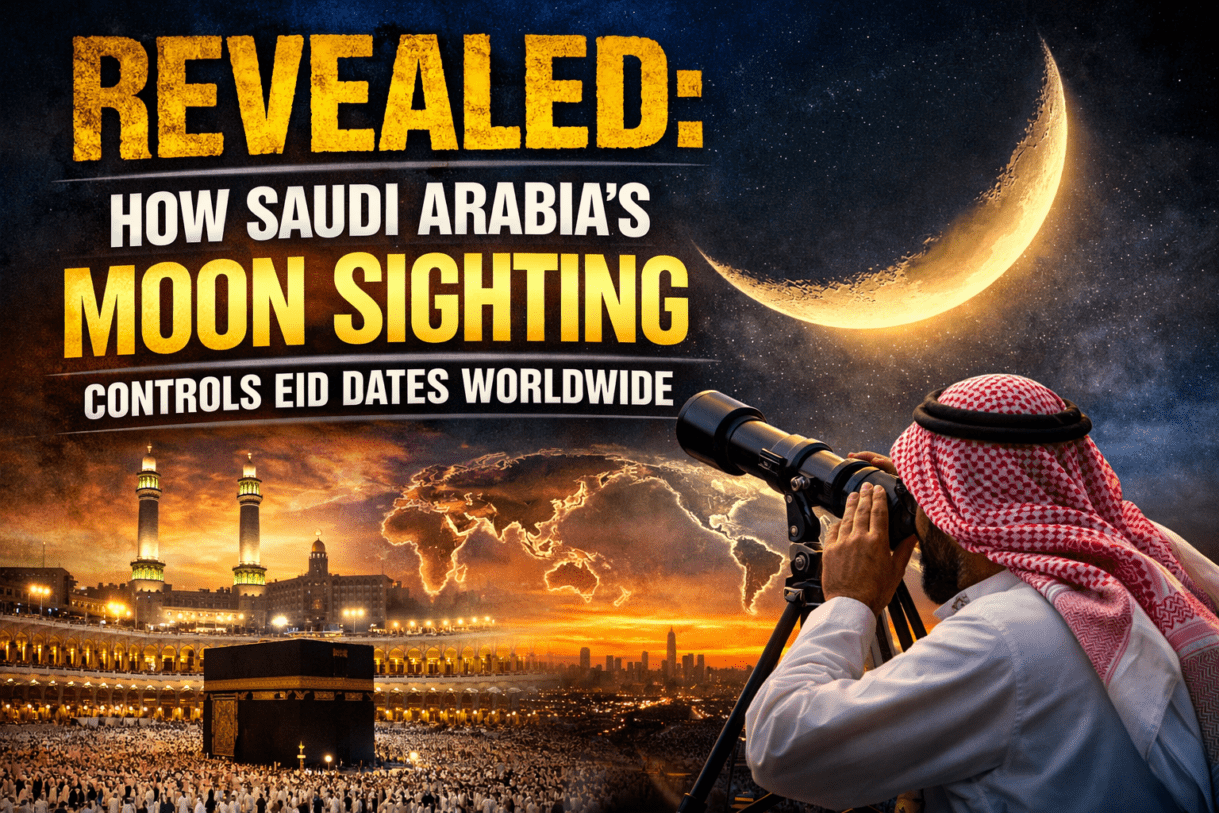
As millions of Muslims around the world prepare for the end of Ramadan, one question resurfaces every year: why do Eid dates depend on the moon? The answer is both simple and deeply rooted in Islamic tradition, scripture, and centuries‑old practice.
With social media speculation growing each Ramadan, it is time to clarify—accurately and accessibly—why the lunar cycle remains the central mechanism for determining Eid‑ul‑Fitr and Eid‑ul‑Adha dates across the Muslim world.
The Islamic Calendar Is Lunar
The Islamic calendar does not follow the familiar Gregorian system of fixed 12‑month solar years. Instead, it is a lunar calendar, based entirely on the phases of the moon. Each month begins only after the new crescent moon (hilal) is observed following sunset.
This simple rule has profound implications. While the Gregorian year has 365 days, the lunar year has approximately 354 days. As a result, Islamic months, and the religious observances tied to them, shift earlier by about 11 days each calendar year.
This is why Ramadan — and the subsequent Eid — appears to “move” through different seasons across decades.
Moon Sighting Determines the Start of Islamic Months
For Muslims, the start of an important month such as Shawwal — the month that begins immediately after Ramadan — can only be confirmed when the new crescent moon is sighted. If the hilal is sighted on the 29th day of Ramadan, the month ends and Eid‑ul‑Fitr is celebrated the following day. If the moon is not seen, Ramadan continues for a full 30 days, with Eid the day after.
The same principle applies to Dhu al‑Hijjah, the month in which Eid‑ul‑Adha is observed. The decisive factor is always the visibility of the new moon.
This method is not arbitrary. It is based on Islamic jurisprudence and is reinforced by text in the Quran, which directs believers to use the moon’s phases as a calendar for timekeeping and religious obligations.
Scripture and Tradition
The Quran mentions the function of the moon in organizing time:
“They ask you about the new moons. Say: They are measurements of time for the people and for Hajj.”
The implication is clear: lunar observation is not merely cultural, it is a religious directive.
For centuries, Muslim communities looked to the sky each month to confirm the new crescent. In modern times, religious authorities in many countries deploy trained observers and scientific tools to join tradition with technology.
Why Eid Can Fall on Different Days in Different Countries
International Muslim communities do not always begin Eid on the same day. The reason is straightforward: moon sighting outcomes can vary geographically.
In some regions, the new crescent will be visible whereas in others it will not, due to differences in weather, horizon conditions, and latitude. Consequently:
- Some countries rely strictly on local moon sightings.
- Others accept regional or global sightings.
- Some Muslim communities use astronomical calculations to predict visibility in advance.
These differing methodologies explain why Muslims in East Africa may celebrate Eid on a different day from those in the Middle East or the Indian subcontinent.
Saudi Arabia’s Role and Global Influence
Saudi Arabia, home to Islam’s two holiest cities, traditionally announces the sighting of the moon through official government committees. These announcements have wide influence globally because of the Kingdom’s central religious role and because millions of Muslims perform Hajj and Umrah there.
Many Muslim communities, particularly in Africa and Asia, follow Saudi Arabia’s official Eid declaration as a unifying reference point. Still, local religious councils retain authority to determine their own dates based on their own moon sighting reports.
The Ongoing Debate: Sighting Versus Calculation
A long‑standing debate within the Muslim world concerns whether Eid dates should be based solely on physical moon sightings or whether astronomical calculations should play a larger role. Proponents of calculation point to scientific precision and predictability. Traditionalists argue that physical sighting preserves the spirit and intent of Islamic practice.
Both approaches aim for religious authenticity, but they differ over methodology, leading to variations in date announcements from country to country.
What This Means for Kenyan Muslims
As Eid approaches, Kenyan Muslim communities will be watching for announcements from authoritative bodies such as the Kenya Supreme Council of Islamic Affairs (KSCIA), which has historically taken a cautious approach, relying primarily on confirmed sighting reports in the region.
Understanding why moon sighting remains central helps explain why Eid cannot be fixed on a single Gregorian date — and why community leaders emphasize patience and observance over calendar predictions.
The moon matters because Islam’s calendar literally depends on it.
Eid celebrations, deeply significant yet mobile across the Gregorian calendar, are anchored to a system that honours centuries‑old tradition and religious scripture.
As the crescent moon once again emerges on the horizon this season, it will bring with it the joyous declaration of Eid — a reminder that time itself, in this tradition, is watched not by watches but by the sky.
SUGGESTED READS
- Why Many Young Kenyans Are Delaying Marriage
- “What Will People Say?” — The Question Quietly Controlling Millions of Kenyans
- Kenya’s Silent Mental Health Crisis: Why Millions Are Struggling in Silence
- In Kenya, Success Comes With Expectations — Here’s Why
- Young, Ambitious, and Struggling: The True Story of Kenya’s Youth
Support Our Website!
We appreciate your visit and hope you find our content valuable. If you’d like to support us further, please consider contributing through the TILL NUMBER: 9549825. Your support helps us keep delivering great content!
If you’d like to support Nabado from outside Kenya, we invite you to send your contributions through trusted third-party services such as Remitly, western union, SendWave, or WorldRemit. These platforms are reliable and convenient for international money transfers.
Please use the following details when sending your support:
Phone Number: +254701838999
Recipient Name: Peterson Getuma Okemwa
We sincerely appreciate your generosity and support. Thank you for being part of this journey!