

simply amazing, always for you.
The Truth We Often Ignore
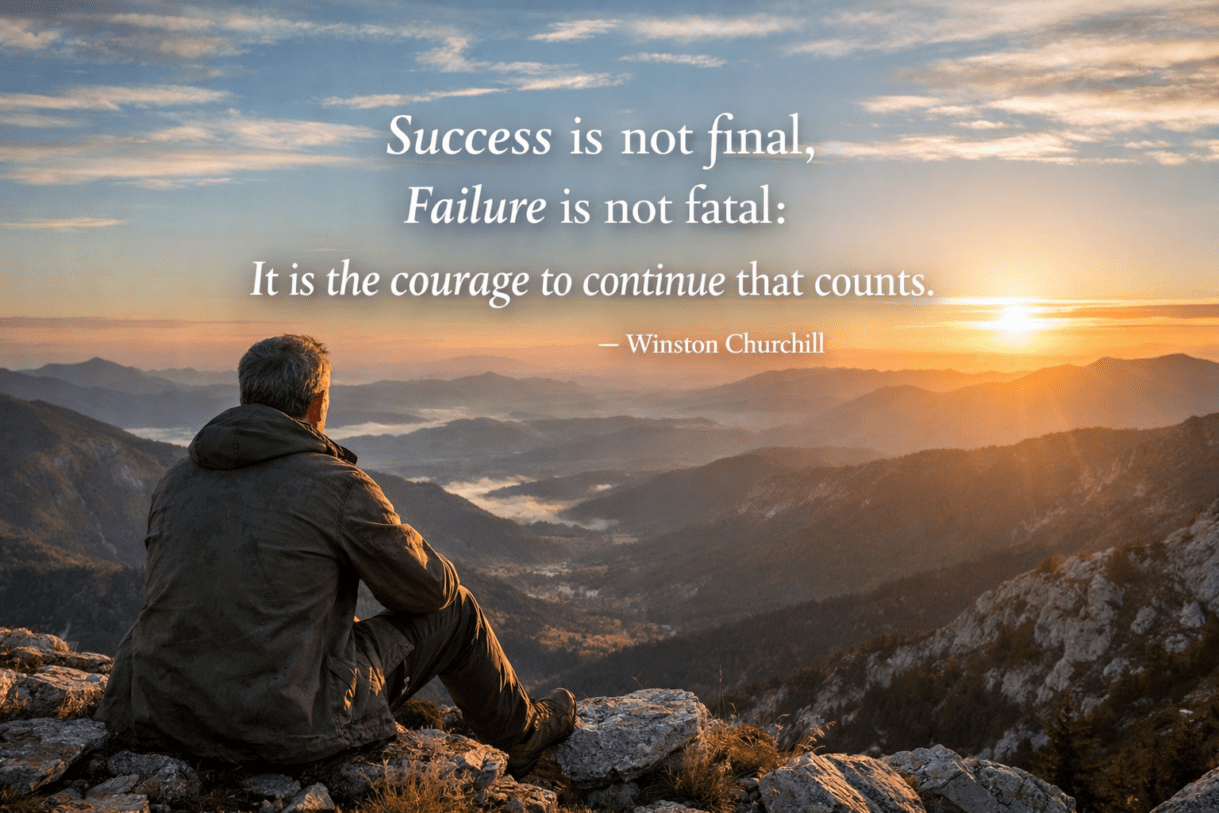
“Success is not final, failure is not fatal: it is the courage to continue that counts.”
At first glance, this quote feels simple and motivational. But when you slow down and examine it closely, it reveals a profound truth about how life actually works. Most people spend their lives chasing success as if it’s a permanent state and avoiding failure as if it’s a permanent scar. This mindset is not only flawed—it is dangerous.
The reality is that success does not last forever, and failure does not define your future. What truly determines your trajectory in life is your ability to keep going, especially when things get difficult.
This article explores the deeper meaning behind this quote, breaks down its three key ideas, and shows how you can apply it in real life to build resilience, achieve long-term success, and develop a mindset that thrives in any situation.
Understanding the First Part: Success Is Not Final
The Myth of Permanent Success
Many people believe that once they achieve success, they have “made it.” They imagine a point where they can relax, stop pushing, and simply enjoy the rewards. This belief is deeply ingrained in society—through social media, movies, and even education systems that emphasize final outcomes over continuous growth.
But success is not a permanent state. It is temporary.
A successful business can fail within a few years. A top-performing employee can become irrelevant if they stop learning. A talented athlete can lose their edge if they stop training. In every field, success requires maintenance, adaptation, and continuous effort.
Why Success Fades
Success fades for several reasons:
- Changing Environments
The world is constantly evolving. Technology advances, industries shift, and new competitors emerge. What worked yesterday may not work tomorrow. - Complacency
After achieving success, many people become comfortable. They stop pushing themselves, assuming they have already reached their peak. - Loss of Discipline
The habits that created success—hard work, consistency, focus—are often abandoned once the goal is achieved. - External Competition
There is always someone else working harder, learning faster, and aiming higher.
The Real Meaning of Success
Instead of seeing success as a destination, it is more accurate to view it as a process. It is something you continuously build, maintain, and evolve.
True success is not about reaching a peak—it is about sustaining progress over time.
Understanding the Second Part: Failure Is Not Fatal
The Fear of Failure
Failure is one of the most feared experiences in life. It brings embarrassment, disappointment, and sometimes even financial or emotional loss. Because of this, many people avoid taking risks altogether.
But avoiding failure also means avoiding growth.
Why Failure Feels Final
Failure feels fatal for several psychological reasons:
- Social Judgment: People fear what others will think.
- Self-Doubt: Failure can make you question your abilities.
- Emotional Pain: The disappointment can feel overwhelming.
- Identity Crisis: Many people tie their self-worth to their achievements.
However, none of these make failure permanent. They only make it feel that way.
Failure as a Learning Tool
Every failure carries information. It tells you what doesn’t work, where you went wrong, and what needs improvement.
Some of the most important lessons in life come from failure, not success.
- Failure teaches resilience.
- Failure builds problem-solving skills.
- Failure strengthens character.
- Failure reveals weaknesses that need attention.
Without failure, growth is limited.
The Difference Between Failure and Defeat
Failure is an event. Defeat is a decision.
You can fail at something and still move forward. But if you decide to stop trying, that is when failure becomes permanent.
The Core Message: Courage to Continue
What Is Courage in This Context?
Courage is not the absence of fear. It is the ability to act despite fear.
The courage to continue means:
- Trying again after failure
- Staying consistent during uncertainty
- Pushing forward without guaranteed results
- Maintaining belief when outcomes are unclear
This type of courage is quiet, persistent, and often invisible to others.
Why Courage Matters More Than Success or Failure
Success and failure are temporary states. Courage is a consistent trait.
- Success without courage leads to complacency.
- Failure without courage leads to quitting.
- Courage ensures continued movement, regardless of outcomes.
In the long run, the person who keeps going will outperform the person who starts strong but stops early.
Real-Life Applications of This Principle
1. In Career Growth
Careers are rarely linear. Promotions, job changes, layoffs, and setbacks are all part of the journey.
- You may succeed in one role but struggle in another.
- You may fail an interview but succeed in the next.
- You may lose a job but find a better opportunity.
The key is to keep improving your skills and stay adaptable.
2. In Business and Entrepreneurship
Most businesses do not succeed on the first attempt.
Entrepreneurs often face:
- Financial losses
- Failed products
- Market rejection
- Unexpected challenges
Those who succeed are not the ones who avoid failure, but the ones who learn from it and try again.
3. In Education
Students often face failure in exams, assignments, or understanding complex concepts.
The difference between a successful student and an unsuccessful one is not intelligence—it is persistence.
4. In Personal Development
Whether it’s fitness, relationships, or self-improvement, progress is never smooth.
You will experience:
- Plateaus
- Setbacks
- Loss of motivation
Courage allows you to continue even when progress is slow or invisible.
The Psychological Framework Behind Persistence
Growth Mindset vs Fixed Mindset
A growth mindset believes abilities can be developed through effort. A fixed mindset believes abilities are static.
- Growth mindset embraces challenges.
- Fixed mindset avoids challenges.
The quote aligns strongly with a growth mindset.
Emotional Resilience
Resilience is the ability to recover quickly from difficulties.
It involves:
- Managing emotions effectively
- Maintaining perspective
- Staying focused on long-term goals
Delayed Gratification
The ability to delay immediate rewards for long-term gains is crucial for persistence.
Courage often requires working without immediate results.
Why Most People Quit Too Early
Unrealistic Expectations
Many people expect quick success. When results don’t come immediately, they lose motivation.
Fear of Judgment
The fear of being judged or criticized can stop people from continuing.
Lack of Discipline
Motivation is temporary. Discipline is what keeps you going when motivation fades.
Overemphasis on Results
Focusing only on outcomes rather than the process leads to frustration.
How to Develop the Courage to Continue
1. Reframe Failure
Instead of seeing failure as a loss, see it as feedback.
Ask yourself:
- What did I learn?
- What can I improve?
- What will I do differently next time?
2. Focus on Process Over Outcome
Success is built through consistent action, not single events.
Focus on daily habits rather than final results.
3. Build Discipline
Create routines that support your goals.
Discipline reduces reliance on motivation.
4. Set Realistic Expectations
Understand that progress takes time.
Avoid comparing your journey to others.
5. Develop Emotional Control
Learn to manage frustration, disappointment, and fear.
Emotional stability supports persistence.
6. Surround Yourself with Support
Being around people who encourage growth can strengthen your resilience.
The Long-Term Impact of Persistence
Compounding Growth
Small, consistent efforts lead to significant results over time.
This is known as compounding.
Increased Confidence
Each time you continue despite difficulty, your confidence grows.
Greater Opportunities
Persistence opens doors that would otherwise remain closed.
Stronger Character
Facing challenges builds mental and emotional strength.
Case Studies of Persistence
The Student Who Failed but Graduated
A student who fails multiple exams but continues studying eventually graduates. The failure did not define them—their persistence did.
The Entrepreneur Who Started Again
A business owner whose first venture failed learns from mistakes and builds a successful company later.
The Athlete Who Trained Through Losses
An athlete who loses competitions but continues training eventually wins.
The Balance Between Success and Failure
The quote encourages a balanced perspective:
- Do not become overconfident in success.
- Do not become discouraged in failure.
Stay consistent regardless of circumstances.
Practical Strategies for Daily Life
- Set small, achievable goals
- Track progress regularly
- Reflect on failures constructively
- Maintain a long-term vision
- Practice patience
The Real Definition of Success
Success is not a single moment. Failure is not a permanent label.
Life is a continuous journey filled with ups and downs. What truly matters is your ability to keep moving forward, regardless of the obstacles you face.
The courage to continue is what separates those who achieve lasting success from those who give up too soon.
If you understand this principle and apply it consistently, you will develop a mindset that is resilient, adaptable, and capable of overcoming any challenge.
Success will come and go. Failure will come and go.
But as long as you keep going, you are still progressing—and that is what truly counts.
SUGGESTED READS
- I Didn’t Fail — I Learned: The Powerful Truth Behind Thomas Edison’s 10,000 Attempts
- The Illusion of Friendship: Understanding the Painful Realization That Some Bonds Were Never Genuine
- The Power of Calmness: How Inner Peace Leads to Clear Thinking and Better Decisions
- As Long as You Know Your Heart and Intentions Are Pure, Don’t Explain Yourself to Anyone
- The Strength in Smiles: A Tribute to Resilient Souls Who Have Been Through a Lot
- Embracing Imperfection: Why Making Mistakes is Better Than Faking Perfection

Support Our Website!
We appreciate your visit and hope you find our content valuable. If you’d like to support us further, please consider contributing through the TILL NUMBER: 9549825. Your support helps us keep delivering great content!
If you’d like to support Nabado from outside Kenya, we invite you to send your contributions through trusted third-party services such as Remitly, western union, SendWave, or WorldRemit. These platforms are reliable and convenient for international money transfers.
Please use the following details when sending your support:
Phone Number: +254701838999
Recipient Name: Peterson Getuma Okemwa
We sincerely appreciate your generosity and support. Thank you for being part of this journey!