

simply amazing, always for you.
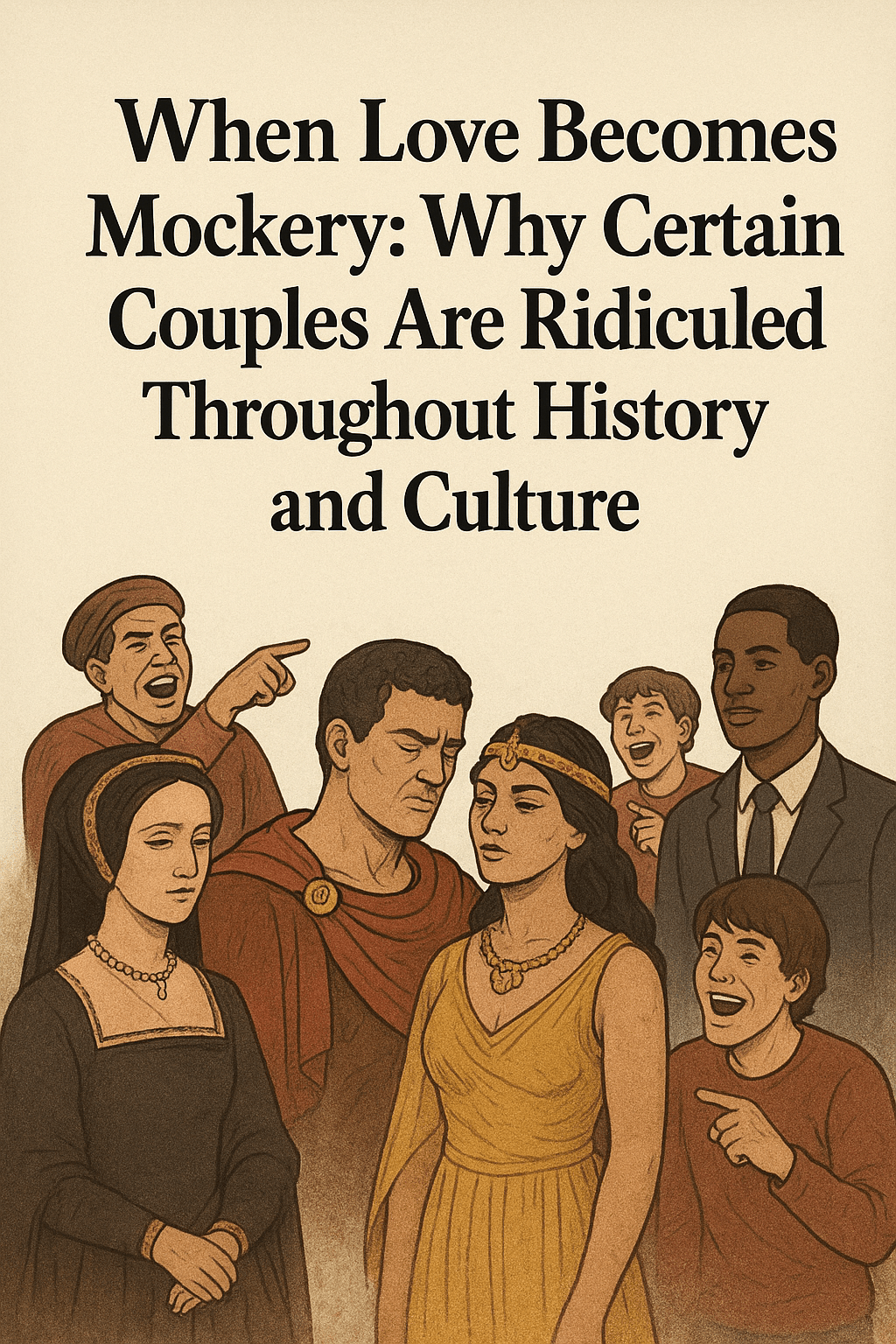
Love is often described as universal — a force that transcends boundaries of race, class, religion, and culture. Yet, throughout history, society has shown that love is rarely accepted when it challenges established norms. Some couples, instead of being celebrated, become the object of ridicule, gossip, and public disdain. From royal marriages that scandalized courts to modern celebrity unions that spark online memes, mocking couples has always been a way societies enforce conformity.
This article dives deep into why certain couples are mocked, tracing the practice through history, culture, and modern media. Beyond entertainment, mockery reveals how deeply societies fear change — and how love becomes a battleground for identity, power, and morality.
1. Love and Mockery: The Historical Roots
Mockery of couples isn’t new. In fact, it’s as old as marriage itself. Ancient societies viewed marriage not primarily as a romantic partnership but as a social contract — a union that affected property, lineage, religion, and politics. When love clashed with duty, mockery often followed.
Ancient and Medieval Examples
In Ancient Rome, political unions were crucial. When Mark Antony fell for Cleopatra, it was more than a love story — it was a political crisis. Roman propaganda painted Cleopatra as a seductive witch manipulating a great Roman general. Satirists mocked their romance, calling it a betrayal of Roman virtue. The couple became symbols of moral decay — not because of their personal behavior, but because their union defied cultural expectations of loyalty and purity.
Similarly, in medieval Europe, when Henry VIII pursued Anne Boleyn, the relationship was derided across Europe. Pamphleteers and preachers mocked Anne as a temptress who bewitched the king. The union not only challenged the Catholic Church but also disrupted the moral order of England. The resulting scandal and execution cemented Anne’s place in history as one of the most publicly mocked women of her time.
Mockery, in these cases, acted as a weapon of control — a way to ridicule deviation from political or religious norms. The same dynamics can be seen across civilizations: societies used ridicule to maintain the status quo, policing who was “fit” to love whom.
2. Why Societies Mock Couples Who Break Norms
Mockery operates as a kind of social discipline. It tells people what’s acceptable — and punishes those who step outside the line. When a couple crosses visible or invisible boundaries, they become targets because they symbolize something disruptive.
a. Crossing Class Boundaries
Historically, class defined love as much as emotion did. When a noble married a commoner, mockery often followed. Such unions were viewed as insults to lineage and privilege.
For example, when Edward VIII of Britain abdicated the throne to marry Wallis Simpson, a divorced American woman, the world was stunned. Newspapers mocked the relationship relentlessly. Satirical cartoons portrayed Wallis as a manipulative social climber, while Edward was seen as weak and foolish. The idea that a king would give up an empire for love was treated as both romantic folly and moral failure.
The laughter and ridicule masked deeper fears — that love might threaten hierarchies that depended on bloodline and class continuity.
b. Defying Racial and Cultural Barriers
Few relationships have faced as much ridicule — and even legal persecution — as interracial couples. In societies obsessed with racial purity, such unions were viewed as threats.
The story of Richard and Mildred Loving, the American couple behind the landmark Loving v. Virginia case (1967), is a defining example. Their marriage — between a white man and a Black woman — was not only mocked but criminalized. They were arrested in their home in Virginia and banished from the state. While some neighbors and newspapers treated them as reckless rebels, history vindicated them. Their quiet defiance overturned anti-miscegenation laws and redefined love in America.
In colonial and postcolonial Africa, similar patterns emerged. Interracial couples were scorned as “betrayers” of their race or culture. In apartheid South Africa, the 1949 Prohibition of Mixed Marriages Act made such unions illegal, and public ridicule often accompanied state persecution.
Mockery in these cases worked hand in hand with law and culture — a way to humiliate those who dared challenge racial hierarchies.
c. Age and Gender Expectations
Another recurring reason couples get mocked is age disparity or gender role reversal. Society tends to tolerate older men dating younger women, but when an older woman dates a younger man, ridicule flows freely.
Consider the case of French President Emmanuel Macron and Brigitte Macron, who has been the target of endless jokes due to their 24-year age gap. Headlines and memes often reduce their marriage to a “teacher-student fantasy,” overlooking their decades-long partnership built on mutual respect. The mockery reveals an uncomfortable truth — society still punishes women who step outside youth-centric beauty norms.
Similarly, when younger women date older, wealthy men, the union is often ridiculed as “gold digging,” ignoring genuine emotional bonds. Mockery, in these instances, becomes a way to reaffirm gender stereotypes: that men must lead and women must follow.
3. Mockery as a Cultural Weapon
Beyond individuals, mockery reflects collective anxieties. It’s not just laughter — it’s a signal that a relationship challenges something sacred in a culture.
a. Enforcing Social Norms
In traditional societies, gossip and ridicule were powerful tools for maintaining conformity. Couples who broke rules — through premarital love, inter-caste unions, or same-sex relationships — became moral lessons for others. They were shamed not only to punish them but to scare others from following their path.
For example, in many traditional African communities, marriage between people of different clans, religions, or social castes was seen as taboo. Ridicule wasn’t just personal — it was communal, often taking the form of songs, jokes, or public shaming during ceremonies.
b. Protecting Cultural Identity
Couples that threaten a community’s identity — by mixing races, religions, or social roles — often become scapegoats. They embody the fear that cherished traditions might vanish.
In South Asia, for instance, the phenomenon of “love jihad” — the conspiracy theory that Muslim men seduce Hindu women to convert them — has turned real couples into political symbols. Mockery, in such cases, morphs into vilification. It’s no longer humor; it’s hostility dressed as cultural defense.
c. Projection of Social Insecurity
Sometimes, mocking couples reflects personal insecurity. When people ridicule others for finding unconventional love, they’re often reacting to their own limitations — fear of being judged, envy of courage, or discomfort with difference. Mockery becomes a defense mechanism against what society secretly desires but publicly condemns.
4. Modern Media: From Gossip Columns to Memes
In the digital age, mocking couples has become faster, meaner, and global. What was once whispered in marketplaces is now amplified through millions of screens.
a. The Rise of Celebrity Mockery
Modern celebrity culture thrives on scrutiny. Famous couples are both idolized and mocked — a duality that fuels tabloids and social media alike.
Take Prince Harry and Meghan Markle. Their interracial, cross-cultural marriage sparked joy and backlash in equal measure. British tabloids relentlessly mocked Meghan, questioning her background, behavior, and motives. The couple’s decision to step back from royal duties only intensified public ridicule — often rooted in racial and class biases.
The mockery masked discomfort with change: a biracial American woman entering an ancient, colonial institution challenged centuries of tradition and privilege.
b. The Internet and Meme Culture
Social media has democratized mockery. Today, anyone can create or share a meme about a couple they’ve never met. The internet rewards judgment — especially of relationships that appear “odd,” “imbalanced,” or “too public.”
For example, when pop star Britney Spears married her younger boyfriend Sam Asghari, online comments oscillated between mockery and voyeurism. Every photo became proof of “trouble” or “drama.” The internet rarely allows couples to just exist — it demands a narrative.
What’s changed is speed and permanence. Once a couple becomes a meme, the mockery lives forever — archived, reshared, and commodified.
c. Public Ridicule as Entertainment
Reality TV and influencer culture have normalized laughing at relationships. Shows like Love Island or 90 Day Fiancé turn real couples into caricatures, editing their lives for drama. Mockery becomes part of the entertainment economy. We consume people’s romantic struggles as spectacle, not stories of vulnerability or courage.
5. The Psychology of Mockery in Love
At its core, mocking couples is about power — the power to define what love should look like.
a. Fear of the Unfamiliar
Humans are tribal by nature. When something unfamiliar threatens group norms, mockery acts as a defense. Laughing at what we don’t understand makes it less threatening.
b. Social Policing
Mockery enforces belonging. By ridiculing couples who break norms, society reinforces what it considers “normal.” This explains why same-sex, interracial, and age-gap couples still face ridicule today — they disrupt the heteronormative, ageist ideal of love.
c. Collective Catharsis
Mockery also offers emotional release. Scandals and “odd” relationships become public distractions from deeper social frustrations. The same public that mocks celebrity couples for failing to meet moral standards often cheers when those couples rebel — proof of society’s conflicted relationship with love and freedom.
6. When Mockery Backfires: Couples Who Redefined Norms
History shows that ridicule doesn’t always win. Some mocked couples become pioneers of change.
a. The Lovings (USA)
Richard and Mildred Loving’s quiet defiance ended America’s racist marriage laws. Once mocked and criminalized, they became symbols of courage and equality.
b. Frida Kahlo and Diego Rivera (Mexico)
Their unconventional, tempestuous marriage — mocked by critics for its chaos and contradictions — produced a partnership that reshaped art and gender politics. Their story became a metaphor for creative freedom and defiance.
c. Harry and Meghan (UK)
Despite being mocked globally, they’ve used their platform to challenge racial bias and mental health stigma, redefining what modern royalty can represent.
These stories prove that mockery often precedes transformation. When couples are ridiculed, it’s not always because they’re wrong — sometimes it’s because they’re ahead of their time.
7. The Cost of Being Mocked
While some couples rise above ridicule, the emotional and social cost is real.
a. Emotional Strain
Constant mockery erodes self-esteem. Couples often internalize society’s judgment, leading to anxiety, isolation, and mistrust. For ordinary people — not celebrities — this can be devastating, forcing them to hide or abandon relationships they cherish.
b. Social Alienation
In conservative settings, ridicule can lead to expulsion from families or communities. In extreme cases, as seen in some interfaith or LGBTQ+ couples, mockery precedes violence.
c. Cultural Regression
When mockery discourages difference, it stalls social progress. Every laugh at a “weird” couple reinforces stereotypes — making society less tolerant of diversity.
8. Toward a More Empathetic Culture of Love
If mockery reflects fear, empathy reflects growth. As societies evolve, how we treat couples who defy norms will define the moral maturity of our age.
a. Rethink What’s “Normal”
Normal is a moving target. Once, interracial or same-sex marriage was unthinkable — now they’re celebrated in many parts of the world. The same empathy must extend to couples who differ in class, religion, age, or culture.
b. Challenge Mockery When You See It
Ridicule often hides behind humor. But laughter at someone’s love story says more about our insecurities than theirs. Media literacy and social awareness are key to recognizing and rejecting this form of prejudice.
c. Celebrate Love in All Its Forms
From art to policy, celebrating diversity in love promotes acceptance. Campaigns, education, and storytelling can reframe how we see difference — not as scandal, but as strength.
9. The Mirror in the Mockery
Mocking couples has always been less about the lovers and more about the audience. Each laugh, rumor, or headline reveals society’s boundaries — and its fears. When love crosses race, age, or status, it threatens power structures built on control and conformity. Mockery becomes the first line of defense.
Yet, history shows that what begins in laughter often ends in transformation. The couples who were mocked — for loving across lines others dared not cross — have often expanded the very definition of love itself. From Antony and Cleopatra to the Lovings and beyond, their stories remind us that ridicule fades, but courage endures.
As long as love challenges the limits of society, mockery will follow. But perhaps the true measure of progress is when the laughter stops being cruel — and starts becoming applause.
SUGGESTED READS
- The Man Who Could’ve Been
- Living with a Shared Secret: Psychological Consequences for Couples
- How Rumors Shape and Destroy Trust in Marriages
- The Link Between Rage, Violence, and Betrayal in Intimate Relationships
- Silent Prisons: Couples Bound by Secrets They Cannot Share

Support Our Website!
We appreciate your visit and hope you find our content valuable. If you’d like to support us further, please consider contributing through the TILL NUMBER: 9549825. Your support helps us keep delivering great content!
If you’d like to support Nabado from outside Kenya, we invite you to send your contributions through trusted third-party services such as Remitly, western union, SendWave, or WorldRemit. These platforms are reliable and convenient for international money transfers.
Please use the following details when sending your support:
Phone Number: +254701838999
Recipient Name: Peterson Getuma Okemwa
We sincerely appreciate your generosity and support. Thank you for being part of this journey!
Your article helped me a lot, is there any more related content? Thanks!
Thanks for sharing. I read many of your blog posts, cool, your blog is very good.
I don’t think the title of your article matches the content lol. Just kidding, mainly because I had some doubts after reading the article.
Thank you for your sharing. I am worried that I lack creative ideas. It is your article that makes me full of hope. Thank you. But, I have a question, can you help me?
Thank you for your sharing. I am worried that I lack creative ideas. It is your article that makes me full of hope. Thank you. But, I have a question, can you help me?
Your article helped me a lot, is there any more related content? Thanks!
Your point of view caught my eye and was very interesting. Thanks. I have a question for you.