

simply amazing, always for you.
Fuel prices are one of those everyday realities you can’t ignore. Whether you drive, commute, or simply buy food at the market, fuel costs quietly shape your life.
In 2026, the story of fuel prices across Africa becomes even more interesting—and more personal—when you look at everything in Kenyan shillings (KSh). Suddenly, the differences between countries become clearer, more relatable, and in some cases, shocking.
Some countries are paying less than KSh 10 per litre. Others are paying over KSh 350 per litre.
That’s not just a gap—it’s a massive divide.
Let’s break it down in a simple, human way.
The Reality Right Now (April 2026)
In Kenya today, petrol is selling at about KSh 206.97 per litre (≈ $1.60).
That number matters because it gives us a baseline.
Now imagine this:
- Someone in Libya is paying around KSh 3–5 per litre
- Someone in Malawi is paying about KSh 370 per litre
- Someone in Nigeria might pay around KSh 95–150 per litre
Same fuel. Same continent. Completely different realities.
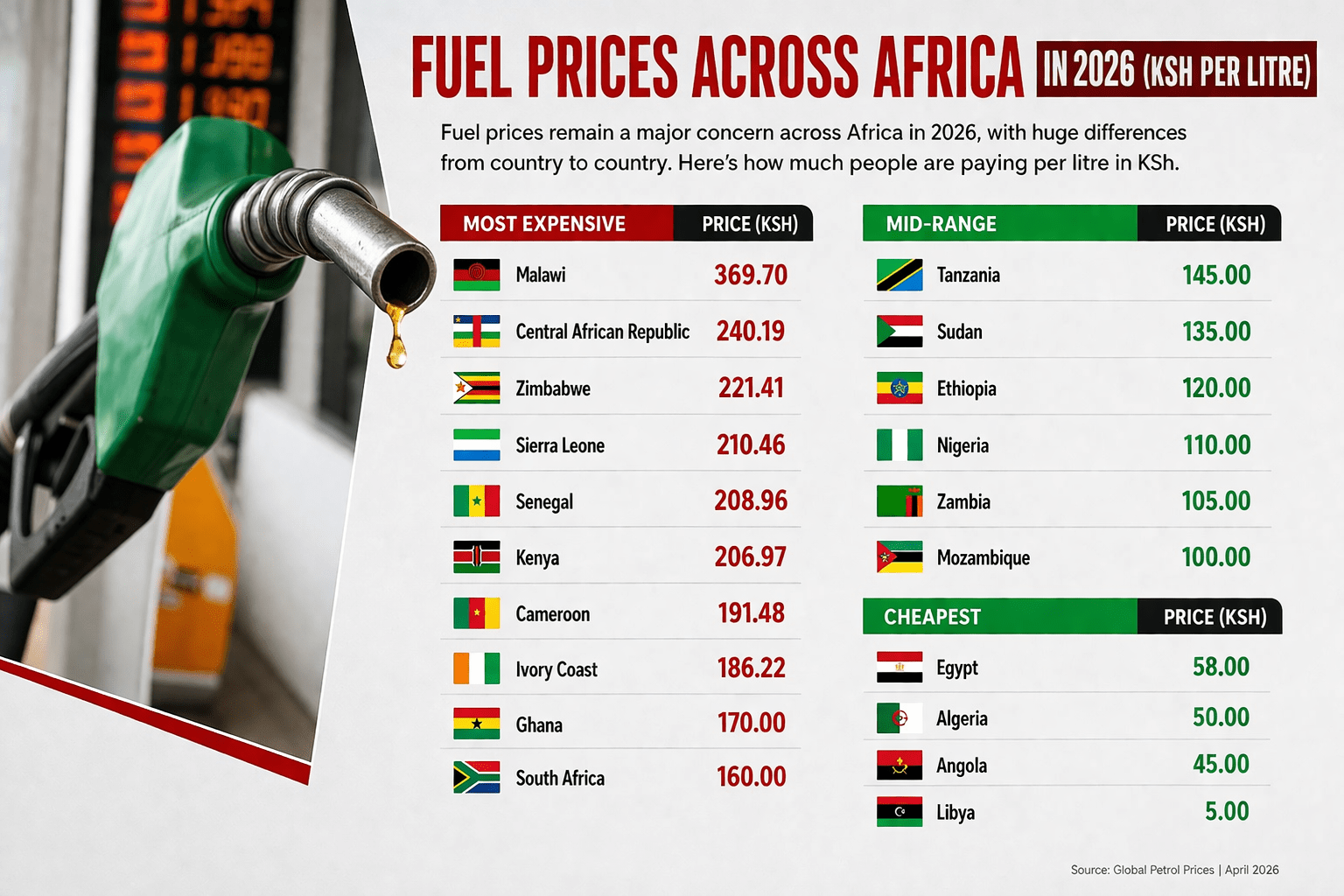
Fuel Prices Across Africa (Converted to KSh)
Below is a simplified, real-world comparison using recent 2026 data.
Most Expensive Countries (KSh per litre)
- Malawi: ~KSh 369–370
- Central African Republic: ~KSh 240
- Zimbabwe: ~KSh 221
- Sierra Leone: ~KSh 210
- Senegal: ~KSh 208
These are countries where fuel is not just expensive—it’s a serious burden.
Mid-Range Countries
- Kenya: ~KSh 206–207
- Cameroon: ~KSh 191
- Ivory Coast: ~KSh 186
- Ghana: ~KSh 170–180
- South Africa: ~KSh 155–165 (approx from $1.2–1.26)
- Tanzania: ~KSh 140–145
This is where most African countries fall—but even here, prices are not “cheap.”
Lower Price Countries
- Nigeria: ~KSh 95–120
- Sudan: ~KSh 135
- Ethiopia: ~KSh 100–300 (depending on subsidy changes)
Even oil-producing countries are no longer as cheap as people expect.
Cheapest Countries in Africa
- Libya: ~KSh 3–5
- Angola: ~KSh 40–45
- Algeria: ~KSh 45–50
- Egypt: ~KSh 55–60
These are the only places where fuel still feels “cheap.”
Why Are the Differences So Huge?
At first glance, it feels unfair. Why should one country pay KSh 5 and another KSh 370?
But once you understand the reasons, it starts to make sense.
1. Oil vs No Oil
This is the biggest factor.
Countries like Libya and Algeria produce oil. That means they don’t rely heavily on imports.
Countries like Kenya or Malawi? They import almost everything.
And importing fuel is expensive.
2. Government Subsidies
Some governments absorb the cost of fuel.
That’s why:
- Libya can sell petrol at KSh 5
- Egypt keeps prices under KSh 60
But subsidies are expensive for governments, so many countries are reducing them.
That’s exactly what’s happening in places like Nigeria and Kenya.
3. Taxes (This One Hurts)
In countries like Kenya, a big part of the fuel price is actually tax.
You’re not just paying for fuel—you’re paying for:
- Road maintenance
- Government revenue
- Infrastructure
That’s why prices stay high even when global oil prices drop.
4. Currency Problems
Fuel is bought in US dollars.
If your currency weakens, fuel becomes more expensive—even if oil prices don’t change.
That’s a major issue across Africa right now.
5. Geography
Landlocked countries like Malawi and Zambia pay more because fuel has to travel long distances.
Every truck, every kilometer, adds cost.
That’s why Malawi ends up with some of the highest prices in Africa.
What This Means for Everyday Life
Fuel prices don’t stay at the petrol station—they spread everywhere.
Transport Gets Expensive
When fuel goes up:
- Matatu fares increase
- Bus prices rise
- Delivery costs go up
Everyone feels it.
Food Prices Rise
Food has to be transported.
Higher fuel = higher food prices.
It’s that simple.
Small Businesses Struggle
Think about:
- Shop owners
- Farmers
- Delivery riders
Fuel is part of their daily cost.
When prices rise, profits shrink.
Life Becomes More Expensive
From rent to groceries, fuel prices quietly push everything up.
That’s why people react strongly to fuel hikes—it affects survival.
Why Prices Are Rising in 2026
Fuel prices aren’t just rising randomly.
There are real global reasons behind it:
- Conflicts affecting oil supply
- Rising global crude oil prices
- Shipping disruptions
- Weak African currencies
In fact, recent increases in Kenya were linked to a sharp rise in imported fuel costs.
This shows how connected Africa is to global markets.
The Big Picture
If you zoom out, a few clear patterns emerge:
- North Africa = cheapest fuel (KSh 3–60)
- West Africa = mixed prices (KSh 95–180)
- East Africa = expensive (KSh 140–210)
- Southern Africa = most expensive (up to KSh 370)
And overall?
Africa’s average sits roughly around KSh 130–180 per litre depending on the country.
What Happens Next?
Looking ahead, a few things are likely:
1. Prices Will Keep Fluctuating
Global oil markets are unstable, so expect ups and downs.
2. Subsidies Will Reduce
Governments are struggling to afford them.
3. Alternatives Will Grow
Electric vehicles and renewable energy are slowly gaining attention.
But for now, fuel is still king.
When you convert fuel prices into Kenyan shillings, the reality becomes clear:
Africa is not one fuel market—it’s many different worlds.
In one country, fuel is almost free.
In another, it’s a daily struggle.
And for millions of people, these prices aren’t just numbers—they determine how far you can travel, what you can afford, and how you live your life.
That’s why fuel prices matter.
Not just economically—but personally.
SUGGESTED READS
- How to Love Yourself More Every Day: The Real, Practical Guide to Building Unshakable Self-Worth
- Who Invented Tattooing and Why Humans First Marked Their Skin
- Success Is Not Final; Failure Is Not Fatal: The Courage to Continue That Counts
- I Didn’t Fail — I Learned: The Powerful Truth Behind Thomas Edison’s 10,000 Attempts
- 15 Powerful Ways to Create a Greener, More Sustainable Lifestyle
- Scientists Finally Reveal Why You Dream — And Why Your Brain Erases It Instantly
Support Our Website!
We appreciate your visit and hope you find our content valuable. If you’d like to support us further, please consider contributing through the TILL NUMBER: 9549825. Your support helps us keep delivering great content!
If you’d like to support Nabado from outside Kenya, we invite you to send your contributions through trusted third-party services such as Remitly, western union, SendWave, or WorldRemit. These platforms are reliable and convenient for international money transfers.
Please use the following details when sending your support:
Phone Number: +254701838999
Recipient Name: Peterson Getuma Okemwa
We sincerely appreciate your generosity and support. Thank you for being part of this journey!
Sweet internet site, super pattern, very clean and employ pleasant.