

simply amazing, always for you.
English is one of the most widely spoken languages in the world today, used across continents for business, education, diplomacy, and entertainment. But despite its global dominance, the story of where English came from is far more complex—and far more fascinating—than many people realize. It is not a language that appeared overnight or developed in isolation. Instead, English is the result of centuries of migration, invasion, cultural exchange, and adaptation.
Understanding the origin of the English language is not just about tracing words back in time. It is about uncovering how history, politics, and human movement shaped a language that continues to evolve today. This article explores the roots of English, its major stages of development, and the key influences that transformed it into the global language we know.
The Birthplace of English: Early Medieval England
The English language originated in England during the early medieval period, around the 5th century AD. At that time, Britain was undergoing significant change following the withdrawal of Roman rule.
After the Romans left, several Germanic tribes began to migrate into Britain. The most influential among them were:
- The Angles
- The Saxons
- The Jutes
These tribes came from regions that are now part of modern-day Germany and Denmark. Each group spoke its own dialect, but over time, their languages blended together. This fusion formed the foundation of what we now call Old English.
Interestingly, the name “England” itself comes from the Angles, meaning “Land of the Angles.” This gives you a clue about how central they were to the language’s early development.
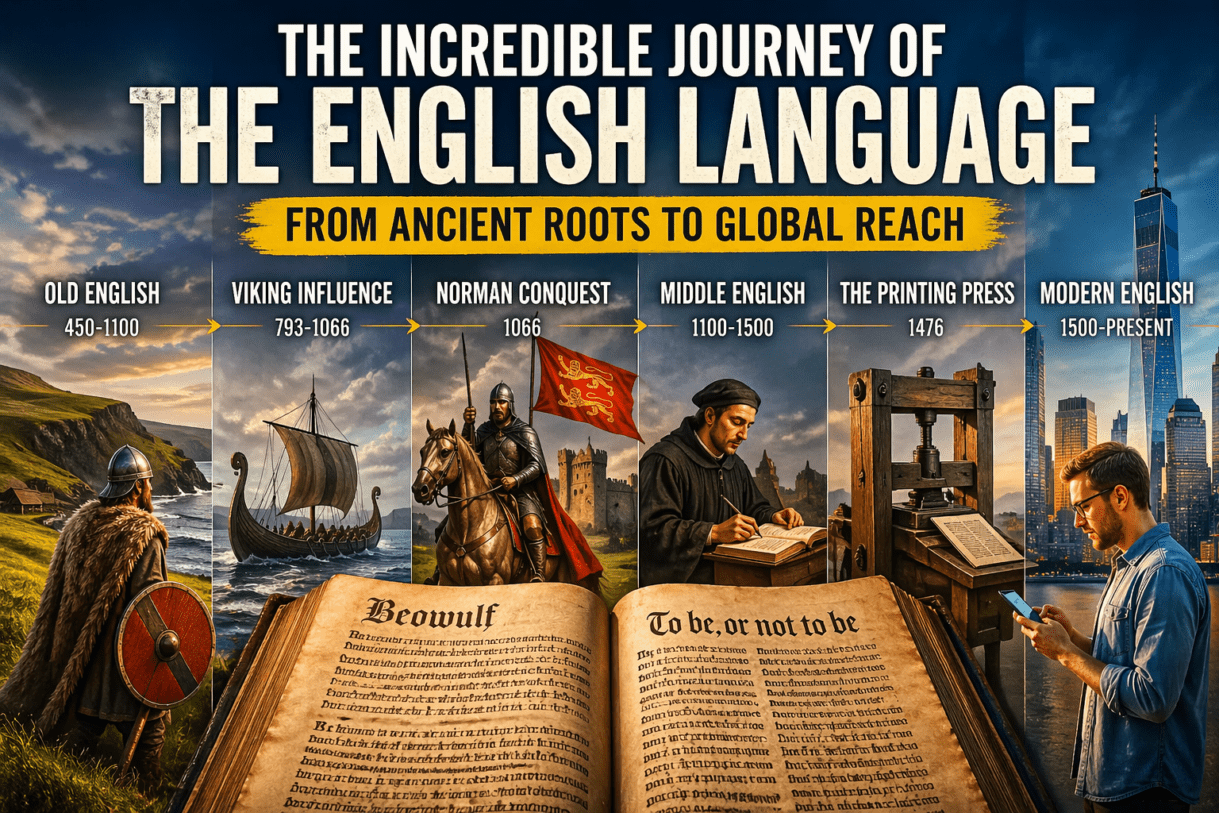
Old English: The Earliest Form (c. 450–1100)
Old English was the first recognizable stage of the English language. However, if you were to read or hear it today, you would likely struggle to understand it.
What Made Old English Unique?
Old English was a Germanic language, closely related to languages like German and Dutch. It had:
- A complex grammar system with cases (like Latin)
- Different word endings depending on usage
- A vocabulary that is mostly unrecognizable today
For example, the word “king” in Old English was cyning, and “house” was hūs.
A Famous Example: Beowulf
One of the most important surviving texts in Old English is the epic poem Beowulf. It provides insight into the language, culture, and values of early English society.
Here’s a short example from Old English:
“Hwæt! We Gardena in geardagum…”
To modern readers, this looks almost like a completely different language—and in many ways, it is.
The Impact of the Viking Invasions
Between the 8th and 11th centuries, Britain faced repeated invasions from Norse Vikings. These invaders spoke Old Norse, another Germanic language.
How Vikings Influenced English
The interaction between Old English speakers and Viking settlers led to:
- The addition of new vocabulary (e.g., sky, egg, knife, they)
- Simplification of grammar
- Increased blending of dialects
This period marked an important step toward making English more flexible and adaptable.
The Norman Conquest: A Turning Point (1066)
One of the most significant events in the history of the English language was the Norman Conquest of 1066. When the Normans, led by William the Conqueror, took control of England, they brought with them Norman French.
Language Divide in Society
After the conquest:
- The ruling class spoke French
- The common people spoke Old English
For nearly 300 years, England was essentially bilingual.
The Result: A Language Transformation
This period gave birth to Middle English, which was heavily influenced by French.
Thousands of French words entered English, especially in areas such as:
- Government (court, judge, parliament)
- Law (jury, justice, attorney)
- Food (beef, pork, mutton)
- Culture (art, music, literature)
This blending of Germanic and Romance elements is one of the reasons English vocabulary is so rich and diverse today.
Middle English: A Language in Transition (c. 1100–1500)
Middle English marked a transitional phase between Old and Modern English.
Key Characteristics
- Simplified grammar compared to Old English
- Increased use of French vocabulary
- More recognizable sentence structures
A Literary Milestone: Geoffrey Chaucer
One of the most important figures in Middle English literature is Geoffrey Chaucer, author of The Canterbury Tales. His work reflects a version of English that is much closer to what we understand today.
Example from Middle English:
“Whan that Aprille with his shoures soote…”
While still challenging, it is far more readable than Old English.
The Great Vowel Shift and the Rise of Modern English
Around the late 15th century, English underwent a major pronunciation change known as the Great Vowel Shift. This marked the transition into Early Modern English.
What Changed?
- The way vowels were pronounced shifted dramatically
- Spelling remained mostly the same, creating inconsistencies
- Words began to sound more like they do today
This explains why English spelling and pronunciation often don’t match perfectly.
The Printing Press: Standardizing English
The introduction of the printing press by William Caxton in 1476 played a critical role in shaping English.
Why It Mattered
- Books became more widely available
- A standard form of English began to emerge
- Spelling and grammar became more consistent
London dialects became dominant because most printed materials came from there.
The Influence of the Renaissance
The Renaissance brought a renewed interest in classical learning, especially Latin and Greek. As a result, English absorbed a large number of new words.
Examples include:
- Education
- Science
- Philosophy
- Temperature
These additions expanded English vocabulary and made it more suitable for academic and intellectual use.
Modern English: A Global Language (1700–Present)
Modern English continued to evolve through:
- Colonial expansion
- Scientific advancement
- Cultural exchange
British Empire and Global Spread
As the British Empire expanded, English spread to:
- North America
- Africa
- Asia
- Australia
Each region developed its own variation, leading to forms like:
- American English
- Australian English
- Indian English
- African English dialects
Why English Is So Unique
English stands out among languages for several reasons:
1. Mixed Origins
English is a hybrid language, combining:
- Germanic roots
- French vocabulary
- Latin and Greek influences
2. Flexible Structure
Compared to many languages, English grammar is relatively simple, making it easier to learn.
3. Massive Vocabulary
English has one of the largest vocabularies in the world, with words borrowed from countless languages.
English Today: Constantly Evolving
English is not a fixed language. It continues to change with time, influenced by:
- Technology (e.g., internet, download, AI)
- Social media
- Global communication
New words and phrases are created regularly, reflecting modern culture and trends.
The English language originated in early medieval England, shaped by the migration of Germanic tribes and transformed by centuries of invasion, cultural exchange, and innovation.
From Old English to Middle English and finally Modern English, the language has undergone remarkable changes.
What makes English truly unique is its ability to absorb and adapt. It is a language built from layers of history—each one adding depth, richness, and complexity.
Today, English serves as a global bridge, connecting people across different cultures and regions. And if history is any indication, it will continue to evolve, reflecting the world that uses it.
SUGGESTED READS
- The Man Who Could’ve Been
- How Kenya is Leading Africa’s Sustainable Future — From Renewable Energy to Zero-Waste Cities
- Youth and the 2027 Elections: How Young Voters Could Shape the Next General Election in Kenya
- RutonomicsAt3 — The True State of William Ruto’s Economic Legacy After 3 Years
- Living with a Shared Secret: Psychological Consequences for Couples
- How Rumors Shape and Destroy Trust in Marriages

Support Our Website!
We appreciate your visit and hope you find our content valuable. If you’d like to support us further, please consider contributing through the TILL NUMBER: 9549825. Your support helps us keep delivering great content!
If you’d like to support Nabado from outside Kenya, we invite you to send your contributions through trusted third-party services such as Remitly, western union, SendWave, or WorldRemit. These platforms are reliable and convenient for international money transfers.
Please use the following details when sending your support:
Phone Number: +254701838999
Recipient Name: Peterson Getuma Okemwa
We sincerely appreciate your generosity and support. Thank you for being part of this journey!