

simply amazing, always for you.
U.S. Special Forces Soldier Accused of Profiting From Secret Maduro Raid
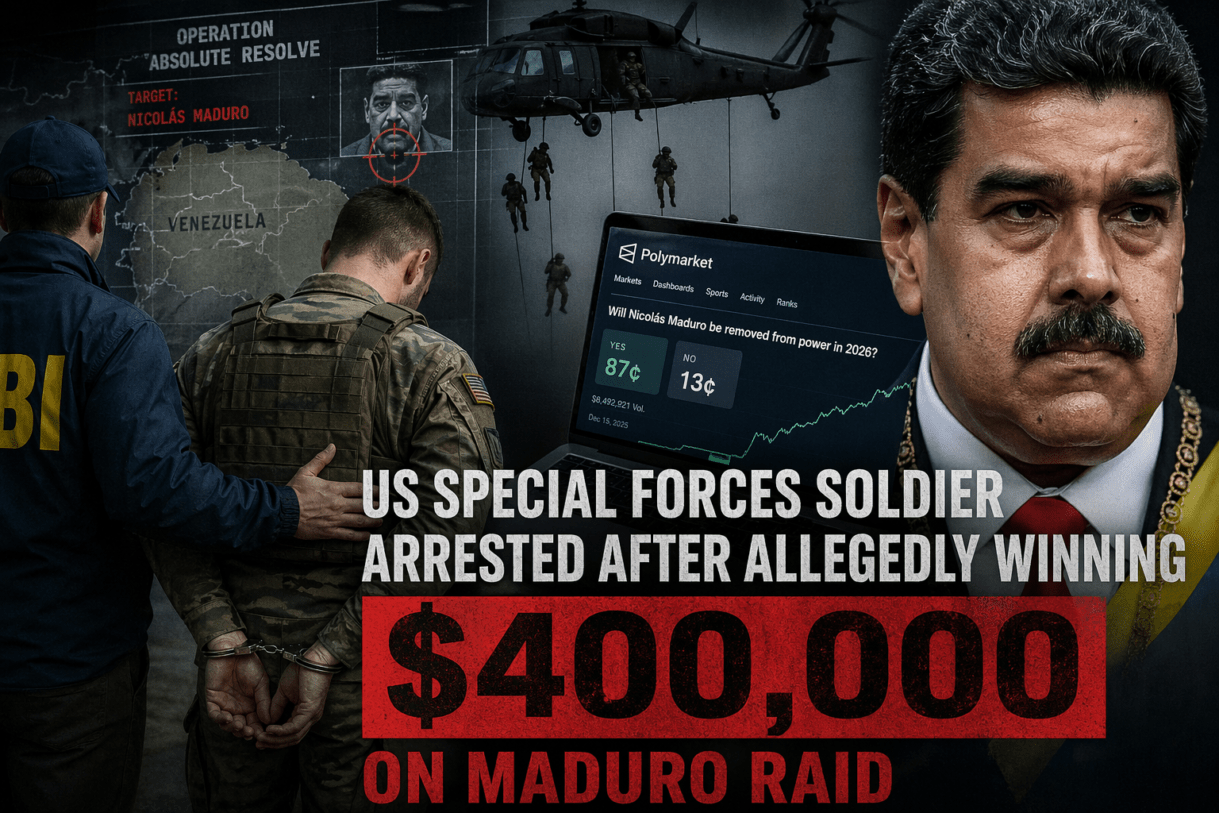
A highly unusual criminal case is unfolding in the United States, where a decorated Special Forces soldier now stands accused of exploiting classified military intelligence to make hundreds of thousands of dollars in betting profits tied to a covert operation targeting Venezuelan leader Nicolás Maduro.
Federal prosecutors allege that the soldier—identified as Gannon Ken Van Dyke—used privileged knowledge of a planned U.S. military raid to place calculated wagers on a political prediction platform, ultimately earning more than $400,000. The case is already being described as one of the first major intersections between national security leaks and the rapidly growing world of decentralized betting markets.
Inside the Alleged Scheme
According to court filings, Van Dyke was deeply involved in operational planning linked to a classified mission widely referred to as “Operation Absolute Resolve.” The mission culminated in the capture of Maduro in early January 2026, a dramatic geopolitical development that sent shockwaves through Latin America and beyond.
But months before the operation became public, prosecutors say Van Dyke began quietly placing bets on outcomes directly tied to the mission’s success. These bets were made on Polymarket, a blockchain-based platform that allows users to wager on real-world events—from elections to geopolitical developments.
The wagers allegedly centered on two key predictions:
- Whether the United States would take military action in Venezuela
- Whether Maduro would be removed from power within a specific timeframe
Because Van Dyke allegedly had access to non-public, classified intelligence, his bets were not speculative—they were, according to investigators, effectively guaranteed.
A Digital Trail That Raised Red Flags
While prediction markets thrive on anonymity and decentralized transactions, investigators say Van Dyke’s activity stood out.
Unusually precise and high-confidence trades reportedly triggered internal alerts at Polymarket. The platform, which has increasingly come under scrutiny from regulators, flagged the activity and later cooperated with U.S. authorities.
Attempts to conceal the operation—through VPN usage, cryptocurrency transfers, and account deletions—ultimately failed to erase the digital footprint, according to prosecutors. Blockchain-based systems, often perceived as opaque, instead provided investigators with a transparent ledger of transactions that helped reconstruct the alleged scheme.
The Charges: A Heavy Legal Reckoning
Van Dyke now faces a series of serious federal charges, including:
- Wire fraud
- Commodities fraud
- Theft of government property
- Unauthorized use of classified information
Legal experts say the combination of national security violations and financial crimes could expose him to decades behind bars if convicted.
The case also raises complex legal questions. While insider trading laws are well-established in financial markets, applying similar principles to prediction platforms like Polymarket is relatively new territory. Prosecutors appear to be framing the case as a hybrid of fraud and national security violations rather than relying on traditional insider trading statutes alone.
A New Frontier: Prediction Markets and National Security
The emergence of prediction platforms has created a novel challenge for governments worldwide. Unlike traditional stock markets, these platforms allow users to bet on virtually any verifiable outcome—including sensitive geopolitical events.
In this case, the alleged misuse of classified intelligence highlights a critical vulnerability: individuals with access to confidential information can potentially monetize that knowledge in real time, outside traditional regulatory frameworks.
Security analysts warn that this could become a growing threat. If insiders can profit from secret operations, the incentive structure around classified information could fundamentally shift.
“This isn’t just about one soldier,” said one former intelligence official familiar with the case. “It’s about the realization that sensitive operations can now be indirectly traded on global platforms before they even happen.”
The Maduro Operation: A Turning Point
The underlying event at the center of the case—the capture of Nicolás Maduro—marks one of the most significant geopolitical developments in recent years.
Maduro, long a controversial figure on the global stage, had faced multiple accusations ranging from authoritarian governance to alleged involvement in international drug trafficking networks. His sudden capture during a U.S.-led operation dramatically altered the political landscape in Venezuela and intensified debates about foreign intervention.
For markets, the event was equally seismic. Political betting platforms saw massive activity as speculation turned into confirmed outcomes, rewarding those who had correctly predicted the sequence of events.
For Van Dyke, prosecutors argue, that reward was not the result of foresight—but of privileged access.
Military Ethics and the Breach of Trust
Beyond the legal implications, the case cuts to the core of military ethics.
Members of the U.S. Armed Forces operate under strict codes of conduct, particularly when it comes to handling classified information. The alleged actions represent not just a legal violation but a breach of institutional trust.
Military officials have emphasized that safeguarding sensitive information is critical not only for operational success but also for the safety of personnel on the ground. Any leak—intentional or otherwise—can compromise missions and put lives at risk.
While there is no indication that the operation itself was jeopardized, the mere possibility that classified details were used for personal gain has sparked concern within defense circles.
Cryptocurrency, Anonymity, and the Illusion of Secrecy
Another striking element of the case is the role of cryptocurrency and decentralized finance.
Van Dyke allegedly attempted to mask his identity and transactions using crypto wallets and offshore mechanisms. However, investigators were able to trace the movement of funds across the blockchain, underscoring a critical misconception: anonymity in crypto is often limited.
Experts note that while blockchain addresses do not inherently reveal identities, patterns of behavior, exchange interactions, and forensic analysis can link transactions back to individuals.
In this sense, the same technology that enabled the alleged scheme also played a role in unraveling it.
Legal and Regulatory Implications
The case is expected to have far-reaching consequences beyond the courtroom.
Regulators are already grappling with how to oversee prediction markets, which exist in a gray area between gambling, financial trading, and information markets. This incident is likely to accelerate calls for stricter oversight.
Key questions emerging include:
- Should betting on geopolitical events be restricted or regulated more heavily?
- How can platforms detect and prevent insider-based trading?
- What responsibilities do platforms have in monitoring suspicious activity?
Lawmakers may push for new frameworks that treat certain forms of predictive wagering as financial instruments, subject to stricter compliance requirements.
A Case That Signals a Shift
What makes this story particularly compelling is not just the alleged crime, but what it represents.
For decades, insider trading has been associated with Wall Street—corporate executives leveraging non-public financial information. This case suggests a new frontier, where geopolitical intelligence itself becomes a tradable asset in decentralized markets.
It also highlights the evolving nature of risk in the digital age. Information, once tightly controlled within institutions, can now be monetized in ways that were unimaginable just a few years ago.
Where Intelligence Meets Markets
The arrest of Gannon Ken Van Dyke marks a pivotal moment at the intersection of national security, technology, and finance.
If the allegations are proven, the case will stand as a cautionary tale about the misuse of privileged information—and a warning about the unintended consequences of emerging digital platforms.
As governments, regulators, and military institutions assess the implications, one thing is clear: the boundaries between intelligence, markets, and personal gain are becoming increasingly blurred.
And in that blurred space, the stakes are far higher than money alone.
SUGGESTED READS
- The Millionaire Who Still Takes the Morning Bus
- “Your Goods Are Expensive” — The Lie, the Truth, and the Fix
- Why Kenya Is Often Called “the Capital of Africa”
- Step-by-Step Blueprint: How to Make Someone Regret Losing You
- How Secrets Corrode Relationships Over Time
- The Dark Side of Forgiveness: When Mercy Becomes Control
- The Psychological Effects of Infidelity on Marriage: A Deep Exploration

Support Our Website!
We appreciate your visit and hope you find our content valuable. If you’d like to support us further, please consider contributing through the TILL NUMBER: 9549825. Your support helps us keep delivering great content!
If you’d like to support Nabado from outside Kenya, we invite you to send your contributions through trusted third-party services such as Remitly, western union, SendWave, or WorldRemit. These platforms are reliable and convenient for international money transfers.
Please use the following details when sending your support:
Phone Number: +254701838999
Recipient Name: Peterson Getuma Okemwa
We sincerely appreciate your generosity and support. Thank you for being part of this journey!