

simply amazing, always for you.
May Night Sky Delivers a Rare Celestial Sequence: Blue Moon, Meteor Shower, and the Return of the Milky Way
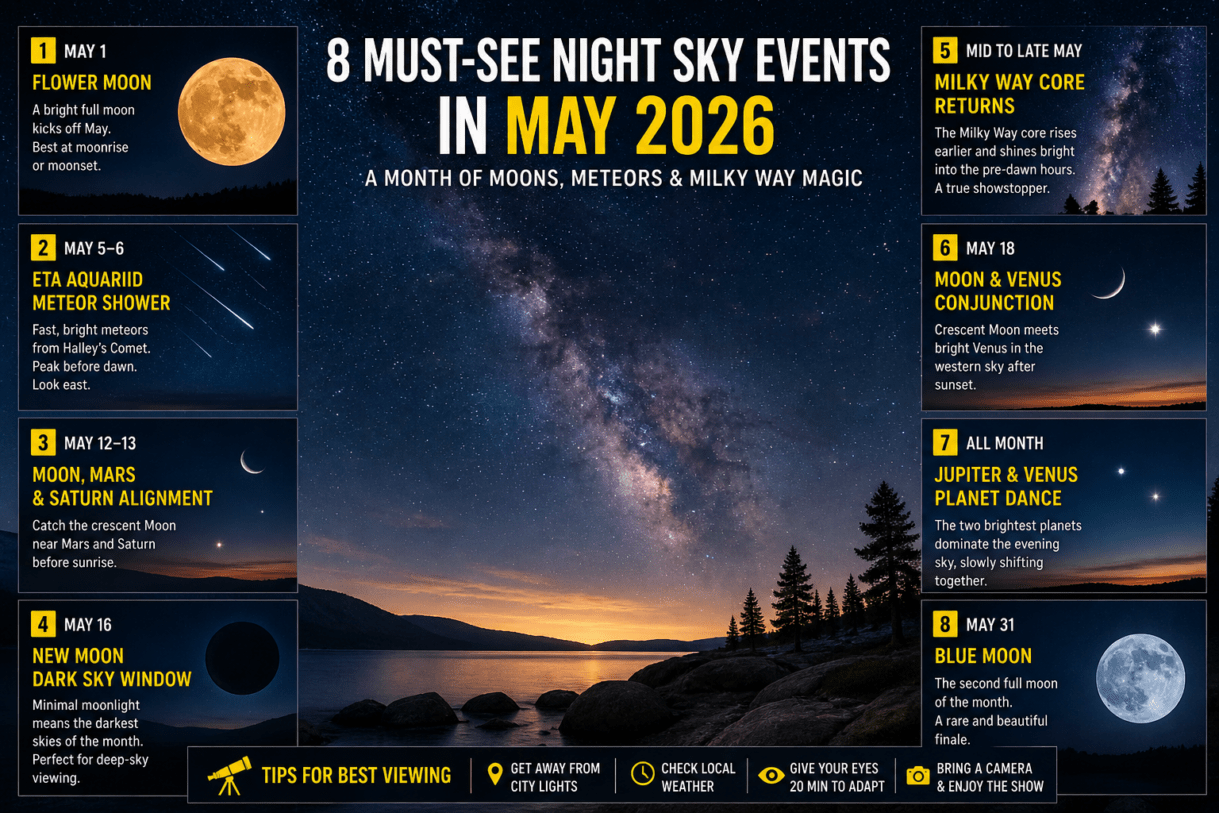
May 2026 is shaping up to be one of the most event-rich months of the year for skywatchers, offering a rare combination of lunar phases, meteor activity, planetary alignments, and the seasonal return of the Milky Way’s bright core.
Rather than a single standout moment, the month unfolds like a continuous sequence of astronomical highlights.
Full Flower Moon opens the month
May begins with the Flower Moon on May 1, a bright full moon associated with the peak of spring in the Northern Hemisphere. It will dominate early night skies, especially when viewed near the horizon, where atmospheric effects can make it appear larger and warmer in color.
This full moon sets the tone for a visually active month.
Eta Aquariid meteor shower peaks in early May
One of the strongest meteor showers of the season arrives between May 5 and 6, when the Eta Aquariids reach peak activity.
Originating from debris left by Halley’s Comet, these meteors are known for their speed and brightness. Observers in dark-sky regions may see multiple streaks per hour, particularly in the pre-dawn hours when Earth faces the densest part of the debris stream.
Early morning planetary grouping mid-month
Around May 12 to 13, the sky features a subtle but visually striking arrangement: a crescent moon appearing near Mars and Saturn in the eastern pre-sunrise sky.
While not as dramatic as meteor showers, this alignment is notable for its clarity and compact formation, best viewed just before dawn.
New Moon creates ideal dark-sky conditions
Around May 16, the New Moon phase brings the darkest skies of the month. With minimal lunar light interference, this period is especially important for deep-sky observation.
Astronomy enthusiasts often consider this the best window for viewing faint objects, including star clusters, nebulae, and the Milky Way’s structure.
Milky Way core becomes visible again
One of the most significant seasonal changes in May is the return of the Milky Way core to earlier and more accessible viewing hours.
By mid to late May, the galaxy’s bright central band begins rising in the pre-dawn hours, becoming increasingly visible in dark rural locations. This marks the beginning of what astronomers often call “galaxy season,” when the Milky Way becomes a central feature of the night sky rather than a faint backdrop.
Venus and the Moon create a bright evening pairing
On May 18, observers will see a close approach between the crescent moon and Venus in the western sky shortly after sunset.
Venus, being the brightest planet visible from Earth, makes this conjunction easy to spot even from urban environments with moderate light pollution. The pairing is expected to be one of the most accessible sky events of the month.
Venus and Jupiter dominate the evening sky
Throughout May, Venus and Jupiter remain dominant features of the sky. Their brightness and slow movement against the background stars make them highly visible throughout the month.
Their shifting positions also provide a useful reference for locating nearby constellations during evening observations.
Blue Moon closes the month
May ends with a Blue Moon on May 31, the second full moon within the same calendar month.
Despite its name, it does not appear blue in color. The term simply refers to the rarity of having two full moons in one month, an event that occurs roughly every two to three years.
A month defined by layered celestial activity
Across astronomy forecasts and skywatching reports, May 2026 stands out because it stacks multiple major events into a single period: a meteor shower, repeated lunar highlights, planetary alignments, and the seasonal return of the Milky Way’s most visible phase.
For observers, the month offers not a single spectacle but a continuous progression of changing skies—each week revealing a different layer of the night sky’s movement.
SUGGESTED READS
- The Millionaire Who Still Takes the Morning Bus
- The Wickediest Thing I Ever Did to Help a Friend
- The Worst Date I Ever Went On (And What It Taught Me About Love, Red Flags, and Self-Respect)
- “The Stupidest Thing I Ever Did on a Dare (And What It Taught Me About Myself)”
- The Man Who Could’ve Been
- The Grave Between Them
- Mke wa Mtu Sumu: The Hidden Faces of Cheating and the Price of Betrayal
- The Chambermaid’s Secret: How One Woman Turned a Billionaire’s Trash into a Million-Dollar Future

Support Our Website!
We appreciate your visit and hope you find our content valuable. If you’d like to support us further, please consider contributing through the TILL NUMBER: 9549825. Your support helps us keep delivering great content!
If you’d like to support Nabado from outside Kenya, we invite you to send your contributions through trusted third-party services such as Remitly, western union, SendWave, or WorldRemit. These platforms are reliable and convenient for international money transfers.
Please use the following details when sending your support:
Phone Number: +254701838999
Recipient Name: Peterson Getuma Okemwa
We sincerely appreciate your generosity and support. Thank you for being part of this journey!