

simply amazing, always for you.
China’s Zero-Tariff Gamble in Africa: The Shipping Strategy That Could Redraw Global Trade
China has made a move that could quietly reshape the future of global commerce—and Africa sits right at the center of it.
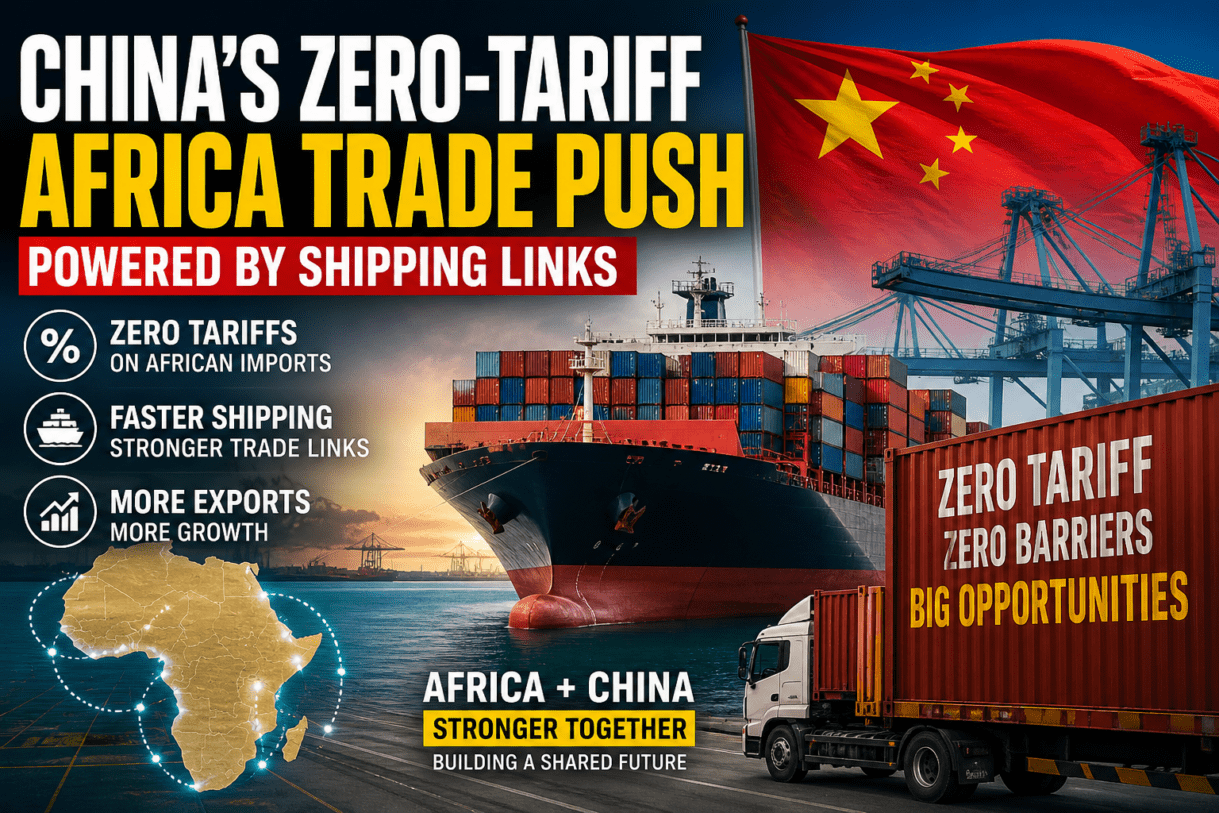
As of May 2026, Beijing has thrown open its vast market to African exports with a sweeping zero-tariff policy, eliminating import duties on goods from nearly every African country with diplomatic ties. On paper, it’s one of the most generous trade concessions ever extended by a major economic power.
But tariffs are only part of the story.
Behind the headlines lies a more strategic play—one that hinges not just on policy, but on ships, ports, and the speed at which goods can cross oceans. China is betting that by tightening shipping links with Africa, it can turn a symbolic trade gesture into a real economic engine.
And if it works, the ripple effects will be felt far beyond the continent.
The Policy That Opened the Door
For years, African exporters have struggled with limited access to major global markets. Tariffs, quotas, and complex trade rules often made it difficult for local producers to compete.
China’s new approach flips that reality.
By removing tariffs on a wide range of African goods—from agricultural produce to manufactured items—China has effectively lowered the cost barrier to zero. For exporters, that means better pricing power, higher margins, and a stronger foothold in one of the world’s largest consumer markets.
It’s a bold signal: Africa is no longer just a supplier of raw materials—it’s being invited to participate more deeply in global trade.
But access alone doesn’t move goods.
Why Shipping Is the Real Game-Changer
Trade policies can open doors, but logistics determines whether anyone walks through them.
China understands this well. That’s why it’s simultaneously investing in faster, more efficient shipping routes linking African ports to Chinese hubs. The logic is straightforward: if African goods can reach Chinese markets faster and cheaper, trade volumes will naturally rise.
This is where the strategy becomes tangible.
- Shorter shipping times mean fresher agricultural exports
- Lower freight costs make African products more competitive
- Improved port infrastructure reduces delays and inefficiencies
In practical terms, it could mean a farmer in East Africa getting produce to a Chinese supermarket in record time—or a textile manufacturer scaling exports without being crushed by logistics costs.
The combination of zero tariffs and improved shipping is not accidental. It’s coordinated.
A Strategic Move in a Changing World
China’s timing is deliberate.
Global trade is becoming more fragmented. Protectionism is creeping back. Supply chains are being rethought. In this environment, offering tariff-free access positions China as a counterweight—a country willing to keep markets open when others are tightening.
At the same time, Africa’s importance is rising.
The continent is rich in natural resources, home to a fast-growing population, and increasingly central to future global demand. Strengthening trade ties now is not just about today’s exports—it’s about securing long-term economic relationships.
There’s also a quieter objective: supply chain stability.
By deepening trade links with Africa, China reduces its reliance on more volatile or politically sensitive regions. It’s a diversification strategy disguised as trade cooperation.
What Africa Stands to Gain
For African economies, the opportunity is real—but it’s not automatic.
1. A Boost for Exports
With tariffs out of the equation, African goods become more attractive in Chinese markets. This could drive growth in sectors like:
- Agriculture (coffee, tea, cocoa, fresh produce)
- Textiles and apparel
- Processed foods
- Minerals and raw materials
Producers who can meet quality and volume demands stand to gain the most.
2. A Push Toward Industrialization
Access to a massive market creates an incentive to move beyond raw exports. Countries can invest in processing, manufacturing, and value addition—keeping more economic benefits at home.
Instead of exporting raw cocoa, for example, there’s a stronger case for exporting finished chocolate products.
3. Infrastructure Development
As trade volumes increase, pressure will grow to improve:
- Ports
- Rail networks
- Roads and logistics hubs
This could accelerate infrastructure investment across the continent, creating jobs and improving connectivity.
The Risks No One Is Ignoring
Despite the optimism, there are real challenges.
Capacity Constraints
Not all countries are ready to scale exports quickly. Limited infrastructure, inconsistent power supply, and production bottlenecks could slow progress.
Trade Imbalance
China already exports far more to Africa than it imports. Without significant growth in African exports, the gap could persist—even with zero tariffs.
Dependency Concerns
There’s an ongoing debate about whether deeper trade ties could lead to over-reliance on a single partner. If African economies remain focused on raw materials, the benefits may be uneven.
The Bigger Picture: A New Trade Corridor
What makes this moment significant is not just the policy—but the system being built around it.
China is aligning:
- Trade policy (zero tariffs)
- Physical infrastructure (ports, shipping routes)
- Market demand (a massive consumer base)
That combination creates a powerful trade corridor—one that could redefine how goods move between Africa and the rest of the world.
It’s not just about increasing trade volume. It’s about reshaping trade patterns.
Early Signs of Momentum
Even before the full rollout, trade between China and Africa has been climbing steadily. Shipping demand is rising. Port activity is increasing. Export sectors are preparing for expansion.
The real test, however, begins now.
Will African producers scale up fast enough?
Will logistics improvements keep pace with demand?
Will the policy remain consistent over time?
These questions will determine whether the initiative becomes a historic success—or a missed opportunity.
A Turning Point in Global Trade?
China’s zero-tariff push, backed by a strong shipping strategy, is more than a policy announcement. It’s a calculated attempt to reshape economic relationships at a global level.
For Africa, it offers a rare opening—a chance to access a massive market with fewer barriers than ever before.
But opportunity alone is not enough.
The countries that invest in production, improve logistics, and adapt quickly will be the ones that benefit most. Those that don’t risk watching from the sidelines as others seize the moment.
One thing is clear: the ships are moving, the tariffs are gone, and the next chapter of Africa-China trade has already begun.
SUGGESTED READS
- The 3-Meter Mistake That Almost Cost Her Life
- Captain Irene Koki Mutungi: The Girl Who Touched the Sky
- Maina Njenga: Prophet, Cult Leader or Political Pawn?
- The Mau Mau Rebellion: Kenya’s First War for Freedom
- The Rise, Evolution, and Impact of the Sungusungu Vigilantes in Kisii, Kenya
- Mungiki: The Rise, Fall, and Shadows of Kenya’s Most Feared Underground Movement
- The Coffin Thief of Nairobi: The True Story of John Kibera

Support Our Website!
We appreciate your visit and hope you find our content valuable. If you’d like to support us further, please consider contributing through the TILL NUMBER: 9549825. Your support helps us keep delivering great content!
If you’d like to support Nabado from outside Kenya, we invite you to send your contributions through trusted third-party services such as Remitly, western union, SendWave, or WorldRemit. These platforms are reliable and convenient for international money transfers.
Please use the following details when sending your support:
Phone Number: +254701838999
Recipient Name: Peterson Getuma Okemwa
We sincerely appreciate your generosity and support. Thank you for being part of this journey!