

simply amazing, always for you.
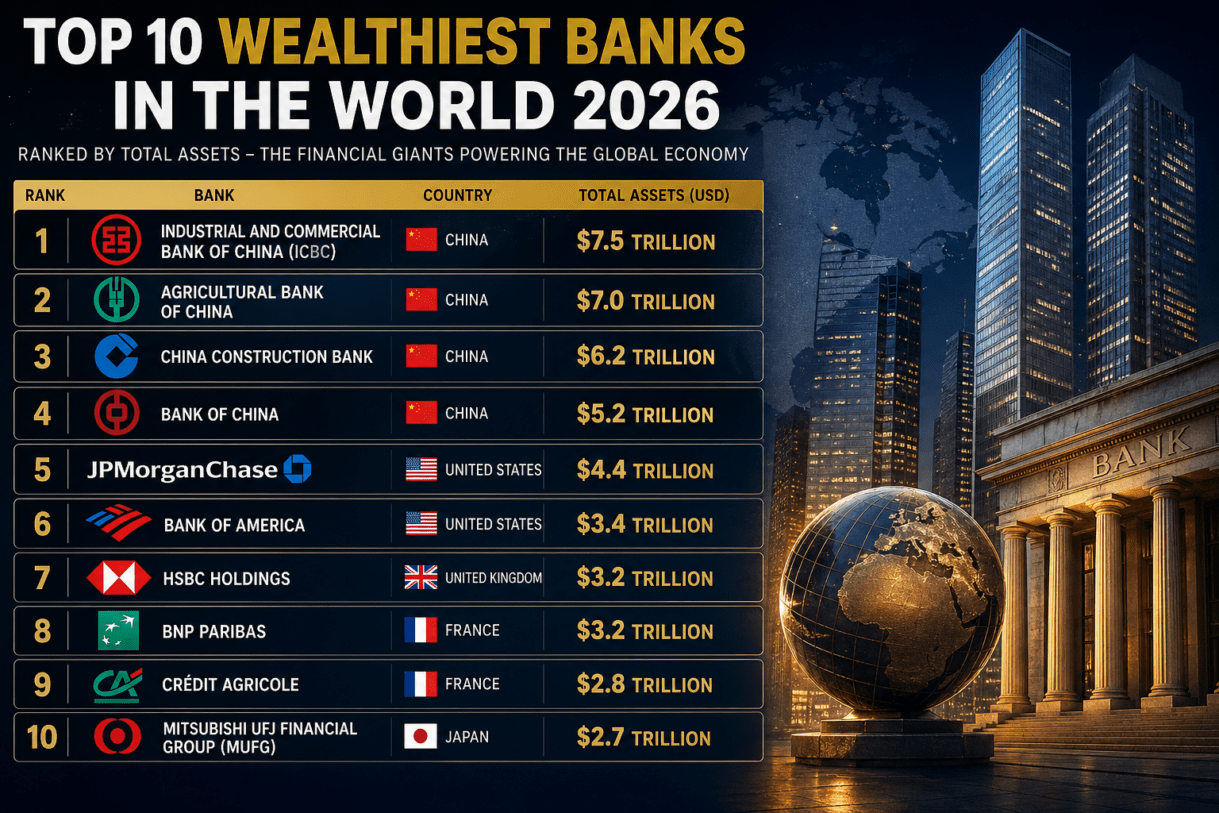
The Top 10 Wealthiest Banks in the World: Inside the Financial Giants Controlling Global Banking
Money powers modern civilization. It drives innovation, fuels businesses, supports governments, and shapes economies. At the center of this global financial machine are banks — institutions that move trillions of dollars daily and quietly influence everything from mortgage rates to international trade.
When people think about the wealthiest companies in the world, names like Apple, Microsoft, and Amazon often come to mind. Yet, some of the most financially powerful institutions on the planet are banks, many of which hold more assets than the GDP of entire nations.
The world’s wealthiest banks are not simply places where customers deposit money. They are massive financial ecosystems involved in lending, investing, wealth management, corporate financing, foreign exchange, and international economic development.
In 2026, the global banking landscape remains dominated by financial giants from China, the United States, Europe, and Japan. These institutions control trillions in assets and play a central role in shaping economic stability worldwide.
This article takes a deep look at the top 10 wealthiest banks in the world, how they built their financial dominance, what makes them powerful, and why their influence matters.
What Determines a Bank’s Wealth?
Before examining the rankings, it is important to understand how bank wealth is measured.
Unlike ordinary companies where value is often measured by market capitalization, banks are typically ranked by:
1. Total Assets
This is the total value of everything a bank owns or controls, including:
- Loans
- Investments
- Cash reserves
- Securities
- Property holdings
Total assets are considered the most reliable indicator of a bank’s size and financial reach.
2. Market Capitalization
This reflects investor confidence and stock market value.
3. Profitability
Annual net income shows how efficiently a bank converts its resources into profit.
4. Global Influence
A bank’s reach across countries and industries also contributes to its overall financial importance.
For this ranking, we focus mainly on total assets.
1. Industrial and Commercial Bank of China (ICBC)
Country: China
Estimated Assets: Over $7 trillion
Industrial and Commercial Bank of China remains the largest and wealthiest bank in the world.
Founded in 1984, ICBC has grown from a domestic commercial bank into a global financial titan. It serves millions of individual customers and businesses while maintaining a strong presence across Asia, Europe, Africa, and the Americas.
Why ICBC Is So Powerful
ICBC benefits from:
- China’s enormous economy
- Strong state backing
- Extensive corporate lending
- Large international operations
Its scale is staggering. The bank finances massive infrastructure projects, supports industrial expansion, and facilitates international trade transactions worth billions.
ICBC’s dominance reflects China’s economic rise and its ambition to shape global finance.
2. Agricultural Bank of China
Country: China
Estimated Assets: Over $6 trillion
Despite its name, the Agricultural Bank of China is no longer limited to rural financing.
Originally established to support China’s agricultural sector, it has evolved into one of the world’s most powerful universal banks.
It offers:
- Retail banking
- Corporate lending
- Investment products
- International financial services
What Makes It Wealthy
China’s massive population gives the bank access to one of the world’s largest customer bases.
Its strong domestic network, combined with increasing international expansion, has allowed it to become a financial giant.
The bank is particularly influential in supporting small businesses and regional economic growth.
3. China Construction Bank
Country: China
Estimated Assets: Around $6 trillion
China Construction Bank was originally established to fund infrastructure projects.
Today, it is one of the largest commercial banks on Earth.
Its specialties include:
- Infrastructure financing
- Real estate lending
- Corporate banking
- Digital financial innovation
Key Strength
China’s rapid urbanization has significantly fueled the bank’s growth.
As cities expanded and construction boomed, China Construction Bank became a central player in financing roads, bridges, skyscrapers, and industrial projects.
It remains deeply integrated into China’s economic development.
4. Bank of China
Country: China
Estimated Assets: Over $5 trillion
The Bank of China is one of the country’s oldest financial institutions.
Founded in 1912, it has evolved into a major international banking powerhouse.
Unlike some Chinese banks that focus heavily on domestic lending, Bank of China has a stronger international footprint.
It operates in dozens of countries and specializes in:
- International trade finance
- Currency exchange
- Cross-border banking
- Corporate finance
Why It Matters Globally
Bank of China is critical to facilitating trade between China and the rest of the world.
Its international role gives it strategic importance far beyond its balance sheet.
5. JPMorgan Chase
Country: United States
Estimated Assets: Over $4 trillion
JPMorgan Chase is the largest bank in the United States and one of the most respected financial institutions globally.
Its roots stretch back over 200 years, making it one of America’s oldest financial institutions.
It operates across:
- Investment banking
- Consumer banking
- Asset management
- Commercial lending
Why JPMorgan Is Different
Unlike many larger Chinese banks, JPMorgan excels in profitability and market influence.
It is often regarded as the most sophisticated banking institution in the world.
The bank advises governments, manages enormous investment portfolios, and facilitates some of the world’s largest corporate deals.
Its CEO, Jamie Dimon, is widely considered one of the most influential voices in global finance.
6. Bank of America
Country: United States
Estimated Assets: Around $3.4 trillion
Bank of America is a household name in the U.S. and one of the world’s largest financial institutions.
It serves millions of customers through:
- Personal banking
- Credit cards
- Wealth management
- Corporate finance
Competitive Advantage
Its acquisition of Merrill Lynch significantly strengthened its investment banking and wealth management capabilities.
Bank of America has also become a leader in digital banking innovation.
Its mobile banking platform serves tens of millions of users.
7. HSBC Holdings
Country: United Kingdom
Estimated Assets: Over $3 trillion
HSBC is one of the most internationally connected banks in the world.
Founded in Hong Kong and Shanghai in 1865, it was built to facilitate trade between East and West.
Today, it operates across:
- Asia
- Europe
- North America
- Middle East
- Africa
Why HSBC Stands Out
Its global reach is unmatched by most competitors.
HSBC’s deep presence in emerging markets gives it unique access to high-growth regions.
It serves as a bridge between international markets, especially between Asia and Europe.
8. BNP Paribas
Country: France
Estimated Assets: Around $3 trillion
BNP Paribas is Europe’s largest bank by assets.
It offers:
- Retail banking
- Investment banking
- Asset management
- Corporate financial services
Financial Strength
The bank’s diversified business model provides resilience.
It operates across more than 60 countries and has a strong reputation for institutional banking.
BNP Paribas plays a central role in financing European business expansion.
9. Crédit Agricole
Country: France
Estimated Assets: Around $2.8 trillion
Crédit Agricole began as a cooperative bank supporting farmers.
Today, it is one of Europe’s most powerful financial institutions.
Its services include:
- Consumer banking
- Insurance
- Investment management
- Corporate lending
Why It Grew So Large
Its cooperative structure gave it a strong local customer base.
That trust translated into long-term financial stability.
It remains one of France’s most trusted banks.
10. Mitsubishi UFJ Financial Group (MUFG)
Country: Japan
Estimated Assets: Around $2.7 trillion
MUFG is Japan’s largest financial group and a major global banking force.
It provides:
- Commercial banking
- Investment banking
- Trust banking
- International finance
Strategic Importance
Japan’s mature economy and strong corporate sector support MUFG’s stability.
The bank has expanded aggressively into Southeast Asia and the United States.
Its partnerships and acquisitions have strengthened its international footprint.
Why Chinese Banks Dominate the Rankings
One of the most striking aspects of global banking is China’s dominance.
Four Chinese banks occupy the top positions.
This is not accidental.
Massive Domestic Market
China has over 1.4 billion people.
That creates enormous demand for financial services.
Government Support
Many major Chinese banks benefit from state ownership or strategic backing.
This provides stability and expansion opportunities.
Infrastructure Financing
China’s large-scale development projects require huge banking support.
Banks finance:
- Railways
- Airports
- Energy projects
- Urban expansion
Global Expansion
Chinese banks are increasingly financing projects worldwide.
Their presence is especially growing in Africa, Asia, and Latin America.
The Difference Between Wealthiest and Most Valuable Banks
Many people confuse size with market value.
These are different.
Wealthiest by Assets
This measures financial scale.
Chinese banks dominate here.
Most Valuable by Market Cap
This reflects investor confidence.
American banks often dominate.
For example, JPMorgan Chase frequently leads global banking market capitalization rankings.
Why?
Because investors value profitability, governance, and long-term growth potential.
How These Banks Shape the Global Economy
These institutions do far more than hold deposits.
They influence:
Interest Rates
Large banks affect lending costs globally.
Corporate Expansion
They finance multinational business growth.
Government Debt Markets
Banks help governments raise capital.
Currency Markets
They facilitate international trade and exchange.
Economic Stability
Their health impacts the broader financial system.
A crisis involving any major global bank could send shockwaves through world markets.
The Rise of Digital Banking Among Financial Giants
Traditional banking is rapidly evolving.
The wealthiest banks are investing heavily in:
- Artificial intelligence
- Blockchain technology
- Cybersecurity
- Mobile banking
- Automated financial advisory services
JPMorgan has invested billions in fintech.
Chinese banks are pioneering digital payment ecosystems.
HSBC and BNP Paribas are expanding digital-first services.
The future of banking will belong to institutions that adapt quickly.
Challenges Facing the World’s Biggest Banks
Even the largest banks face serious challenges.
Regulatory Pressure
Governments impose strict oversight to prevent financial crises.
Cybersecurity Threats
Banks are prime targets for cyberattacks.
Economic Slowdowns
Global recessions can increase loan defaults.
Competition From Fintech
Digital startups are disrupting traditional banking.
Geopolitical Risks
Trade tensions and sanctions affect international operations.
Maintaining dominance requires constant adaptation.
Which Bank Is the Strongest?
This depends on how “strongest” is defined.
Largest by Assets
ICBC
Most Profitable
Often JPMorgan Chase
Most International
HSBC
Strongest European Bank
BNP Paribas
Strongest Asian Bank Outside China
MUFG
Each excels in different areas.
Could New Banks Enter the Top 10?
Possibly.
Several institutions are rising rapidly.
These include:
- Wells Fargo
- Citigroup
- UBS
- Santander
- Goldman Sachs
Digital transformation and strategic acquisitions could reshape future rankings.
What This Means for Everyday People
You may never open an account with ICBC or BNP Paribas, but these banks still affect your life.
They influence:
- Loan rates
- Mortgage costs
- Investment markets
- Currency values
- Economic growth
Their decisions ripple across the global economy.
The Future of Global Banking
The banking industry is entering a transformative period.
Key trends include:
AI-Driven Banking
Automation will improve efficiency.
Green Finance
Banks are funding climate-friendly projects.
Digital Currencies
Central bank digital currencies may reshape transactions.
Financial Inclusion
Banks are expanding access in underserved regions.
The institutions that adapt fastest will likely dominate the next decade.
The top 10 wealthiest banks in the world are far more than financial institutions.
They are pillars of global commerce, economic development, and financial stability.
China currently dominates the rankings through sheer scale.
The United States leads in innovation and market confidence.
Europe and Japan remain powerful through resilience and international influence.
As technology transforms finance and economic power shifts globally, the competition among these giants will intensify.
One thing is certain: the banks on this list will continue shaping the world economy for years to come.
Understanding who they are and how they operate offers valuable insight into the forces that quietly influence global wealth.
SUGGESTED READS
- Why Your Daily Spending Decisions Matter More Than You Think
- How to Supercharge Your Productivity at Work
- The Simple Habits That Help Kenyans Become Financially Stable
- Living Paycheck to Paycheck in Kenya: The Silent Financial Crisis No One Is Talking About
- Why More Kenyans Are Choosing Side Hustles Over Employment
- How to Manage Money in Kenya When Prices Keep Rising
- The Honest Reality of Freelancing in Kenya (Income, Struggles, and Success Tips)

Support Our Website!
We appreciate your visit and hope you find our content valuable. If you’d like to support us further, please consider contributing through the TILL NUMBER: 9549825. Your support helps us keep delivering great content!
If you’d like to support Nabado from outside Kenya, we invite you to send your contributions through trusted third-party services such as Remitly, western union, SendWave, or WorldRemit. These platforms are reliable and convenient for international money transfers.
Please use the following details when sending your support:
Phone Number: +254701838999
Recipient Name: Peterson Getuma Okemwa
We sincerely appreciate your generosity and support. Thank you for being part of this journey!