

We aint done yet… Expect another one.
Have you ever remembered something so clearly that you could almost see it happening in front of you, only to discover later that it may never have happened?
Perhaps you remember having a conversation with someone, visiting a particular place as a child, or experiencing an embarrassing moment years ago. You can picture the surroundings. You can almost hear the voices. You may even remember how you felt at the time.
Then someone tells you, “That never happened.”
It can be disturbing.
How can you remember something that apparently never happened?
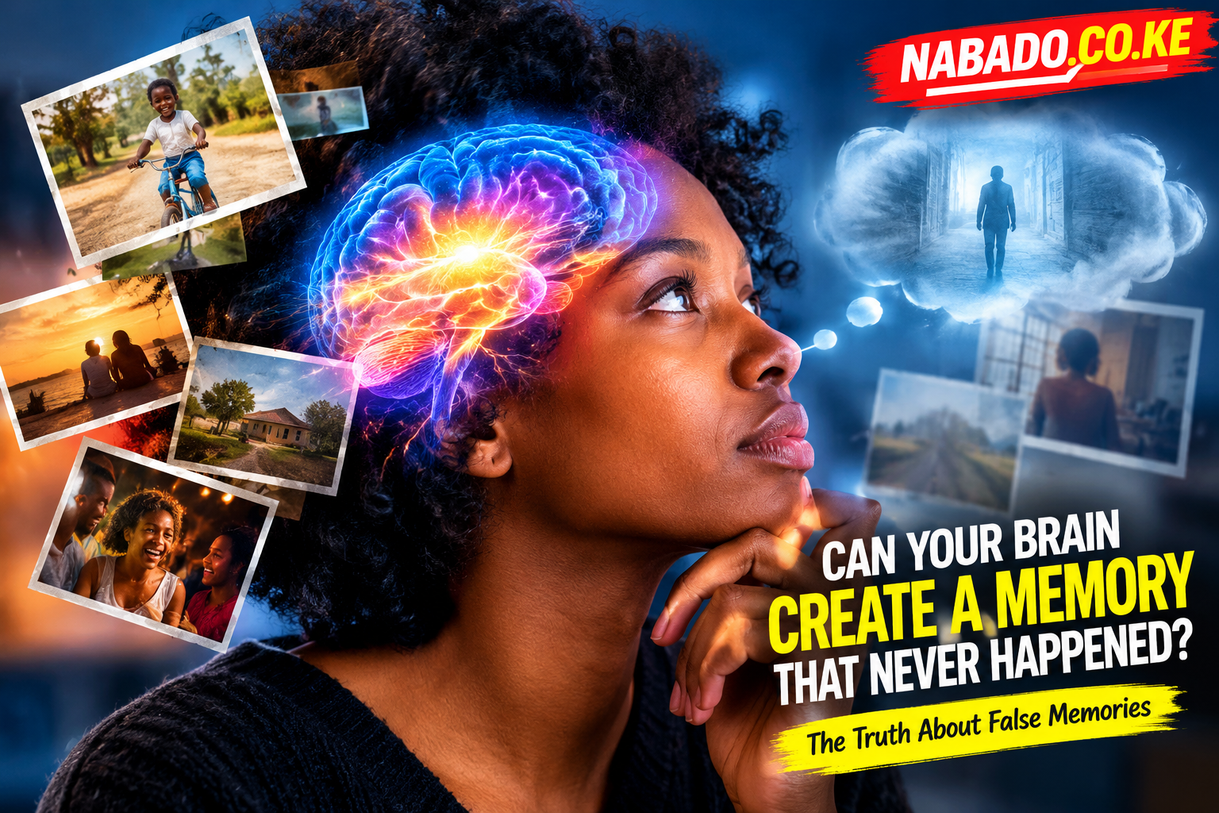
The surprising answer is that yes, your brain can create a memory of an event that never actually occurred. These experiences are known as false memories, and they are a fascinating reminder that human memory is far more complicated than simply storing and replaying the past.
Memory is not a perfect recording of everything we experience. Instead, it is a reconstruction. Every time we remember something, the brain rebuilds that memory using pieces of information, emotions, knowledge and other memories.
Sometimes, the reconstruction is accurate.
Other times, the brain fills in gaps, changes details or even creates an event that feels real despite never happening.
What Is a False Memory?
A false memory is a recollection of an event, detail or experience that does not accurately represent what actually happened.
The important thing about false memories is that they are not necessarily lies.
A person with a false memory usually believes the memory is genuine. They are not deliberately inventing a story. Their brain has simply produced a recollection that differs from reality.
For example, imagine that your family repeatedly tells you that you fell off a bicycle when you were five years old.
You hear the story several times.
Eventually, you might begin to picture yourself lying on the ground, looking at the bicycle and crying. You may even develop additional details about the weather, the location or who was present.
But what if you never actually fell off the bicycle?
Your brain may have transformed repeated information into something resembling a personal memory.
This illustrates one of the most important facts about memory: remembering something does not automatically prove that it happened exactly as remembered.
Your Brain Does Not Store Memories Like a Video Camera
One of the biggest misconceptions about memory is that the brain records life like a camera.
If that were true, remembering would simply mean pressing “play” on an internal recording.
Human memory doesn’t work that way.
When you experience something, your brain processes different aspects of the experience, including sights, sounds, emotions, words and surroundings. These pieces become associated with one another.
Later, when you remember the event, the brain reconstructs it.
That reconstruction can be remarkably accurate, but it can also contain errors.
Think of memory more like rebuilding a puzzle than watching a movie.
Some pieces may be missing. Some may have become distorted. Your brain may use information from other experiences to complete the picture.
Most of the time, you don’t notice this process.
You simply experience the result as a memory.
Why Can the Brain Create False Memories?
There is no single reason why false memories occur. Several psychological and neurological processes can contribute to them.
1. Suggestion Can Change Memory
One of the most powerful influences on memory is suggestion.
Suppose a friend tells you, “Remember when we went to that restaurant and you accidentally spilled juice on yourself?”
You don’t remember it.
But they keep talking about the incident.
Eventually, you might begin imagining it.
Over time, the imagined scene may become familiar enough that you start wondering whether you actually remember it.
This is one reason leading questions can influence people’s recollections.
Instead of asking, “What happened at the restaurant?” someone might ask, “What color was the table where you spilled the juice?”
The question itself can subtly encourage the brain to accept the event as something that happened.
2. Memories Can Become Blended Together
Another common cause of false memories is the mixing of different experiences.
Imagine you visited two different beaches during childhood.
At one beach, you played with your cousin.
At the other, you lost a toy.
Years later, your brain may combine the two experiences.
You might remember playing with your cousin at the beach where you lost the toy, even though those events happened on separate occasions.
The memory may contain real pieces, but they have been assembled incorrectly.
This is sometimes called source confusion — remembering information but incorrectly remembering where that information came from.
Dreams Can Sometimes Complicate Memory
Dreams can also create confusion.
Some dreams are incredibly vivid. During a particularly realistic dream, you may have conversations, visit familiar locations and experience powerful emotions.
After waking up, the dream usually becomes recognizable as a dream.
But occasionally, especially when the dream is unusually realistic, fragments can remain in memory alongside real experiences.
A person might later remember having a conversation with someone when, in reality, the conversation occurred only in a dream.
This does not mean dreams routinely become false memories. Rather, it shows how the brain can sometimes confuse the source of remembered information.
The brain may remember the content without perfectly identifying whether it came from an actual experience, a dream, a conversation, a photograph, a story or imagination.
Imagination Can Make Something Feel Familiar
Another fascinating phenomenon is the relationship between imagination and memory.
If you repeatedly imagine an event, the imagined scenario can become increasingly familiar.
For example, suppose you imagine what it would be like to meet a famous person.
You picture the location.
You imagine what you would say.
You imagine how they might respond.
You visualize the surroundings.
After thinking about the scenario repeatedly, the imagined experience may become easier to recall.
That does not mean your brain believes every imagined event literally happened. But familiarity can sometimes contribute to confusion about the source of information.
This is one reason researchers distinguish between remembering an event and remembering the source of the information about that event.
Repetition Can Change the Way We Remember
Have you ever told the same childhood story dozens of times?
Every time you tell it, you may focus on certain details.
You might leave other details out.
Someone else might correct you.
Another person might add something.
Eventually, the story you remember can become different from the original experience.
The change doesn’t necessarily happen deliberately.
Human memory is influenced by repetition.
The more frequently a version of an event is discussed, the more familiar that version may become.
This can make it difficult to separate the original experience from everything that was later said about it.
Emotions Can Make Memories Feel More Real
Strong emotions are closely associated with memory.
Fear, embarrassment, excitement, sadness and happiness can make an experience feel extremely significant.
But emotional intensity does not guarantee perfect accuracy.
In fact, people can sometimes remember the emotional core of an experience while getting specific details wrong.
Someone may remember being extremely embarrassed at school but incorrectly remember exactly who was present or what was said.
The feeling may be genuine even when parts of the story have changed.
This distinction is important.
A memory can contain a real emotional response while still containing inaccurate factual details.
Why Are Childhood Memories Especially Vulnerable?
Childhood memories can be particularly complicated because they are old, and memories generally become less detailed over time.
Young children are also still developing the cognitive abilities needed to organize experiences and distinguish different sources of information.
As people grow older, they may hear stories about their childhood from parents and relatives.
They may see old photographs.
They may watch videos.
They may visit places from their childhood.
All of these sources can become mixed with their own recollections.
A person might therefore develop a detailed memory containing elements from personal experience, family stories, photographs and imagination.
The final memory can feel completely personal even though some of its details came from other sources.
False Memories Don’t Mean Your Brain Is Broken
Having an inaccurate memory does not necessarily indicate a serious problem.
Memory errors are a normal part of human cognition.
In fact, our brains constantly prioritize some information over other information.
We don’t remember every conversation we have.
We don’t remember every meal we eat.
We don’t remember every street we walk down.
Instead, memory tends to preserve information that seems meaningful, useful or emotionally important.
As time passes, details can disappear while the general meaning remains.
When the brain reconstructs the memory later, it may fill in some missing information.
This can produce an inaccurate recollection without there being anything fundamentally wrong with the person’s brain.
Can People Be Completely Certain About a False Memory?
Yes.
This is perhaps the most surprising aspect of false memories.
A person can be highly confident that an event happened and still be mistaken.
Confidence and accuracy are not identical.
Someone might say:
“I know exactly what happened.”
They may genuinely believe that.
But certainty alone cannot guarantee that every detail is correct.
This is particularly important when memories involve other people, historical events or serious accusations.
Human memory should not automatically be treated as an objective recording simply because someone describes an experience with confidence.
False Memories and Eyewitness Testimony
The fallibility of memory has important consequences outside everyday life.
Eyewitnesses are sometimes asked to identify people involved in crimes or describe what they saw during stressful situations.
However, memories can be influenced by factors such as stress, the passage of time, questions from investigators, conversations with other witnesses and exposure to photographs or media reports.
An eyewitness may genuinely believe they remember something correctly while still being mistaken.
This does not mean eyewitness testimony is useless.
It means that memory should ideally be considered alongside other evidence.
Physical evidence, photographs, recordings, documents, digital information and independent witnesses can help establish what actually happened.
Can You Tell Whether a Memory Is False?
Unfortunately, there is no simple test that allows you to look at a memory and immediately determine whether it is true.
A vivid memory can be accurate.
A vague memory can be accurate.
A vivid memory can also be wrong.
Instead of asking only, “How strongly do I remember this?” it can be useful to ask:
Where did this memory come from?
Did you personally experience it?
Did someone tell you about it?
Have you seen photographs?
Have you watched a video?
Did you repeatedly imagine it?
Could it be mixed with another event?
Have other people described the incident differently?
These questions can help separate the memory itself from its possible sources.
Why Does the Brain Work This Way?
At first, false memories may seem like a design flaw.
But there is another way to look at them.
The brain is not necessarily designed to preserve every tiny detail of every moment. It has to process enormous amounts of information while helping us make decisions, recognize patterns and understand our environment.
Memory is therefore selective and reconstructive.
The same system that allows us to generalize from past experiences and understand the bigger picture can also produce errors.
In other words, the brain’s ability to reconstruct information is extremely useful — but reconstruction comes with the possibility of distortion.
False Memories Can Contain Real Pieces
One of the most interesting things about false memories is that they aren’t always completely fabricated from nothing.
A false memory may contain several genuine elements.
Perhaps you really visited a particular location.
Maybe you really spoke to a particular person.
Perhaps another event actually happened.
The problem is that your brain may connect those pieces incorrectly.
Imagine having five puzzle pieces from different puzzles and accidentally putting them together.
The resulting picture may look convincing even though it doesn’t represent the original image.
Memory can work in a similar way.
Why Some Memories Stay With Us for Decades
Some memories remain powerful for decades.
People can remember childhood homes, school experiences, first relationships, major celebrations or embarrassing moments from many years earlier.
But long-lasting memories are not necessarily perfect memories.
Sometimes what survives is the central meaning of an experience rather than every factual detail.
You may remember that you were extremely embarrassed during a school presentation, for example, but the exact date, words spoken and people sitting in the room may have changed over time.
The older the memory becomes, the more difficult it can be to verify individual details.
Should You Trust Your Memories?
You should trust your memories enough to use them as part of your understanding of your life, but it is wise to recognize their limitations.
For everyday situations, small memory errors usually don’t matter.
Whether someone wore a blue or black shirt ten years ago is rarely important.
But when memories involve major decisions, relationships, legal disputes or serious accusations, caution becomes much more important.
If something matters greatly, independent evidence can be valuable.
Messages, photographs, documents, recordings and other people’s accounts may help establish what actually happened.
The Bigger Lesson About Human Memory
False memories reveal something profound about the human mind.
We often think of ourselves as people who experience the world, record it and later remember it.
Reality is more complicated.
Our brains continuously interpret information.
They select what seems important.
They connect new experiences to old ones.
They fill gaps.
They update memories.
They sometimes make mistakes.
That means the story we tell ourselves about our past is not necessarily a perfect transcript of our lives.
It is a reconstruction.
And sometimes, that reconstruction contains events that never happened.
So, can your brain create a memory that never happened?
Yes.
False memories are a recognized phenomenon in psychology and neuroscience. They can arise through suggestion, imagination, source confusion, memory blending, repeated conversations, dreams and the natural reconstruction of memories over time.
Perhaps the strangest part is that a false memory doesn’t necessarily feel false.
It can feel vivid.
It can feel emotional.
It can feel familiar.
It can even feel completely certain.
That is why memory should not be thought of as a perfect recording device. It is better understood as a dynamic system that reconstructs the past using information available to the brain.
The next time you suddenly remember something from years ago, you don’t necessarily need to doubt everything you remember.
But it is worth remembering one simple truth:
A memory can feel real without being completely true.
And sometimes, the brain can tell you a story about your past that never actually happened.
SUGGESTED READS
- Who Invented Tattooing and Why Humans First Marked Their Skin
- 15 Powerful Ways to Create a Greener, More Sustainable Lifestyle
- Scientists Finally Reveal Why You Dream — And Why Your Brain Erases It Instantly
- The World Is Drowning in Waste — Why Recycling Is No Longer Optional
- African Man Goes From Dreamer to U.S. Citizen — The Brutal, Little-Known Journey Behind the American Dream
- London’s Secret Underground EXPOSED: 7 Abandoned Tube Stations Hidden Beneath Your Feet
- Why Is It Cooler at Night Compared to Daytime

Support Our Website!
We appreciate your visit and hope you find our content valuable. If you’d like to support us further, please consider contributing through the TILL NUMBER: 9549825. Your support helps us keep delivering great content!
If you’d like to support Nabado from outside Kenya, we invite you to send your contributions through trusted third-party services such as Remitly, western union, SendWave, or WorldRemit. These platforms are reliable and convenient for international money transfers.
Please use the following details when sending your support:
Phone Number: +254701838999
Recipient Name: Peterson Getuma Okemwa
We sincerely appreciate your generosity and support. Thank you for being part of this journey!