

We aint done yet.. Expect another one.
Imagine working for an entire month, receiving your salary, and discovering that the money you earned can barely buy the food you need. Imagine saving for years, only to watch your savings lose nearly all their value. Now imagine visiting a shop where prices change so frequently that the amount printed on a banknote no longer tells you what you can afford.
This was the extraordinary reality experienced by millions of Zimbabweans during one of the worst episodes of hyperinflation in modern economic history.
Zimbabwe, once known for its productive agricultural sector and relatively developed economy, experienced a financial disaster that turned its national currency into a symbol of economic collapse. The crisis became so severe that the country issued a banknote worth 100 trillion Zimbabwean dollars, an amount that sounds unimaginable but could not guarantee its holder a comfortable meal.
The story of Zimbabwe’s currency collapse is not simply about a government printing too much money. It is about declining production, unsustainable government financing, weakening institutions, collapsing public confidence and an economic crisis that reinforced itself until the national currency was practically abandoned.
Understanding how this happened provides important lessons for countries around the world, particularly those struggling with rising prices, currency depreciation and increasing pressure on household incomes.
Zimbabwe Before the Economic Collapse
To understand the scale of Zimbabwe’s financial disaster, it is important to understand that the country was not always associated with worthless money and extreme inflation.
Zimbabwe gained independence from British rule in 1980. In the years that followed, the country maintained important agricultural, mining and manufacturing industries. Commercial farming played a significant role in producing food and generating export earnings, while the country’s industrial sector supplied a range of goods to domestic and regional markets.
The Zimbabwean dollar initially had meaningful purchasing power. Businesses could plan their operations, workers could receive wages and households could save money without expecting their entire financial position to change overnight.
However, economic difficulties accumulated over time. Government spending pressures, policy uncertainty, declining production and deteriorating relations with international financial institutions and other international partners contributed to a worsening economic environment.
During the early 2000s, the economy came under increasing strain. Agricultural production was severely disrupted, industrial activity weakened and foreign currency became increasingly difficult to obtain.
These problems created the conditions for a financial crisis that would eventually become catastrophic.
The Beginning of Zimbabwe’s Inflation Crisis
Inflation occurs when the general prices of goods and services rise over time, reducing the purchasing power of money.
Moderate inflation is common in functioning economies. However, when prices increase extremely rapidly and people lose confidence in the currency, an economy can experience hyperinflation.
Zimbabwe’s inflation crisis intensified during the late 1990s and early 2000s, before accelerating dramatically in the years leading up to 2008.
Several factors contributed to the deterioration of the economy, including declining production, fiscal pressures, exchange-rate instability and the expansion of money creation by the Reserve Bank of Zimbabwe.
The government faced growing difficulties financing its activities as economic output and tax revenues weakened. Instead of relying exclusively on sustainable revenue collection and manageable borrowing, monetary financing became a major part of the problem.
The result was an expanding supply of domestic money in an economy that was struggling to produce sufficient goods and services.
When the amount of money available to spend grows much faster than the economy’s capacity to supply goods and services, prices can rise sharply. When this process continues alongside collapsing confidence, inflation can accelerate beyond the point at which ordinary monetary measures are effective.
According to the International Monetary Fund, Zimbabwe’s real gross domestic product contracted by approximately 14 per cent in 2008, following a cumulative decline of around 40 per cent during 2000–2007. These figures illustrate the depth of the economic crisis that accompanied the currency collapse.
How Excessive Money Printing Destroyed the Zimbabwean Dollar
One of the most important causes of Zimbabwe’s hyperinflation was excessive money creation to finance government-related spending and other activities.
To understand why this was so damaging, consider a simple example.
Imagine a small town with 100 loaves of bread available for sale. Residents collectively have 10,000 units of currency to spend.
If the amount of money in circulation suddenly increases to one million units while the number of available loaves remains unchanged, people have more money competing for the same limited supply of bread.
Prices may rise as buyers compete for the available goods.
This example simplifies a complicated economic process, but it illustrates why money creation cannot substitute for real production.
Zimbabwe faced a much more serious version of this problem. The economy was shrinking, essential goods were becoming difficult to obtain, and the monetary authorities were creating money on an enormous scale.
As the supply of Zimbabwean dollars expanded, confidence in the currency deteriorated. People increasingly tried to exchange their local money for foreign currencies or spend it before prices increased further.
The more confidence weakened, the less willing people became to hold Zimbabwean dollars.
This created a destructive cycle: excessive monetary expansion contributed to rising prices, rising prices weakened confidence, and declining confidence encouraged people to abandon the currency more quickly.
The central lesson is that a government can create additional banknotes, but it cannot create additional food, fuel, electricity or manufactured goods simply by printing money.
Land Reform and the Collapse of Agricultural Production
Another major factor in Zimbabwe’s economic decline was the disruption of agricultural production associated with land reform.
Beginning around 2000, the country underwent extensive and often violent land redistribution, with commercial farms being taken from established owners and redistributed under a politically charged programme.
The effects varied across regions and agricultural sectors, but the disruption of commercial farming, uncertainty over land ownership and difficulties accessing finance and inputs contributed to declining output in important areas.
Agriculture had been a significant source of employment, food production and export earnings. When production fell, the consequences spread far beyond individual farms.
Less food was available in domestic markets. Agricultural exports generated less foreign currency. Businesses supplying farmers faced reduced demand, while industries depending on agricultural raw materials experienced additional difficulties.
The country also became more vulnerable to shortages and import costs.
This mattered because Zimbabwe needed foreign currency to purchase goods and services from abroad, including fuel, machinery, medicines and other essential supplies.
As export earnings weakened and production declined, obtaining the foreign currency needed to sustain the economy became increasingly difficult.
The agricultural crisis did not, by itself, explain the full scale of hyperinflation. Rather, it contributed to a broader economic collapse that interacted with monetary mismanagement, fiscal problems and declining confidence.
The result was an economy with fewer goods available and a currency that was losing value at an extraordinary speed.
When Prices Began Changing Faster Than People Could Spend
During ordinary inflation, businesses may adjust prices every few months or even less frequently. During Zimbabwe’s hyperinflation crisis, prices could change dramatically over much shorter periods.
Money that appeared valuable in the morning might purchase far less by the evening.
For ordinary families, this created an exhausting daily struggle. Workers had to think about when to spend their wages, shopkeepers had difficulty setting prices and businesses struggled to calculate costs.
Imagine receiving your salary and deciding to postpone buying groceries until the weekend. By the time you returned to the shop, the same amount of money might purchase substantially less food.
Saving in the domestic currency became a dangerous proposition because its purchasing power could disappear before people had an opportunity to use it.
Businesses also faced enormous uncertainty. A retailer who sold goods at one price might discover that replacing the same stock required far more money. Suppliers could demand immediate payment, while customers struggled to keep up with rising prices.
This disrupted ordinary commercial activity and made long-term planning extremely difficult.
Inflation also damaged the relationship between workers and employers. Negotiating salaries became increasingly complicated because a nominal pay rise did not necessarily translate into a better standard of living.
A worker whose salary doubled might still become poorer if prices tripled.
In this environment, the amount of money printed on a banknote became a poor measure of its actual economic value.
Zimbabwe’s 100 Trillion Dollar Banknote
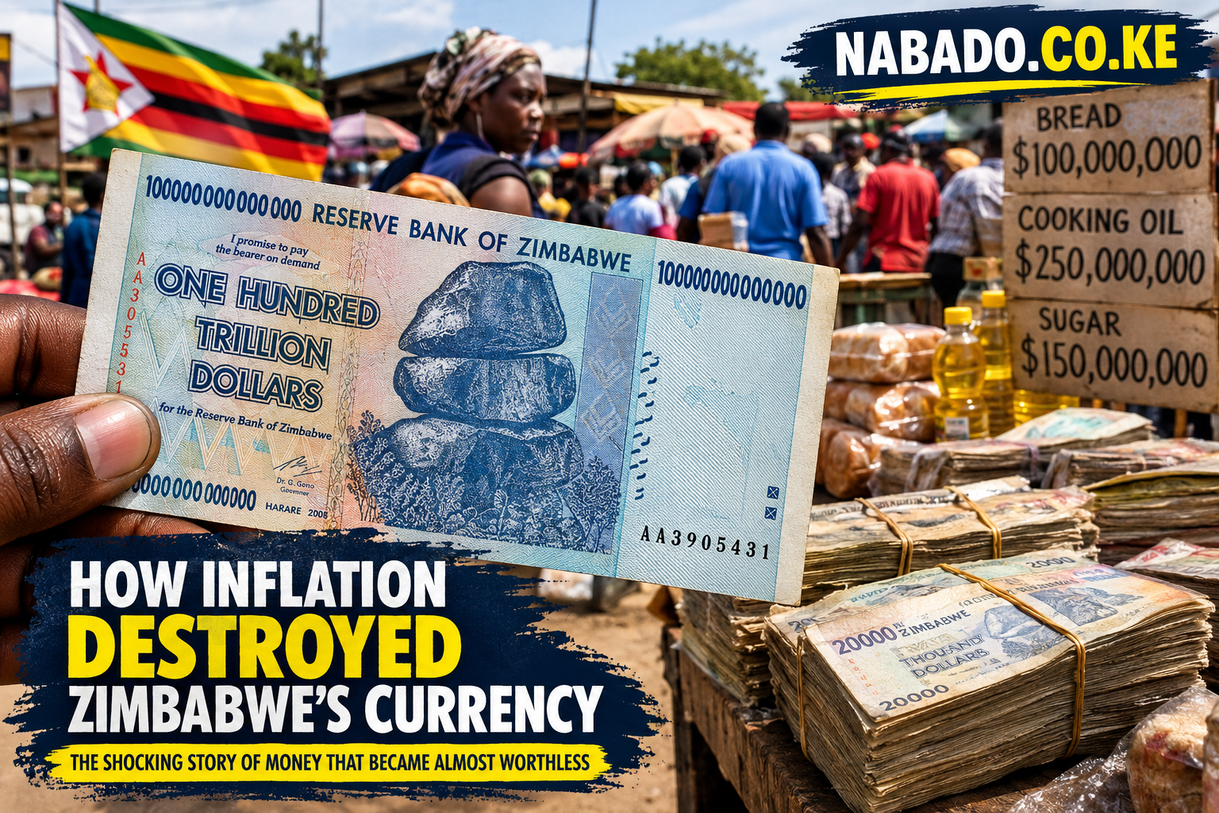
One of the most recognizable symbols of Zimbabwe’s economic crisis is the 100 trillion Zimbabwean dollar banknote issued in 2009.
The note became famous around the world because its denomination was almost impossible to comprehend in an everyday monetary system.
A trillion is one thousand billion. A hundred trillion represents an enormous nominal amount, yet Zimbabwe’s hyperinflation had so severely reduced the purchasing power of the domestic currency that such a denomination was necessary for transactions.
The banknote was not evidence that ordinary Zimbabweans had become extraordinarily wealthy. It was evidence that the unit in which their wealth was measured had lost much of its usefulness.
A person could possess billions or trillions of Zimbabwean dollars without being able to purchase the quantity of goods that the number might suggest.
The distinction between nominal value and real purchasing power is essential to understanding the crisis.
Nominal value is the amount written on a banknote. Real purchasing power describes what that money can actually buy.
When inflation becomes extreme, the nominal value of money can rise dramatically while its real value collapses.
Zimbabwe also removed zeros from its currency through redenomination measures during the crisis. However, removing zeros from a banknote does not restore the purchasing power that has been lost through inflation.
Without credible economic stabilisation, the same underlying problem can return.
Why Zimbabweans Lost Faith in Their Own Currency
A currency depends heavily on public confidence.
People accept money because they believe other people will also accept it in exchange for goods, services and financial obligations. They also need reasonable confidence that the currency will retain purchasing power over the period in which they hold it.
When that confidence disappears, people begin looking for alternatives.
During Zimbabwe’s crisis, businesses and households increasingly turned to foreign currencies, particularly the US dollar and South African rand.
Some people attempted to spend their Zimbabwean dollars as quickly as possible. Others sought foreign currency, goods that could retain value or alternative ways of protecting their savings.
This behaviour was understandable from the perspective of individuals trying to protect their livelihoods. However, it further weakened demand for the domestic currency.
When people are unwilling to hold a currency, they may demand more of it to complete transactions or refuse to accept it altogether.
The currency then loses its usefulness as a medium of exchange, a store of value and a unit for measuring prices.
These are three of the essential functions of money. Zimbabwe’s hyperinflation severely undermined all three.
The crisis ultimately reached a point where the domestic currency had virtually disappeared from everyday circulation by late 2008.
The Human Cost of Hyperinflation
Behind the extraordinary banknotes and economic statistics were millions of people trying to survive.
Hyperinflation did not affect everyone equally. People with savings and fixed incomes denominated in Zimbabwean dollars were particularly vulnerable because their money rapidly lost purchasing power.
Pensioners who had spent decades saving for retirement could discover that their accumulated savings were no longer sufficient to cover basic expenses.
Workers faced uncertainty over whether their salaries would be enough to pay for transport, rent and food.
Parents struggled to provide necessities for their children, while businesses found it increasingly difficult to remain open.
The crisis also weakened the government’s capacity to deliver public services. As the economy contracted and revenue collection deteriorated, funding for essential services came under severe pressure.
The IMF documented the extensive economic and humanitarian damage experienced in 2008, including widespread poverty and serious disruptions to public services.
Hyperinflation therefore represented much more than a problem involving prices. It affected livelihoods, access to essential goods, household security and the ability of institutions to function.
It also damaged trust in financial systems, making the process of rebuilding economic stability more difficult.
How Zimbabwe Abandoned Its Currency in 2009
By late 2008, the Zimbabwean dollar had become practically unusable for ordinary transactions.
In 2009, Zimbabwe formally adopted a multicurrency system, allowing the use of foreign currencies for transactions. The US dollar became particularly important, alongside currencies such as the South African rand.
This represented a dramatic shift. A country that had issued its own national currency increasingly relied on money issued by other countries.
The move helped end the hyperinflation associated with the collapsing Zimbabwean dollar. With domestic transactions increasingly conducted in more stable foreign currencies, the government could no longer sustain the same inflationary process through the abandoned currency.
Dollarisation also restored a degree of predictability to pricing and commercial transactions.
Businesses could quote prices in a currency that was more widely trusted, while consumers could make decisions without expecting the value of their money to collapse at the same pace.
However, adopting a foreign currency came with trade-offs. Zimbabwe surrendered much of its independent monetary-policy flexibility because it could not issue US dollars at will.
The country also remained vulnerable to other economic challenges, including limited foreign-exchange availability, weak investment and disruptions in domestic production.
Dollarisation helped stop the hyperinflation crisis, but it was not a complete solution to every structural problem facing the economy.
Zimbabwe’s Later Currency Challenges
Zimbabwe’s monetary history did not end with the abandonment of its original dollar.
The country later reintroduced domestic currencies and implemented additional monetary reforms. However, renewed instability at different points in time demonstrated how difficult it can be to restore public confidence after a currency has suffered a major collapse.
In April 2024, the Reserve Bank of Zimbabwe introduced a new currency called Zimbabwe Gold, commonly known as ZiG. The currency was presented as a structured currency backed by a reserve-asset framework that included gold and foreign-currency assets.
The introduction of ZiG was intended to strengthen monetary discipline, improve currency stability and rebuild confidence in domestic money.
The broader lesson from Zimbabwe’s experience is that introducing a new currency or changing its name cannot, on its own, guarantee lasting stability.
People need evidence that the authorities can control money supply, manage public finances responsibly, support production and maintain credible monetary institutions.
A new banknote can be issued in a matter of days. Rebuilding trust in that banknote can take years.
What Zimbabwe’s Currency Collapse Teaches Other African Countries
Zimbabwe’s experience offers important lessons for other economies, including countries dealing with inflation, currency depreciation and pressure on public finances.
1. Printing money is not a substitute for economic growth
Creating more currency does not automatically increase national wealth.
Sustainable economic growth depends on producing valuable goods and services, improving productivity, developing infrastructure and supporting businesses that generate employment and income.
If money supply grows rapidly while production stagnates or contracts, inflationary pressures can intensify.
2. Governments must manage public finances responsibly
Persistent government deficits can create serious economic risks, especially when they are financed through excessive monetary expansion.
A sustainable fiscal framework helps protect the currency and reduces the risk that inflation will become a substitute for taxation or borrowing.
This does not mean governments should never spend money during a crisis. It means spending decisions must be supported by credible financing arrangements and sound economic management.
3. Domestic production matters
Countries that rely heavily on imports may face substantial pressure when their currencies weaken.
Producing more food, manufactured goods and other essential products domestically can improve resilience, create employment and reduce some exposure to external shocks.
However, domestic production must be supported by reliable infrastructure, access to finance, clear regulations and a stable business environment.
4. Confidence is an economic asset
Public trust is central to the effectiveness of monetary policy.
When households and businesses believe that a currency will retain reasonable purchasing power, they are more willing to save, invest and enter into long-term contracts.
When confidence disappears, even policy announcements may struggle to persuade people to hold the domestic currency.
Credible institutions, transparent policies and consistent implementation are therefore essential.
5. Currency stability requires more than controlling inflation
A country may temporarily reduce inflation without resolving all the underlying weaknesses in its economy.
Long-term stability also requires sustainable public finances, productive businesses, adequate foreign-exchange earnings and a financial system that people can trust.
Zimbabwe’s experience demonstrates why stabilisation must be accompanied by broader economic recovery.
Could Another Country Experience Zimbabwe-Style Hyperinflation?
Zimbabwe’s experience does not mean every country facing inflation is destined for the same outcome.
Inflation has many causes, including supply shortages, higher fuel costs, exchange-rate depreciation, excessive demand and monetary expansion. These factors do not automatically produce hyperinflation.
The risk becomes more serious when a government persistently finances large deficits through money creation, production collapses, institutions weaken and the public loses confidence in the currency.
Countries with credible central banks, sustainable public finances, functioning markets and strong public confidence generally have more tools available to control inflation before it reaches extreme levels.
For ordinary citizens, the important warning signs include rapidly accelerating prices, a growing gap between official and informal exchange rates, shortages of essential goods, and increasing reluctance among businesses to accept domestic currency.
These indicators do not guarantee that hyperinflation will occur. However, they can signal deeper economic problems that require attention.
Preventing a currency crisis is usually less damaging than attempting to rebuild an economy after public confidence has collapsed.
The Price of Destroying Confidence in Money
Zimbabwe’s hyperinflation crisis remains one of the clearest examples of how a national currency can lose almost all its practical value.
The collapse was driven by a combination of excessive monetary expansion, unsustainable fiscal pressures, declining production, economic disruption and a profound loss of public confidence.
The consequences extended far beyond the disappearance of purchasing power. Families saw their savings eroded, businesses struggled to operate, public services deteriorated and the country eventually abandoned its original currency for everyday transactions.
The infamous 100 trillion Zimbabwean dollar banknote remains a powerful reminder that the number printed on money is not the same as its real value.
Money works because people trust it and because it can be exchanged for goods and services produced by the economy.
When that trust disappears and production declines, creating more banknotes cannot solve the underlying problem.
Zimbabwe’s story offers a lasting economic lesson: a country cannot print its way to prosperity. Lasting financial stability depends on responsible monetary policy, sustainable public finances, productive economic activity and institutions capable of maintaining public confidence.
The value of a currency is ultimately supported not by the size of the numbers printed on it, but by the strength and credibility of the economy behind it.
SUGGESTED READS
- Can Your Brain Create a Memory That Never Happened? The Truth About False Memories
- What Is the Most Common Thing Humans Lie About? The Truth Behind Every day Lies
- Why Do Songs Get Stuck in Your Head? The Science Behind Earworms
- Why Does Time Feel Faster as You Get Older? The Science Behind the Feeling
- Can Two People Have the Exact Same Dream? The Truth About Shared Dreams
- Inside the World’s Most Dangerous City: How Gang Violence Turned Port-au-Prince into a City of Fear
- Are You Actually Living—or Just Existing? The Brutal Truth About a Life Well-Lived

Support Our Website!
We appreciate your visit and hope you find our content valuable. If you’d like to support us further, please consider contributing through the TILL NUMBER: 9549825. Your support helps us keep delivering great content!
If you’d like to support Nabado from outside Kenya, we invite you to send your contributions through trusted third-party services such as Remitly, western union, SendWave, or WorldRemit. These platforms are reliable and convenient for international money transfers.
Please use the following details when sending your support:
Phone Number: +254701838999
Recipient Name: Peterson Getuma Okemwa
We sincerely appreciate your generosity and support. Thank you for being part of this journey!