

We aint done yet.. Expect another one.
Time is something people rarely question. Every day, millions of people wake up, check their phones, look at their wristwatches and organise their activities according to the clock. However, behind the simple act of telling time is an extraordinary scientific achievement that has transformed modern technology.
While ordinary clocks rely on mechanical movements or electronic signals to measure time, atomic clocks use the natural behaviour of atoms to keep time with astonishing accuracy.
These remarkable devices are considered among the most precise timekeeping instruments ever developed. They are so accurate that some can measure time with a level of precision that would be almost impossible to achieve using conventional clocks.
From GPS navigation and international telecommunications to scientific research and space exploration, atomic clocks play an important role in keeping the modern world connected.
But how exactly do they work? Why are they more accurate than ordinary clocks? And how can the vibrations of tiny atoms help determine the exact time around the world?
Here is everything you need to know about atomic clocks and the science behind their incredible accuracy.
What Is an Atomic Clock?
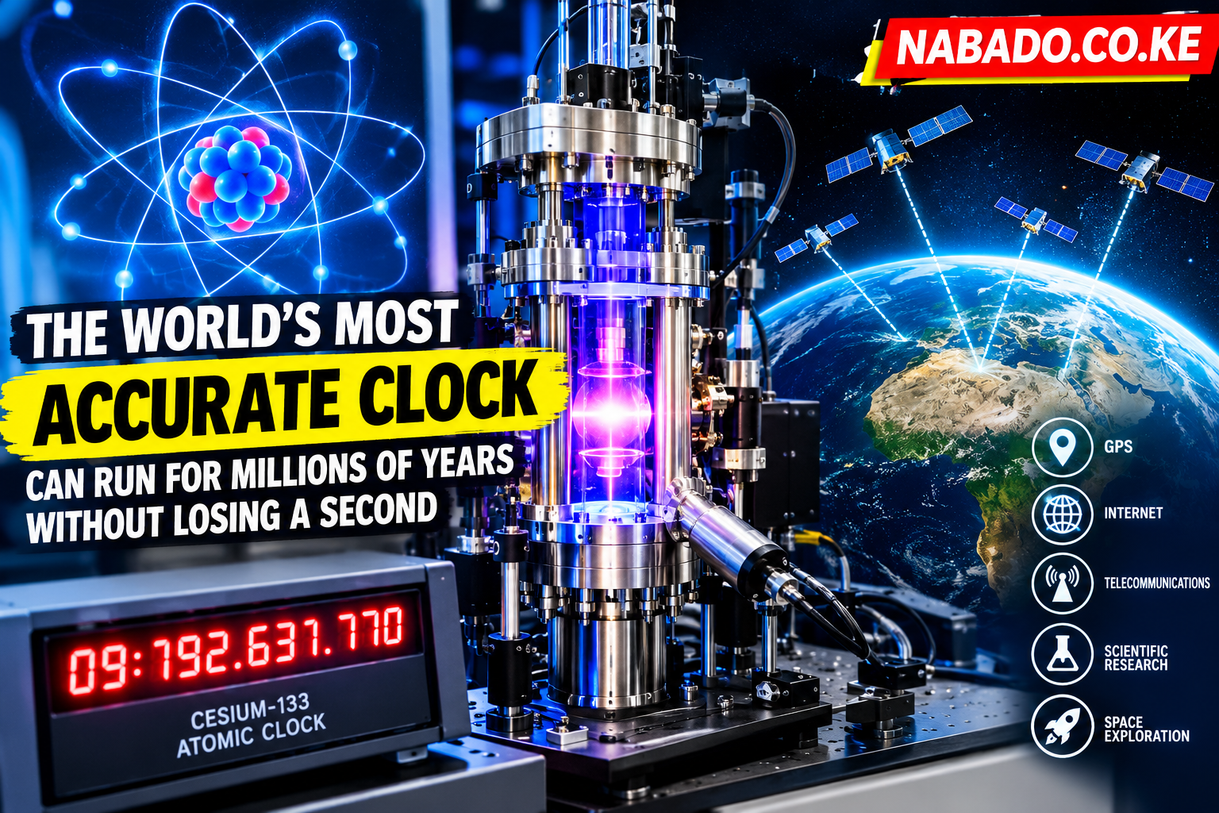
An atomic clock is an extremely accurate timekeeping device that measures time using the natural and predictable frequency of electromagnetic radiation associated with energy transitions in atoms.
Unlike traditional clocks, which depend on moving hands, swinging pendulums or vibrating quartz crystals, atomic clocks use the consistent behaviour of atoms as their reference.
Atoms contain particles, including protons, neutrons and electrons. Their electrons occupy specific energy levels. When atoms move between certain energy states, they absorb or emit electromagnetic radiation at highly precise frequencies.
Scientists use these frequencies as a reliable reference for measuring time.
One of the most widely used elements in traditional atomic clocks is caesium-133.
The behaviour of this element is particularly useful because its natural frequency provides an exceptionally stable reference that can be reproduced in laboratories around the world.
The technology is so important that the international definition of one second is based on the frequency associated with a particular transition in the caesium-133 atom.
According to the official definition, one second equals exactly 9,192,631,770 periods of the radiation corresponding to that transition.
This means scientists can measure time by counting an extraordinarily large number of atomic oscillations.
How Does an Atomic Clock Work?
Understanding how an atomic clock operates requires looking at what happens inside an atom.
Atoms do not vibrate like the components of a mechanical clock. Instead, atomic clocks take advantage of extremely precise frequencies associated with transitions between different atomic energy states.
A traditional caesium atomic clock generally works through several stages.
1. Preparing the atoms
The clock begins by preparing a collection of caesium-133 atoms.
In many modern systems, the atoms are placed in a controlled environment where scientists can minimise external disturbances that could affect measurements.
Some atomic clocks use beams of atoms, while others use specialised techniques to cool and trap them.
2. Exposing atoms to microwave radiation
The prepared atoms are exposed to microwave radiation at a frequency close to their natural transition frequency.
When the microwave frequency matches the correct atomic transition, the atoms respond in a predictable way.
Scientists can detect this response and determine how closely the applied frequency matches the atomic reference.
3. Measuring the atomic response
The clock monitors how many atoms undergo the relevant energy transition.
If the microwave frequency is slightly inaccurate, the atomic response changes.
Scientists use this information to correct the frequency and keep the system aligned with the atomic reference.
4. Counting the oscillations
Once the frequency is properly controlled, the clock uses it as a highly stable timing signal.
By counting the cycles of the radiation, the system can measure extremely small intervals of time.
This process allows atomic clocks to maintain remarkable accuracy over long periods.
Why Are Atomic Clocks More Accurate Than Ordinary Clocks?
The biggest difference between atomic clocks and ordinary clocks is the stability of their reference signals.
A mechanical clock depends on physical components such as gears, springs and pendulums. These components can gradually change because of friction, temperature variations, wear and other environmental conditions.
Quartz clocks are more reliable because they use the vibrations of a quartz crystal when an electrical voltage is applied.
However, quartz crystals can also be affected by temperature, ageing and other external factors.
Atomic clocks operate differently.
They use the natural properties of atoms, which behave in highly predictable ways under controlled conditions.
An atom of a particular isotope has the same fundamental transition frequency regardless of whether it is measured in Kenya, the United States, Japan or another country.
This consistency makes atomic clocks exceptionally reliable.
Although scientists must account for environmental influences and measurement errors, atomic clocks can maintain a level of precision that conventional clocks cannot easily match.
How Accurate Are Atomic Clocks?
The accuracy of atomic clocks is difficult to appreciate because their performance goes far beyond everyday timekeeping requirements.
Some traditional atomic clocks can remain accurate to within approximately one second over millions of years, depending on the particular technology and operating conditions.
Newer optical atomic clocks have achieved even greater levels of precision.
These advanced instruments use optical frequencies rather than the microwave frequencies employed by traditional caesium clocks.
Optical frequencies are much higher, meaning scientists can count significantly more cycles within the same period.
This provides opportunities to measure time with extraordinary precision.
Some experimental optical clocks have demonstrated uncertainties at levels around one part in 10¹⁸.
At that level, the potential timing error is equivalent to approximately one second over tens of billions of years.
However, it is important to distinguish between accuracy and precision.
Accuracy describes how close a clock is to the correct time, while precision describes how consistently it measures time.
Modern atomic clocks are designed to achieve both.
The Different Types of Atomic Clocks
Atomic clock technology has developed significantly since the first practical systems were introduced.
Today, scientists use several types of atomic clocks, each designed for particular applications.
1. Caesium atomic clocks
Caesium atomic clocks
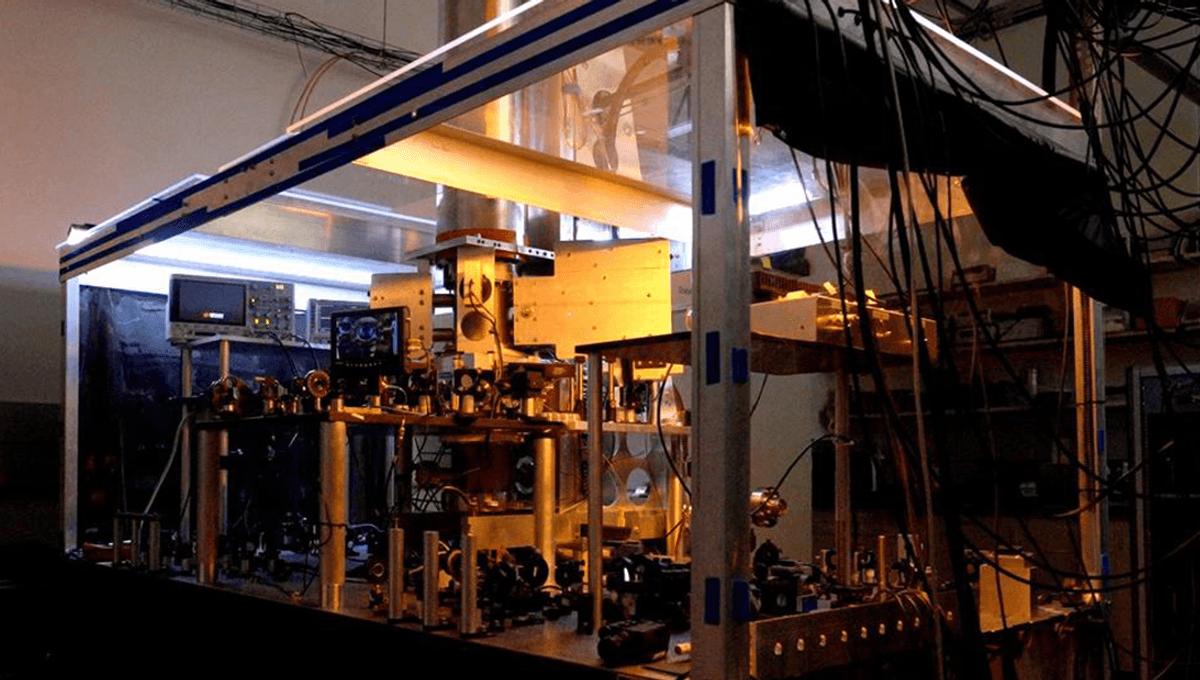
Caesium atomic clocks are among the most important timekeeping instruments ever developed.
They use the microwave transition frequency of caesium-133 atoms.
For decades, caesium clocks have provided the foundation for the international definition of the second.
They remain essential in national metrology laboratories and international timekeeping systems.
2. Hydrogen maser clocks
Hydrogen masers use the properties of hydrogen atoms to generate extremely stable microwave signals.
They are particularly useful when scientists require excellent short-term frequency stability.
Hydrogen masers are commonly used in research facilities, satellite tracking stations and international timekeeping laboratories.
3. Rubidium atomic clocks
Rubidium atomic clocks
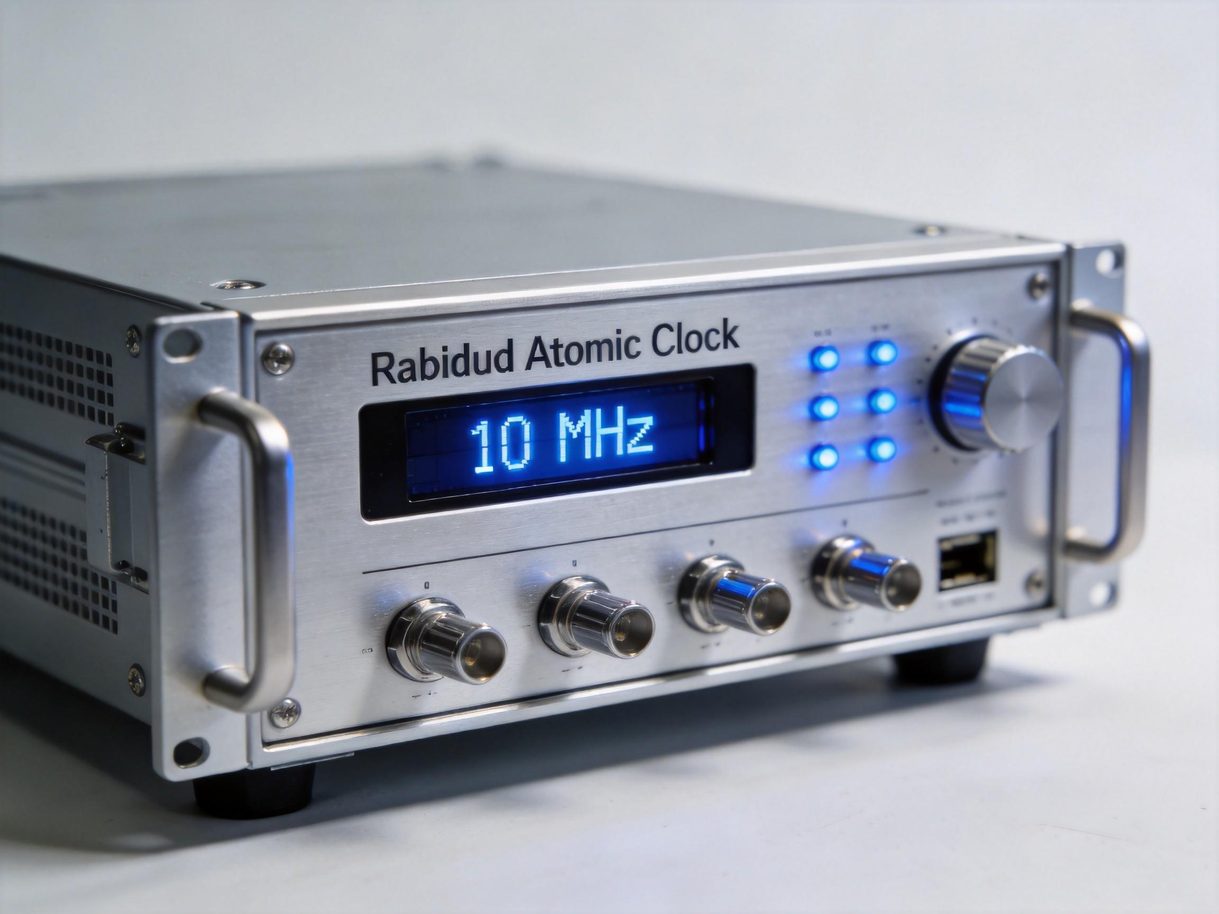
Rubidium atomic clocks are generally smaller and less expensive than many other atomic clock systems.
They are widely used in telecommunications, navigation equipment and electronic timing applications.
Although they may not achieve the same performance as the most advanced laboratory clocks, their compact design makes them practical for everyday technological systems.
4. Optical atomic clocks
Optical atomic clocks represent one of the most exciting developments in modern timekeeping.
Instead of relying on microwave transitions, they use much higher-frequency optical transitions in atoms such as strontium and ytterbium.
These clocks can achieve extraordinary precision and are helping scientists investigate fundamental questions about physics.
Researchers are also studying whether optical clocks could eventually support a future redefinition of the second.
How Atomic Clocks Make GPS Navigation Possible
One of the most important applications of atomic clocks is the Global Positioning System (GPS).
Millions of people depend on GPS technology every day without thinking about the complex science behind it.
Whether someone is using Google Maps to find a restaurant, tracking a delivery or navigating an unfamiliar road, satellite timing plays a central role.

Hvordan fungerer GPS-system
GPS satellites carry highly accurate atomic clocks that transmit time information alongside their location data.
A GPS receiver calculates how long signals take to travel from several satellites to the receiver.
Since radio signals travel at approximately the speed of light, even tiny errors in timing can produce significant errors in calculated distance.
For example, a timing error of just one-millionth of a second can translate into approximately 300 metres of distance error.
This demonstrates why precise timekeeping is essential for satellite navigation.
By comparing signals from multiple satellites, a GPS receiver can calculate its position.
Without highly accurate timing systems, modern satellite navigation would be far less reliable.
This technology supports transport systems, aviation, emergency response, agriculture, shipping and countless other activities.
How Atomic Clocks Keep the Internet Running
The internet may appear to operate independently of time, but accurate timing is essential to its infrastructure.
Computer networks rely on synchronised clocks to organise communications, coordinate data transfers and maintain reliable records.
Atomic clocks help establish highly accurate time references used by telecommunications companies, financial institutions, research facilities and other organisations.
For example, financial markets require precise timestamps to establish the order in which transactions occur.
Mobile networks also depend on accurate timing to coordinate communication between different network components.
When timing becomes inaccurate, systems can experience synchronisation problems that affect performance and reliability.
Atomic clocks therefore contribute to the invisible infrastructure supporting modern digital communication.
Can Atomic Clocks Detect Differences in Gravity?
One of the most fascinating discoveries associated with modern atomic clocks is their ability to measure tiny differences in the passage of time caused by gravity.
This phenomenon is connected to Albert Einstein’s theory of general relativity.
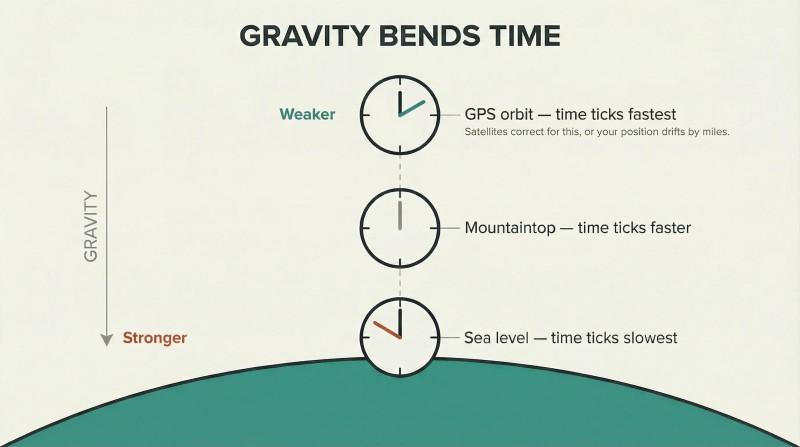
According to Einstein’s theory, gravity affects the passage of time.
A clock closer to a massive object, such as Earth, experiences time slightly more slowly than an otherwise identical clock positioned farther away.
This effect is known as gravitational time dilation.
A Brief History of Time
For ordinary clocks, these differences are extremely difficult to detect.
However, modern optical atomic clocks are sensitive enough to measure incredibly small changes in gravitational potential.
Scientists can use two highly accurate clocks positioned at different heights to investigate how gravity affects time.
Even a relatively small difference in elevation can produce a measurable difference under sufficiently controlled experimental conditions.
This technology could eventually help scientists study underground geological structures, monitor changes in Earth’s gravitational field and improve our understanding of fundamental physics.
Are Atomic Clocks Used in Space Exploration?
Yes. Atomic clocks are extremely important in space science and exploration.
Spacecraft and satellites require highly accurate timing systems to navigate, communicate and coordinate operations.
Atomic clocks help provide the precise timing references required for these activities.
One particularly interesting development is NASA’s Deep Space Atomic Clock project.
The project demonstrated advanced atomic clock technology designed to improve navigation for spacecraft travelling far beyond Earth.

NASA’s Deep Space-Bound Atomic Clock Has Activated
Traditional deep-space navigation often requires spacecraft signals to travel between the spacecraft and Earth before navigational calculations can be completed.
Advanced onboard atomic clocks could allow spacecraft to perform more navigation calculations independently.
This could make future space missions more efficient, particularly when travelling to distant destinations where communication delays become significant.
Does Every Country Have Its Own Atomic Clock?
Not every country necessarily operates an independent primary atomic clock, but international timekeeping is coordinated through a global system.
The world’s official civil timekeeping framework is based on Coordinated Universal Time, commonly known as UTC.
UTC is calculated using measurements from atomic clocks operated by laboratories around the world.
The International Bureau of Weights and Measures (BIPM) coordinates these measurements to produce the internationally recognised time standard.
Different countries then establish their local time zones using UTC as their reference.
For example, Kenya uses East Africa Time, which is UTC+3.
This means that when it is 12 noon in UTC, the corresponding time in Kenya is 3 pm.
Kenya does not need to operate an independent atomic clock for people to access accurate time. Its national time can be maintained through internationally coordinated time references and appropriate time-distribution systems.
What Would Happen If Atomic Clocks Stopped Working?
Atomic clocks are not simply devices that help people know whether it is morning or evening.
They support critical systems across the modern world.
If all atomic time references suddenly became unavailable, several industries could experience serious difficulties.
GPS navigation would become less reliable as timing errors accumulated.
Telecommunications networks could experience synchronisation problems.
Financial systems that depend on accurate timestamps could face challenges when recording and ordering transactions.
Scientific experiments requiring extremely precise measurements would also be affected.
However, modern infrastructure uses multiple timing sources, backup systems and alternative references.
A failure of one atomic clock would not automatically bring the world’s technology to a standstill.
The global timekeeping system is designed with redundancy to maintain reliability.
The Future of Atomic Clock Technology
Scientists continue to improve atomic clocks, with optical atomic clocks attracting significant attention.
These instruments could eventually change how the international scientific community defines and measures the second.
Researchers are also exploring smaller and more portable atomic clocks that could be installed in satellites, vehicles and specialised navigation equipment.
Another exciting possibility is using atomic clocks to study changes in the Earth’s gravitational field.
Because gravity influences the passage of time, extremely accurate clocks could help scientists detect subtle changes associated with underground movements and geological activity.
There is also growing interest in using atomic clocks to investigate fundamental physical constants and search for possible new physics beyond existing scientific theories.
Although these applications are still developing, they demonstrate that atomic clock technology has uses far beyond simply measuring time.
Frequently Asked Questions About Atomic Clocks
1. What is an atomic clock used for?
Atomic clocks are used in GPS navigation, telecommunications, scientific research, satellite operations, financial systems and international timekeeping.
2. What element is used in atomic clocks?
Caesium-133 is the element used in the traditional atomic clock definition of one second. Other atomic clocks use elements such as rubidium, hydrogen, strontium and ytterbium.
3. Is an atomic clock more accurate than a digital clock?
Yes. Most digital clocks rely on quartz oscillators, which are generally less stable than the atomic references used in atomic clocks.
4. Can an atomic clock lose time?
Yes. No physical clock is completely free from errors. However, modern atomic clocks are extraordinarily stable and can maintain exceptional accuracy over long periods.
5. How many years can an atomic clock operate without losing one second?
The answer depends on the type of atomic clock. Some highly accurate systems can maintain their timing to within approximately one second over millions of years, while advanced experimental optical clocks can achieve substantially better performance.
6. Does an atomic clock control the time on my phone?
Not directly in most cases. Smartphones generally obtain accurate time through network services, internet time synchronisation and satellite systems that ultimately rely on highly accurate timing references.
The Tiny Atoms Behind the World’s Most Accurate Time
Atomic clocks have changed the way humanity measures and understands time.
What began as an advanced scientific achievement has become an essential part of modern civilisation, supporting everything from satellite navigation and telecommunications to international scientific research.
Their extraordinary accuracy comes from using the predictable behaviour of atoms rather than relying on mechanical components or ordinary electronic oscillators.
More importantly, atomic clocks have helped scientists discover that time itself is not as straightforward as people once believed. Through Einstein’s theory of relativity, researchers have demonstrated that gravity can influence how quickly time passes.
As technology continues to advance, atomic clocks are likely to become even more accurate, compact and useful.
The next time you open a navigation application, make an international phone call or check the time on your smartphone, remember that behind these ordinary activities is an extraordinary scientific system built around the behaviour of some of the smallest building blocks of matter.
SUGGESTED READS
- How Smart Creators Are Using AI to Make $1,000+ a Week in today’s world.
- 15 Most Dangerous Snakes in the World: The Deadly Reptiles You Would Never Want to Encounter
- Why Sex Is So Important in a Relationship: 10 Things Every Couple Should Know
- Elifasi Msomi: The Axe Killer Who Terrorised Rural Natal
- The Malawi Vampire Panic: How Rumors Sparked a Deadly Wave of Fear
- How Foday Sankoh Led Sierra Leone into Chaos: The Ruthless Rise of a Rebel
- The Blood Oath: Rise of the Bakassi Boys
- The Man Who Survived Two Atomic Bombs: The Unbelievable Story of Tsutomu Yamaguchi
- The Bird That Lived Without a Head for 18 Months

Support Our Website!
We appreciate your visit and hope you find our content valuable. If you’d like to support us further, please consider contributing through the TILL NUMBER: 9549825. Your support helps us keep delivering great content!
If you’d like to support Nabado from outside Kenya, we invite you to send your contributions through trusted third-party services such as Remitly, western union, SendWave, or WorldRemit. These platforms are reliable and convenient for international money transfers.
Please use the following details when sending your support:
Phone Number: +254701838999
Recipient Name: Peterson Getuma Okemwa
We sincerely appreciate your generosity and support. Thank you for being part of this journey!