

simply amazing, always for you.
The internet is full of creepy stories, but few have achieved the legendary status of the “Russian Sleep Experiment.” Shared across forums, social media platforms, and horror websites, the tale describes a secret Soviet experiment in which prisoners were kept awake for weeks using a mysterious stimulant gas. According to the story, the subjects gradually descended into madness, mutilated themselves, and transformed into terrifying, inhuman creatures.
The story has frightened millions of readers since it first appeared online. Many people who encounter it for the first time wonder whether it could actually be true.
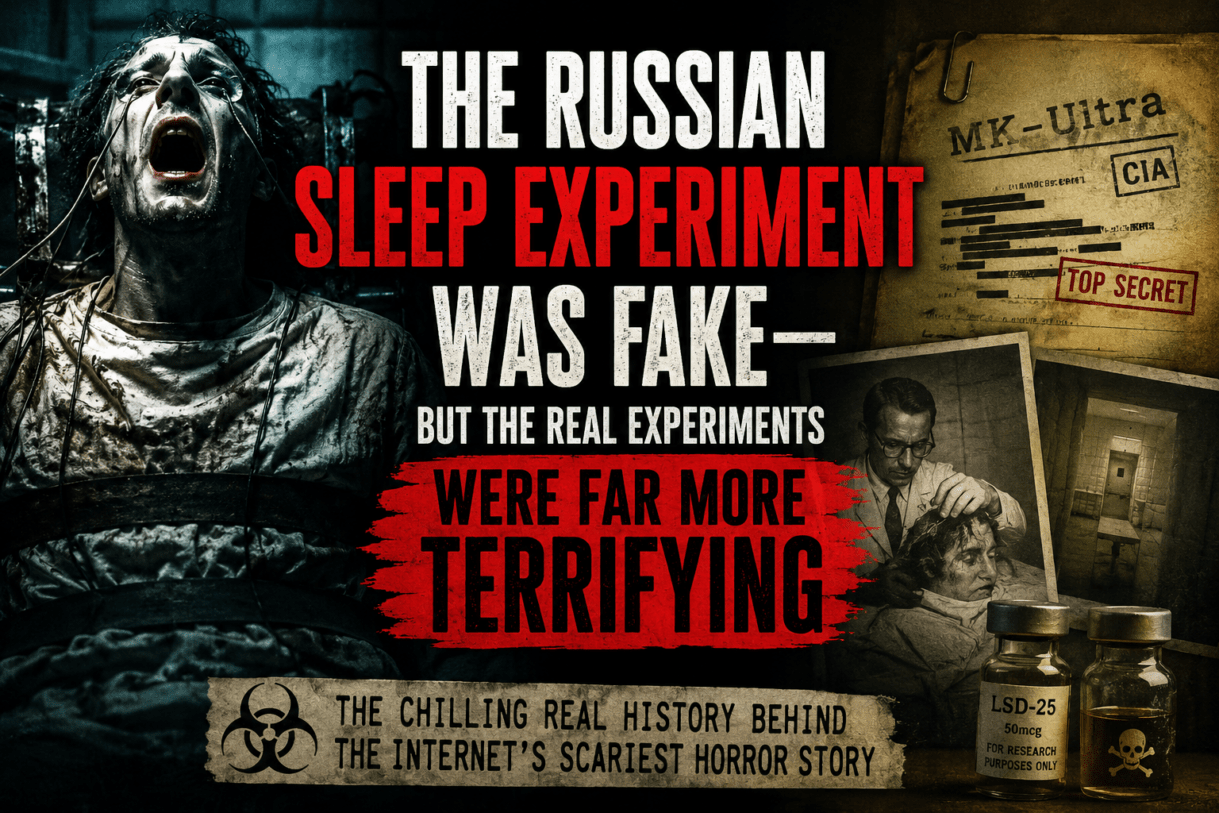
The answer is no. The Russian Sleep Experiment is entirely fictional. It originated as a creepypasta—a type of internet horror story designed to spread online and blur the line between fact and fiction.
Yet what makes the story so fascinating is that it draws inspiration from something very real: the history of unethical human experimentation carried out by governments, military organizations, and intelligence agencies during the 20th century.
Ironically, while the Russian Sleep Experiment never happened, some real-world experiments were disturbing enough to rival the horror story itself.
What Is the Russian Sleep Experiment?
The Russian Sleep Experiment first appeared online in the late 2000s and quickly became one of the most famous creepypastas ever written.
The story claims that Soviet researchers conducted an experiment shortly after World War II. Five political prisoners were locked inside a sealed chamber and exposed to a gas designed to eliminate the need for sleep.
At first, the subjects behaved normally. However, as days passed without sleep, they reportedly became paranoid, violent, and mentally unstable.
The story escalates dramatically, claiming the prisoners ripped their own flesh apart, refused medical treatment, and developed superhuman abilities. Eventually, researchers supposedly discovered that the subjects no longer wanted to sleep because they had become addicted to the horrific state they were experiencing.
The narrative ends with one of the most chilling lines in internet horror:
“We are you. We are the madness that lurks within all of you.”
It is a gripping story—but there is absolutely no evidence that such an experiment ever occurred.
Historians, medical experts, and researchers have repeatedly confirmed that the tale is fictional.
Why People Believed It
One reason the story became so popular is that it sounds just believable enough.
The Soviet Union was famously secretive during the Cold War. Stories of classified projects, hidden laboratories, and government cover-ups have always fascinated people.
The creepypasta also borrows elements from real science. Sleep deprivation can cause serious psychological and physical problems, including:
- Hallucinations
- Anxiety
- Confusion
- Memory loss
- Mood swings
- Impaired judgment
- Paranoia
Readers familiar with the effects of sleep deprivation may initially find parts of the story plausible.
However, the extreme events described—self-mutilation, superhuman strength, and monstrous transformations—have no scientific basis.
The Real Effects of Sleep Deprivation
Although the Russian Sleep Experiment is fake, sleep deprivation itself is a serious medical issue.
One of the most famous real-world sleep studies involved American student Randy Gardner.
In 1964, Gardner stayed awake for 11 consecutive days as part of a science project.
As the days passed, researchers observed numerous symptoms:
- Difficulty concentrating
- Memory problems
- Mood changes
- Hallucinations
- Impaired coordination
Despite these effects, Gardner did not become violent or transform into anything resembling the fictional story.
Instead, he eventually recovered after receiving normal sleep.
His case demonstrated that prolonged sleep deprivation can be dangerous but not in the supernatural way depicted by internet horror stories.
The Dark Reality of Human Experimentation
Although the Russian Sleep Experiment never happened, governments around the world have conducted real experiments that crossed ethical boundaries.
Some of these projects remain among the most controversial chapters in modern history.
MKUltra: America’s Secret Mind-Control Program
Perhaps the most famous example is MKUltra.
Launched by the Central Intelligence Agency during the Cold War, MKUltra sought to explore methods of controlling or influencing human behavior.
Researchers experimented with:
- LSD
- Hypnosis
- Sensory deprivation
- Psychological manipulation
- Electroshock techniques
In many cases, subjects were not informed that they were participating in experiments.
Some people received powerful psychoactive drugs without their knowledge or consent.
The program remained secret for years before investigations exposed its existence during the 1970s.
While MKUltra never created mind-controlled superhumans, it revealed how far governments were willing to go in pursuit of intelligence advantages.
The Tuskegee Syphilis Study
Another infamous case occurred in the United States through the Tuskegee Syphilis Study.
Researchers monitored hundreds of African American men infected with syphilis.
Even after effective treatment became available, participants were often denied proper care.
The study continued for decades and became a symbol of unethical medical research.
Public outrage following its exposure helped strengthen research ethics and informed consent requirements.
Soviet Human Experiments
The Soviet Union also conducted controversial medical and psychological research during the Cold War.
Because many records remain classified or incomplete, historians continue debating the extent of these activities.
Reports suggest that Soviet authorities investigated:
- Interrogation methods
- Psychological conditioning
- Drug effects
- Isolation techniques
The secrecy surrounding these programs helped create fertile ground for myths like the Russian Sleep Experiment.
People often assume that if governments carried out some unethical projects, then perhaps the horror story could also be true.
However, no credible evidence has ever linked the Soviet Union to anything resembling the events described in the creepypasta.
Why Horror Stories Use Real History
The most effective horror stories often mix fact and fiction.
The Russian Sleep Experiment works because it combines:
- Real Cold War fears
- Genuine sleep-deprivation science
- Historical government secrecy
- Human fascination with psychological breakdown
Readers recognize elements of reality, making the fictional parts feel more believable.
This storytelling technique has been used for centuries.
Many famous legends—from haunted houses to mysterious disappearances—borrow details from actual events to increase their impact.
The Internet Age of Urban Legends
Before the internet, urban legends spread through word of mouth.
Today, creepypastas spread globally within hours.
The Russian Sleep Experiment became one of the earliest examples of a modern internet legend.
Its success inspired countless videos, podcasts, documentaries, artwork, and discussions.
Many people still encounter the story without realizing it was created as online fiction.
The blurred line between fact and fiction is part of what keeps the legend alive.
Could Anything Like It Ever Happen?
Based on current scientific understanding, the answer is no.
Extreme sleep deprivation can cause:
- Hallucinations
- Psychosis-like symptoms
- Cognitive decline
- Physical exhaustion
However, it does not create the monstrous transformations described in the story.
Eventually, the human body begins shutting down critical functions.
The victims would suffer severe medical complications long before reaching the supernatural state depicted in the creepypasta.
The Truth Is Disturbing Enough
The Russian Sleep Experiment remains one of the internet’s greatest horror stories because it taps into a universal fear: losing control of the mind.
Yet the most unsettling part of the story is not the fiction—it is the reality that inspired it.
Real governments conducted secret experiments.
Real people were exposed to dangerous drugs.
Real subjects were manipulated without consent.
Real lives were damaged in the pursuit of scientific, military, or political goals.
Compared to those documented events, the fictional horrors of the Russian Sleep Experiment begin to look less like fantasy and more like an exaggerated reflection of humanity’s darker chapters.
The story may be fake, but the history behind it is very real—and that reality is frightening enough on its own.
SUGGESTED READS
- The Corpse That Wouldn’t Decompose: The Haunting Mystery of Rosalia Lombardo
- Meet the Meru Man With 18+ Wives: Inside Kenya’s Most Extraordinary Family Empire
- The Green Children of Woolpit: The Medieval Mystery That Still Defies Explanation
- The Dancing Plague of 1518: The Terrifying Mystery of the People Who Couldn’t Stop Dancing
- The Chilling Mystery of Dyatlov Pass
- The Man Who Received Calls From the Dead
- The Radio Station That Predicted a Murder
- The Bear Who Went to War: The Unbelievable Story of Wojtek

Support Our Website!
We appreciate your visit and hope you find our content valuable. If you’d like to support us further, please consider contributing through the TILL NUMBER: 9549825. Your support helps us keep delivering great content!
If you’d like to support Nabado from outside Kenya, we invite you to send your contributions through trusted third-party services such as Remitly, western union, SendWave, or WorldRemit. These platforms are reliable and convenient for international money transfers.
Please use the following details when sending your support:
Phone Number: +254701838999
Recipient Name: Peterson Getuma Okemwa
We sincerely appreciate your generosity and support. Thank you for being part of this journey!