

From ancient rituals to modern memories, the humble handkerchief has always been more than just a piece of cloth—it’s a symbol of love, loss, status, and human connection.
simply amazing, always for you.
I. A Small Cloth with a Grand Story
There are few objects as small, personal, and quietly powerful as the handkerchief.
Folded neatly in a pocket, perfumed with traces of someone’s skin, or stained with tears — it has been a silent witness to some of humanity’s most intimate moments.
At first glance, it’s just fabric. But through centuries, that fabric has been waved to send armies off to war, offered as a token of affection, held tightly at funerals, or twirled in joyful dance. In a world before text messages and emojis, the handkerchief was our first form of wordless communication — a language of touch, scent, and gesture.
Its story, much like the delicate stitching that often adorns its edges, is woven with emotion.
II. The Ancient Beginnings: Where It All Started
The origins of the handkerchief reach back thousands of years.
In ancient Egypt, noblemen carried small squares of fine linen not to wipe away sweat — but to display wealth and hygiene. Egyptians believed cleanliness was divine; thus, a white linen cloth symbolized purity of both body and spirit.
In ancient Rome, the sudarium (literally “sweat cloth”) served multiple roles. Romans waved it during gladiator games to show excitement, while politicians used it to signal the start of public events. A simple handkerchief could move an entire crowd — proof that a small cloth already carried social weight.
Meanwhile, in China, embroidered silk handkerchiefs were treasured as tokens of fortune. Women often gifted them to loved ones before long journeys, believing the cloth would absorb their blessings and protect the traveler.
Across civilizations, the handkerchief represented more than utility. It carried meaning — an object that touched both body and soul.
III. The Renaissance: When the Handkerchief Became Art
By the Renaissance period, the handkerchief had transformed into an object of beauty and courtly symbolism.
Queen Elizabeth I is said to have owned dozens, each delicately embroidered with gold thread and lace trim. To present a handkerchief to someone was no longer a mere act of courtesy — it was a gesture of esteem.
During the 1500s, noblewomen across Europe used scented or embroidered handkerchiefs as part of their wardrobe. They became a fashion statement, a symbol of refinement, and in many ways, a code of intimacy.
A drop of perfume, a single embroidered initial, or a faint lipstick mark — these turned the handkerchief into a messenger of love.
In portraits of the era, both men and women are often painted holding or wearing handkerchiefs — not because they needed them, but because they said something about who they were: cultured, refined, and connected to emotion.
IV. The Language of Love and Gesture
The 18th and 19th centuries gave rise to the handkerchief’s most romantic and mysterious chapter — the language of the handkerchief.
At a time when society dictated silence on matters of the heart, lovers invented subtle codes to express forbidden feelings. Much like the “language of the fan,” gestures with a handkerchief conveyed secret messages.
A few examples from old etiquette guides and love manuals show just how intricate this “silent dialogue” could be:
- Dropping your handkerchief intentionally: “I wish to speak to you.”
- Pressing it to your heart: “You hold my affection.”
- Drawing it slowly across your cheek: “I love you.”
- Folding and refolding it nervously: “I’m anxious or uncertain.”
- Throwing it to the ground: “I reject you.”
A lady dropping her handkerchief at a ball was rarely an accident — it was a quiet invitation. The gentleman who picked it up knew that he wasn’t just returning cloth; he was responding to a whisper from her heart.
This was love’s theater, played out without a single word.
V. The Handkerchief Goes to War
When men went off to war — whether in medieval battles or 20th-century world wars — women often sent them off with a handkerchief. Sometimes embroidered with initials, sometimes perfumed, always personal.
Soldiers carried them in breast pockets, using them as reminders of home and love. Some were tucked under helmets or wrapped around small keepsakes. Others became the last tangible link to someone left behind.
In countless letters from the trenches of World War I and II, soldiers wrote about the handkerchief she gave me. It was something to hold on to in the uncertainty of battle — soft against the roughness of war, human against the inhuman.
It’s no exaggeration to say that handkerchiefs once carried hope across oceans.
VI. Weddings, Farewells, and Tears
Few ceremonies have embraced the handkerchief tradition more deeply than weddings.
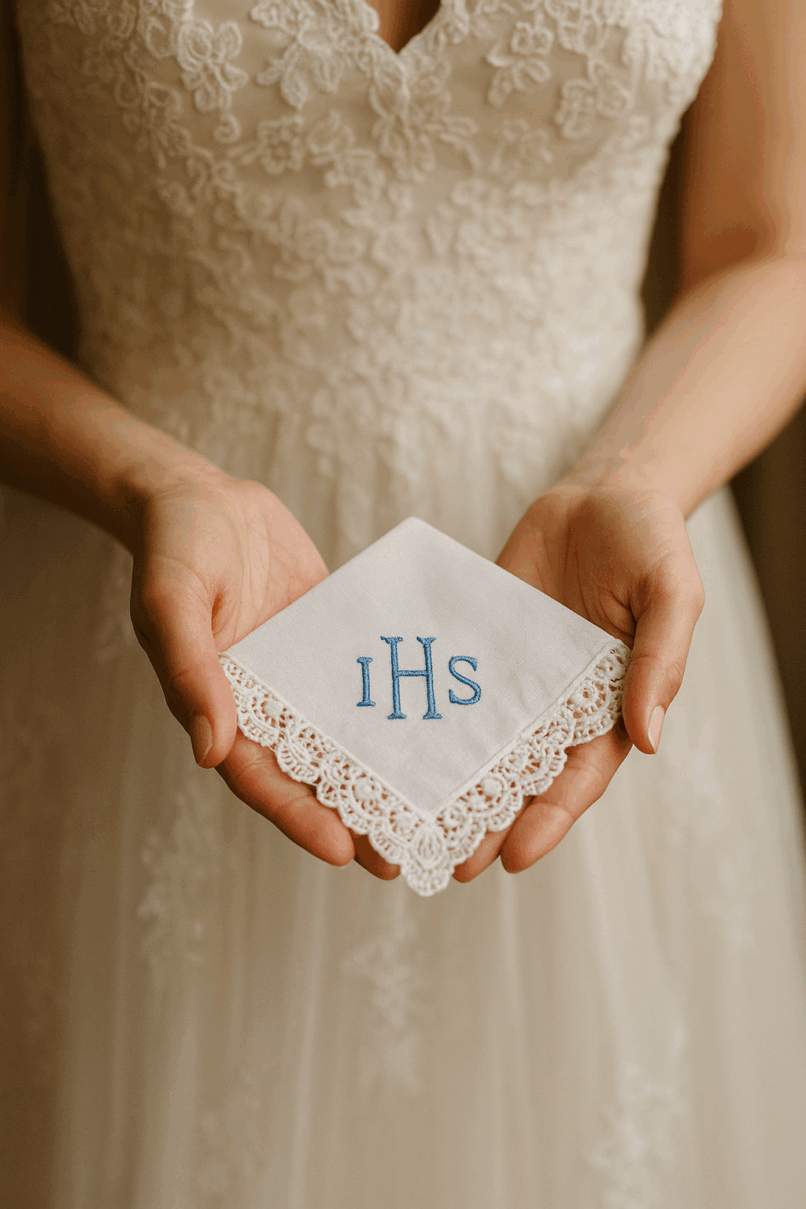
In European customs, brides would carry or wear a handkerchief embroidered with their initials or lace from their mother’s veil. After the ceremony, it was sometimes kept as a baby’s christening cloth or passed down as a family heirloom — a symbol of continuity and blessing.
In Asian weddings, particularly in Japan and the Philippines, white handkerchiefs symbolize purity and new beginnings. They’re often used to wipe tears of joy — literal reminders that love and emotion coexist.
And in African and Caribbean celebrations, handkerchiefs appear in dances, waved by guests to express joy and divine approval. In church ceremonies, waving a white handkerchief means victory and spiritual freedom.
From wiping tears to waving in rhythm, the handkerchief became an instrument of emotion — equally suited for sorrow and joy.
VII. Across Cultures: The Handkerchief’s Global Journey
The beauty of the handkerchief tradition lies in its universality. Across the world, it found new meanings while keeping its core symbolism: connection and expression.
a) The Spanish and Latin American Dance
In the Marinera of Peru and the Cueca of Chile, dancers use a handkerchief to flirt. They wave it above their heads or twirl it gracefully to mimic courtship — the dance of attraction, playfulness, and elegance. The handkerchief here is not for wiping tears but for celebrating desire.
b) Japan’s Culture of Courtesy
In Japan, the tenugui — a type of hand towel or handkerchief — is part of daily life. People carry them for hygiene, but also as expressions of thoughtfulness. A well-folded tenugui offered to a friend or colleague says, “I care.” It’s a quiet nod to the Japanese ideal of omotenashi — wholehearted hospitality.
c) Africa’s Spiritual Symbol
In many African churches, particularly in Kenya, Nigeria, and Ghana, congregants wave white handkerchiefs during praise songs. The gesture is believed to invoke spiritual energy and joy — a dance of gratitude between body and soul.
At weddings or funerals, the same cloth may reappear, showing that life’s highs and lows are connected by one enduring symbol.
VIII. The Handkerchief in Literature and Art
If you look closely at art history or literature, the handkerchief appears again and again — always at emotional turning points.
In Shakespeare’s Othello, the handkerchief is more than a prop; it’s the thread that unravels love and trust. Othello gives Desdemona his mother’s embroidered handkerchief as proof of his devotion. When it’s lost and stolen, jealousy consumes him.
That small square of fabric becomes the evidence of betrayal — a haunting metaphor for how love, once stained, can never be fully cleansed.
In 18th- and 19th-century poetry, handkerchiefs symbolize memory. Romantic poets like Byron and Shelley wrote of handkerchiefs soaked in tears, kept by lovers as tokens of parting. Even painters used them as visual shorthand for vulnerability — a woman holding one suggested sensitivity and depth of feeling.
The handkerchief, through art, became shorthand for humanity’s softest emotions.
IX. Modern Meanings: From Fashion to Sentiment
By the mid-20th century, disposable tissues had replaced handkerchiefs in most homes. Convenience triumphed over sentiment. Yet, the tradition never truly died — it merely evolved.
a) The Gentleman’s Pocket Square
Today, the handkerchief survives as the pocket square — a staple of men’s fashion. Folded neatly in a suit pocket, it adds color and character. But beyond style, it also nods to a forgotten era of manners and care — when offering a clean handkerchief to someone in distress was a mark of respect.
b) Eco-Friendly Elegance
As sustainability grows more important, handkerchiefs are making a quiet comeback. Many eco-conscious individuals now prefer reusable cotton or linen handkerchiefs over disposable tissues. Brands are reimagining them with modern designs and embroidery, turning an old tradition into a statement of consciousness.
c) Memory and Heirloom
For many families, handkerchiefs still hold emotional value. A grandmother’s lace-trimmed hanky tucked into a wedding bouquet, a father’s pocket square kept after his passing, a personalized gift exchanged on anniversaries — these are small, tactile reminders of love that endures.
Even in our digital age, people crave tangible expressions of feeling. The handkerchief provides that — something you can hold, press to your heart, or pass down.
X. Why the Handkerchief Still Matters
When you think about it, the handkerchief represents everything we risk losing in modern life: slowness, softness, sentiment.
It belongs to a world where gestures mattered — where to wipe a tear or offer comfort wasn’t an act of embarrassment but of shared humanity.
It reminds us that care can be carried, that emotion can have texture, and that love can live in something as small as a square of cloth.
Perhaps it’s time we bring the handkerchief back — not just for nostalgia, but for what it teaches us: that empathy doesn’t need words, and tenderness doesn’t need technology.
XI. The Enduring Fabric of Humanity
In the end, the story of the handkerchief is the story of us — how we express, connect, and remember.
From Egyptian linen to Victorian lace, from soldiers’ keepsakes to bridal heirlooms, from dance floors to church aisles, it has been present at every emotional milestone of human life.
It has absorbed our sweat, caught our tears, waved our goodbyes, and celebrated our joys.
A mere cloth? Hardly.
It’s a piece of humanity — stitched with meaning, soft with memory, and eternal in its simplicity.
SUGGESTED READS
- Top African Countries That Bring the Most Global Attention to Africa
- Future in Motion: How Global Trends Are Transforming Life in 2025 and Beyond
- Youth and the 2027 Elections: How Young Voters Could Shape the Next General Election in Kenya
- RutonomicsAt3 — The True State of William Ruto’s Economic Legacy After 3 Years
- Understanding the 2022 Kenyan Elections: Have We Learned from the Past?

Support Our Website!
We appreciate your visit and hope you find our content valuable. If you’d like to support us further, please consider contributing through the TILL NUMBER: 9549825. Your support helps us keep delivering great content!
If you’d like to support Nabado from outside Kenya, we invite you to send your contributions through trusted third-party services such as Remitly, western union, SendWave, or WorldRemit. These platforms are reliable and convenient for international money transfers.
Please use the following details when sending your support:
Phone Number: +254701838999
Recipient Name: Peterson Getuma Okemwa
We sincerely appreciate your generosity and support. Thank you for being part of this journey!
Thank you for your sharing. I am worried that I lack creative ideas. It is your article that makes me full of hope. Thank you. But, I have a question, can you help me?
Your article helped me a lot, is there any more related content? Thanks!
Your point of view caught my eye and was very interesting. Thanks. I have a question for you.