

We Ain’t Done Yet… Expect Another One.
There is a question so simple that even a child can ask it, yet so profound that humanity has spent thousands of years struggling to answer it:
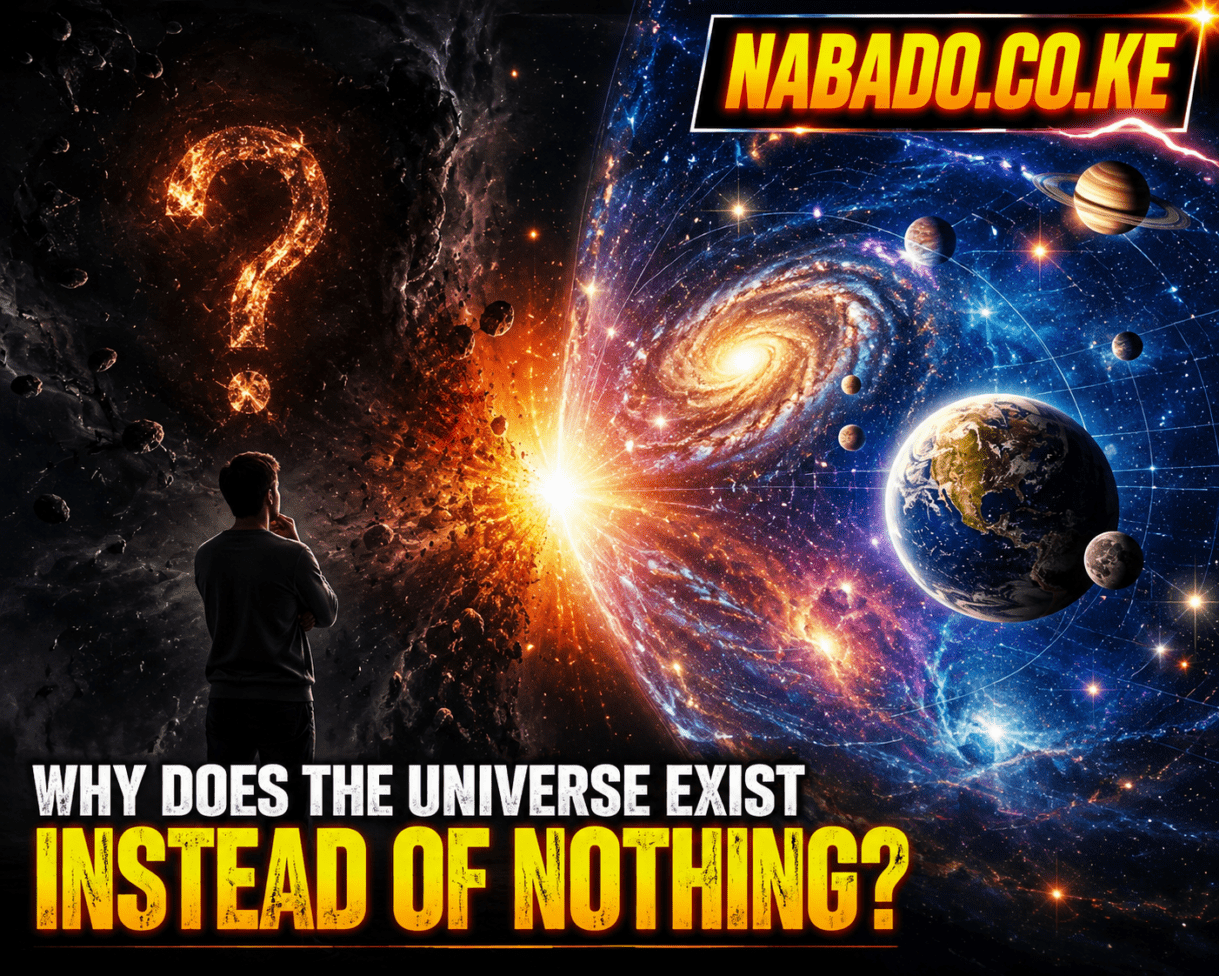
Why does the universe exist instead of nothing?
Look around you. There are galaxies, stars, planets, oceans, trees, animals, human beings, atoms and invisible fields of energy. There is space. There is time. There are physical laws that appear to govern everything from the movement of galaxies to the behavior of subatomic particles.
But why is any of it here?
Why isn’t there simply nothing?
No stars. No planets. No Earth. No people. No space. No time. No matter. No energy. No physical laws. Nothing at all.
This question goes deeper than asking how the universe began. Modern cosmology has developed powerful theories describing the universe’s early evolution. Evidence strongly supports the picture of an early universe that was extremely hot and dense and subsequently expanded and cooled.
But explaining how our universe developed is not necessarily the same thing as explaining why reality exists in the first place.
And that distinction is what makes the question so difficult.
The Big Bang Does Not Completely Answer the Question
When people hear the question about the existence of the universe, the Big Bang is often the first answer that comes to mind.
The Big Bang theory describes the early universe as an extremely hot, dense state followed by cosmic expansion. As the universe expanded and cooled, particles formed, atoms eventually appeared, stars were born, and galaxies developed.
This is one of the most successful scientific models in history.
But there is an important misunderstanding surrounding it.
The Big Bang theory does not necessarily mean that scientists have discovered the moment when absolute nothingness suddenly became something.
In fact, modern cosmology does not currently provide a complete description of whatever fundamental regime, if any, preceded or underlies the earliest period we can describe with established physics. The boundary between general relativity and quantum physics remains one of the major problems in understanding the universe’s ultimate origin.
So saying “the universe began with the Big Bang” can answer one question:
How did the early universe evolve?
It does not automatically answer the deeper question:
Why was there a universe, or a physical reality capable of producing a universe, at all?
That is where physics begins to meet philosophy.
What Does “Nothing” Actually Mean?
Before trying to explain why there is something rather than nothing, we need to define the word nothing.
This sounds easy.
It isn’t.
When most people imagine nothing, they picture an empty room. Maybe it is completely dark. There is no furniture, no people and no sound.
But that is not absolute nothingness.
The room still exists.
Space still exists.
Time still passes.
Physical laws still operate.
There is still a gravitational field, quantum fields or other physical structure.
Absolute nothing would be radically different.
There would be no space.
There would be no time.
There would be no matter.
There would be no energy.
There would be no fields.
There would be no physical laws.
There would not even be a place in which anything could exist.
Philosophers have spent considerable effort examining whether such absolute nothingness is even a coherent possibility. The philosophical literature treats “nothing” as a surprisingly complicated concept rather than simply an empty physical environment.
This creates an immediate problem.
If absolute nothingness is impossible or incoherent, then perhaps the universe—or some form of reality—had no genuine alternative.
But if nothingness is possible, we still have to explain why reality won instead.
Maybe Something Is More Natural Than Nothing
Human intuition tells us that nothing should be simpler than something.
After all, imagine an empty box.
It seems easier for the box to contain nothing than to contain a complicated object.
But the universe is not an empty box.
There is no larger empty container sitting outside reality.
That means we cannot necessarily apply ordinary everyday reasoning to the origin of existence itself.
We normally ask why something exists by pointing to something else.
Why is the tree here?
Because a seed grew.
Why is the house here?
Because people built it.
Why is the planet here?
Because physical processes formed it from material orbiting the young Sun.
But eventually the question reaches the bottom.
Why are there physical processes?
Why are there particles?
Why are there fields?
Why are there laws of nature?
Why is there anything capable of producing anything else?
This is where ordinary cause-and-effect reasoning starts to struggle.
The Quantum Vacuum Is Not “Nothing”
Another popular explanation says the universe could have emerged from a quantum vacuum.
This sounds like an answer to the problem of existence.
But there is an important catch.
A quantum vacuum is not absolute nothingness.
In physics, a vacuum can still possess structure and physical properties. It exists within a theoretical framework governed by physical principles. The Stanford Encyclopedia of Philosophy specifically notes that treating a vacuum state as “nothing” confuses a physical state with metaphysical nothingness.
This distinction matters enormously.
Suppose someone says:
“The universe came from nothing.”
The obvious next question becomes:
“What do you mean by nothing?”
If the answer is “a quantum vacuum,” then the explanation has not really started from absolute nothing. It has started from a physical state.
And now we can ask:
Why does that quantum framework exist?
Why are there quantum fields?
Why are there laws?
Why is there a mathematical structure capable of generating a universe?
The question has simply moved one level deeper.
Perhaps the Universe Is a Brute Fact
One possibility is both simple and uncomfortable:
Maybe the universe just exists.
There may be no deeper explanation.
Some philosophers and physicists have argued that our search for an ultimate explanation may eventually have to stop at basic facts that simply have no further cause. Sean Carroll, for example, has argued that attempts to explain why there is something rather than nothing may ultimately terminate in fundamental facts about reality rather than an external cause.
This idea can feel unsatisfying.
Human beings are trained to look for explanations. When something happens, we instinctively ask what caused it.
But perhaps existence itself is not the kind of thing that requires a cause.
Imagine asking:
“Why is reality real?”
There may be no deeper answer.
Reality could simply be the starting point.
That does not necessarily mean science has failed. Science is extraordinarily powerful at explaining relationships within reality. But an ultimate explanation for existence itself may require a different kind of reasoning.
The Argument From a Necessary Reality
Another possibility comes from philosophy.
Perhaps reality exists because something must exist.
This is the idea of a necessary being or necessary reality.
A contingent thing is something that could have failed to exist.
You and I are contingent. Earth is contingent. The Sun is contingent. Galaxies are contingent. Even the particular arrangement of matter in the universe appears contingent.
But perhaps there is something that cannot fail to exist.
Philosophers such as Gottfried Wilhelm Leibniz famously connected the question of why there is something rather than nothing with the idea of a necessary being whose existence does not depend on something else. Modern philosophical discussions continue to examine versions of this argument.
For religious thinkers, that necessary reality is often identified with God.
The argument is essentially this:
If everything that exists were contingent, then we could ask why each thing exists. But if there is a necessary reality whose non-existence is impossible, that reality could provide an ultimate foundation for everything else.
It is an intellectually serious proposal.
But it also produces another difficult question:
Why must the necessary being exist?
The answer given by proponents is that a necessary being, by definition, does not require an external explanation for its existence.
Critics, however, may ask why the universe itself could not be considered necessary.
That debate remains unresolved.
Maybe There Are Many Universes
Another possibility is the multiverse.
Some cosmological theories allow for scenarios in which our observable universe is only one region or one member of a much larger reality.
If countless universes exist, perhaps it becomes less surprising that at least one universe exists with the conditions necessary for stars, planets and life.
But again, the deeper question returns.
Why does the multiverse exist?
If our universe requires an explanation, wouldn’t the larger reality containing countless universes also require one?
The multiverse may therefore help address certain questions about the properties of our particular universe, but it does not automatically solve the ultimate philosophical question of existence.
What About the Laws of Physics?
This may be one of the strangest aspects of the entire problem.
The universe doesn’t appear to be random chaos.
Nature follows patterns.
Gravity behaves according to mathematical relationships. Electromagnetism follows precise equations. Quantum mechanics describes the behavior of particles with extraordinary accuracy.
The universe is, in a remarkable sense, mathematically describable.
But why?
Why do these laws exist?
Why these laws rather than completely different ones?
Could there have been no laws at all?
And if there were no laws, could anything exist?
These questions push us toward the boundary between physics and metaphysics.
Science can investigate the laws we observe. It can test predictions derived from those laws. It can develop theories attempting to explain deeper physical principles.
But asking why there are laws of nature at all is a different level of question.
The Mystery of Time Makes the Problem Even Stranger
There is another problem hidden inside the question.
We often imagine the universe having a beginning and immediately ask:
“What happened before it?”
But if time itself is part of the universe, the word “before” may not work in the ordinary sense.
Imagine asking what is north of the North Pole.
The question sounds reasonable because we are accustomed to directions. But at the North Pole, the concept of “further north” breaks down.
Similarly, if time has a fundamental boundary, asking what happened “before” that boundary may not be meaningful in the ordinary sense.
This is one reason cosmology must be careful when discussing the beginning of the universe.
The question may not simply be:
“What happened before the universe?”
It may be:
“Why does spacetime exist at all?”
That is much harder.
Could Nothingness Be Impossible?
Perhaps the most radical possibility is that absolute nothingness was never a genuine possibility.
Maybe reality must exist.
If there is no possible state in which absolutely nothing exists, then the question changes.
Instead of asking:
“Why did something defeat nothing?”
we would ask:
“Why did we ever imagine that nothing could exist?”
Some philosophers have explored arguments according to which existence may be unavoidable or grounded in a necessary structure. Others reject this and argue that nothingness remains conceptually possible. The philosophical debate is far from settled.
This possibility is fascinating because it turns our basic assumption upside down.
Maybe existence isn’t the strange thing.
Maybe nothingness is.
Science Has Taken Us Astonishingly Far
It is important not to interpret this mystery as meaning that science knows nothing about the universe.
Quite the opposite.
Scientists have reconstructed an extraordinary amount of cosmic history.
We know that the universe expanded from an extremely hot and dense early state. We have observations of the cosmic microwave background, the afterglow from the early universe, and evidence showing how tiny early fluctuations eventually helped seed the structures that became galaxies and clusters.
We also know that the early universe was dramatically different from the universe we see today.
Matter formed.
Atoms formed.
Stars ignited.
Galaxies developed.
Heavy elements were manufactured inside stars and distributed through cosmic processes.
Eventually, planets appeared.
On at least one planet, life emerged.
And eventually, creatures evolved that could look into the night sky and ask why any of it exists.
That is perhaps the strangest part of all.
The universe produced beings capable of questioning the existence of the universe itself.
The Question May Be Bigger Than Science
Science is designed around observation, evidence, testing and prediction.
That makes it exceptionally good at answering questions such as:
How old is the universe?
How fast is it expanding?
How did galaxies form?
What happened during the universe’s early evolution?
What physical processes produced the elements?
But “Why does anything exist at all?” may not be a conventional scientific question.
That doesn’t make it meaningless.
It means that answering it may require philosophy, cosmology, mathematics and perhaps theology to interact.
There is an extensive philosophical literature devoted specifically to this problem, including attempts to construct non-causal explanations for existence rather than assuming every explanation must involve an earlier physical cause.
The Most Honest Answer
After thousands of years of philosophy and decades of modern cosmology, we still cannot give a universally accepted answer to the ultimate question:
Why is there something rather than nothing?
We have possibilities.
Perhaps existence is necessary.
Perhaps the universe is a brute fact.
Perhaps there is a deeper physical reality from which our universe emerged.
Perhaps a multiverse exists.
Perhaps a necessary being provides the ultimate foundation.
Perhaps our concept of absolute nothingness is incoherent.
Or perhaps the final answer lies in a theory of physics that humanity has not discovered yet.
At present, none of these possibilities has been established as the definitive answer.
And that uncertainty is not a weakness. It is an honest reflection of where human knowledge currently stands.
Maybe the Most Amazing Fact Is That There Is a Question at All
Think about it for a moment.
Before there were cities, civilizations, books or computers, there were stars.
Before there were stars, there was an extremely hot and dense early universe.
Before that, our established physical descriptions reach their limits.
And yet here we are.
A collection of atoms on a small planet around an ordinary star, asking why atoms, stars, planets and the laws governing them exist.
The question may never have a final answer.
But that does not make it pointless.
Sometimes the deepest questions reveal the limits of what we currently understand.
Why does the universe exist instead of nothing?
Science can take us incredibly close to the beginning of the observable cosmic story. Philosophy can examine whether existence requires an ultimate explanation. Religion can offer metaphysical answers about a creator or necessary reality.
But the final mystery remains.
There is something.
There is a universe.
There is time.
There is space.
There is matter.
There is consciousness.
And somehow, out of all of this, there are beings capable of looking at the night sky and asking one of the oldest and most unsettling questions imaginable:
Why is there anything at all?
For now, the most scientifically responsible answer may simply be:
We don’t know yet.
And perhaps that unanswered question is one of the reasons the universe remains so fascinating.
SUGGESTED READS
- Kenya’s Democracy Is Being Tested — And Many Fear It’s Quietly Slipping Away
- What the 2027 Elections Mean for Kenya’s Economy and Jobs
- How Politics Is Quietly Reshaping Daily Life in Kenya
- Are Protests Becoming a Way of Life in Kenya? Inside a Country That Won’t Stay Silent
- Why Kenya’s Youth Are Angry — And Why Ignoring Them Is Dangerous
- Kenya in 2026: What Ordinary Citizens Are Experiencing That Leaders Rarely Admit
- “Is Collecting Rainwater Illegal? Everything You Need to Know About Laws, Permits, and Safe Harvesting”
- Why Learning About Different Cultures Is Crucial in Today’s World

Support Our Website!
We appreciate your visit and hope you find our content valuable. If you’d like to support us further, please consider contributing through the TILL NUMBER: 9549825. Your support helps us keep delivering great content!
If you’d like to support Nabado from outside Kenya, we invite you to send your contributions through trusted third-party services such as Remitly, western union, SendWave, or WorldRemit. These platforms are reliable and convenient for international money transfers.
Please use the following details when sending your support:
Phone Number: +254701838999
Recipient Name: Peterson Getuma Okemwa
We sincerely appreciate your generosity and support. Thank you for being part of this journey!