

We Ain’t Done Yet… Expect Another One.
There are few questions more unsettling than this:
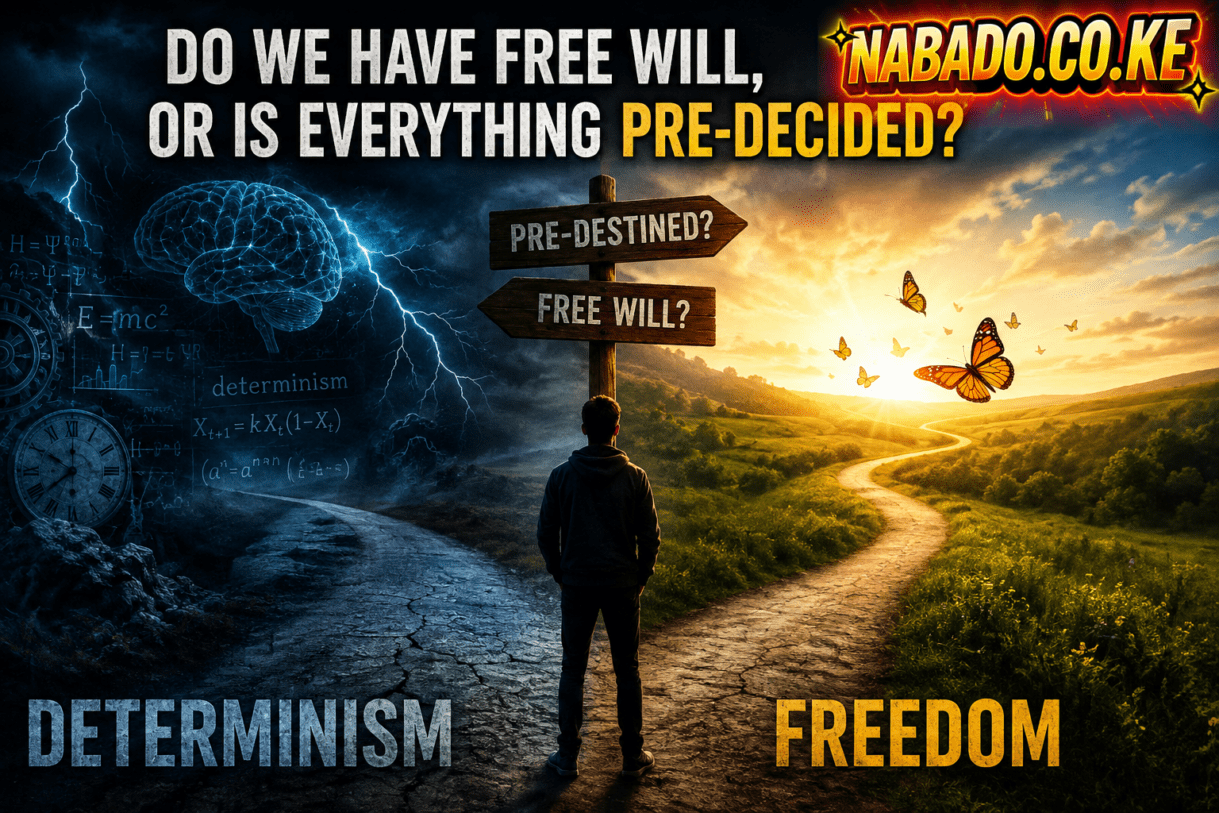
Are you really in control of your life, or are you simply following a path that was already set in motion before you were born?
Every day, we make hundreds of decisions. We decide what to eat, who to call, where to work, whom to love, what to believe and whether to take one opportunity or walk away from it.
We usually assume those decisions belong to us.
But what if they don’t?
What if your personality was shaped by your genes, your childhood, your environment and thousands of experiences you never consciously chose? What if the thoughts appearing in your mind are the product of electrical and chemical activity in your brain? What if the decision you believe you are making freely was already determined by everything that happened to you before that moment?
That possibility has fascinated philosophers, scientists and religious thinkers for centuries.
The debate over free will versus determinism is not merely an academic argument. It touches almost every part of human life, including responsibility, morality, religion, relationships, justice and even the way we understand ourselves.
So, do we actually have free will?
The honest answer is that nobody has completely solved the mystery.
What Does Free Will Actually Mean?
Before asking whether free will exists, we need to understand what we mean by it.
At its simplest, free will is the ability to make choices voluntarily rather than being completely controlled by outside forces or circumstances.
Imagine you are sitting in a restaurant and choosing between chicken and fish.
You look at the menu. You think about what you ate yesterday. Perhaps you consider the price, your appetite and what you enjoy more. Eventually, you choose chicken.
It feels obvious that you made the decision.
But now imagine that scientists could somehow examine every detail of your brain, your memories, your genes, your current emotional state, your surroundings and every other factor influencing you.
Would they discover that your decision was the inevitable result of everything that happened before it?
If so, was your decision truly free?
That is where the problem begins.
The Case for Determinism
Determinism is the idea that events are caused by previous events and conditions.
In a strict deterministic universe, everything that happens has a cause.
Your decision today could be influenced by yesterday’s experiences. Yesterday’s experiences were influenced by events before them. Those events were influenced by earlier circumstances.
Eventually, you have a massive chain of cause and effect stretching backward through your entire life.
Under this view, even apparently spontaneous decisions have explanations.
You might say:
“I decided to become a journalist because I wanted to.”
But where did that desire come from?
Perhaps you grew up reading newspapers. Maybe someone encouraged you when you were young. Perhaps you were influenced by a teacher. Your personality might have made you naturally curious. Your experiences could have made you interested in society and human behavior.
None of those things were entirely chosen by you.
The argument therefore becomes uncomfortable.
If the things that shaped your desires were outside your control, how much control do you really have over the decisions those desires produce?
Your Brain Makes Decisions Before You Are Conscious of Them
The free-will debate became even more complicated when scientists began investigating how the brain makes decisions.
Some experiments have suggested that certain patterns of brain activity can appear before people become consciously aware that they have made a decision.
This has been interpreted by some thinkers as evidence that the brain may begin preparing an action before the conscious mind experiences the feeling of deciding.
Imagine deciding to raise your hand.
You experience the thought:
“I am going to raise my hand.”
But what if your brain had already begun preparing the movement before you became consciously aware of that intention?
Does that mean your brain decided first and your conscious mind simply received the message afterward?
Not necessarily.
Neuroscience is considerably more complicated than the popular claim that scientists have “proved free will doesn’t exist.”
The brain is not simply a machine with a single button labelled decision. Human decision-making involves multiple processes, including unconscious processing, conscious reflection, memories, emotions, predictions and evaluation.
The experiments are fascinating, but they do not settle the philosophical question.
Maybe Free Will Is Not About Being Completely Uncaused
One of the strongest responses to determinism comes from a philosophical position known as compatibilism.
Compatibilists argue that determinism and free will can coexist.
This sounds strange at first.
If everything has a cause, how can anything be free?
The answer is that perhaps freedom does not mean being completely independent of causes.
Instead, freedom might mean being able to act according to your own reasons, values, desires and decisions without being forced by someone else.
Consider two people handing over their wallets.
The first person voluntarily gives their wallet to a friend because they want to help.
The second person gives their wallet to a criminal who threatens them with violence.
Both actions have causes.
But there is an important difference.
The first person’s action reflects their own wishes. The second person’s action is produced by coercion.
Most people would instinctively say the first person acted freely while the second person did not.
This suggests that perhaps free will isn’t about being completely independent from causation.
It is about the ability to think, evaluate options and act according to your own motivations.
Are We Just Products of Our Past?
This question becomes especially powerful when we think about childhood.
Nobody chooses their parents.
Nobody chooses the country in which they are born.
Nobody chooses their genetic makeup.
Nobody chooses whether they grow up in poverty or wealth.
Nobody chooses every teacher, friend, trauma, opportunity or disappointment they encounter.
Yet these experiences can profoundly influence who we become.
A person raised in a loving environment may develop a different outlook from someone who grows up surrounded by violence.
Someone who experiences repeated rejection may develop different expectations about relationships from someone who grows up feeling secure.
A child encouraged to read might become an adult who loves books.
Another child discouraged from expressing opinions might become an adult who avoids confrontation.
So when adults make decisions, they bring their entire history with them.
This raises a difficult question:
How much of the person making the decision was actually chosen by that person?
But Humans Can Change
There is another side to the argument.
People are not completely frozen by their past.
Human beings can change.
Someone who has always been impatient can learn patience.
Someone who was once afraid of public speaking can become a confident speaker.
Someone who grew up believing one thing can encounter new evidence and completely change their mind.
A person can recognize a destructive habit and deliberately work to break it.
That ability to reflect on ourselves may be one of the strongest arguments for meaningful human freedom.
We don’t simply experience thoughts.
Sometimes we question our own thoughts.
We can ask:
“Why do I believe this?”
“Why did I react that way?”
“Is this really what I want?”
“Should I behave differently next time?”
That ability to step back and examine our own minds is extraordinary.
What About Fate?
The idea of fate takes the question in another direction.
Many cultures and religions have traditions involving destiny, providence or a predetermined path.
Some people believe that certain events are meant to happen.
Others believe that God knows the future but still allows human beings to make meaningful choices.
This creates a classic philosophical problem.
Suppose God already knows exactly what you will do tomorrow.
Can you choose differently?
If you could choose differently, then God’s knowledge would apparently have been wrong.
But if you cannot choose differently, does that mean your choice was predetermined?
Religious philosophers have proposed different answers to this problem.
Some argue that knowing what someone will do is not the same thing as forcing them to do it.
For example, knowing someone extremely well might allow you to predict how they will behave, but your knowledge itself doesn’t necessarily cause their action.
The debate remains unresolved.
The Illusion of Choice
Imagine waking up tomorrow and being presented with two identical shirts.
You choose the blue one.
You might say:
“I could have chosen the white one.”
But could you really?
Perhaps your brain preferred blue because you associate it with positive memories. Maybe you wore blue the previous day and liked how you looked. Perhaps your mood influenced you.
If all of those factors were identical and the universe replayed the exact moment under exactly the same conditions, would you make the same decision again?
A strict determinist would likely say yes.
A believer in libertarian free will would argue that genuine alternatives may still exist.
And a compatibilist might say the question misses the point.
What matters is that you chose the blue shirt because you wanted the blue shirt, rather than because somebody physically forced your hand.
Why This Question Matters in Everyday Life
At first glance, the free-will debate may sound like something philosophers discuss in universities.
But it has enormous practical consequences.
Consider criminal justice.
If a person commits a serious crime, society generally believes they should be held responsible.
But what if their behavior was influenced by genetics, childhood abuse, poverty, neurological disorders, social conditions and years of environmental influence?
Does responsibility disappear?
Not necessarily.
Even if behavior has causes, society may still need systems of accountability to protect others and discourage harmful actions.
The question simply becomes more complicated.
Understanding the causes of behavior could also encourage compassion without eliminating responsibility.
Instead of saying:
“This person is simply evil,”
we might ask:
“What caused this behavior, and how can society prevent it from happening again?”
That is a very different way of looking at human behavior.
Free Will Could Exist on a Spectrum
Perhaps the biggest mistake is assuming that humans are either completely free or completely controlled.
Reality may be more complicated.
You cannot choose everything.
You cannot control the weather.
You cannot control what another person thinks about you.
You cannot change the past.
You cannot decide which thoughts spontaneously appear in your mind.
You cannot control every biological process happening inside your body.
But you can sometimes choose how you respond.
Someone insults you.
Your first emotional reaction might be anger.
But you can pause.
You can decide not to respond immediately.
You can walk away.
You can reconsider your interpretation.
You can choose your next action.
That space between impulse and action may be one of the most important forms of human freedom.
The Strange Relationship Between Freedom and Responsibility
Our belief in free will is also closely connected to responsibility.
We praise people for making good decisions.
We blame people for harmful decisions.
We admire courage.
We criticize dishonesty.
We reward hard work.
We encourage people to learn from their mistakes.
All of these concepts assume that people have at least some ability to influence their behavior.
But recognizing that behavior has causes does not necessarily mean we should abandon responsibility.
In fact, it could make responsibility more meaningful.
If people can reflect, learn and change, then consequences can become part of that process.
A person who makes a terrible decision today may become a completely different person years later.
That possibility of transformation is one reason the idea that humans are nothing more than predetermined machines feels incomplete.
What If Both Sides Are Partly Right?
There may be an uncomfortable middle ground.
Perhaps your choices are heavily influenced by things you did not choose, while you still possess some ability to evaluate those influences and respond differently.
Think about a river.
You don’t control the landscape through which the river flows.
The mountains, rocks and valleys determine much of its path.
But water can still move through countless channels.
Human life may be similar.
Our genes, upbringing, environment, culture and experiences create boundaries.
Within those boundaries, however, there may be room for reflection, decision-making and change.
That would mean freedom is not unlimited.
It is constrained freedom.
And perhaps that is the only kind of freedom humans ever needed.
So, Do We Have Free Will?
There is no scientific experiment that has conclusively demonstrated that humans possess absolute free will.
There is also no definitive proof that every human decision is completely predetermined.
The philosophical debate continues because both positions face difficult problems.
If everything is predetermined, it becomes difficult to explain our powerful experience of choice and responsibility.
But if our choices are completely independent of previous causes, it becomes difficult to explain what makes those choices genuinely ours rather than random events.
Perhaps the most reasonable position is that human beings are neither completely free nor completely helpless.
We are shaped by forces we did not choose.
But we can also examine those forces, respond to them and sometimes overcome them.
We inherit circumstances.
We don’t necessarily have to inherit the same future.
The Most Important Question May Not Be Whether We Are Free
There is an even deeper question hiding beneath the free-will debate.
Instead of asking:
“Do I have absolute free will?”
perhaps we should ask:
“What can I do with the freedom I actually have?”
You may not have chosen where your story began.
You may not control every event that enters your life.
You may not be able to rewrite your childhood, change yesterday or control another person’s decisions.
But you are here now.
You can learn.
You can reconsider.
You can apologize.
You can change direction.
You can develop new habits.
You can question beliefs you inherited.
You can make a different decision tomorrow than you made yesterday.
And perhaps that is what meaningful freedom looks like.
Not the ability to control everything.
Not the ability to escape every influence.
But the ability to participate consciously in what happens next.
The Mystery Remains
The human brain is trying to understand itself.
That may be why the free-will question is so difficult.
The same mind asking “Am I really choosing?” is the mind responsible for making the choice.
Maybe our decisions are ultimately the result of countless biological and environmental processes.
Maybe consciousness has a deeper role than we currently understand.
Maybe free will exists, but not in the simple way we imagine.
Or perhaps the universe is far stranger than either determinism or traditional free will suggests.
For now, we don’t know.
But there is something fascinating about the fact that human beings can even ask the question.
We can look at our own thoughts and wonder where they came from.
We can examine our habits and decide to change them.
We can question our past rather than simply repeating it.
And even if our freedom is limited, that ability to reflect may be one of the most remarkable features of being human.
Maybe you didn’t choose the starting point of your life.
Maybe you don’t control everything that happens along the way.
But perhaps the choices you make within those limitations still matter.
And until humanity discovers the ultimate answer to free will, that may be enough reason to take our choices seriously.
Final Thought
Whether everything is predetermined or whether genuine free will exists, one fact remains impossible to ignore: we experience ourselves as beings capable of choosing.
Every morning presents another set of possibilities.
You can repeat yesterday.
You can make a different decision.
You can stay where you are.
Or you can change direction.
Perhaps the universe has already written the ending.
Perhaps it hasn’t.
Either way, you are still living the story—and the next page has not yet been read.
SUGGESTED READS
- Why African Countries Should Unite: The Key to a Stronger, Wealthier, and More Influential Continent
- Kenya at a Crossroads: Power, Youth, Economy, and the Fight for the Nation’s Future
- From Silence to Resistance: How Kenyans Are Reclaiming Their Voice
- The New Kenyan Revolution Isn’t on the Streets — It’s on Your Phone
- The Untold Story of Youth Movements in Modern Kenya: How a Generation Is Quietly Rewriting Power
- Inside Kenya’s Protest Culture: Why Anger Keeps Exploding—and Why Hope Refuses to Die
- Voters Are Exhausted — Inside Kenya’s Rising Political Fatigue
- Kenya’s Democracy Is Being Tested — And Many Fear It’s Quietly Slipping Away

Support Our Website!
We appreciate your visit and hope you find our content valuable. If you’d like to support us further, please consider contributing through the TILL NUMBER: 9549825. Your support helps us keep delivering great content!
If you’d like to support Nabado from outside Kenya, we invite you to send your contributions through trusted third-party services such as Remitly, western union, SendWave, or WorldRemit. These platforms are reliable and convenient for international money transfers.
Please use the following details when sending your support:
Phone Number: +254701838999
Recipient Name: Peterson Getuma Okemwa
We sincerely appreciate your generosity and support. Thank you for being part of this journey!