

We Ain’t Done Yet… Expect Another One.
There are some questions that seem simple when we first hear them but become surprisingly difficult the longer we think about them.
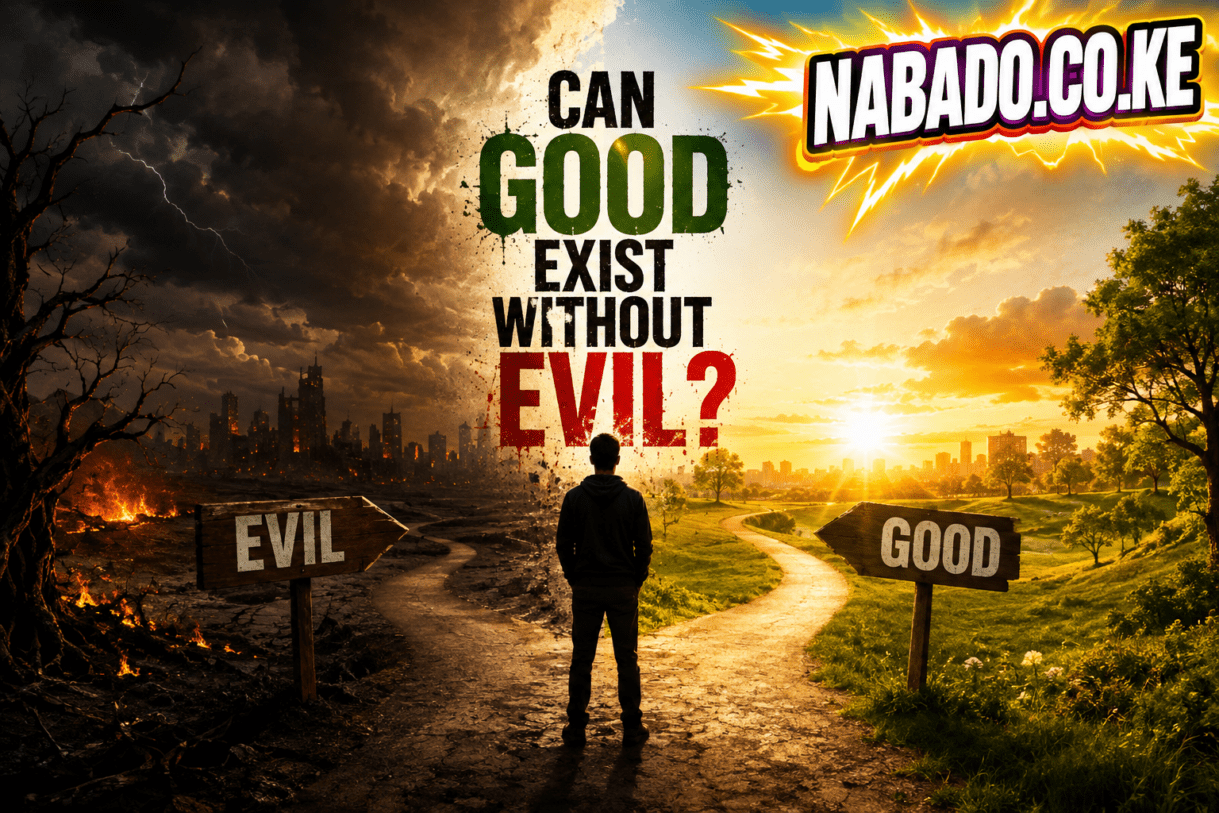
Can good exist without evil?
At first, the answer might appear obvious. Of course good can exist without evil. We can imagine a world where people are kind, honest, generous and peaceful, with nobody hurting anyone else.
But then another question appears.
If there were no evil, would we still understand what goodness means?
Would kindness have the same meaning if cruelty had never existed? Would courage exist if there were nothing to fear? Could we call something just if nobody had ever experienced injustice?
This is where the question becomes much deeper.
The relationship between good and evil has occupied philosophers, religious thinkers, writers and ordinary people for thousands of years. It sits at the heart of some of humanity’s biggest questions: Why do people suffer? Why do people deliberately hurt one another? Is morality objective? Does God exist? And can human beings understand goodness without experiencing its opposite?
For readers of NABADO.CO.KE, this is not merely an abstract philosophical debate. Every society wrestles with questions of right and wrong, justice and injustice, compassion and cruelty.
So, can good exist without evil?
The answer depends largely on what we mean by “exist.”
What Do We Mean by Good and Evil?
Before answering the question, it helps to define the terms.
Good generally refers to actions, intentions or qualities considered morally desirable. Honesty, compassion, generosity, justice, courage and love are commonly regarded as forms of goodness.
Evil, on the other hand, usually refers to serious moral wrongdoing. Murder, torture, deliberate cruelty, exploitation and extreme injustice are examples of what people commonly describe as evil.
But philosophy complicates these definitions.
Is something good because society says it is good?
Is something evil because it causes suffering?
Or are good and evil objective realities that exist independently of human opinion?
Different philosophical traditions provide different answers.
Some philosophers argue that morality is rooted in reason. Others believe morality comes from human societies and cultures. Religious traditions often ground goodness in God or a divine moral order.
That makes the question of whether good requires evil even more complicated.
Could Good Exist in a Perfect World?
Imagine a world in which nobody lies.
Nobody steals.
Nobody murders.
Nobody abuses another person.
Nobody deliberately humiliates someone else.
Everyone has enough food, shelter and security. People care for one another, keep their promises and treat each other with dignity.
Would goodness exist in that world?
Absolutely.
People could still be compassionate. They could still help one another. They could still create beautiful things, raise families, explore nature, discover scientific knowledge and form meaningful relationships.
The absence of evil would not automatically eliminate goodness.
In fact, it could allow goodness to flourish without being constantly threatened.
This suggests an important distinction:
Good may not need evil in order to exist, but humans may need the possibility of evil in order to recognize certain forms of good.
That distinction changes the entire debate.
We Often Understand Things Through Their Opposites
Human beings frequently understand concepts through comparison.
We understand darkness partly because we understand light.
We understand silence because we know sound.
We understand hunger because we know what it means to be fed.
We understand loneliness because we know connection.
Similarly, we often understand goodness because we have encountered wrongdoing.
Someone who has experienced betrayal may understand loyalty differently from someone who has never been betrayed.
Someone who has lived through violence may appreciate peace in a way that another person takes for granted.
Someone who has experienced injustice may have a particularly strong understanding of fairness.
This does not necessarily mean that the negative experience created the positive quality.
It may simply have made the positive quality more visible.
Does Darkness Create Light?
Consider the relationship between darkness and light.
Darkness does not create light.
Light exists independently.
However, darkness can make light easier to notice.
A candle in the middle of a bright afternoon may barely attract attention. The same candle in a dark room immediately becomes significant.
Goodness can sometimes work in a similar way.
A generous person may stand out when surrounded by selfishness.
A truthful person may stand out in a culture of deception.
A peaceful leader may stand out during conflict.
A person who protects the vulnerable may become particularly memorable when others choose to ignore suffering.
The existence of evil can therefore provide a contrast against which goodness becomes visible.
But contrast is not the same as dependence.
A candle does not need darkness in order to produce light.
Likewise, goodness may not need evil to exist.
Could Courage Exist Without Evil?
This is where the argument becomes particularly interesting.
Consider courage.
We usually think of courage as a virtue.
But courage appears to require danger, fear or difficulty.
If there were absolutely nothing frightening or dangerous in existence, would courage still exist?
Perhaps not in the form we understand it today.
You cannot be courageous while facing absolutely no risk.
Similarly, forgiveness requires wrongdoing.
Mercy requires the possibility of punishment.
Resistance requires something to resist.
Justice becomes particularly visible when injustice occurs.
This means certain virtues depend on difficult circumstances for their expression.
But that still does not mean evil is necessary for morality itself.
A world without murder might have no need for the courage required to stop a murderer. But it could still contain courage in other forms—such as exploring an unknown environment, facing uncertainty or accepting difficult truths.
The disappearance of one kind of challenge does not necessarily mean the disappearance of virtue.
The Religious Perspective on Good and Evil
The question becomes even more significant in religion.
Many religious traditions describe God as the ultimate source of goodness.
If God is perfectly good, then goodness cannot logically depend upon evil.
Otherwise, there would be a strange problem.
If evil disappeared completely, would God suddenly stop being good?
Most religious philosophies would reject that conclusion.
Instead, they often understand evil as something that departs from or corrupts goodness.
This idea became especially influential in Christian philosophy through thinkers such as Augustine.
Augustine argued that evil could be understood as a privation of good. In other words, evil is not necessarily an independent substance competing with goodness. It is a distortion, absence or corruption of something that ought to be good.
Think about a lie.
Truth exists as the proper state of communication. A lie deliberately distorts it.
Think about cruelty.
Compassion and respect are replaced by deliberate harm.
Think about injustice.
A proper relationship between people is damaged.
Under this interpretation, good comes first conceptually.
Evil is what happens when something good is corrupted or rejected.
The Problem of Evil
This leads to one of philosophy’s most famous problems: the problem of evil.
If an all-powerful and perfectly good God exists, why does evil exist?
If God is powerful enough to prevent suffering, why doesn’t God stop it?
And if God is perfectly good, why would a world containing enormous suffering exist at all?
These questions have challenged religious thinkers for centuries.
There is no universally accepted answer.
Some argue that human free will requires the possibility of choosing evil.
Others argue that suffering can sometimes produce moral growth, courage or compassion.
Some suggest that human beings simply cannot understand the full purpose behind suffering.
Others reject the idea that suffering has a divine purpose.
The debate continues because the existence of suffering is not merely an intellectual problem. It is also a deeply human one.
When someone loses a loved one, experiences violence or watches innocent people suffer, philosophical explanations can suddenly feel inadequate.
Does Free Will Require Evil?
Another argument connects evil with freedom.
Imagine a world where every person was programmed to behave perfectly.
Nobody could lie.
Nobody could steal.
Nobody could hurt anyone.
At first, that sounds like paradise.
But would those people actually be morally good?
Suppose a person helps another because they genuinely want to help.
Now compare that with a machine programmed to help.
The actions may look identical, but something important is different.
The human being chose.
Some philosophers and theologians therefore argue that genuine moral goodness requires freedom.
If humans are free to choose compassion, they must also have the ability to choose selfishness.
If people can choose honesty, they must be capable of choosing dishonesty.
If they can choose love, they must have the possibility of rejection.
Freedom creates the possibility of evil.
But again, this does not prove that evil itself is necessary.
It may simply mean that the possibility of evil is a consequence of having meaningful moral freedom.
Could Humans Appreciate Good Without Experiencing Evil?
This is perhaps the most relatable part of the question.
Many people discover the value of something after losing it.
A person may not appreciate good health until becoming sick.
Someone may not appreciate peace until experiencing conflict.
A family may not fully appreciate togetherness until separation occurs.
A person may not understand the value of trust until someone betrays them.
But there is a danger in taking this argument too far.
We should not conclude that suffering is therefore good.
Suffering can teach people important lessons, but that does not make suffering morally desirable.
A child does not need to be abused in order to understand kindness.
A society does not need war in order to appreciate peace.
A person does not need to experience murder in order to understand that life has value.
Human beings can learn through observation, empathy, education and imagination.
Evil May Make Good More Visible, But It Does Not Define It
This may be the most balanced way to understand the relationship.
Evil can make goodness more visible.
It can create circumstances in which virtues such as courage, forgiveness, sacrifice and compassion become particularly obvious.
But goodness does not necessarily depend on evil.
Imagine two people living in a peaceful community.
One spends their life helping elderly neighbours, caring for children and supporting people in difficult circumstances.
The other spends their life trying to manipulate and exploit people.
The first person’s goodness is real even if the second person disappears.
The absence of evil does not erase compassion.
It simply removes the contrast.
What Happens If Evil Disappears?
Suppose humanity somehow reached a point where war, murder, corruption and deliberate cruelty disappeared.
Would morality become meaningless?
Probably not.
Human beings would still face choices.
How should resources be distributed?
How should society respond to disagreements?
How should scientific discoveries be used?
How should humans treat animals and the natural environment?
How should people balance individual freedom with collective responsibility?
How should parents raise children?
How should societies respond to mistakes?
Goodness would continue to matter because moral life is not simply about preventing evil.
It is also about pursuing positive values.
Justice is more than preventing injustice.
Peace is more than preventing war.
Love is more than preventing hatred.
Generosity is more than preventing selfishness.
Human flourishing requires more than simply avoiding wrongdoing.
Can Evil Exist Without Good?
Interestingly, turning the question around may provide a stronger answer.
Can evil exist without good?
It is difficult to describe something as evil without having some concept of what should be good.
We call murder wrong because we believe human life has value.
We call torture wrong because we believe unnecessary suffering should not be inflicted.
We call corruption wrong because we believe public responsibility should involve fairness and honesty.
We call betrayal wrong because we believe trust has value.
In this sense, the concept of evil appears to depend on a standard of goodness.
If nothing mattered morally, it would become difficult to explain what “evil” actually means.
This creates an intriguing philosophical asymmetry.
Good may be understandable without evil, while evil appears much harder to understand without some concept of good.
Good and Evil in Everyday Life
The debate does not exist only in philosophy books.
Every day, people make choices between competing values.
A worker discovers a mistake that could cost their employer money. Do they report it?
A person finds a wallet full of cash. Do they return it?
Someone sees another person being bullied. Do they intervene?
A government official is offered a bribe. Do they accept it?
A stranger needs help. Do we stop?
These situations demonstrate that morality is not merely an abstract battle between superheroes and villains.
Most moral decisions happen quietly.
They happen in homes, workplaces, schools, businesses, streets and communities.
Goodness often appears in ordinary acts that receive no applause.
A parent sacrificing personal comfort for a child.
A neighbour helping someone during a difficult period.
A stranger returning something that does not belong to them.
A person refusing to participate in corruption even when nobody would discover it.
These acts demonstrate something important.
Goodness does not need an audience to exist.
Why Humans Are Fascinated by Good Versus Evil
Stories about good and evil appear in virtually every culture.
Heroes fight villains.
Kings battle tyrants.
Communities defend themselves against threats.
Characters struggle with temptation.
People seek revenge but later choose forgiveness.
Why are these stories so powerful?
Because they reflect an internal human struggle.
Most people are capable of both selfishness and generosity.
We can be compassionate in one situation and selfish in another.
We can tell the truth sometimes and lie at other times.
We can forgive one person while holding a grudge against another.
The battle between good and evil is therefore not always happening somewhere outside us.
Sometimes it happens inside us.
The Most Important Question May Be About Choice
Perhaps the deepest lesson is that the existence of evil makes moral choice meaningful, but it does not make evil desirable.
If people have no choice but to behave well, their behaviour may be good in outcome but not necessarily moral in the deepest sense.
When a person has the opportunity to act selfishly but chooses generosity, the decision tells us something about their character.
When someone can lie but chooses honesty, that choice matters.
When someone has the power to hurt another person but chooses mercy, that decision becomes meaningful.
The possibility of wrongdoing gives moral choices weight.
But the ultimate goal of morality should not be to create more opportunities for evil.
It should be to build a world in which fewer people are harmed and more people can flourish.
So, Can Good Exist Without Evil?
Yes.
Goodness can logically exist without evil.
A world without cruelty could still contain love.
A world without murder could still contain compassion.
A world without war could still contain courage.
A world without injustice could still contain fairness.
A world without hatred could still contain love.
What evil may provide is contrast.
It can make certain forms of goodness easier to recognize. It can create circumstances in which courage, forgiveness and sacrifice become visible.
But that does not mean evil is the source of good.
A beautiful sunrise does not need a tragedy to make it beautiful.
A loving relationship does not need betrayal to become meaningful.
A kind person does not need a cruel person standing beside them to be kind.
Goodness can stand on its own.
Perhaps the better way to think about the relationship is this:
Good does not need evil in order to exist, but human beings often understand good more clearly when they encounter its opposite.
And perhaps that is why the question continues to fascinate us.
We are not merely asking whether good and evil can exist independently.
We are asking what morality actually is, why human beings care about right and wrong, whether suffering has meaning, and whether goodness is something fundamental about reality—or something humanity created to make sense of its existence.
Those questions have no universally accepted final answer.
But they force us to look beyond the simple idea of heroes versus villains.
The real philosophical challenge is much closer to home:
When we have the freedom to choose between selfishness and compassion, what kind of person do we choose to become?
That may be where the meaning of good and evil truly begins.
SUGGESTED READS
- How Youth Unemployment Fuels Radicalization in Kenya: The Silent Crisis
- Post-Election Violence in Kenya (2007–2008): What Really Happened?
- Herbal Medicine in Africa: What Works and What Doesn’t
- Why Many Nigerians Still Visit Native Doctors: A Deep Dive into Beliefs, Culture, and Modern Realities
- The Truth About African Traditional Religions: Myths, Realities, and Why They Still Matter Today
- Behind the Bars: The Most Dangerous Prisons in the World
- Understanding the 2022 Kenyan Elections: Have We Learned from the Past?

Support Our Website!
We appreciate your visit and hope you find our content valuable. If you’d like to support us further, please consider contributing through the TILL NUMBER: 9549825. Your support helps us keep delivering great content!
If you’d like to support Nabado from outside Kenya, we invite you to send your contributions through trusted third-party services such as Remitly, western union, SendWave, or WorldRemit. These platforms are reliable and convenient for international money transfers.
Please use the following details when sending your support:
Phone Number: +254701838999
Recipient Name: Peterson Getuma Okemwa
We sincerely appreciate your generosity and support. Thank you for being part of this journey!