

We aint done yet.. Expect another one.
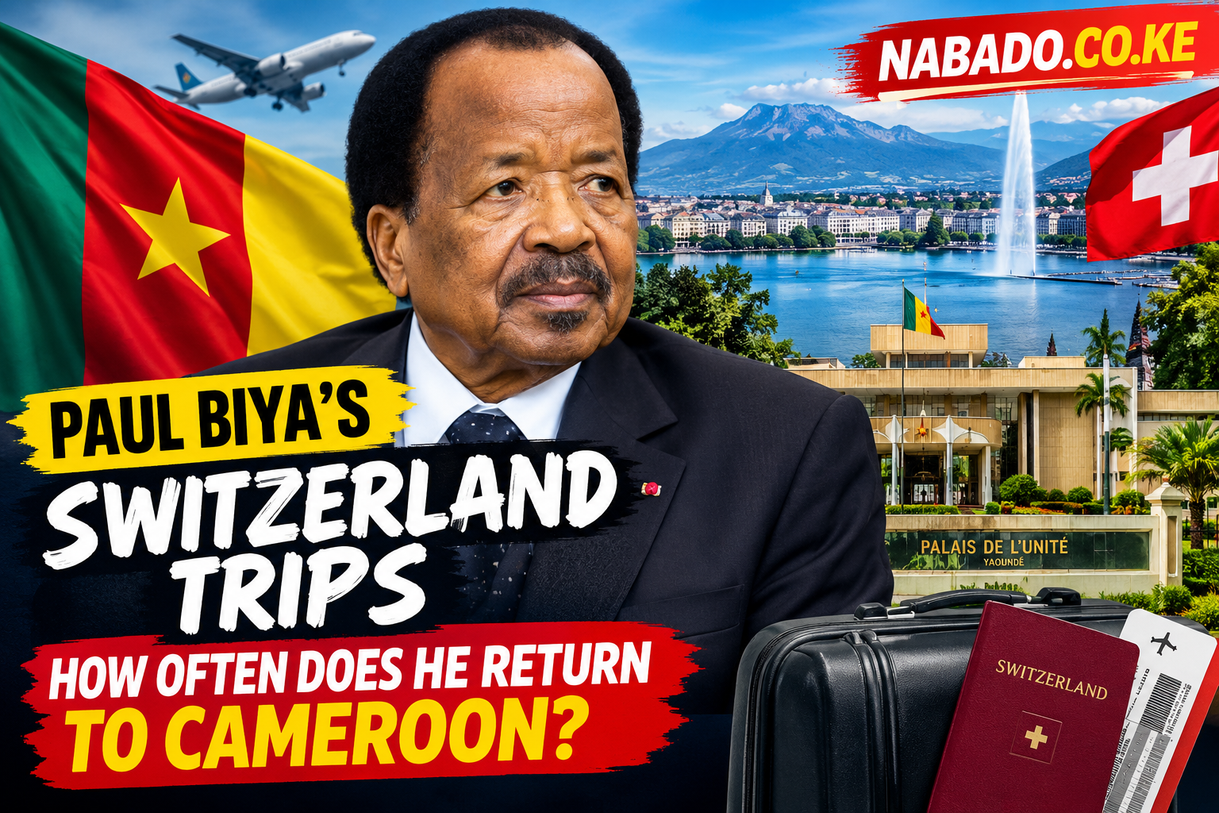
How Often Does Cameroon’s President Paul Biya Return From Switzerland?
Cameroon President Paul Biya has developed a long-established pattern of spending extended periods outside his country, particularly in Switzerland and other European destinations. His frequent overseas stays have attracted attention from journalists, opposition politicians and ordinary Cameroonians, raising questions about how often the country’s leader returns home and how his government operates when he is away.
Unlike presidents who regularly publish detailed travel schedules, Biya does not follow a publicly established timetable for returning from Switzerland. His visits to Cameroon vary, and some overseas stays that officials initially describe as brief have lasted several weeks or months.
The issue became particularly prominent in 2026 when Biya returned to Cameroon on August 20 after spending more than ten weeks abroad. He had departed on June 7 for what his office described as a brief private stay in Europe. His extended absence generated renewed debate about presidential visibility, government accountability and the practical implications of a head of state spending considerable time outside the country. Reuters reported that the trip was his longest recorded stay abroad since he took power in 1982.
So, how often does Paul Biya visit Cameroon from Switzerland? The answer is that there is no fixed monthly or quarterly schedule. Historical reporting shows that he has repeatedly spent weeks abroad, while some individual trips have lasted several months.
Paul Biya’s 2026 Absence: More Than Ten Weeks in Europe
One of the clearest recent examples of Biya’s travel pattern occurred in June 2026.
On June 7, the Cameroonian president left the country for Europe. The presidency described the trip as a brief private stay. However, he remained abroad for more than ten weeks before returning to Yaoundé on August 20.
According to Reuters, Biya arrived at Nsimalen International Airport from Geneva, Switzerland, before travelling to the Unity Palace, his official presidential residence in Yaoundé.
The length of the trip attracted considerable attention because Biya was 93 years old at the time. His prolonged absence from public view encouraged speculation about his whereabouts and health, although speculation should not be confused with verified medical information.
The government maintained that the president remained in charge of national affairs while abroad. During the absence, presidential decrees concerning military appointments were issued, demonstrating that government decisions continued to be announced.
However, the absence of regular public appearances made it difficult for citizens to assess the president’s day-to-day activities. The lack of detailed public information also contributed to debate about the degree of direct presidential involvement in government business.
The president’s return on August 20 ended that particular period abroad, but it did not establish a new travel schedule. There is no reliable public timetable indicating exactly when he will next travel to Switzerland or how long he will remain there.
Has Paul Biya Spent Months Outside Cameroon Before?
Yes. Biya’s extended stays abroad did not begin in 2026. Investigative reporting has documented a pattern of lengthy private visits to Europe spanning several decades.
A notable investigation by the Organized Crime and Corruption Reporting Project (OCCRP), published in 2018 under the title Paul Biya, Cameroon’s Roaming President, examined records of his foreign travel over approximately 35 years.
The investigation used historical editions of the government newspaper Cameroon Tribune to estimate how long Biya had spent abroad. According to its calculations, he had spent at least four and a half years on private visits outside Cameroon during the period examined. Official trips added approximately another year.
OCCRP cautioned that its figures were conservative because some newspaper editions were missing from the available archives.
The investigation also found that, in certain years, Biya spent roughly one-third of the year outside Cameroon. His destinations included Switzerland and France, with Geneva becoming particularly associated with his private stays.
These findings demonstrate that the president’s extended absences are part of a much older pattern rather than a development that began recently.
Nevertheless, the historical figures should be interpreted carefully. They describe the period covered by the investigation and should not be presented as a complete calculation of every day Biya has spent abroad throughout his presidency.
Why Does Paul Biya Spend So Much Time in Switzerland?
The precise reasons for every private trip are not always publicly documented.
Cameroonian presidential communications have repeatedly described certain European journeys as private stays or periods of rest. Switzerland, particularly Geneva, has been a recurring destination.
However, it would be inaccurate to assume that every trip is connected to a particular medical procedure or that the president has a confirmed medical condition based solely on the length of his absence.
In 2026, his extended stay prompted widespread speculation about his health. Officials denied some reports circulating during the period, while the government did not provide a detailed public account of all his private activities.
The distinction between confirmed information and speculation is important. A president’s extended absence may generate legitimate questions about transparency and continuity of government, but it does not independently establish a diagnosis or prove that the leader is unable to perform his duties.
Another relevant factor is that Biya has maintained a longstanding pattern of relatively limited public appearances compared with some other political leaders. This has sometimes made it harder for citizens to distinguish between periods of ordinary private travel and absences that raise broader political questions.
The most reliable way to understand his travel pattern is therefore to examine documented departure and return dates, official announcements and credible reporting rather than relying on unverified claims about his private life.
What Happens in Cameroon When the President Is Abroad?
A president’s absence does not automatically mean that a country stops functioning.
Cameroon has a government structure that includes a prime minister, ministers, senior presidential officials, parliament and other public institutions. These institutions continue to carry out their respective responsibilities when the president travels.
During Biya’s 2026 absence, for example, presidential decrees concerning senior military appointments were announced. This indicated that important government decisions continued to be processed despite the president’s physical absence from Cameroon.
The government also maintained that the president remained in control of state affairs.
However, the continuation of administrative activity is not the same as the president appearing publicly, explaining decisions or directly participating in visible national engagements.
This distinction became central to the debate surrounding Biya’s prolonged stay in Switzerland. Critics questioned whether citizens were receiving sufficient information about the president’s activities and the arrangements for exercising presidential authority during his absence.
The issue is particularly important in a country facing security, economic and political challenges. Cameroon has experienced a separatist conflict in its English-speaking regions, insecurity associated with Boko Haram in the north, and persistent concerns about employment and economic opportunities.
These challenges require coordination among state institutions and clear communication between government leaders and the public.
A president can exercise certain responsibilities from abroad, but the public may still reasonably seek information about the decision-making process, the officials responsible for daily administration and the arrangements for handling emergencies.
Does Paul Biya Govern Cameroon From Switzerland?
The Cameroonian government has maintained that Biya remains in charge even when he is outside the country.
In practice, modern governments can conduct substantial administrative work through official communications, signed documents, senior ministers and established institutional procedures. Physical presence in the presidential palace is not the only means through which a head of state can exercise authority.
During his 2026 stay in Europe, presidential decrees were issued, including decisions involving military leadership. This showed that official business continued during the president’s absence.
However, the existence of official decisions does not, by itself, reveal how much personal involvement the president had in every matter or how frequently he communicated with senior officials.
That distinction matters when assessing claims about remote governance. Publicly available decrees can demonstrate that certain decisions were made, but they cannot establish the full details of the president’s daily working arrangements.
Opposition figures and other critics have raised concerns about the concentration of authority around the presidency and the limited public visibility of the head of state during extended absences.
Government supporters, meanwhile, have maintained that state affairs continue under the existing administrative structure.
A balanced assessment must distinguish between these competing interpretations and the facts that can be independently established.
Why the President’s Absences Attract Public Attention
Presidential travel becomes a matter of national interest when it affects public confidence, government transparency or perceptions of political stability.
In Cameroon’s case, Biya has led the country since November 1982. His long tenure means that generations of citizens have grown up under his presidency.
His extended overseas stays therefore attract attention beyond the question of where he spends his private time. They also prompt questions about how national leadership operates and how the country will manage future political transitions.
The debate is influenced by several factors.
First, the president’s age has made his prolonged absences more closely scrutinised. At 93 in 2026, he was widely described in international reporting as the world’s oldest serving head of state. His age does not, on its own, establish anything about his medical condition or ability to govern, but it has increased public interest in the transparency of official information.
Second, Cameroon faces important political and security challenges. When a president remains outside the country for weeks, citizens may seek reassurance that senior officials can respond effectively to developing events.
Third, limited public communication during an absence can create an information gap. When official statements provide few details, speculation can spread through social media and political debate.
Finally, the absence of a clearly communicated public travel schedule makes it difficult to determine whether a return is imminent or whether a trip will continue for several more weeks.
These factors help explain why Biya’s journeys to Switzerland attract attention even when the government describes them as private stays.
A Look at Paul Biya’s 2024 Absence
The events of 2026 were not the first time that Biya’s extended absence generated public discussion.
In 2024, he was away from Cameroon for approximately six weeks, according to reporting cited by Al Jazeera in October 2026.
That earlier absence also generated questions about his whereabouts and the operation of the government while he was abroad.
The comparison with 2026 is revealing. His June-to-August 2026 trip lasted 74 days according to Al Jazeera’s account, exceeding the approximately 42-day absence recorded in 2024.
Although the two periods do not establish a regular pattern of travel, they demonstrate that Biya’s overseas stays can last substantially longer than a few days.
They also show why it would be misleading to say that he visits Cameroon from Switzerland at a predictable interval. The length of one stay cannot reliably be used to forecast the next.
For citizens trying to understand his movements, documented travel dates offer a more dependable basis for assessing the situation than estimates or rumours about when he might return.
Where Does Paul Biya Live When He Is in Cameroon?
When he is in Cameroon, Biya’s official presidential residence is the Unity Palace in Etoudi, Yaoundé.
The palace serves as a central location for presidential activities and official business. Yaoundé is Cameroon’s capital and the seat of its national government.
Biya was born on February 13, 1933, in Mvomeka’a, in the South Region of Cameroon, according to his official presidential biography. His birthplace is different from his official presidential residence.
When he travels to Switzerland, he is outside Cameroon for a private or other overseas stay. Public reporting has frequently associated his visits with Geneva, although the exact details of his private accommodation and daily movements are not consistently published.
This distinction is important because a president’s official residence does not necessarily mean that the individual is physically present there throughout the year.
Biya’s documented travel history shows that he has spent significant periods abroad while retaining the office of president.
Does Cameroon Have a Fixed Schedule for Presidential Returns?
There is no publicly established schedule requiring Biya to return from Switzerland every month, every two months or at another regular interval.
His movements have historically varied according to the circumstances of individual trips. Some overseas visits have been relatively short, while others have continued for many weeks.
The phrase “brief private stay” used in official communications has not always corresponded to a stay lasting only a few days. In 2026, the trip that began on June 7 continued until August 20.
This does not mean every future trip will follow the same duration. It simply illustrates why the length of a president’s next stay cannot be predicted from previous journeys alone.
A more transparent travel calendar could help the public understand when the president is expected to be abroad, what official engagements he plans to attend and how state responsibilities are handled during his absence.
However, the existence of such a calendar should not be assumed unless the government publishes one.
For now, the best way to establish how often Biya returns is to follow confirmed departure and arrival reports from credible news organisations and official presidential communications.
What Paul Biya’s Travel Pattern Means for Cameroon
The question of how often Biya returns from Switzerland reflects a broader debate about leadership, transparency and the functioning of public institutions.
His extended stays abroad have become a recurring feature of political discussion in Cameroon. Historical investigations show that private visits to Europe have accounted for substantial periods away from the country, while recent reports demonstrate that individual absences can exceed two months.
At the same time, the country’s government continues to operate through established institutions, and officials have maintained that the president remains in charge during his travels.
The central question is therefore not simply whether the president is physically present in Cameroon on a particular day. It is also whether the public has sufficient information to understand how decisions are made, how national challenges are addressed and how presidential responsibilities are exercised during extended absences.
These are questions of public accountability rather than proof of any particular claim about the president’s health or private life.
As Cameroon continues to confront political, economic and security challenges, public interest in presidential travel is likely to remain closely connected to wider discussions about governance and the future of the country’s leadership.
How Often Does Paul Biya Visit Cameroon from Switzerland?
Paul Biya does not follow a fixed, publicly documented schedule for returning to Cameroon from Switzerland. His travel history includes repeated private stays in Europe lasting several weeks, and some have extended for months.
In 2024, he was absent for approximately 42 days. In 2026, he spent 74 days abroad between his departure on June 7 and his return to Yaoundé on August 20.
These documented periods show that his overseas stays can be lengthy, but they do not establish a predictable interval between visits.
Biya’s official residence remains the Unity Palace in Yaoundé, and his government has maintained that state affairs continue while he is abroad. Nevertheless, his extended absences have prompted continuing questions about transparency, public communication and the practical operation of presidential leadership.
The clearest answer is that Paul Biya returns when his individual travel arrangements bring him back; there is no confirmed monthly or quarterly timetable. His next departure or return should be established through verified reporting rather than speculation.
This article distinguishes documented travel dates and historical reporting from unverified claims about the president’s private activities or health. Travel figures should be updated if new, independently confirmed information becomes available.
SUGGESTED READS
- The Hidden Reason You Still Don’t Know Who You Really Are
- Why Was Yugoslavia So Feared? The Powerful Military State That Refused to Bow to the Superpowers
- Can Good Exist Without Evil? The Deep Philosophical Question About Morality
- Why Does the Universe Exist Instead of Nothing? The Biggest Question Science Cannot Fully Answer
- Do We Have Free Will, or Is Everything Pre-Decided? The Question That Could Change How You See Life
- What Is the Meaning of Life? The Search for Purpose, Happiness and Why We Are Here
- Why African Countries Should Unite: The Key to a Stronger, Wealthier, and More Influential Continent
Support Our Website!
We appreciate your visit and hope you find our content valuable. If you’d like to support us further, please consider contributing through the TILL NUMBER: 9549825. Your support helps us keep delivering great content!
If you’d like to support Nabado from outside Kenya, we invite you to send your contributions through trusted third-party services such as Remitly, western union, SendWave, or WorldRemit. These platforms are reliable and convenient for international money transfers.
Please use the following details when sending your support:
Phone Number: +254701838999
Recipient Name: Peterson Getuma Okemwa
We sincerely appreciate your generosity and support. Thank you for being part of this journey!