

simply amazing, always for you.
Kenya’s presidency is one of the most powerful and closely watched political offices in Africa. Every election cycle sparks national conversations about leadership, governance, development, corruption, youth empowerment, and the future of the country. Many Kenyans dream of one day contesting for the presidency, but few fully understand what the process actually involves.
Running for president in Kenya is not simply about popularity or making speeches at rallies. It is a constitutional process governed by strict legal requirements, nomination procedures, integrity standards, and nationwide political organization. A serious presidential bid requires preparation, funding, legal compliance, strategy, and national support.
Whether you are a young Kenyan interested in politics, a civic learner, a journalist, or someone genuinely considering a future presidential run, understanding the process is essential.
This detailed guide explains everything you need to know about how to register and run for president in Kenya, including qualifications, IEBC requirements, nomination rules, campaign strategies, legal procedures, costs, challenges, and the realities of presidential politics in modern Kenya.
Understanding the Kenyan Presidency
Kenya operates under a presidential system established by the Constitution of Kenya 2010. The president serves as:
- Head of State
- Head of Government
- Commander-in-Chief of the Kenya Defence Forces
The president holds executive authority and oversees national governance through ministries, state departments, and constitutional institutions.
Presidential elections in Kenya are conducted every five years by the Independent Electoral and Boundaries Commission (IEBC). Citizens vote directly for a presidential candidate and their deputy president running mate.
To win the presidency, a candidate must secure:
- More than 50% of all valid votes cast
- At least 25% of votes in more than half of Kenya’s 47 counties
This system ensures that the winner has broad national support rather than regional popularity alone.
Constitutional Qualifications for Presidential Candidates
The first step toward becoming president in Kenya is meeting the constitutional qualifications outlined under Article 137 of the Constitution.
A presidential candidate must:
1. Be a Kenyan Citizen by Birth
Only Kenyan citizens by birth can contest for the presidency. Naturalized citizens are not eligible.
This rule was designed to ensure that presidential candidates have permanent constitutional allegiance to Kenya from birth.
2. Be Qualified to Stand for Election as a Member of Parliament
A presidential aspirant must also meet the qualifications required for Members of Parliament. This includes:
- Being a registered voter
- Satisfying moral and ethical standards
- Not being declared bankrupt
- Not having been convicted of serious criminal offenses
The integrity and leadership provisions under Chapter Six of the Constitution also apply.
3. Be Nominated by a Political Party or Run as an Independent Candidate
You can contest the presidency through two main paths:
Political Party Candidate
Most presidential candidates are nominated by political parties. Political parties provide:
- Campaign structures
- Mobilization networks
- Funding support
- Grassroots agents
- Political alliances
Major parties in Kenya often conduct internal nominations before selecting a presidential flag bearer.
Independent Candidate
An independent candidate runs without party sponsorship.
However, independent candidates must meet additional requirements, including proving that they are not affiliated with any political party for a specified period before the election.
Independent candidates also need their own symbols, campaign teams, and national support networks.
4. Obtain Support Signatures from Registered Voters
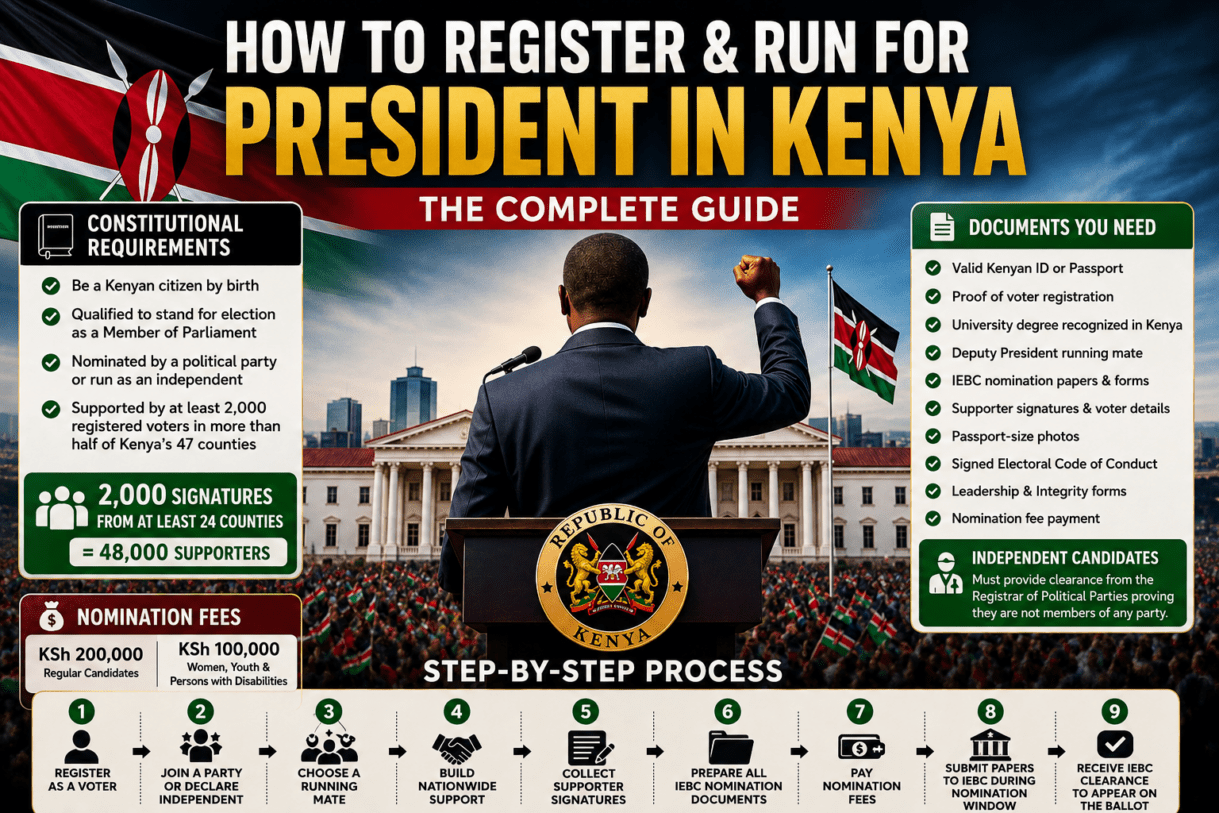
The Constitution requires presidential aspirants to collect at least 2,000 signatures from registered voters in a majority of counties.
Since Kenya has 47 counties, a candidate must secure signatures from at least 24 counties.
The minimum theoretical calculation is:
24 counties × 2,000 voters per county
24×2000=48,000
This means a candidate requires at least 48,000 valid supporter signatures distributed nationally.
In practice, candidates usually collect far more signatures because some entries may be rejected during IEBC verification.
Who Cannot Run for President in Kenya?
The Constitution also specifies disqualifications.
You cannot contest for president if you:
- Owe allegiance to a foreign state
- Are a public officer who has not resigned in time
- Have been convicted of offenses involving abuse of office
- Have violated integrity provisions under Chapter Six
- Have been declared bankrupt
- Are of unsound mind according to the law
These restrictions are intended to protect the integrity of the presidency.
Educational Requirements for Presidential Candidates
One of the most discussed requirements in Kenyan politics is academic qualification.
Currently, presidential candidates are generally required to possess a university degree recognized in Kenya.
This requirement has generated major political debate, with critics arguing it may exclude grassroots leaders who lack formal education but possess leadership ability.
Nonetheless, candidates usually submit certified copies of academic certificates during nomination.
Foreign degrees may require recognition from Kenyan education authorities.
The Role of the Deputy President Running Mate
A presidential candidate in Kenya cannot run alone.
Every candidate must nominate a deputy president running mate before registration.
The presidential and deputy presidential candidates appear together on the ballot as a joint ticket.
This means:
- Voters elect both individuals simultaneously
- If the presidential candidate wins, the deputy automatically assumes office alongside them
- The deputy president can take over if the president leaves office
Choosing a running mate is often one of the most strategic political decisions in Kenyan elections.
Candidates usually consider:
- Regional balance
- Ethnic representation
- Political influence
- Gender considerations
- Professional expertise
- Public image
A poor running mate selection can weaken a campaign significantly.
Registering as a Voter
Before aspiring to any elective office in Kenya, you must first be a registered voter.
The IEBC conducts voter registration exercises periodically across the country.
Requirements typically include:
- Kenyan national ID or passport
- Biometric registration
- Physical appearance at registration centers
Without voter registration, you cannot legally contest for president.
Political Party Nomination Process
For candidates running under political parties, internal party nomination is a critical step.
Political parties often establish:
- Party primaries
- National delegates conferences
- Internal voting systems
- Consensus arrangements
Major Kenyan parties sometimes negotiate coalition agreements before settling on a single presidential candidate.
Party nominations can be extremely competitive and politically intense.
In some cases, losing candidates defect to smaller parties or run independently.
Running as an Independent Candidate
Independent presidential candidates face unique challenges.
To qualify as an independent candidate, you generally must:
- Not have belonged to a political party for a legally specified period before elections
- Submit a unique symbol
- Establish a national support structure
- Collect required signatures independently
Independent candidates do not enjoy party machinery, which makes campaigns more difficult financially and logistically.
However, independent candidacy can appeal to voters frustrated with traditional political parties.
IEBC Nomination Requirements
The Independent Electoral and Boundaries Commission plays the central role in clearing presidential candidates.
The IEBC nomination process includes submission of several documents and compliance requirements.
These may include:
1. Nomination Papers
Candidates must submit official IEBC nomination forms completed correctly and signed where required.
Errors can lead to disqualification.
2. Supporter Lists
Candidates must submit verified supporter details, including:
- Names
- ID numbers
- Voter registration information
- County distribution
IEBC scrutinizes these signatures carefully.
3. Academic Certificates
Candidates usually provide certified copies of degrees and other academic credentials.
4. Passport Photos
Official nomination documents require recent passport-size photographs.
5. Code of Conduct Forms
Candidates must sign the Electoral Code of Conduct agreeing to peaceful and lawful campaigns.
6. Integrity Documents
Leadership and Integrity self-declaration forms may be required.
7. Nomination Fees
Candidates pay nomination fees before clearance.
These fees vary depending on regulations issued for each election cycle.
Presidential Nomination Fees in Kenya
Nomination fees are intended to regulate serious candidacy and reduce frivolous applications.
Recent IEBC guidelines have included:
- KSh 200,000 for regular candidates
- Reduced fees for women, youth, and persons with disabilities
However, fees may change depending on updated election regulations.
Presidential campaigns themselves cost far more than the nomination fee.
How IEBC Verifies Presidential Candidates
After submission, IEBC conducts verification procedures.
The commission examines:
- Signature authenticity
- Academic qualifications
- Voter registration status
- Citizenship
- Legal compliance
- Integrity requirements
If discrepancies are found, candidates may be rejected.
Rejected candidates can challenge decisions in court.
Campaigning for the Presidency in Kenya
Receiving IEBC clearance is only the beginning.
Campaigning for president in Kenya is a massive undertaking involving:
- Nationwide travel
- Public rallies
- Media appearances
- Television debates
- Social media campaigns
- Coalition building
- Fundraising
- Grassroots mobilization
Successful presidential campaigns require extensive organization.
The Importance of National Appeal
Kenya’s constitutional threshold means presidential candidates must think nationally.
A candidate cannot rely only on support from one region or ethnic community.
Winning requires:
- Cross-county support
- Broad coalition building
- National messaging
- Inclusive leadership image
Modern Kenyan politics increasingly rewards candidates capable of appealing to diverse demographics.
Financing a Presidential Campaign
Presidential campaigns in Kenya are extremely expensive.
Major campaign expenses include:
- Transport
- Security
- Advertising
- Staff salaries
- Campaign merchandise
- Digital campaigns
- Event organization
- Polling and research
Candidates often rely on:
- Personal wealth
- Political donors
- Party funding
- Fundraising networks
Financial transparency laws also apply.
The Role of Social Media in Modern Campaigns
Social media has transformed Kenyan presidential politics.
Platforms like:
- TikTok
- X
- YouTube
now shape political narratives and public opinion.
Digital campaigns help candidates:
- Reach young voters
- Respond rapidly to criticism
- Share campaign promises
- Build political branding
However, social media can also spread misinformation and political propaganda.
Challenges Facing Presidential Candidates
Running for president in Kenya is extremely difficult.
Candidates face several obstacles.
1. Financial Pressure
Campaigns require enormous resources.
2. Political Competition
Kenyan politics is highly competitive and alliance-driven.
3. Media Scrutiny
Candidates face constant examination from journalists and the public.
4. Security Concerns
Political rallies can sometimes become tense or dangerous.
5. Regional Dynamics
Balancing regional interests remains a major challenge.
Women and Youth in Presidential Politics
Kenya has seen increasing conversations about youth and women leadership.
However, structural barriers remain.
Challenges include:
- Limited campaign funding
- Patriarchal political systems
- Party favoritism
- Media bias
Despite this, younger leaders and women continue gaining influence in national politics.
Ethics and Leadership Expectations
The Kenyan Constitution places strong emphasis on integrity.
Presidential candidates are expected to demonstrate:
- Accountability
- Transparency
- Respect for constitutionalism
- Ethical leadership
Corruption allegations can significantly damage campaigns.
Public trust increasingly shapes electoral outcomes.
What Happens After Nomination?
Once cleared by the IEBC, candidates officially become presidential contenders.
The campaign period intensifies until election day.
During this time:
- Political rallies increase
- Media coverage expands
- Debates may be organized
- Coalition negotiations continue
Campaign conduct is regulated by electoral laws.
Election Day in Kenya
On election day:
- Registered voters cast ballots
- Votes are counted at polling stations
- Results are transmitted electronically
- IEBC verifies national tallies
Presidential results are among the most closely monitored processes in Kenya.
Winning the Presidency
To win outright, a candidate must obtain:
Majority Vote Requirement
Valid Votes>50%
and
County Distribution Requirement
At least 25% of votes in more than half of the 47 counties
If no candidate meets these thresholds, a runoff election is held between the top two candidates.
Presidential Election Petitions
Kenya’s presidential elections can be challenged in the Supreme Court.
Election petitions may involve disputes concerning:
- Vote tallying
- Electoral irregularities
- Technology failures
- Constitutional compliance
The Supreme Court has authority to:
- Uphold results
- Nullify elections
- Order fresh elections
Kenya has experienced historic presidential petition cases that shaped electoral law.
Common Mistakes Aspiring Candidates Make
Many presidential hopefuls underestimate the complexity of national politics.
Common mistakes include:
- Starting campaigns too late
- Ignoring grassroots mobilization
- Weak funding strategies
- Poor coalition building
- Failure to comply with IEBC requirements
- Overreliance on social media popularity
Successful campaigns require long-term planning.
Can an Ordinary Kenyan Become President?
Legally, yes.
Kenya’s Constitution allows any qualified citizen to contest the presidency.
However, practical realities make presidential politics extremely demanding.
Serious candidates usually require:
- Political networks
- Financial backing
- National visibility
- Organizational capacity
- Strategic alliances
Still, democratic systems evolve, and outsider candidates can rise unexpectedly.
The Future of Presidential Politics in Kenya
Kenyan politics continues changing rapidly.
Key trends shaping future presidential elections include:
- Youth voter influence
- Digital campaigning
- Governance accountability
- Economic concerns
- Anti-corruption demands
- Devolution politics
Future presidential races may increasingly depend on policy credibility rather than traditional political loyalties alone.
Running for president in Kenya is both a constitutional right and a monumental responsibility. The process involves much more than public popularity or political ambition.
Candidates must satisfy strict legal requirements, build national support, comply with IEBC regulations, raise significant resources, and convince millions of Kenyans that they can lead the country effectively.
From voter registration and signature collection to nationwide campaigns and constitutional compliance, every step demands preparation and seriousness.
Kenya’s presidency remains one of the most influential offices in East Africa, and the journey toward State House requires resilience, organization, leadership, and vision.
For anyone dreaming of contesting the presidency one day, understanding the legal and political framework is the first major step toward transforming ambition into reality.
SUGGESTED READS
- Inside the Supreme Court: The Invisible Power That Decides Nations, Rights, and the Fate of Justice
- From Tribal Tongue to Global Power: The Untold Story of How English Took Over the World
- The Ugly Truth About Chasing Someone Who Keeps Losing Interest
- The Power of Kind Gestures: Meaningful Ways to Show Appreciation in Everyday Life
- Why Your Brain Struggles to Let Go After a Breakup
- Why Men Disappear Emotionally After Sex
- The Hidden Male Fear That Makes Him Pull Away From You
- When Money Changes Love: The Hidden Ways Wealth Affects Relationships

Support Our Website!
We appreciate your visit and hope you find our content valuable. If you’d like to support us further, please consider contributing through the TILL NUMBER: 9549825. Your support helps us keep delivering great content!
If you’d like to support Nabado from outside Kenya, we invite you to send your contributions through trusted third-party services such as Remitly, western union, SendWave, or WorldRemit. These platforms are reliable and convenient for international money transfers.
Please use the following details when sending your support:
Phone Number: +254701838999
Recipient Name: Peterson Getuma Okemwa
We sincerely appreciate your generosity and support. Thank you for being part of this journey!