

We Ain’t Done Yet… Expect Another One.
The World’s Most Expensive Trees: Why Some Trees Are Worth Millions
Most people see trees as part of nature—providing shade, producing oxygen, and supplying timber for homes and furniture. While this is true, some trees have become incredibly valuable because of their rarity, beauty, fragrance, or the exceptional quality of their wood.
Imagine a single tree being worth more than a luxury mansion or a private jet. It may sound unbelievable, but it happens. Around the world, certain tree species are sold for hundreds of thousands or even millions of dollars. In some cases, a kilogram of wood from one of these trees is more expensive than gold.
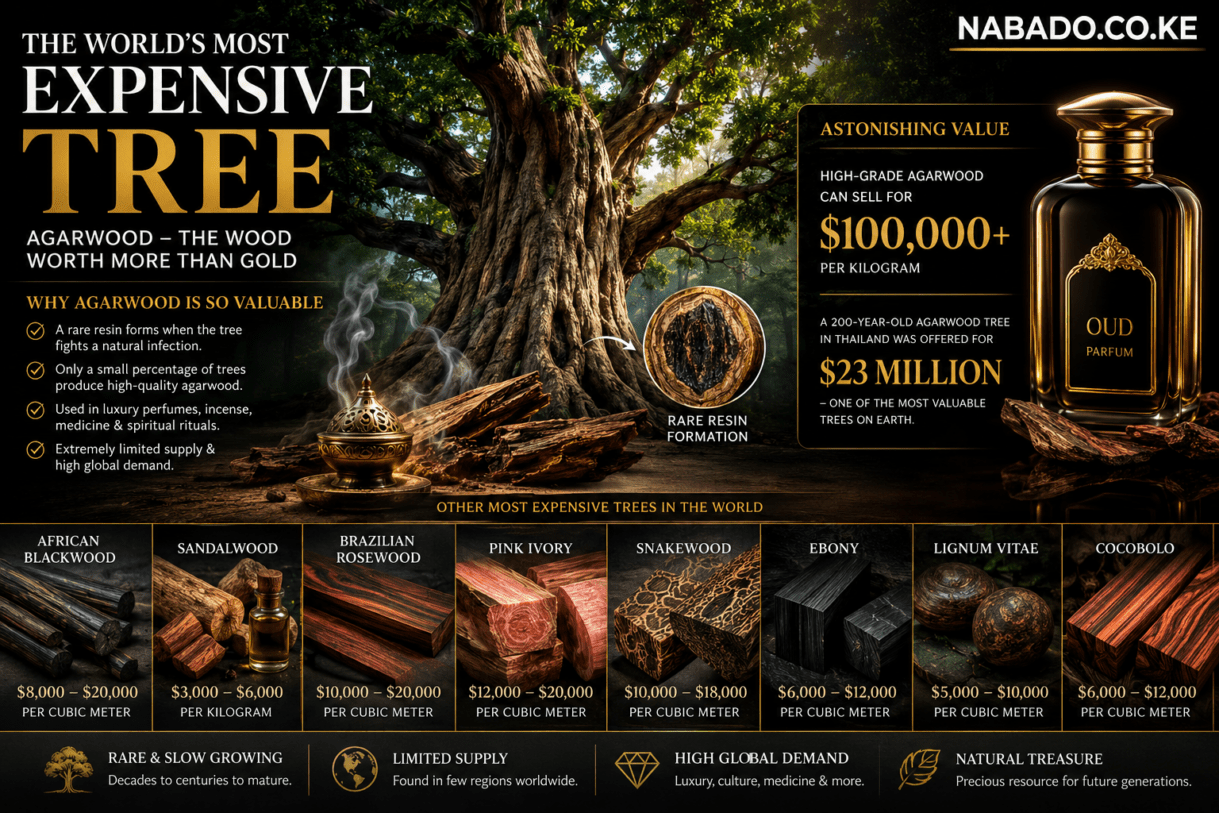
At the top of this exclusive list is agarwood, a remarkable tree that produces one of the world’s most luxurious natural products. Its resin is transformed into priceless perfume oils, incense, and traditional medicines that have been treasured for centuries.
But agarwood is far from the only valuable tree. Species such as African blackwood, sandalwood, Brazilian rosewood, pink ivory, and snakewood have all earned reputations as some of the most expensive trees on Earth.
In this guide, we’ll explore what makes these trees so valuable, how they are harvested, why demand continues to rise, and which species command the highest prices in today’s global market.
What Makes a Tree Expensive?
Not every old or large tree is valuable. In fact, several factors determine whether a tree becomes one of the world’s most sought-after natural resources.
These include:
- Rarity
- Slow growth
- Exceptional wood quality
- Beautiful grain patterns
- Fragrance
- Medicinal value
- Musical instrument applications
- Limited geographic distribution
- International demand
- Legal restrictions on harvesting
When several of these characteristics combine, prices can reach astonishing levels.
1. Agarwood: The World’s Most Expensive Tree
Among all tree species, agarwood stands in a league of its own.
Known scientifically as Aquilaria, agarwood grows naturally across Southeast Asia, including countries such as:
- India
- Bangladesh
- Thailand
- Vietnam
- Cambodia
- Laos
- Malaysia
- Indonesia
Unlike ordinary timber trees, agarwood becomes valuable only after an extraordinary natural process occurs.
The Incredible Story Behind Agarwood
Healthy agarwood trees are actually quite ordinary.
Their value begins when the tree is wounded or infected by a specific type of fungus.
To defend itself, the tree produces a thick, dark aromatic resin.
Over many years, this resin slowly saturates the heartwood, transforming pale timber into dark, fragrant wood known as agarwood.
Ironically, the disease that infects the tree is what makes it priceless.
Without the fungal infection, the tree has relatively little commercial value.
Nature Creates Luxury
The formation of agarwood cannot be rushed naturally.
It may take decades before enough resin develops to produce premium-quality wood.
Even then, only a small percentage of wild trees ever produce significant amounts of resin.
This rarity explains why genuine agarwood commands extraordinary prices worldwide.
Today, many plantations artificially inoculate trees with fungi to stimulate resin production, although naturally formed agarwood remains the most prized.
Why Is Agarwood Worth So Much?
Several industries compete fiercely for premium agarwood.
Luxury Perfume Industry
Perhaps the biggest buyer is the luxury perfume market.
The resin is distilled into oud oil, one of the rarest and most expensive perfume ingredients on Earth.
High-end perfume houses use only tiny amounts because of its intense fragrance.
Oud has become especially popular in the Middle East, Europe, Japan, and increasingly North America.
Religious Ceremonies
For thousands of years, agarwood has been burned as incense during religious ceremonies.
It holds spiritual significance in:
- Buddhism
- Hinduism
- Islam
- Traditional Chinese practices
- Japanese incense ceremonies
Its rich aroma is believed to create a peaceful atmosphere for meditation and worship.
Traditional Medicine
Many traditional medical systems value agarwood for its supposed therapeutic properties.
Historically, it has been used to support:
- Digestion
- Stress relief
- Respiratory health
- Sleep
- Pain management
Although scientific evidence varies, demand remains strong across Asia.
Luxury Collectors
Collectors also purchase premium agarwood pieces as investment assets.
Rare naturally formed resinous wood often appreciates in value over time because supplies continue to decline.
How Expensive Is Agarwood?
The prices are astonishing.
Depending on quality, agarwood may sell for:
- Hundreds of dollars per kilogram
- Several thousand dollars per kilogram
- Tens of thousands of dollars per kilogram
- Exceptional grades exceeding $100,000 per kilogram
Pure oud oil can be even more valuable.
Some luxury perfume ingredients derived from premium agarwood sell for thousands of dollars per small bottle.
Million-Dollar Trees
Certain mature agarwood trees have attracted offers worth millions of dollars.
These trees contain enormous amounts of naturally formed resin accumulated over decades or even centuries.
Their value depends on:
- Age
- Resin concentration
- Fragrance quality
- Weight
- Origin
Some exceptionally old specimens in Southeast Asia have reportedly been valued at over $20 million, making them among the most valuable individual trees ever recorded.
Why Agarwood Is Becoming Rarer
Unfortunately, its incredible value has created major conservation problems.
Illegal logging has devastated wild populations throughout Asia.
Poachers often cut down healthy trees hoping to find resin inside.
Many discover there is little or no agarwood after the tree has already been destroyed.
As a result, several Aquilaria species are now protected under international trade regulations.
Governments have introduced licensing systems and plantation programs to reduce pressure on natural forests.
Can Farmers Grow Agarwood?
Yes.
Modern technology has transformed agarwood into a commercial crop.
Farmers plant Aquilaria seedlings and, after several years of growth, artificially inoculate the trees.
Special fungal cultures trigger resin production.
Although plantation-grown agarwood usually sells for less than naturally formed resin, it has become an increasingly profitable agricultural investment.
Countries such as Vietnam, Thailand, Malaysia, and Indonesia have established thriving agarwood industries.
The Global Market for Agarwood
Demand continues to grow every year.
Major buyers include:
- Saudi Arabia
- United Arab Emirates
- Qatar
- Japan
- China
- Singapore
- France
- Italy
Luxury perfume manufacturers remain among the largest consumers of oud oil.
Meanwhile, wealthy collectors continue searching for rare natural agarwood, pushing prices even higher.
Why People Call It “Wood Worth More Than Gold”
Gold has long symbolized wealth.
Yet premium agarwood can exceed the price of gold on a per-kilogram basis.
This remarkable comparison has earned agarwood nicknames such as:
- Liquid Gold
- Black Gold of the Forest
- Wood Worth More Than Gold
Its scarcity, cultural importance, and luxury appeal combine to create extraordinary value that few natural resources can match.
Other Trees Worth a Fortune
Although agarwood dominates the rankings, it is not the only tree capable of commanding incredible prices.
Several other rare species have become highly prized because of their beauty, durability, musical qualities, or limited supply.
In the next part of this article, we’ll examine African Blackwood, Sandalwood, Pink Ivory, Brazilian Rosewood, Snakewood, Ebony, Lignum Vitae, and many other trees that rank among the most expensive in the world, explaining what makes each of them so valuable.
In the first part of this guide, we explored why agarwood is widely regarded as the most expensive tree in the world and how its rare resin has fueled a multi-billion-dollar global industry. While agarwood sits comfortably at the top of the list, several other tree species are also worth astonishing amounts of money.
Some are prized for their luxurious fragrance, others for their exceptionally hard timber, while a few are sought after because they are so rare that finding legally harvested wood has become increasingly difficult.
Here are some of the world’s most valuable trees and what makes them extraordinary.
2. African Blackwood – The Musician’s Dream
Scientific name: Dalbergia melanoxylon
Native to East Africa, African blackwood is considered one of the finest hardwoods ever discovered. Despite its name, it is more closely related to rosewood than to ebony.
Its heartwood is extremely dark, dense, and smooth, making it one of the heaviest woods in the world.
Why is it so expensive?
African blackwood has exceptional acoustic properties. It is the preferred material for manufacturing premium:
- Clarinets
- Oboes
- Bagpipes
- Flutes
- Recorders
Professional musicians often insist on instruments crafted from African blackwood because of its rich tone and durability.
The tree grows very slowly, sometimes taking more than 70 years to reach commercial maturity. This slow growth, combined with increasing demand and habitat loss, has significantly reduced supplies.
High-quality African blackwood can sell for thousands of dollars per cubic meter, making it one of the world’s most valuable hardwoods.
3. Sandalwood – The Fragrant Treasure
Scientific name: Santalum album
Few trees have influenced religion, medicine, and perfumery as much as sandalwood.
Native to India and parts of Southeast Asia, sandalwood is famous for its sweet, long-lasting fragrance.
Unlike most fragrant plants, the scent comes directly from the heartwood and roots.
Why is sandalwood valuable?
Its wood is distilled into sandalwood oil, one of the world’s most expensive essential oils.
The oil is widely used in:
- Luxury perfumes
- Aromatherapy
- Traditional medicine
- Religious ceremonies
- Cosmetics
- Premium skincare products
A mature sandalwood tree may require 20 to 40 years before harvesting.
Because of illegal logging and excessive demand, many countries now regulate sandalwood harvesting very strictly.
4. Brazilian Rosewood – The Legendary Guitar Wood
Scientific name: Dalbergia nigra
Among guitar enthusiasts, Brazilian rosewood is legendary.
For decades, it was regarded as the finest wood for crafting high-end acoustic guitars.
Its rich tones, beautiful grain patterns, and exceptional resonance made it the preferred choice for master luthiers.
Today, the tree has become extremely rare because of overharvesting.
International trade is tightly controlled, making legally sourced Brazilian rosewood increasingly scarce.
Vintage guitars made from genuine Brazilian rosewood often sell for tens of thousands of dollars.
5. Pink Ivory – Africa’s Royal Timber
Scientific name: Berchemia zeyheri
Pink ivory is among the rarest decorative woods on Earth.
Native primarily to Zimbabwe, Mozambique, and South Africa, this tree produces stunning bright pink timber unlike any other species.
Historically, only African royalty were permitted to own objects carved from pink ivory.
Because of this royal association, the wood has long symbolized prestige and wealth.
Modern artisans use it to create:
- Luxury knife handles
- Fine jewelry
- Chess sets
- Decorative carvings
- Custom pens
Its rarity ensures consistently high prices.
6. Snakewood – Nature’s Most Beautiful Pattern
Scientific name: Brosimum guianense
Snakewood gets its name from its remarkable grain pattern, which resembles snakeskin.
The tree grows in South America, especially:
- Suriname
- Guyana
- French Guiana
- Brazil
The wood is extremely difficult to work because it is both dense and brittle.
Despite these challenges, collectors eagerly seek it for luxury products.
Common uses include:
- Violin bows
- Fountain pens
- Jewelry
- Walking canes
- Luxury furniture accents
Premium snakewood is among the highest-priced specialty timbers in the world.
7. Ebony – The Symbol of Luxury
Ebony has represented elegance for centuries.
Several ebony species grow across Africa and Asia.
The wood’s natural jet-black appearance has made it one of history’s most recognizable luxury materials.
It has been used in:
- Piano keys
- Sculpture
- Furniture
- Musical instruments
- Decorative inlays
Because ebony trees grow slowly and mature over many decades, sustainable harvesting has become increasingly important.
8. Lignum Vitae – The Wood That Sinks
Scientific name: Guaiacum officinale
Lignum vitae literally means “wood of life.”
It is one of the densest woods ever discovered.
Unlike most timber, lignum vitae sinks in water because of its extraordinary density.
Its natural oils make it highly resistant to wear.
Historically, engineers used it to manufacture:
- Ship propeller bearings
- Industrial machinery
- Pulleys
- Heavy-duty mechanical components
Today, its rarity has increased its value considerably.
9. Cocobolo – A Luxury Wood for Craftsmen
Scientific name: Dalbergia retusa
Cocobolo grows mainly in Central America.
It produces spectacular colors ranging from orange and red to dark brown and purple.
Its natural oils create a glossy finish without extensive polishing.
Luxury manufacturers use cocobolo for:
- Fine furniture
- High-end knives
- Musical instruments
- Gunstocks
- Decorative art
Because exports are tightly controlled, prices continue to rise.
10. Koa – Hawaii’s Golden Treasure
Koa grows naturally only in Hawaii.
The wood displays striking golden waves and shimmering grain patterns.
Native Hawaiians traditionally used koa to build:
- Canoes
- Spears
- Surfboards
- Furniture
Today, it has become one of the world’s most valuable decorative hardwoods.
Luxury guitars built from Hawaiian koa often command premium prices.
11. Bubinga – Africa’s Red Giant
Bubinga is admired for its dramatic reddish color and intricate grain.
It has become a favorite material for:
- Executive office furniture
- Luxury interiors
- High-end guitars
- Decorative veneers
Because of excessive harvesting, international trade restrictions now protect many bubinga species.
12. Ziricote – Mexico’s Hidden Gem
Native to Mexico and Central America, ziricote is famous for its dramatic spider-web grain.
Every board appears like a natural work of art.
Woodworkers prize it for custom guitars, expensive furniture, and decorative panels.
Its limited supply keeps prices consistently high.
13. Purpleheart – Naturally Purple
Very few trees produce naturally purple timber.
Purpleheart does exactly that.
Freshly cut wood appears dull brown before turning a vivid purple when exposed to sunlight.
Its unusual appearance has made it popular among luxury furniture makers and artisan craftsmen worldwide.
14. Black Walnut – America’s Premium Hardwood
Black walnut has remained one of North America’s most valuable hardwoods for generations.
Its rich chocolate-brown color makes it ideal for:
- Luxury cabinets
- Dining tables
- Interior décor
- Antique reproductions
- Fine woodworking
Large, knot-free walnut logs often command premium prices at timber auctions.
15. Teak – The King of Outdoor Timber
Teak is famous for one reason above all others—durability.
Its natural oils protect it against:
- Rain
- Rot
- Insects
- Saltwater
Because of these properties, teak has become the preferred wood for luxury yachts and outdoor furniture.
Old-growth teak remains among the most valuable commercial hardwoods available.
16. Mahogany – Timeless Luxury
Mahogany has been associated with elegance for centuries.
Its warm reddish-brown color and smooth finish make it highly desirable for:
- Grand staircases
- Luxury homes
- Antique furniture
- Musical instruments
- Executive offices
High-quality genuine mahogany remains expensive due to limited supplies and sustainable forestry regulations.
Trees Worth Millions Beyond Their Timber
Not every valuable tree is harvested for wood. Some individual trees command enormous prices because of their age, rarity, cultural significance, or artistic value.
Among the most remarkable are ancient olive trees that are hundreds or even thousands of years old. These living monuments are carefully transplanted into luxury estates, hotels, vineyards, and botanical gardens, where they serve as breathtaking landscape features.
Another fascinating category is bonsai. While bonsai are miniature trees rather than separate species, some carefully cultivated specimens have sold for extraordinary sums at auctions. Their value comes from decades—or even centuries—of meticulous shaping, care, and artistic refinement.
Rare bonsai crafted from species such as Japanese pine, juniper, and maple have fetched hundreds of thousands of dollars, with exceptional examples selling for well over a million dollars.
Comparison of the World’s Most Expensive Trees
| Rank | Tree | Native Region | Why It’s Valuable | Main Uses |
|---|---|---|---|---|
| 1 | Agarwood | Southeast Asia | Rare resin (oud) | Perfume, incense, medicine |
| 2 | African Blackwood | East Africa | Dense, premium hardwood | Musical instruments |
| 3 | Sandalwood | India, Australia | Fragrant heartwood | Essential oil, perfumes |
| 4 | Brazilian Rosewood | Brazil | Exceptional acoustic quality | Luxury guitars, furniture |
| 5 | Pink Ivory | Southern Africa | Extremely rare pink timber | Jewelry, carvings |
| 6 | Snakewood | South America | Unique snakeskin grain | Luxury crafts |
| 7 | Ebony | Africa, Asia | Jet-black hardwood | Furniture, pianos |
| 8 | Lignum Vitae | Caribbean | Extremely dense wood | Industrial uses |
| 9 | Cocobolo | Central America | Beautiful color and durability | Furniture, knife handles |
| 10 | Hawaiian Koa | Hawaii | Stunning grain patterns | Guitars, luxury furniture |
| 11 | Bubinga | Central Africa | Decorative reddish wood | Veneers, furniture |
| 12 | Ziricote | Mexico | Spider-web grain | Fine woodworking |
| 13 | Purpleheart | South America | Naturally purple wood | Decorative furniture |
| 14 | Black Walnut | North America | Rich color and strength | Cabinets, interiors |
| 15 | Teak | South and Southeast Asia | Weather-resistant | Yachts, outdoor furniture |
| 16 | Mahogany | Central and South America, Africa | Elegant appearance | Luxury furniture |
Why Are These Trees Becoming More Valuable?
Several global trends continue to push prices upward.
1. Declining Natural Forests
Deforestation has significantly reduced the number of mature trees available in the wild. Many valuable species require decades—or even centuries—to reach peak quality, making replacement a slow process.
2. Growing Luxury Markets
Demand for premium furniture, luxury interiors, handcrafted musical instruments, and niche perfumes continues to rise, particularly in Asia, the Middle East, Europe, and North America.
Affluent consumers are often willing to pay premium prices for rare natural materials with unique stories and craftsmanship.
3. Strict International Regulations
Many valuable tree species are protected by national laws and international agreements that regulate trade to prevent overexploitation.
While these protections are essential for conservation, they also reduce legal supply, increasing the market value of sustainably sourced wood.
4. Slow Growth Rates
Unlike crops that mature within months, many premium tree species grow extremely slowly.
Examples include:
- Agarwood: Resin formation may take decades.
- African Blackwood: Often 60–80 years to mature.
- Sandalwood: Typically 20–40 years before harvest.
- Ebony: Several decades to produce high-quality heartwood.
This slow biological timeline limits production and contributes to high prices.
The Environmental Cost of High-Value Trees
The enormous value of these trees has unfortunately encouraged illegal logging in many parts of the world.
Criminal networks target protected forests because rare timber can generate substantial profits on international markets.
The consequences include:
- Loss of biodiversity.
- Habitat destruction for wildlife.
- Soil erosion.
- Reduced forest regeneration.
- Economic losses for local communities and governments.
Illegal harvesting also undermines legitimate businesses that invest in sustainable forestry.
Conservation Efforts Around the World
Recognizing the ecological importance of these species, governments, researchers, and conservation organizations have launched various initiatives to protect them.
These efforts include:
- Establishing protected forest reserves.
- Promoting sustainable plantation forestry.
- Strengthening law enforcement against illegal logging.
- Supporting local communities with alternative livelihoods.
- Encouraging certification systems for responsibly sourced timber.
For species like agarwood, cultivated plantations are helping reduce pressure on wild populations while meeting market demand.
Can Valuable Trees Be Grown as an Investment?
In some cases, yes.
Commercial plantations already cultivate species such as:
- Agarwood
- Sandalwood
- Teak
- Mahogany
- Black Walnut
These plantations may provide long-term returns, but they require careful planning, suitable growing conditions, legal compliance, and patience.
Prospective investors should research local regulations, market demand, and the risks associated with tree farming before committing significant resources.
Fascinating Facts About Expensive Trees
- Agarwood resin forms only when certain trees respond to injury or infection, making naturally resin-rich wood exceptionally rare.
- African blackwood is so dense that freshly cut logs often sink in water.
- Some sandalwood trees naturally attach their roots to nearby plants to obtain nutrients, making them partially parasitic.
- Bonsai trees are not a distinct species; they are ordinary trees cultivated using specialized techniques to create miniature living artworks.
- Vintage guitars made from legally sourced Brazilian rosewood are highly prized by collectors and musicians because new supplies are tightly restricted.
Frequently Asked Questions
What is the most expensive tree in the world?
Agarwood is generally regarded as the most expensive tree because the resin it produces—known as oud—is one of the world’s most valuable natural products.
Why is agarwood so expensive?
Its value comes from a rare combination of natural resin formation, limited supply, strong demand from the luxury perfume industry, cultural significance, and the many years required for high-quality resin to develop.
Which tree produces the most expensive wood?
Premium agarwood is often considered the most valuable on a per-kilogram basis. Among hardwoods used for timber, African blackwood consistently ranks among the most expensive.
Are expensive trees endangered?
Some species face significant conservation challenges due to habitat loss and illegal logging. Sustainable forestry practices and regulated trade play an important role in protecting these resources.
Can anyone buy agarwood?
Yes, but authenticity and legality matter. Buyers should purchase from reputable suppliers who comply with applicable laws and provide documentation for legally sourced products.
Is investing in valuable trees a guaranteed way to make money?
No. Tree farming involves biological, environmental, regulatory, and market risks. While some plantations have been successful, returns are never guaranteed.
The world’s most expensive trees remind us that forests are far more than sources of timber. They are reservoirs of biodiversity, culture, craftsmanship, and economic value.
Agarwood stands apart as the undisputed champion of value, thanks to its extraordinary resin and centuries-old association with luxury perfumes, spirituality, and traditional practices. Yet it shares the spotlight with other remarkable species—from the musical brilliance of African blackwood to the fragrant heartwood of sandalwood and the striking beauty of pink ivory, snakewood, and Hawaiian koa.
Their stories also highlight an important lesson: rarity often comes with responsibility. Unsustainable harvesting and illegal trade threaten many of these species, making conservation and responsible forestry essential for future generations.
As demand for luxury wood products continues to grow, the future of these extraordinary trees will depend on balancing commercial interests with environmental stewardship. Sustainable cultivation, responsible sourcing, and informed consumer choices can help ensure that these natural treasures continue to thrive.
Whether you are fascinated by rare woods, considering long-term forestry investments, or simply curious about the natural world’s hidden riches, these remarkable trees demonstrate that some of nature’s greatest treasures are rooted firmly in the ground—growing slowly, quietly, and, in some cases, becoming worth millions.
SUGGESTED READS
- Meet the 10 Wealthiest Banks in the World Dominating Global Finance
- Naked and Unashamed: The Shocking Truth Behind the World’s Most Controversial Festivals
- How to Love Yourself More Every Day: The Real, Practical Guide to Building Unshakable Self-Worth
- Who Invented Tattooing and Why Humans First Marked Their Skin
- 15 Powerful Ways to Create a Greener, More Sustainable Lifestyle
- Scientists Finally Reveal Why You Dream — And Why Your Brain Erases It Instantly

Support Our Website!
We appreciate your visit and hope you find our content valuable. If you’d like to support us further, please consider contributing through the TILL NUMBER: 9549825. Your support helps us keep delivering great content!
If you’d like to support Nabado from outside Kenya, we invite you to send your contributions through trusted third-party services such as Remitly, western union, SendWave, or WorldRemit. These platforms are reliable and convenient for international money transfers.
Please use the following details when sending your support:
Phone Number: +254701838999
Recipient Name: Peterson Getuma Okemwa
We sincerely appreciate your generosity and support. Thank you for being part of this journey!