

simply amazing, always for you.
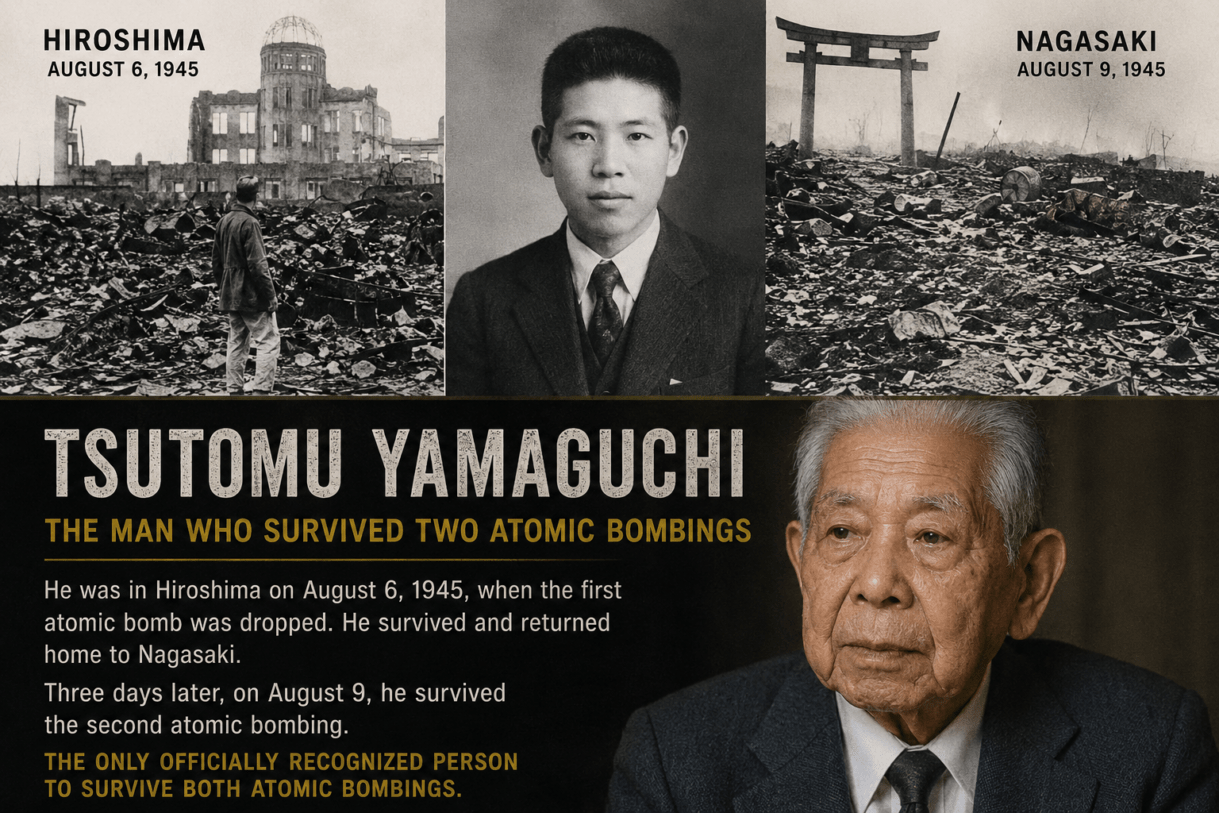
History is filled with stories so extraordinary that they almost sound fictional. Some involve impossible survival, incredible courage, or moments where fate seems to bend reality itself. Among the most astonishing stories ever documented is the life of Tsutomu Yamaguchi — the man who survived both atomic bombings during World War II.
On August 6, 1945, Yamaguchi was caught in the devastating atomic explosion over Hiroshima. Burned, injured, and traumatized, he somehow escaped the destroyed city. But in an unimaginable twist of fate, he returned home to Nagasaki just in time for the second atomic bomb three days later.
He survived again.
Out of hundreds of thousands of people affected by the bombings, Yamaguchi’s story became one of the most powerful symbols of endurance, luck, suffering, and the human will to live. His life later transformed into a global message against nuclear warfare, reminding the world of the terrifying destructive power unleashed in 1945.
This is the incredible true story of the only officially recognized person to survive both atomic bombings.
Who Was Tsutomu Yamaguchi?
Tsutomu Yamaguchi was born on March 16, 1916, in Nagasaki, Japan. He grew up during a time when Japan was rapidly modernizing and expanding its industrial and military influence across Asia. Like many young men of his generation, he pursued technical education and eventually became an engineer.
Yamaguchi worked for Mitsubishi Heavy Industries, one of Japan’s largest industrial corporations. His work involved shipbuilding and engineering projects tied to Japan’s wartime economy.
By 1945, World War II had already devastated large parts of Europe and Asia. Japan was under increasing pressure from Allied forces, and American air raids had become more frequent across Japanese cities.
Still, few people could imagine the horror that was about to unfold.
Hiroshima Before the Bomb
In early August 1945, Yamaguchi traveled to Hiroshima on a business assignment. Hiroshima was an important military and industrial center at the time, which made it a strategic target for the United States.
Despite the ongoing war, daily life continued in the city. Factories operated, workers commuted, and families tried to maintain normal routines under growing uncertainty.
Yamaguchi had spent several months working in Hiroshima and was preparing to return home to Nagasaki. On the morning of August 6, he was heading to the shipyard when he realized he had forgotten an important document.
That small mistake may have saved his life.
As he turned back, he looked into the sky and saw an American B-29 bomber flying overhead.
Seconds later, the world changed forever.
The First Atomic Bomb Explosion
At 8:15 a.m. on August 6, 1945, the United States dropped the atomic bomb known as “Little Boy” over Hiroshima.
The explosion released an unimaginable amount of energy. Temperatures near the center of the blast became hotter than the surface of the sun. Buildings vaporized instantly. Human bodies disappeared in seconds.
Yamaguchi was about three kilometers from ground zero when the bomb detonated.
He later described seeing a massive flash of light that lit up the sky. The shockwave threw him violently into the air. He suffered severe burns on the upper half of his body, temporary blindness, and ruptured eardrums.
Around him, chaos erupted instantly.
Entire neighborhoods collapsed. Fires spread rapidly across the city. Thousands of injured people wandered through the streets with horrific burns and injuries. Many were screaming for water. Others died silently where they stood.
Hiroshima had effectively become hell on earth within seconds.
Surviving the Destruction
What makes Yamaguchi’s story extraordinary is not only that he survived the blast, but also how he managed to escape afterward.
Despite his injuries, he spent the night in an air raid shelter. The next morning, he began searching for a way out of the destroyed city. Transportation systems were crippled, communication lines were destroyed, and survivors were struggling to comprehend what had happened.
Yet somehow, train lines partially reopened.
Bleeding and badly burned, Yamaguchi boarded a train back to Nagasaki.
Even today, many people are shocked to learn that transportation continued operating in limited forms after such catastrophic destruction. But Japan’s wartime systems pushed desperately to maintain movement and communication wherever possible.
The journey home must have been agonizing. Yamaguchi was injured, exhausted, and mentally traumatized. He had witnessed scenes few human beings could ever fully process.
Still, he survived.
And he believed the worst was over.
He was wrong.
Returning Home to Nagasaki
When Yamaguchi arrived in Nagasaki, he reunited with his wife and family. Though injured, he immediately reported to work despite his condition.
On August 9, 1945, he was meeting with his supervisor and attempting to explain the destruction he had witnessed in Hiroshima.
According to later accounts, his boss reportedly struggled to believe that a single bomb could destroy an entire city.
Then it happened again.
At 11:02 a.m., another blinding flash filled the sky.
The United States had dropped a second atomic bomb — “Fat Man” — over Nagasaki.
Surviving the Second Atomic Bomb
The second explosion devastated Nagasaki just as horribly as Hiroshima.
Massive shockwaves tore through buildings. Fires erupted across the city. Tens of thousands died instantly or from injuries and radiation exposure in the days and weeks that followed.
Yamaguchi once again found himself caught inside an atomic blast zone.
Although he survived the immediate explosion, he suffered additional injuries and radiation exposure. His wife and infant son were also exposed, though they too survived.
The odds against surviving one atomic bomb were already incredibly small.
Surviving two was almost beyond comprehension.
To many people, Yamaguchi’s story seemed impossible. Yet historical records, witness accounts, and official documentation confirmed it.
He became one of the few known “double hibakusha” — survivors of both atomic bombings.
The Horror of Atomic Warfare
To understand the true significance of Yamaguchi’s story, it is important to understand what atomic bombs actually did to human beings and cities.
The bombings of Hiroshima and Nagasaki were unlike anything the world had ever seen.
The explosions caused destruction through several simultaneous forces:
Extreme Heat
The heat generated by the bombs instantly ignited fires across huge areas. Human skin burned within seconds. Many victims suffered terrible injuries even miles away from the blast center.
Shockwaves
The pressure waves from the explosions flattened buildings, shattered windows, and hurled people across streets and rooms.
Radiation
Perhaps the most terrifying aspect was radiation exposure. Survivors often developed severe illnesses days, months, or years later. Hair loss, bleeding, cancer, and immune system damage became common among many survivors.
Psychological Trauma
The emotional scars lasted generations. Survivors lost family members, homes, communities, and entire futures in moments.
Yamaguchi carried those memories for the rest of his life.
Japan Surrenders
After the second atomic bombing, Japan faced total collapse.
On August 15, 1945, Emperor Hirohito announced Japan’s surrender, effectively ending World War II.
The bombings remain controversial to this day. Some historians argue the attacks forced Japan to surrender quickly and prevented a larger invasion that could have killed millions more people.
Others argue the bombings caused unnecessary civilian suffering and introduced a terrifying new era of nuclear warfare.
Regardless of political debate, the human cost was undeniable.
Entire cities were destroyed.
Families vanished.
Generations were scarred forever.
And survivors like Tsutomu Yamaguchi became living witnesses to the darkest capabilities of modern warfare.
Life After the Bombings
For many years after the war, Yamaguchi tried to live a relatively quiet life.
Like many survivors, he dealt with long-term health complications caused by radiation exposure. He experienced recurring illness and emotional trauma.
Yet he also rebuilt his life.
He continued working as an engineer and raised his family in postwar Japan. The country itself underwent massive transformation, eventually becoming one of the world’s leading economic powers.
Still, the memories of Hiroshima and Nagasaki never left him.
Survivors of the atomic bombings often faced social discrimination in Japan. Some people feared radiation exposure could somehow be contagious or hereditary, which led to prejudice against hibakusha families.
Many survivors stayed silent for decades because the emotional pain was too deep.
Yamaguchi was no exception.
Why He Finally Spoke Out
As he grew older, Yamaguchi began speaking publicly about his experiences.
He believed younger generations needed to understand the true horror of nuclear weapons.
He gave interviews, participated in documentaries, and advocated for nuclear disarmament. His testimony carried unusual emotional weight because he had experienced both bombings firsthand.
Unlike military leaders or politicians debating strategy, Yamaguchi represented the ordinary civilian caught inside catastrophic violence.
His message was simple but powerful:
No human being should ever experience nuclear war again.
Official Recognition as a Double Survivor
For decades, Japan officially recognized Yamaguchi as a survivor of the Nagasaki bombing but not both bombings simultaneously.
That changed in 2009.
The Japanese government formally acknowledged him as a double hibakusha, making him the first person officially recognized as surviving both atomic bombings.
The recognition brought renewed global attention to his story. Newspapers, historians, and documentary filmmakers revisited his extraordinary life.
People around the world were stunned.
Many had never even heard that anyone survived both bombings.
Yet here was a man who had lived through humanity’s most destructive weapon twice.
The Science Behind the Atomic Bombs
The bombs dropped on Hiroshima and Nagasaki were developed as part of the Manhattan Project, a secret American research effort involving scientists from multiple countries.
The project fundamentally changed human history.
The Hiroshima bomb used uranium-235, while the Nagasaki bomb used plutonium. Both weapons unleashed energy through nuclear fission, splitting atomic nuclei and releasing enormous power.
The destructive capability shocked even some scientists involved in their creation.
After World War II, nuclear weapons became central to global politics during the Cold War. Nations raced to build larger and more powerful arsenals capable of destroying civilization many times over.
The world entered the nuclear age.
And survivors like Yamaguchi became living reminders of what those weapons could do.
How Rare Was His Survival?
Statistically, Yamaguchi’s survival was almost impossible.
Most people near the centers of the blasts died instantly. Others later died from burns, injuries, starvation, or radiation sickness.
To survive one atomic bombing required incredible luck.
To survive two involved an almost unimaginable combination of timing, distance, shelter, and circumstance.
Historians estimate that a small number of people experienced both bombings, usually because they traveled between the cities during those days. However, Yamaguchi became the most famous and officially recognized example.
His survival continues to fascinate historians, psychologists, and ordinary people because it challenges assumptions about probability and human endurance.
The Lasting Legacy of Hiroshima and Nagasaki
Today, Hiroshima and Nagasaki stand not only as modern Japanese cities but also as global symbols of peace and anti-nuclear activism.
Memorials, museums, and annual ceremonies honor the victims and survivors.
Visitors from around the world travel to places like the Hiroshima Peace Memorial to learn about the bombings and reflect on the consequences of war.
The stories of survivors remain central to those memorial efforts.
As fewer hibakusha remain alive, preserving their testimonies has become increasingly urgent.
Their experiences provide firsthand evidence of what nuclear war actually means beyond politics, strategy, and military theory.
The Human Side of Survival
One reason Yamaguchi’s story resonates so deeply is because it feels intensely human.
He was not a soldier on a battlefield.
He was not a politician or military commander.
He was an ordinary working man trying to return home to his family.
His experience reflects how civilians often bear the greatest suffering during war.
People sometimes imagine history as distant events involving famous leaders and military campaigns. But history is also made of ordinary people caught in extraordinary moments.
Yamaguchi’s survival reminds us that behind every major historical event are individual lives, fears, and stories.
Why the Story Still Fascinates the World
Even decades later, the story of Tsutomu Yamaguchi continues spreading online, in documentaries, classrooms, and history books.
Part of the fascination comes from the sheer improbability of surviving two atomic bombings.
But there is something deeper too.
His story combines tragedy and hope in almost equal measure. It reveals both humanity’s capacity for destruction and the resilience of the human spirit.
In a world still shaped by nuclear tensions, his experience remains painfully relevant.
Several countries still possess nuclear weapons capable of catastrophic destruction. Global debates about deterrence, military strategy, and disarmament continue today.
Whenever those discussions happen, the testimonies of survivors like Yamaguchi serve as powerful reminders that nuclear warfare is not abstract.
It is personal.
It is human.
And its consequences last for generations.
Tsutomu Yamaguchi’s Final Years
In his later years, Yamaguchi became increasingly active in anti-nuclear advocacy despite declining health.
He participated in interviews and international discussions, hoping future generations would never repeat the mistakes of the past.
In 2010, he died of stomach cancer at age 93.
Although many factors can contribute to cancer, radiation exposure from the bombings remained part of the broader health struggles faced by numerous survivors.
His death marked the end of an extraordinary life story that few people on Earth could truly comprehend.
Yet his message survived him.
Lessons From His Story
The life of Tsutomu Yamaguchi teaches several powerful lessons:
Human Resilience Is Extraordinary
People can survive experiences that seem impossible. The human capacity to endure trauma, rebuild, and continue living is remarkable.
War Always Has Civilian Victims
Ordinary people often suffer most during conflicts. Families, workers, children, and communities bear devastating consequences far beyond battlefields.
Nuclear Weapons Carry Unimaginable Consequences
The bombings of Hiroshima and Nagasaki demonstrated destructive power unlike anything previously seen in human history.
Personal Stories Matter
Statistics alone cannot fully explain tragedy. Individual experiences create emotional understanding in ways numbers never can.
The story of Tsutomu Yamaguchi remains one of the most extraordinary survival stories ever documented.
Caught in the atomic destruction of Hiroshima, he somehow escaped alive. Then, after returning home, he survived the bombing of Nagasaki as well.
His life became more than a historical curiosity. It became a symbol of survival, resilience, and the urgent need to remember the true human cost of nuclear warfare.
Today, decades after World War II ended, the names Hiroshima and Nagasaki still carry enormous emotional weight across the world. And among all the stories connected to those cities, few are as astonishing as the man who survived both.
Tsutomu Yamaguchi’s experience reminds humanity that even in history’s darkest moments, survival is possible, memory matters, and the voices of witnesses must never be forgotten.
SUGGESTED READS
- The 3-Meter Mistake That Almost Cost Her Life
- Captain Irene Koki Mutungi: The Girl Who Touched the Sky
- Maina Njenga: Prophet, Cult Leader or Political Pawn?
- The Mau Mau Rebellion: Kenya’s First War for Freedom
- The Rise, Evolution, and Impact of the Sungusungu Vigilantes in Kisii, Kenya
- Mungiki: The Rise, Fall, and Shadows of Kenya’s Most Feared Underground Movement
- The Coffin Thief of Nairobi: The True Story of John Kibera
- The Dark Legacy of Okija Shrine: Nigeria’s Most Notorious Traditional
- How Foday Sankoh Led Sierra Leone into Chaos: The Ruthless Rise of a Rebel

Support Our Website!
We appreciate your visit and hope you find our content valuable. If you’d like to support us further, please consider contributing through the TILL NUMBER: 9549825. Your support helps us keep delivering great content!
If you’d like to support Nabado from outside Kenya, we invite you to send your contributions through trusted third-party services such as Remitly, western union, SendWave, or WorldRemit. These platforms are reliable and convenient for international money transfers.
Please use the following details when sending your support:
Phone Number: +254701838999
Recipient Name: Peterson Getuma Okemwa
We sincerely appreciate your generosity and support. Thank you for being part of this journey!