

We aint done yet… Expect another one.
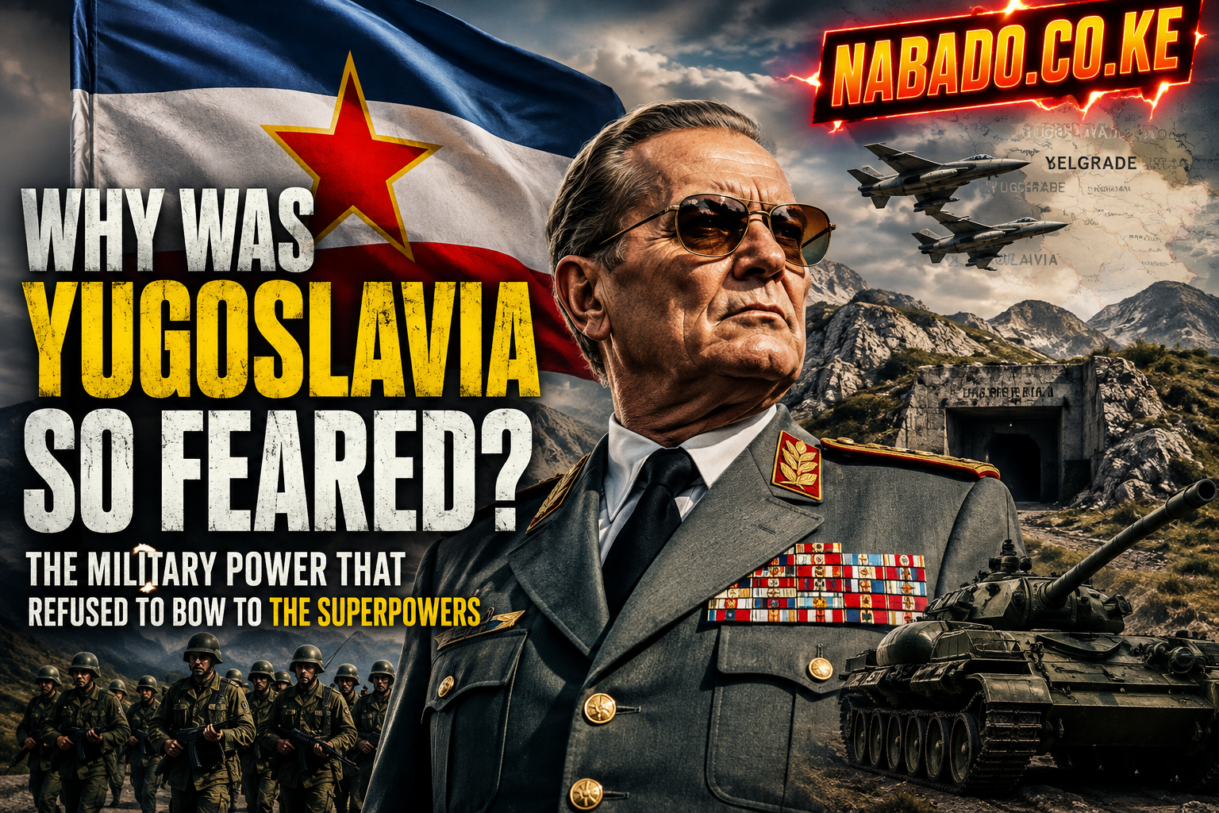
There was a time during the Cold War when Yugoslavia occupied a remarkably unusual position in Europe.
It was communist, but it was not a Soviet satellite.
It traded with the West, but it did not join the Western military alliance.
It maintained relations with Washington while also maintaining ties with Moscow.
And perhaps most importantly, it had a leader who had already demonstrated that he was prepared to tell one of the most powerful men in the world that Yugoslavia would not simply follow orders.
That leader was Josip Broz Tito.
For decades, Tito’s Yugoslavia developed a reputation for independence, military preparedness and political confidence that was unusual for a medium-sized European country.
But was Yugoslavia really “feared”?
The answer requires some nuance.
Yugoslavia was not a military superpower capable of defeating the United States or Soviet Union in a conventional war. Its population, economy and military resources could not compete with the enormous capabilities of either superpower.
What made Yugoslavia formidable was something different.
Invading Yugoslavia could be relatively easy compared with occupying it.
The country’s military planners understood that a much larger enemy could potentially destroy conventional military formations. Their answer was to prepare the entire country for resistance.
Mountains would become defensive positions.
Forests would become hiding places.
Villages and towns could support resistance fighters.
Underground facilities could protect military personnel and command structures.
And ordinary citizens could potentially be mobilized as part of a massive territorial defense system.
This was the thinking behind Yugoslavia’s doctrine of Total National Defense.
It was a strategy designed around one fundamental idea: if an enemy was powerful enough to win a conventional battle, Yugoslavia would make sure that winning the war remained another matter entirely.
Tito: The Man Who Challenged Stalin
To understand why Yugoslavia became so independent and militarily self-confident, it is necessary to understand Tito.
After World War II, Yugoslavia emerged as a communist state under Tito and the Communist Party of Yugoslavia.
At first glance, Yugoslavia appeared to be part of the Soviet camp.
The Soviet Union under Joseph Stalin was the dominant communist power in Europe. Communist governments across Eastern Europe generally operated within Moscow’s political and strategic orbit.
Yugoslavia, however, was different.
Tito had enormous political authority inside his country, and his wartime Partisans had developed a strong independent military organization during the struggle against Nazi Germany and its allies.
Unlike some communist governments that were heavily dependent on Soviet troops and Soviet political support, Tito’s government had its own revolutionary legitimacy.
That mattered enormously.
In 1948, the relationship between Tito and Stalin broke down spectacularly.
Yugoslavia was expelled from the Communist Information Bureau, commonly known as the Cominform.
The confrontation became one of the defining moments of the early Cold War.
Stalin expected Yugoslavia to fall back into line.
Tito refused.
That decision transformed Yugoslavia.
Instead of becoming another Soviet satellite, Yugoslavia began pursuing its own version of socialism and its own foreign policy.
For the rest of Tito’s rule, the country carefully guarded its independence from both major Cold War blocs.
Why Tito’s Break With Stalin Was So Important
The Tito-Stalin split sent a powerful message.
If Yugoslavia was willing to resist Stalin, then other countries could not easily assume that Belgrade would automatically obey Moscow.
At the same time, Yugoslavia did not become an American ally.
This created an extraordinary strategic position.
The country could cooperate economically with Western countries while remaining socialist.
It could maintain diplomatic relations with the Soviet Union without becoming subordinate to it.
And it could build relationships with newly independent countries across Asia, Africa and the Middle East.
This eventually contributed to the rise of the Non-Aligned Movement.
Tito became one of its most recognizable leaders.
The movement attempted to give countries outside the major Cold War alliances greater room to pursue their own foreign policies.
For Yugoslavia, non-alignment was not simply an ideological slogan.
It was also a strategic necessity.
The country was situated in one of the most sensitive parts of Europe.
It bordered countries belonging to different political and military systems and sat between the broader spheres of influence of NATO and the Warsaw Pact.
Yugoslavia therefore had every reason to prepare for the possibility that its independence could one day be tested by force.
The Yugoslav People’s Army
At the center of Yugoslavia’s defense strategy was the Yugoslav People’s Army, commonly abbreviated as the JNA.
It was one of the most important institutions in socialist Yugoslavia.
The army inherited a powerful tradition from the Partisan movement of World War II.
The Partisans had learned how to fight a stronger enemy using mobility, local knowledge, intelligence networks and guerrilla tactics.
After the war, Yugoslavia combined those experiences with conventional military organization.
The result was a large and sophisticated defense establishment.
The JNA operated tanks, artillery, aircraft, naval vessels and other military equipment.
Yugoslavia also developed a domestic defense industry capable of producing substantial quantities of military hardware.
This was particularly important because Yugoslavia could not safely depend on a single foreign supplier.
Its relationship with the Soviet Union could deteriorate.
Its relationship with Western countries could change.
Therefore, maintaining domestic military production gave Yugoslavia another layer of strategic independence.
Yugoslavia Did Not Want to Fight Like a Superpower
This is one of the biggest misunderstandings about Yugoslav military power.
Yugoslavia did not seriously expect its army to march into Moscow or defeat NATO in a conventional war.
Its military strategy was based on a much more realistic assessment.
If a superpower attacked Yugoslavia, the enemy would probably possess overwhelming advantages in certain areas.
It could potentially have more aircraft.
It could deploy larger armored forces.
It could possess greater artillery capabilities.
It could have superior logistical resources.
Yugoslav planners therefore had to ask a different question.
What happens after the first major battles?
That question shaped the country’s defense strategy.
Instead of attempting to match a superpower weapon for weapon, Yugoslavia planned to make an invasion extraordinarily expensive.
The Doctrine of Total National Defense
The concept known as Total National Defense became one of the defining features of Yugoslav military planning.
The basic principle was simple.
The defense of Yugoslavia should not depend exclusively on the regular army.
The entire country had to be capable of contributing to national resistance.
This involved the organization of territorial defense forces, local structures and civilian preparations.
If the regular army was forced to retreat, other forces could continue fighting.
If an enemy captured a major city, resistance could continue elsewhere.
If conventional military units were destroyed, local forces could remain active.
In theory, an invading army would never receive the satisfaction of believing that the war was finished simply because it had defeated the main Yugoslav formations.
This was particularly suited to Yugoslavia’s geography.
Yugoslavia’s Geography Was a Military Nightmare
Look at a map of the former Yugoslavia and one immediately sees why military planners paid so much attention to terrain.
The country contained extensive mountainous areas, forests, valleys, rivers and rugged regions.
The Balkans have historically been difficult terrain for large military formations.
Armored forces can move rapidly across open plains.
They face a very different challenge in mountains and narrow valleys.
Large formations require roads, bridges, fuel, ammunition and food.
Destroy or disrupt those supply lines and an advancing army can quickly develop serious logistical problems.
Yugoslav planners understood this.
The country’s terrain could therefore become an enormous defensive asset.
A powerful invading force might capture important infrastructure, but maintaining control over every valley, road and settlement could require huge numbers of troops.
That was precisely the kind of war Yugoslavia wanted to create.
The Ghost of the Partisans
The experience of World War II remained deeply embedded in Yugoslav military culture.
Tito’s Partisans had fought Axis forces under extremely difficult conditions.
The Partisan experience became more than a historical story.
It became part of the national identity.
The message was clear: a numerically and technologically superior enemy could still face relentless resistance from a determined population.
The Yugoslav leadership believed that the lessons of the Partisan war could be adapted to a modern conflict.
Instead of simply recreating the World War II guerrilla struggle, Yugoslavia developed a sophisticated combination of conventional and territorial defense.
The regular army could fight major battles.
Territorial forces could operate locally.
The population could support resistance.
Infrastructure could be adapted for defense.
And military command structures could continue functioning even under occupation.
This was not an attempt to make Yugoslavia invincible.
It was an attempt to make victory over Yugoslavia extremely expensive.
The Underground World of Yugoslav Military Facilities
Perhaps nothing captures the mindset of Cold War Yugoslavia better than its underground military infrastructure.
During the Cold War, Yugoslavia constructed numerous military facilities, shelters and hardened installations.
Some were designed to protect military personnel and command structures from conventional attack.
Others were intended to provide continuity of operations in the event of a catastrophic conflict.
Among the most famous examples was the enormous underground military complex near Konjic, commonly associated with Tito and the Yugoslav leadership.
The facility, today widely known as ARK D-0, was built deep inside a mountain.
It was designed as a protected command and strategic facility.
The existence of such installations demonstrates how seriously Yugoslav authorities took the possibility of a major war.
The objective was not simply to survive a bombing raid.
The broader objective was to preserve the ability of the state and military leadership to function after an attack.
In a Cold War environment dominated by fears of nuclear war, this was strategically significant.
Why the Bunkers Mattered
A bunker by itself does not make a country powerful.
The importance of Yugoslavia’s underground facilities came from the broader defense doctrine surrounding them.
Military planners were preparing for a scenario in which conventional infrastructure could be destroyed.
Airfields could be attacked.
Communication centers could be targeted.
Government buildings could be destroyed.
Major roads could be disrupted.
Commanders could be killed.
A hardened underground facility offered a way to preserve command and control.
In a prolonged conflict, that could matter enormously.
An enemy might believe that destroying the country’s central leadership would end organized resistance.
Yugoslavia’s defensive architecture was designed to make that assumption dangerous.
Yugoslavia’s Domestic Defense Industry
Another factor behind Yugoslavia’s military reputation was its ability to manufacture significant amounts of military equipment domestically.
The country developed a substantial defense-industrial base.
This reduced its dependence on foreign powers.
For a non-aligned country, that was extremely valuable.
Imagine relying almost entirely on Soviet weapons.
If Moscow cuts supplies, your military becomes vulnerable.
Now imagine relying entirely on Western equipment.
The same problem could arise if relations with Western powers deteriorate.
Yugoslavia wanted greater independence.
Its domestic industries therefore produced a range of military equipment, including armored vehicles, artillery systems, aircraft and naval equipment.
The country also developed engineering and technical capabilities that supported its armed forces.
This did not make Yugoslavia self-sufficient in every possible military requirement.
But it gave the country far greater freedom than many smaller states possessed.
Yugoslavia’s Air Force
The Yugoslav Air Force was another important component of national defense.
Yugoslavia operated a mixture of domestically produced and foreign aircraft.
Its aircraft inventory included fighters, attack aircraft, transport planes and helicopters.
The country also invested in its own aviation industry.
One of the most notable examples was the Soko aircraft manufacturing industry.
The ability to produce and maintain aircraft domestically was strategically valuable.
Yugoslavia understood that an enemy with air superiority could severely damage its conventional military capabilities.
Therefore, air defense and the dispersal of military infrastructure were important components of its broader defensive planning.
Again, the goal was not to dominate the skies against a superpower.
The goal was to ensure that destroying Yugoslav military capabilities would require substantial effort.
The Navy and the Adriatic
Yugoslavia’s coastline also played an important role in its defense strategy.
The country controlled a long stretch of the Adriatic coast, including numerous islands and rugged coastal areas.
The Yugoslav Navy therefore had an important role.
The coastline offered opportunities for naval defense, coastal artillery, submarine operations and other forms of maritime warfare.
The geography of the Adriatic could also complicate an enemy’s operations.
Hundreds of islands and an irregular coastline created numerous defensive possibilities.
Again, geography became part of Yugoslavia’s military strategy.
Why the Soviet Union Could Not Simply Control Yugoslavia
The Tito-Stalin split created a serious strategic problem for Moscow.
The Soviet Union could not simply treat Yugoslavia as another Eastern European satellite.
Tito had domestic legitimacy.
The Yugoslav military was loyal to the country’s leadership.
And Yugoslavia’s geography presented significant challenges to any invasion.
There were also political consequences to consider.
An invasion could transform Yugoslavia into another major resistance battlefield.
The Soviet leadership already understood how costly occupation and guerrilla warfare could become.
The experience of World War II remained fresh.
Yugoslavia therefore occupied a strange position.
It was communist enough to concern the West but independent enough to frustrate Moscow.
Why the West Also Respected Yugoslavia
Yugoslavia’s independence from Moscow eventually created opportunities for Western governments.
During the Cold War, Western countries had a strategic interest in preventing Yugoslavia from being completely absorbed into the Soviet sphere.
The United States and its allies therefore developed relatively cooperative relations with Tito’s government.
Yugoslavia received various forms of economic and military assistance from Western countries at different points during the Cold War.
This created another unusual feature of Yugoslav power.
The country could obtain support from one side of the Cold War without formally becoming a member of that side.
Tito had successfully turned Yugoslavia’s geopolitical position into leverage.
Non-Alignment Gave Tito Global Influence
Tito’s influence extended beyond Europe.
Yugoslavia became one of the leading members of the Non-Aligned Movement.
This brought Tito into close contact with leaders from Asia, Africa and the Middle East.
The movement sought to provide countries with greater independence from the competing Cold War blocs.
For Yugoslavia, this diplomacy increased its international importance.
Tito could meet American presidents, Soviet leaders and leaders of newly independent states.
He could present Yugoslavia as proof that a country did not have to become a satellite of either superpower.
That was a powerful diplomatic message.
Was Yugoslavia Stronger Than Its Neighbors?
In many respects, Yugoslavia possessed considerable military strength compared with other European countries of similar size.
Its military was large.
Its defense industry was substantial.
Its territorial defense system was extensive.
Its geography favored defensive warfare.
Its leadership was experienced.
And its population had been exposed to decades of military organization and national defense propaganda.
But it is important not to exaggerate.
Yugoslavia was not secretly capable of defeating the Soviet Union or NATO.
A major superpower possessed enormous advantages in industrial capacity, air power, naval power, intelligence, logistics and strategic weapons.
The phrase “feared Yugoslavia” therefore needs to be understood within context.
The fear was not necessarily that Yugoslavia could destroy a superpower.
The concern was that Yugoslavia could make an invasion painful, prolonged and unpredictable.
The Balkan Resistance Problem
The Balkans have a long history of resistance movements.
Mountainous terrain, fragmented settlements and strong local identities can make occupation difficult.
Yugoslavia’s defense doctrine took advantage of these characteristics.
A hypothetical invading force might capture Belgrade.
But would that mean the war was over?
Not necessarily.
Resistance could continue in other regions.
Local forces could disrupt communications.
Roads and bridges could be attacked.
Military units could disappear into difficult terrain.
Occupation forces could be forced to guard infrastructure and supply routes.
Every additional requirement would consume manpower.
This was precisely the strategic logic behind Yugoslavia’s defense planning.
The Psychological Power of Yugoslavia’s Military Strategy
Military strength is not always about the weapons a country possesses.
Sometimes it is about what an enemy believes will happen after an attack.
Yugoslavia wanted potential aggressors to understand that there would be no quick victory.
The country was effectively saying:
If you invade us, you will not simply defeat an army. You will have to deal with an entire system designed to resist occupation.
That psychological deterrent was valuable.
A potential aggressor had to consider the political, economic and military consequences of a prolonged conflict.
This was especially important during the Cold War.
The superpowers had enormous arsenals, but they also understood that military action could create unpredictable political consequences.
Tito’s Personal Role
Tito himself was a major part of Yugoslavia’s international reputation.
He was not merely a ceremonial leader.
He had been a revolutionary commander.
He had survived World War II.
He had confronted Stalin.
He had built an independent socialist state.
And he had become one of the world’s best-known leaders of the Non-Aligned Movement.
His personal authority helped hold Yugoslavia’s political system together.
Foreign governments understood that Tito was willing to make difficult strategic decisions to preserve Yugoslav independence.
That credibility mattered.
The Paradox of Yugoslav Power
There was a fascinating contradiction at the heart of Yugoslavia.
The country was powerful partly because it was deeply united around the idea of independence.
But that unity was heavily connected to Tito.
After Tito died in 1980, Yugoslavia’s political system faced an increasingly difficult future.
The country continued to exist for more than a decade, but economic problems, political disagreements, rising nationalism and institutional weaknesses gradually became more severe.
The same country that had appeared extraordinarily united during the Cold War began to fracture.
What Happened After Tito?
Tito died on May 4, 1980.
His death marked the beginning of a new era.
Yugoslavia adopted a collective leadership system designed to prevent excessive concentration of power in one individual.
But the system faced enormous challenges.
The economy experienced serious problems.
Inflation and debt increased.
Relations among the republics became increasingly tense.
Political leaders increasingly appealed to national identities.
By the late 1980s and early 1990s, Yugoslavia’s political crisis had become extremely serious.
Then came the collapse.
Slovenia and Croatia declared independence in 1991.
Conflict followed.
Bosnia and Herzegovina declared independence in 1992, followed by an extraordinarily destructive war.
The former Yugoslavia descended into some of Europe’s worst violence since World War II.
The Irony of Yugoslavia’s Military Legacy
There is a painful irony in the story.
The Yugoslav military had been built primarily to defend the country against an external invasion.
Instead, after Yugoslavia began to collapse, military forces became involved in wars between the country’s own communities and emerging states.
The JNA itself became deeply entangled in the political crisis.
What had been presented as a symbol of Yugoslav unity was increasingly affected by the fragmentation of the country.
This demonstrated a fundamental truth about military power.
A powerful army can defend a state from external enemies, but it cannot necessarily solve political divisions inside that state.
Was Yugoslavia One of Europe’s Most Militarized Countries?
By Cold War standards, Yugoslavia was heavily militarized.
Military service was an important part of life for generations of citizens.
The armed forces were highly visible.
Territorial defense organizations extended military preparedness beyond the regular army.
The government maintained extensive defense infrastructure.
And military production was an important part of the industrial economy.
This was not accidental.
Yugoslavia’s leadership genuinely believed that national independence required the ability to defend itself.
Why Yugoslavia Never Wanted to Become a Superpower
Tito understood something that many smaller countries have struggled with.
A smaller state cannot realistically compete with a superpower in every category.
Instead, it has to exploit its strengths.
Yugoslavia’s strengths included:
- Geography
- Military organization
- Domestic defense production
- Experienced leadership
- Diplomatic flexibility
- Territorial defense
- National mobilization
- Guerrilla warfare experience
Together, these created a credible deterrent.
The strategy was essentially asymmetric.
Rather than asking, “Can Yugoslavia destroy its enemy?”
the question was:
“Can Yugoslavia make victory so costly that attacking it becomes unattractive?”
That is a very different definition of military power.
Why the Yugoslav Model Fascinates Military Historians
Military historians continue to find Yugoslavia interesting because its defense strategy was unusual.
It combined conventional warfare with guerrilla resistance.
It combined centralized military planning with decentralized territorial defense.
It combined domestic weapons production with equipment acquired from different international sources.
And it was built around a country that refused to permanently attach itself to either Cold War bloc.
The result was an independent military system unlike those of most European countries.
The Myth Versus Reality
Stories about Yugoslavia’s military sometimes become exaggerated.
There are claims that Yugoslavia could have easily defeated NATO.
There are claims that the country’s underground bunkers made it virtually impossible to conquer.
There are also claims that the Yugoslav Army was one of the strongest armies on Earth.
These statements go too far.
Yugoslavia had significant military capabilities, but it did not possess the industrial, economic or strategic resources necessary to match the United States or Soviet Union.
Its strength was relative.
More accurately, Yugoslavia was exceptionally well prepared for a smaller country facing the possibility of invasion by a much larger power.
That is what made the Yugoslav model so interesting.
The Real Reason Yugoslavia Was Respected
The most important factor was probably not any individual tank, aircraft or bunker.
It was independence.
Yugoslavia demonstrated that a medium-sized socialist country could resist Soviet pressure without becoming a Western client.
That was a remarkable achievement during the Cold War.
Tito built a state that could negotiate with both sides.
He built an army that was designed to defend national sovereignty.
He developed relationships with countries across the developing world.
And he created a military doctrine that assumed Yugoslavia might someday have to stand alone.
That combination gave Yugoslavia an influence far greater than its raw military numbers might suggest.
What Made an Invasion of Yugoslavia So Difficult?
If an enemy had attempted to invade Yugoslavia during the height of the Cold War, several problems could have emerged.
First, conventional military forces would have to be defeated.
Second, major population centers would need to be secured.
Third, roads, bridges, railways and communication systems would have to be protected.
Fourth, mountainous and rural areas would have to be controlled.
Fifth, resistance networks would have to be dismantled.
Sixth, occupation forces would have to remain in place for an extended period.
That final point was critical.
An invading army could potentially win battles.
But occupation is a completely different military problem.
Yugoslavia’s defense system was designed around that distinction.
The Legacy of Tito’s Yugoslavia
Today, Yugoslavia no longer exists.
The country that Tito built disappeared through a series of political crises and wars in the 1990s.
Its republics became independent states.
The Yugoslav People’s Army disappeared.
The Non-Aligned Movement continued, but without Yugoslavia occupying the same central role.
Yet the legacy remains.
Across the former Yugoslavia, abandoned military installations, bunkers, airfields and underground complexes continue to remind visitors of the Cold War era.
They represent a period when the country feared invasion from both East and West.
They also represent something more profound.
They show how seriously Yugoslavia took the concept of sovereignty.
The Final Answer: Why Was Yugoslavia So Feared?
Yugoslavia was not feared because it was stronger than the Soviet Union or the United States.
It was respected because it was difficult to intimidate, difficult to control and potentially extremely difficult to occupy.
Tito’s confrontation with Stalin proved that Yugoslavia was willing to defend its independence politically.
The Yugoslav People’s Army demonstrated that the country was willing to defend that independence militarily.
The Total National Defense doctrine extended that responsibility beyond the regular army.
The country’s mountainous geography provided natural defensive advantages.
Its underground military facilities offered protection against devastating attacks.
Its domestic defense industry reduced dependence on foreign powers.
And its position within the Non-Aligned Movement gave it diplomatic influence far beyond its size.
Perhaps the most important lesson from Yugoslavia is that military power is not simply a question of how many tanks, aircraft or soldiers a country possesses.
Military power is also about geography, organization, political will, logistics, national unity and the ability to make an enemy pay a heavy price for victory.
For much of the Cold War, Yugoslavia possessed those qualities in remarkable measure.
That is why the country occupied such a unique position.
It was not a superpower.
It did not need to be.
Yugoslavia’s strategy was based on ensuring that any power contemplating an invasion would understand one thing:
Taking Yugoslavia might be possible. Holding it could be an entirely different war.
And that was the real source of Yugoslavia’s Cold War reputation.
It was a country caught between two superpowers that refused to become anyone’s satellite, built an army prepared to fight alone and constructed an entire national defense system around the possibility of invasion.
For a country of its size, that was an extraordinary achievement.
For the superpowers watching from Washington and Moscow, it was a factor that could not simply be ignored.
SUGGESTED READS
- Can Good Exist Without Evil? The Deep Philosophical Question About Morality
- Why Does the Universe Exist Instead of Nothing? The Biggest Question Science Cannot Fully Answer
- Do We Have Free Will, or Is Everything Pre-Decided? The Question That Could Change How You See Life
- What Is the Meaning of Life? The Search for Purpose, Happiness and Why We Are Here
- Why African Countries Should Unite: The Key to a Stronger, Wealthier, and More Influential Continent
- Kenya at a Crossroads: Power, Youth, Economy, and the Fight for the Nation’s Future
- From Silence to Resistance: How Kenyans Are Reclaiming Their Voice
- How Economic Pressure Is Redefining Kenyan Families

Support Our Website!
We appreciate your visit and hope you find our content valuable. If you’d like to support us further, please consider contributing through the TILL NUMBER: 9549825. Your support helps us keep delivering great content!
If you’d like to support Nabado from outside Kenya, we invite you to send your contributions through trusted third-party services such as Remitly, western union, SendWave, or WorldRemit. These platforms are reliable and convenient for international money transfers.
Please use the following details when sending your support:
Phone Number: +254701838999
Recipient Name: Peterson Getuma Okemwa
We sincerely appreciate your generosity and support. Thank you for being part of this journey!