

We aint done yet… Expect another one.
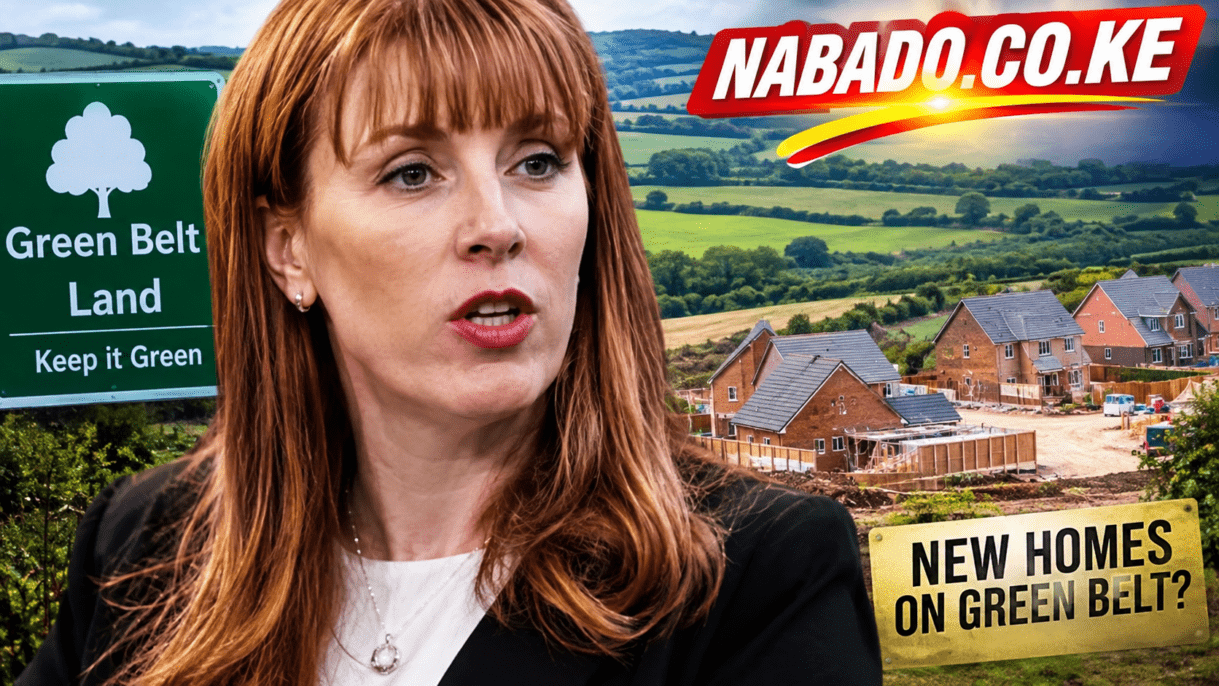
Britain’s housing debate has entered another contentious phase after the government confirmed that new homes could be built on parts of England’s Green Belt as ministers push ahead with sweeping planning reforms designed to accelerate housebuilding.
The latest changes place particular emphasis on land close to railway and tram stations, with the government introducing a more favourable planning approach for housing in locations that are considered well connected to public transport. Some of these sites can fall within areas currently designated as Green Belt.
The announcement is likely to intensify the political battle over England’s protected open spaces, with ministers arguing that Britain urgently needs more homes while opponents fear the reforms could gradually erode the Green Belt.
Government puts housing ahead of planning restrictions
The government has set an ambitious target of delivering 1.5 million homes in England during the current parliamentary term. However, construction has been significantly slower than required to meet that goal.
Recent figures show that planning permission was granted for about 216,141 homes over the previous year, substantially below the annual rate needed to deliver 300,000 homes. Planning approvals for larger developments have also fallen sharply.
Ministers therefore argue that the planning system needs to make it easier to build in areas where additional housing can be supported by existing infrastructure and public transport.
The new approach means housing proposals close to train, tram and Underground stations will receive a much more favourable planning presumption.
The government says concentrating development around transport hubs can help create communities where residents can reach jobs and services without depending heavily on cars.
What does this mean for the Green Belt?
The Green Belt is a planning designation covering large areas of open land around towns and cities. Its traditional purpose includes preventing urban sprawl, protecting the countryside and stopping neighbouring settlements from merging together.
But the government has increasingly distinguished between high-quality Green Belt land and areas it describes as “grey belt”.
Grey Belt land can include previously developed sites, land on the edge of settlements and other areas that may have limited environmental or landscape value.
Government policy introduced in recent years allows councils to assess Green Belt areas to identify land that meets the criteria for grey belt development.
The government has insisted that this does not amount to opening every Green Belt field to construction.
Instead, ministers say development should be focused on appropriate locations while valuable environmental and landscape areas remain protected.
Official planning policy also includes conditions intended to ensure that Green Belt developments deliver benefits for surrounding communities, including affordable housing, infrastructure and improvements to green spaces.
Why ministers are under pressure
Britain’s housing shortage has become one of the central challenges facing the government.
High property prices and rents have made it increasingly difficult for younger people and lower-income households to find affordable homes, particularly in areas where employment opportunities are concentrated.
Ministers argue that simply relying on brownfield sites will not be enough.
The government’s earlier planning reforms explicitly stated that brownfield development should be the first priority, but acknowledged that previously developed land alone cannot meet the country’s housing requirements. Councils were therefore asked to review Green Belt boundaries where necessary to address unmet housing needs.
That argument is at the heart of the latest reforms.
Rather than allowing housing development to spread randomly, the government wants more construction in locations with transport links, jobs and existing services.
Critics warn of a Green Belt giveaway
The policy has nevertheless attracted strong opposition.
Conservative and Reform UK politicians have accused the government of weakening local control over planning and putting pressure on communities to accept development.
Environmental campaigners have also raised concerns about the long-term consequences of building on protected land.
Critics argue that once Green Belt boundaries are changed, it can become difficult to restore them. They also warn that new housing developments can increase pressure on roads, schools, healthcare, water supplies and other infrastructure.
The government’s response is that development should come with appropriate infrastructure and community benefits.
Under its Green Belt reforms, housing proposals on qualifying land are expected to meet strict requirements, including substantial affordable housing provision and improvements to green spaces.
Transport hubs become a major focus
One of the most significant aspects of the latest policy is the emphasis on development around railway stations.
The government believes that land near well-connected stations represents an opportunity to increase housing supply without encouraging further car-dependent suburban expansion.
The proposed approach effectively creates a “default yes” principle for suitable housing proposals within walking distance of certain transport hubs, subject to planning requirements and safeguards.
That could place some Green Belt sites near major transport corridors under greater pressure for development.
For supporters, the logic is straightforward: if Britain needs millions of additional homes, building close to public transport can provide housing while reducing dependence on private vehicles.
For opponents, however, the question is whether the policy will eventually lead to development creeping into increasingly valuable countryside.
A difficult balancing act
The government now faces a delicate balancing act.
Building too few homes risks worsening Britain’s affordability crisis and undermining its economic ambitions. Building too aggressively on protected land risks environmental damage and a political backlash from communities determined to preserve the countryside.
The government’s concept of the “grey belt” is intended to provide a middle ground.
Rather than treating every piece of Green Belt land as equally valuable, planners can distinguish between land with significant environmental or landscape importance and land that may be suitable for carefully controlled development.
Government guidance specifically allows local authorities to assess Green Belt areas when preparing plans to meet housing and other development needs.
Whether that distinction can satisfy both housing campaigners and environmental groups remains uncertain.
The bigger question
At the centre of the controversy is a simple question: where should Britain build the homes it desperately needs?
The government believes the answer must include well-connected locations and selected areas of Green Belt land.
Opponents believe Britain should do more to maximise brownfield development before considering protected countryside.
What is increasingly clear is that the political consensus around the Green Belt is changing.
For decades, Green Belt protection has been one of the strongest principles in English planning. But the scale of Britain’s housing shortage is forcing ministers and local authorities to reconsider whether every parcel of designated land should receive the same level of protection.
The latest reforms do not mean that every Green Belt site can suddenly be developed. But they do signal a significant shift: some Green Belt land could now become part of Britain’s future housing supply.
And as the government races to deliver 1.5 million homes, the battle over where those houses should go is only likely to become more intense.
SUGGESTED READS
- Why More Women Are Choosing Not to Wear Bras and Underwear Nowadays
- How Fabric Choice Affects the Way Your Clothes Fit
- Before You Wear That Bodycon Dress, Read This
- The Hidden Rules of Wearing Leggings in Public: What No One Tells You
- Which Underwear Is Healthier for Daily Wear — Seamless or Cotton?
- How to Get Rid of Visible Panty Lines for Good — Smart, Comfortable Solutions
- Why Do Ladies Show Pant Lines? The Honest Truth No One Talks About

Support Our Website!
We appreciate your visit and hope you find our content valuable. If you’d like to support us further, please consider contributing through the TILL NUMBER: 9549825. Your support helps us keep delivering great content!
If you’d like to support Nabado from outside Kenya, we invite you to send your contributions through trusted third-party services such as Remitly, western union, SendWave, or WorldRemit. These platforms are reliable and convenient for international money transfers.
Please use the following details when sending your support:
Phone Number: +254701838999
Recipient Name: Peterson Getuma Okemwa
We sincerely appreciate your generosity and support. Thank you for being part of this journey!